And furthermore ...

One Man's Treasure encourages the use of anonymous photographs posted here to illustrate books and album covers.
If an image appeals to you, contact John Toohey at johntoohey@hotmail.com.
Showing posts with label cartes de visite. Show all posts

Friday, 13 November 2015

THE BACK COUNTRY


Back stamps and design on cartes de visite and cabinet cards.
 “Of all of our inventions for mass communication, pictures still speak the most universally understood language.”
Walt Disney


For some people, the pleasure in collecting cartes de visite and cabinet cards lies entirely on the reverse, in the stamps that identify the studio and sometimes advertise the range of services. This is understandable. The images on the other side are often commonplace and uninteresting while the back carries an intricate design that can also be a code. This stamp on the back of a cabinet card from the Phebus studio in Constantinople is dominated by Apollo, the god of the sun and of light – AKA Phoebus Apollo - an obvious choice for a photographic studio. Apollo could also be a god of truth, which again makes sense for a photographic studio, since that was what they purported to offer. Note the idealized Ottoman script at the top and the French Photographie. Without knowing who runs the studio we can tell from the French that he was Armenian, because French was the lingua franca of the Armenia business community in Constantinople. Sure enough, Phebus was run by Boğos Tarkulyan, one of the better known photographers in town around the turn of last century. The Art Nouveau pattern was a deliberate nod to contemporary ideas in Western Europe, identifying Tarkulyan as someone less, or even not, interested in Ottoman traditions. The choice of flower in the frames at the top would have been conscious too. It may be amaryllis, which has some connection with Apollo, but that’s only a guess.

 
 The study of the backs of CDVs and cabinet cards is a branch of iconography, specifically one that can trace its origins back to the frontispieces found in books from the sixteenth century through to the beginning of the nineteenth. The frontispiece could be a declaration of intent or an acknowledgement of a patron’s greatness but were never just random images. It was intended to be read in minute detail and required knowledge of biblical imagery as well as more demotic symbols. By the 1860s, when this carte was produced, the art and meaning of frontispieces had fallen out of use but Theophile Gastonguay evoked them with the image of a beaver. Although the beaver did not become the official emblem of Canada until 1975, it had been commonly used as a symbol of Canada since the seventeenth century.

 
 Archibald McDonald ran a photography studio in Melbourne throughout the gold rush. Like every other studio photographer in Melbourne at this time he came from another country, from Nova Scotia in fact, just a spit away (in Canadian distances) from Theophile Gastonguay. You might wonder why St George and not a kangaroo but there we see the difference a century and a half of colonization can make. Although by the 1860s people around the world recognized the kangaroo as Australian, it wasn’t a national symbol. Australia (AKA “The Colonies”) didn’t have such a thing, or if it did it was likely to be St George’s dragon, which, like Australia, was proudly British. Archibald McDonald: logic tells us he was of Scottish background and he might have been the type to give a Glasgow kiss to anyone who called him British, but St George here doesn’t stand for England so much as a landmark in Melbourne. Long gone now, once upon a time everyone in Melbourne knew where St George’s Hall was.

 
 A similar thinking may have been behind Louis of Paris’s depiction of the Porte St Martin, which then as today was close by the central shopping district. Firstly it told customers the studio was located in one of the more salubrious areas, and then it told them how to get there. Notice it was opposite the Theatre de l’Ambigu, a place made famous by Louis Daguerre’s set designs.


Migevant’s studio may not have been at such a desirable address as Louis’ but no Parisian had to ask where the Place de la Bastille was. When this CDV was produced in the early 1870s there couldn’t have been too many people around who remembered the Revolution and the storming of the Bastille in 1789 but enough would have recalled the glorious revolution of 1830, which the July Monument seen here honoured. Essentially the French replaced one monarch with another, which is a little like stumbling from one failed relationship with a drunken philanderer straight into another. Today the Boulevarde Beaumarchais is lined with shops selling antique cameras.


The back stamp can be evidence. In 1876 Alfred Mayman took over the Temple Photographic Gallery at 170 Fleet St in London. Two years later the City of London dismantled the Temple Bar on account of Fleet Street needing widening and the structure was dilapidated. The sections were carefully stored and in 1880 Henry Meux bought it and reassembled it on his estate in Hertfordshire. In 1984 it was bought back from Meux’s descendants and re-erected in Paternoster Square. All this to say that there was only a two year period between 1876 and 1878 when there was any practical purpose for Mayman to have an illustration of the structure on the back of his CDVs. We don’t need any other information to date the image.  

 
 Images of cherubs with cameras are common, as is the inclusion of an artist’s palette, but what does it mean? Strictly speaking, these round and flabby infant creatures are Putti: cherubs have several heads and bits of eagle and lion attached to them. The precise symbolic meaning of the Putti is not understood but since the late Renaissance they have had an association with the arts, and music in particular. Originally the true artist had his muse, a goddess, who inspired him and for whom he created. The little toddlers might have been intended to suggest the playfulness every serious artist needs but also, babies were the inevitable result of creative coupling. In the way that a red and blue barber’s poles once indicated a place to have a bit of bloodletting and these days means a haircut, Monge, and every other photographer who used the imagery saw it as an icon not a symbol.

 
 Just to reinforce the point (somewhat), we find exactly the same image on the reverse of a CDV by a studio located on Rue de la Sabliere. The companies that printed the blanks for CDVs usually have their name in small letters down the bottom. We don’t get any such on either Monge or the Sabliere studio card and while we could assume the same company produced the blanks, it is also possible that several bought their designs from another source. Somebody could have produced this image of the putto, sold it on to the printers who then customized it for the various studios who used them.  

 
This palette is also very common, with a fairly obvious interpretation although it ought to be pointed out that few commercial photographers thought of themselves as artists in the way that people used that word even in the relatively staid 1860s. ‘Artist’ was a kind of password for quality of technique rather than ideas. Apart from being a photographer, Camille Benoit was an art dealer, so he may have seen the image as a pun. 


 Harrison Nathaniel Rudd ran his studio in Costa Rica around the turn of last century, as board mounted photographs were giving way to postcards. Costa Rica was relatively prosperous and peaceful at this time, meaning an American could operate a studio with some confidence it would not be closed down or he would have to get out at short notice. This rather elegant design may have also come from a template customized to his requirements. Or not. There is a pun here as well, in the idea of the woman’s hand holding out a carte or cabinet card. A camera is depicted at the top of the crest.  Maybe Rudd also had cartes with the same back design that the hand holds out.


THE BACK COUNTRY

Saturday, 4 August 2012

MODERN GHOSTS


 11 cartes de visite based on characters from de Maupassant short stories
 “Our memory is a more perfect world than the universe: it gives back life to those who no longer exist.”
Guy de Maupassant


 Guy de Maupassant’s grave at Montparnasse Cemetery is modest and surrounded by others of much the same dimensions, so even with a good map you have to search for it. Visitors have attached various mementoes including a small teddy bear and a china dove that look out of place on the tomb of someone whose most famous stories are about cruelty and madness. Across the road, Baudelaire’s grave is littered with whiskey bottles, beer cans and dead flowers, which seem more appropriate to the writer, even if Baudelaire wanted to be remembered as a great aesthete and art critic, not a laudanum addict.
Trying to find a dozen carte de visites in the collection that could resemble characters from Maupassant’s short stories turned out to be difficult, partly because the restrictions – French, between 1860 and 1890, and not used in a previous blog post – precluded some better examples. No one remotely matched Boule de Suif, “round as a barrel, fat as butter and with fingers tightly jointed like strings of small sausages (and with) two magnificent dark eyes shaded by thick black lashes”.  The woman above could pass for another passenger on the coach, Madame Loiseau; “tall, stout and determined looking, (with) a shrill voice and a brisk manner”, but then she could be any one of the stolid, middle class matrons who never suffered in his stories but observed the misery inflicted on others with smug indifference. The portrait incidentally is from Bayard and Berthall. Hippolyte Bayard was one of the pioneers of photography, famous for his self portrait as a drowned man, who went on to a distinguished career in photography and has a chain of islands off Antarctica named after him.


A survey like this must include a Prussian officer since so many of Maupassant’s short stories were set during the Franco-Prussian War, and here is one, photographed by a French studio in Metz, a city close to Alsace that was captured by Prussia and not returned to France until 1918.  Part of the popularity of Maupassant’s short war stories was in his ability to show the French as either victims or perpetrators of atrocities with a directness that made their actions understandable. The problem is that Maupassant’s Prussians tend to be of two types, the simple minded conscript or the heartless boor and this man appears to be neither. He could be one of the soldiers billeted with Mother Savage, who “behaved as good sons would towards their mother”, but that would assume he escaped the revenge the mother extracted from the soldiers for her son’s death in another theatre of the war. 

  
 And here could well be Mother Savage’s son, or one of the many others who paid the price for a French officer’s stupidity or a Prussian’s military obligations. A popular theory after the war was that France’s defeat was brought about by a crisis in masculinity; a nation of once strapping men had become weak and listless, the result of growing up in cities that encouraged pleasure and dissolution. However strongly Maupassant subscribed to the idea, most of his young men are not fit or ready for war. Lacking the brute pragmatism of the Prussians they often bring on their own deaths by showing an unnecessary moment of compassion. The carte has no photographer’s stamp but a look at the records shows that A. Jorda operated from 10 Rue Villedo during the 1860s.


“Oh! Yes; you understand me well enough. It is now three months since I had my last child, and as I am still very beautiful, and as, in spite of all your efforts you cannot spoil my figure, as you just now perceived, when you saw me on the doorstep, you think it is time that I should think of having another child.” In contests involving romantic love women always succeed in making the men look like fools. In ‘Useless Beauty’ the countess schemes against her husband by insinuating one of their many children is not his, then watches him stew as he tries to work out which one. Though the woman in this portrait is not a countess, she matches Maupassant’s description in every other way. Look at the child. The photographer has arranged a distraction off camera in order to keep her (or it could be him) still. Back then a distraction could involve anything from a bird on a stick – “watch the birdie” – to firing a pistol. Some studios were also known to dose children up with opium, which also worked.


 I was born with all the instincts and senses of primitive man but these have been tempered with time by both the reasoning and the sensibilities of his civilized successor. I am passionately fond of hunting yet a bleeding animal, a bird with blood on its wings, or even the sight of blood on my own hands often makes me feel faint. This is from the opening paragraphs to ‘Love; three pages from the diary of a hunting man’ and it could describe most men from Maupassant’s social circle, they being an urbane bunch who boasted of their masculine prowess yet often came up short when it was put to the test. Though he was taken under the wing by Flaubert, Maupassant didn’t think much of the famous author’s friends, particularly the Goncourt brothers who struck him as vain and pretentious. Not to label the subject of this portrait by Lefevre as such but he does come across as a typical Parisian, chasing pleasure before duty and, in Maupassant’s view, sure to have one of life’s cruel lessons inflicted on him …


 … Like the central character in ‘Tombstones’: One of the most lively of them was Joseph de Bardon, a bachelor living the Parisian life in its fullest and most whimsical manner. He was not a debauche nor depraved, but a singular, happy fellow, still young, for he was scarcely forty. A man of the world in its widest and best sense, gifted with a brilliant, but not profound, mind, with much varied knowledge, but no true erudition, ready comprehension without true understanding, he drew from his observations, his adventures, from everything he saw, met with and found, anecdotes at once comical and philosophical, and made humorous remarks that gave him a great reputation for cleverness in society.
Bardon thinks he is on to a good thing when he meets a young woman wracked with grief in Montmartre Cemetery. By the story’s end he is more mystified by human behaviour than a self-proclaimed man of the world ought to be.


 Maître Hauchecome, economical like a true Norman, thought that everything useful ought to be picked up, and he bent painfully, for he suffered from rheumatism. He took the bit of thin cord from the ground and began to roll it carefully when he noticed Maître Malandain, the harness maker, on the threshold of his door, looking at him. They had heretofore had business together on the subject of a halter, and they were on bad terms, both being good haters.
This from ‘A Piece of String’, one of hundreds of stories Maupassant wrote about the peasants of Normandy. He is mostly unsparing. They are possessed of a stupid cunning and utter lack of curiosity and if they get what they want it is often through pig-headedness or sheer chance. What’s more, like the above paragraph suggests, they can be consumed by a rivalry that has no known or a completely trivial source. This portrait is by Claudius Couton, a Nice photographer better known for his work in Algeria. He was working there when Maupassant toured through the country though the chances they met are slim. In the 1870s Algeria was full of Frenchmen seeking artistic inspiration. Most of them came back with something, usually the pox.


And here is a lumber merchant or some other business operator from Normandy. Note how he looks well dressed though could hardly be described as having the sophisticated style expected of a Parisian. Maupassant came from a well off Norman family and he is more sympathetic to men like the one above than to any other from the region. They are inevitably sensible, practical and above the petty demands and grievances of the peasants. In a typical story, a man like ours above will sit at a bar and recount some tale from the district that has a meaning he doesn’t quite grasp.


What, you might ask, is a nun doing here? Well, apart from it being an uncommonly good portrait from the era, we can talk about the clergy because Maupassant scarcely does. Given the authority the Church still held over France, especially in the provinces, you’d think a considered atheist like Maupassant would be ready to expose its hypocrisy and dishonesty but then even his supernatural stories are set in the real world. God and religion have no place there, not even as enemies. His parents divorced when he was young and he was sent to a seminary, a grooming yard for the priesthood but had himself expelled within a few months, indicating his lack of belief was already established. On Good Friday the critic Sainte-Beuve and the illegitimate son of Napoleon III would get drunk and throw sausages at a crucifix yet it is what Maupassant didn’t say that marked him as subversive.


It is usual to associate Maupassant’s tales of madness with his decline into insanity brought on by syphilis but he was writing stories about the profoundly psychologically traumatised long before he knew he was afflicted. Madness was a popular image in French literature, thanks partly to Dr Jean-Martin Charcot, whose public lectures at Salpêtrière Hospital Maupassant and most of the Paris literati attended every Tuesday. Charcot’s most significant breakthroughs in the study of hysteria were in linking it to a trauma – though he resisted the obvious association with sexual trauma such as incest, leaving that to his student, Freud – and in declaring that men too suffered from it. The portrait above was taken at an unidentified French hospital in the 1880s. She has been diagnosed with hysteria.


Maupassant’s most famous story is ‘the Horla: Modern Ghosts’, which like earlier stories such as ‘Who Knows?’ linked the supernatural to paranoia and psychosis rather than the paranormal. The portrait above comes from the same hospital as the previous image. Though he is dishevelled his mental state isn’t immediately apparent. Neurology was still an uncertain science and a paranoid could be entering the tertiary stage of syphilis, suffering trauma as the result of war experiences or injury, be homeless or he could be an agitator the police or other authorities arranged to have locked up. In his last years Maupassant was severely afflicted, attempted suicide several times and spent his last months in the psychiatric hospital run by Esprit Blanche where the poet Nerval and composer Gounod were also treated.

VIEW THE GALLERY HERE
DE MAUPASSANT

Friday, 18 May 2012

GERMAN HUMOUR


German cartes from the 1900s

“There are no facts, only interpretations.”
Friedrich Nietzsche


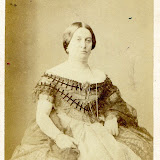
The idea that there might have been something called a unique or native German photography doesn’t get much attention until the 1920s when an essential form of modernism took off in the Weimar Republic. Until then German photography is regarded as a variation on a general European theme, but around the very end of the 19th century German studios began producing portraits that are so distinctive you only have to glance at one to know where it came from. One of the keys is the tonal range; muted greys are preferred over the contrasts of black and white. Another is the colour of the card mounts, olive, drab brown and pearl grey replace the cream of earlier times. Dimensions matter too. Once CDVs and cabinet cards came in standard international dimensions. Now studios begin utilizing card sizes with specific names: the Mignon (45x67mm), the Melanie (90x120), the Promenade (105x210) and so one, some 40 that are officially recognized above what studios came up with on their own. This portrait of a woman is a classic example. Actually it is a standard cabinet card but you know at once it comes from Germany, or at least the Germanic speaking lands east of France. It is also (speaking relatively here) very modern. You would say at once that it was taken sometime around 1910. Partly it’s her expression, which admittedly isn’t that vivid but rather more subtle than earlier photographers would have been allowed, and one reason for that is that it is obvious she is being lit by electric lamps. Historians might dither over where to place it on the timeline. Is it a remnant of 19th century portraiture, Pictorialist or early Modernist? We don’t have to concern ourselves with such details. It is enough to look at it to know it is good.


Going back a few years, we have a typical example of an1870s CDV. It could have come from anywhere – France, the US, Australia or even Turkey. It is a rather excellent study of a boy but the most interesting part may be that it was taken in a studio belonging to Anna and Minna Kohnke, in Mehlbye, near Kappeln, close to the border with Denmark. Studios run by women weren’t unusual, just uncommon, but Mehlby was just a village. You feel there is more to the story of Anna and Minna Kohnke but what exactly that is remains unknown for now.


Moving on to the turn of the century and another portrait that could come from just about anywhere, which doesn’t detract from its quality. Some people might be drawn to the tow boat, the fake rock or the boy’s sailor suit but for me the best part is the backdrop. It is so quietly done it almost disappears but looking closely we see a yacht on the horizon and a dune and grasses just behind the boy. It is an attempt to make the scene as natural as possible. Borkum is a resort island in the Frisians and like most resort photographers, Hans Kretschmann constructed an elaborate effect for what existed naturally just outside his window,


Americans are in the habit of claiming that modern photography began around the end of the First World War, when Alfred Stieglitz and Edward Steichen ditched the soft focus of Pictorialism in favour of sharp, clean lines but there is a lot of evidence to show they weren’t the first; like this 1912 photograph. The woman is using a chair as a prop, as millions had before her, but here instead of merely being a device to add detail to the composition, the back becomes integral to the design, corresponding to the pleats in her skirt. Karl Lützel, the photographer, was fairly prolific in Munich but he wasn’t renowned for his experimentation. A commercial portraitist, he used ideas that were already in place. German, or to be absolutely pedantic, Central European photography, was already developing its own aesthetics when the Americans made their move.


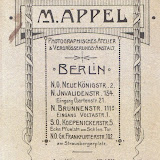
Sometimes the most interesting part of a German carte is its back. Information on Hartmann is scant but it is obvious that by 1902 he had embraced the Jugendstil aesthetic, employing its typography and decorative elements. Well, he was hardly alone in that; just about every photographic studio in Germany was doing it too. 


Here’s another example, by the better known Heinrich Axtmann of Plauen. Like most studios he has dispensed with the traditional and difficult to read Gothic font in favour of several others that are simple and clear. This is the modern world after all and in typography as much as architecture, the ridiculously elaborate pretensions of the Baroque and Neo-Classicism have no place in it. Jugendstil was the German version of Art Nouveau but whatever you want to call it, it was a very feminine movement, with tendrils instead of sharp angles and flowers replacing solid shapes.


None of this was necessarily reflected in the photographs themselves although in Axtmann’s portrait here and Hartmann’s above there is more emphasis on the woman’s shape than earlier portraitists would have considered. Notice the way she appears to blend with the background and dissolve at the base; whatever her intentions for having her portrait taken he wanted a study in contours, stripped of extraneous detail. To his eye she could represent the idea of modern sophistication, less an attitude than an appearance.


Germany in the first decade of the 20th century has a somewhat schizophrenic reputation. Berlin was the centre for the most radical ideas and behaviour in Europe and Weimar had been a home for Goethe, Nietzsche and Rudolph Steiner, but away from those places the impression was of a rigid, humourless Protestantism, somewhat like Scotland, and a disciplined militarism. At first glance this couple look to be the epitome of dour, Germanic severity, but look again and you realize she gives off that aura, he’s a little more ambiguous. Something about him suggests a familiarity with the less sophisticated side of Kolberg, which then was in Germany and now is in Poland. If this was taken, as I guess, around 1910, he would have been too young to take part in the Franco-Prussian War and would have had only vague memories of Germany before the declaration of empire in 1871. Compared to what his parents and his offspring experienced, his life was relatively free from turmoil, Germany was rich, he looks prosperous and, judging from her expression, the wife was probably happy to stay at home with her Bible and her knitting while he trawled the streets.


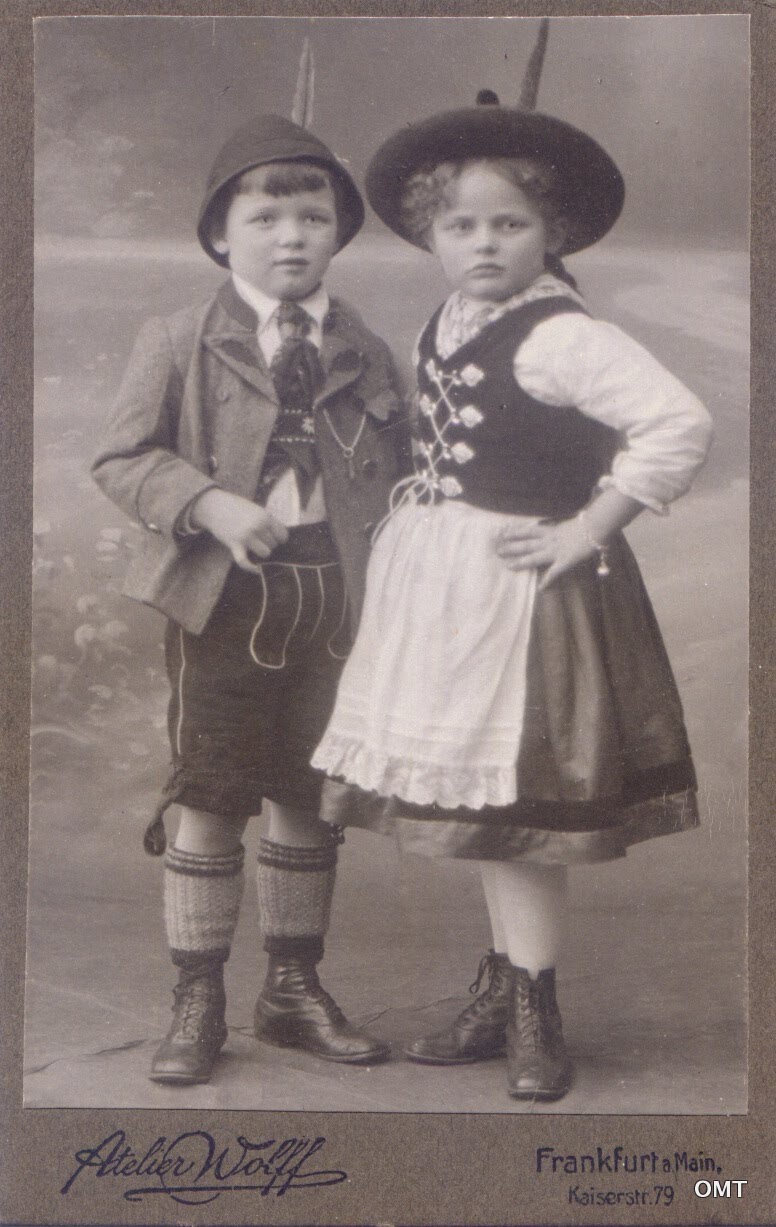
At the turn of the century Germany was producing the best cameras and the sharpest in the world but commercially they failed at photography because unlike the French, the British or the Americans they could not do cute. In other countries photographers had no problem giving a boy in a sailor suit a toy boat and extracting an expression of winsome innocence from him. The Germans tried, like the Wolff studio in Frankfurt did here, but most German children appear to have found it repugnant to put on airs for adults’ sake. The boy looks bemused, the girl frankly irritated at having to dress like Hansel and Gretel, and why not? They’d obviously feel stupid wearing those clothes out on the street so why should they feel different in a photographer’s studio. The girl will go through life getting her own way. Her brother will make one compromise after another until he longs for the sweet mercy of oblivion.


The portrait of this soldier was taken in Berlin, probably between 1905 and 1914. He isn’t wearing any discernable insignia, which suggests he was at an officer training academy. At any time after 1910 he would have known war was inevitable though he might have assumed it would be located in the Balkans and Germany’s main role was to shore up the collapsing Austro-Hungarian Empire. Even in the first months of the war he could have been forgiven for believing an officer’s first role was to provide a model of dignity and poise to his soldiers. After all, everyone around the Kaiser was confident this was a just an argument that would quickly be resolved. 


And what of this polished individual? He looks like officer material too though he is young enough to be a student photographed before a ball. Whatever the case, he’s of an age that made frontline action almost inevitable – almost because if his family had money or influence he could have secured a desk job in Berlin. When you think of what was happening in photography and what would come after, it’s easy to dismiss this German period as commercially ordinary but right at the time these portraits were taken August Sander was running a studio in Cologne and producing work of much the same standard. He was also at the beginning stages of his massive compendium of portraits of the German people. A lot of those early efforts depend on the now accepted formula of clean lines, even tones, muted, angled lighting and a complete absence of artificial sentiment. The difference was that Sander didn’t just rely on whoever came through his door but went out looking for his subjects. It isn’t far fetched to see in these portraits a missing link between the 19th century and modern photography.


GERMAN HUMOUR

Friday, 17 February 2012

GONE WITH THE WIND


10 vignette portraits from the American Civil War era

"Do you only fix your glance upon it and leave your features here. Thus he spoke and he shut up the mirror with the picture trapped inside."
Statius; The Silvae


During the Civil War, Michigan sent 90 000 soldiers to fight and 14 749 died. The first figure must account for virtually every able bodied man in the state; the latter doesn’t include the war wounded who died later. Even though no one wears any obvious militaria such as a uniform or badges, the war informs all the portraits here. Given the numbers above, it is difficult to imagine any of these people lived through it without suffering personal loss. Take the woman portrayed here. The CDV can be dated to between 1862 and 1865 and she is probably in her early twenties. You can assume she lost brothers or friends. Partly because no one is identified in any of the portraits, because we don’t know anything at all about their lives, but also because they are ordinary citizens, death and tragedy are the things that come to mind first.


In the 1860s the U.S was a bit slow in cottoning on to the new technology available to photographers. In Europe the carte de visite and the collodion process rapidly made daguerreotypes and ambrotypes redundant so by 1861 they were scarcely in demand but in the US they remained as popular as CDVs. War usually hastens technology so if something is faster, cheaper and easier to use people jump on it. Maybe it was their singularity that preserved the daguerreotypes’ popularity. In the midst of war, the gift of a unique portrait would have meant much more than something replicated a dozen times.
For photographers however the arrival of the CDV overturned everything they’d been trained in regarding the production, economics and aesthetics of photography. A CDV could be reproduced ad infinitum, even if most sitters were happy with a dozen. Whereas the studio had once been a room with the only requirement that enough light was provided for the camera, with the CDV it became an integral part of the image. Studio props and backdrops were rare in daguerreotypes but with the new cartes they were considered de rigueur. To survive the studios had to adapt but that didn’t mean they had to abandon their old ways entirely or at once. The vignette portrait with the gold border was fashionable between about 1861 and 1865, the years when the daguerreotype was being phased out, and it owes something to its predecessor, especially in the way the focus was on the face. Extraneous details such as clothing weren’t that important to daguerreotypists or their customers, particularly if the portrait was to be put in a locket.   


They also owed a lot to the commercial art of portraiture that flourished in painting, intaglio and lithography before photography, when the vignette and the cameo were the most popular ways to present portraits. In the carte above the photographer added a pink blush to the woman’s cheeks and lips and dabs of black to her pupils. These techniques were widely used by daguerreotypists to give the illusion of colour. Done well, as here, they were barely noticeable. What is going on here isn’t so much a claim for photography to be recognized as art but a response to customer demand that it ought to look like it. These vignette portraits don’t attract anything like the attention other CDVs get but spend a bit of time studying them and they reveal a lot more about the sitter’s emotions. She has a sad weariness about her that doesn’t look staged.


Among the six studios identified in these cartes, John Carbutt is the best known, though not for his portraits. He was an early landscape photographer and one of the first in America to produce stereoviews. A lot of his work was on commission for the railways. He was also experimenting with dry plates and magnesium flash when they were still strictly theoretical for most photographers. Born in England in 1832, he was photographing in Canada in the 1850s and in 1861 he opened his first studio in Chicago, where, according to some sources, he introduced cartes de visite. This portrait was taken about 1867 or 68 when he had a studio on Washington St in Chicago. In 1868 he wrote a panegyric, Biographical Sketches of the Leading Men of Chicago, that included 93 of his portraits. Unfortunately the copies online don’t include the photographs so it is hard to say if this man was one of them. He has the look and demeanour of a leading citizen, in commerce you would think, rather than government, religion or culture. Carbutt may have been an excellent photographer but his writing was a deep tone of purple.


A contemporary of Carbutt’s, Gottshalk Grelling was born in Berlin in 1826 and by the 1850s was working as a daguerreotypist in Chicago, where he ran the “Gallery of Arts”; a common name for daguerreotype and photographic studios in the US. We know a little more about him – he married Adaline Byram, they had a daughter, he died in 1888 – but it’s the portrait rather than the photographer that gets our attention. Daguerreotypes tended to capture the detail in people’s faces better than the early CDVs and typical for the time, this one might have undergone some retouching. Still, part of the effect of vignetting is to leave you nothing but the face to contemplate and here we have a boy who almost certainly joined the 90 000 and possibly the 14 749. He doesn’t look like a shirker. Maybe it’s the suit but he appears destined for a life in commerce or banking, which in those days meant keeping a lot of figures in your head and a practical, unambivalent attitude to life. That’s all speculation of course. We have no idea who he was or what happened. He could have headed west and become a lawman.


In the 1860s. Chestnut St in Philadelphia was lined with photographers’ studios and Montgomery Pike Simons ran one of the better known establishments. He was producing daguerreotypes in Philadelphia in 1842 so was one of the earliest working photographers in the United States. Like Carbutt, he was interested in experimenting with technique and technology and published manuals on ivorytypes, colouring photographs and in 1859, Photography in a nut shell; or, The experience of an artist in photography, on paper, glass and silver. Despite the record, he appears to have slipped into obscurity compared to other American pioneers like Jeremiah Gurney and Charles Frederick. Sometimes you pass someone on the street and you think they have a face straight out of the Florentine renaissance, the 1920s or some other period. This man works the other way. He looks like people I know. He could be alive today.


The major studios aside, it was more common than not for photography to be part of a mixed business. Usually there was a connection so a lot of photographers were also jewellers, engravers or printers. Combining photography with upholstery and a furniture store was unusual. D. A. Simons, who did not appear to be any relation to Montgomery, ran his studio from his furniture store on Smyth’s Block in Manchester, New Hampshire. The D is for Darwin. An online gazetteer from New Hampshire in the 1860s reveals there were at least three other men in Manchester with the first name Darwin. He was on record as a daguerreotypist in the late 1850s and the furniture and upholstery store was still in business twenty years later. During those years Simons was elected to various committees and boards of trade. You think he did alright for himself. So too his subject in this study; he looks into the camera with a practised gaze. He has also done alright for himself in business.


So far the portraits show people apparently in the best of health - which seems remarkable when you read about the number of diseases wafting about the industrialised landscape - but that was thanks more to the skill of the retouchers than any lifestyle choice. Scars, wrinkles, moles and other appurtenances tended to vanish before the client received the mounted portrait. This woman has a face that appears unravaged by either experience or illness yet is afflicted nevertheless. In the late 1860s neurasthenia was diagnosed as a peculiarly American disease and specific to women. Its usual symptoms were fatigue, apathy and social withdrawal but so was any odd behaviour not covered in the textbooks. Cures ranged from enforced rest to induced orgasms, and that was before doctors began toying with electricity. If her family had money, this woman’s shadowed eyes would have marked her out as a neurasthenic. If they didn’t, her eyes were probably taken as clues to loose morals.


Randall of Detroit was the photographer but who was his subject? The beard required cultivation and regular grooming and you couldn’t really afford one like it unless you occupied a respectable position in the city. He looks self possessed and aloof, as you would if you’d inherited the family business or made your way through Harvard Law School and couldn’t see why anyone would settle for less, but that’s unfair. We really know nothing about him. Stockholder or stationmaster on the Underground Railroad, Know Nothing, Northern Republican, Southern Democrat or none of the above; someone with a practiced eye for discerning the codes of dress and appearance during the war could probably identify his background, politics and his profession. The rest of us are left with guesswork. It’s a rather excellent photograph, so finely produced it could have been done in inks.


Speaking of faces that belong to a certain time, there is something vivid and modern about this woman yet her expression immediately suggests the 19th century school teacher. The pleasure in these vignettes lies in not knowing anything about the people; having no more clues than the face to go on and nothing at all biographical. The internet has made it possible to sit in another country and construct skeletal biographies from birth, marriage and death registries, but a little knowledge is a dangerous thing. If we knew her name and read that she lost a husband or a son in the war we’d be tempted to see tragedy when at the time she sat for the portrait it may not have happened yet. On the one hand you are curious, on the other it’s refreshing to realize she will remain a mystery. It’s a paradox really. These portraits are the most tangible proof we have these people were alive but anything they tell us depends entirely on our imaginations.

GONE WITH THE WIND

Saturday, 12 November 2011

THE GREAT MOUSTACHE MYSTERY


Some great moustaches

“Since I don't smoke, I decided to grow a moustache - it is better for the health.
However, I always carried a jewel-studded cigarette case in which, instead of tobacco, were carefully placed several moustaches, Adolphe Menjou style. I offered them politely to my friends: "Moustache? Moustache? Moustache?"
Nobody dared to touch them. This was my test regarding the sacred aspect of moustaches.”
Salvador Dali


Actually, there are several mysteries regarding the moustache. One is its erratic place in our history. Today’s moustache would be a joke if it were actually funny. On most men it’s not much more than a puddle of fuzz across the upper lip, biologically something between a nicotine stain and a pipe cleaner, especially when in it’s most fashionable form, attached to a neatly trimmed goatee. Not a hundred years ago however, a moustache could be a thing of great and audacious beauty. A man tended to his the way he would a garden, lovingly clipping, pruning and shaping it. He devoted time to it. After all, it was his identity.


For the Edwardian gentleman serious about cultivating his facial hair, the investment wasn’t just in time but money. Alongside the various clippers and razors he needed curlers, which needed to be heated to a precise temperature that would allow the ends to be shaped without burning the whiskers. Wax was essential, as was a snood, a netted mask that retained the moustache’s shape during sleep. Moustache cups and soup bowls had a bar across the lip that protected the whiskers from liquids and if he had the money he could think about a silver moustache spoon that had a guard to stop soup clinging to his face, saving others the indignity of having to avert their eyes during conversation. When travelling, a comb and a dab of grease would suffice for his hair but he’d probably need a small bag for all the accoutrements necessary to keep his moustache in working order.


Research (Wikipedia) suggests the earliest documented free standing moustaches – i.e. not backed up by a beard – belonged to the Pazyryk of the Altay Mountains, which is no surprise.  The Pazyryk were ancestors of Turkic tribes and had strong cultural affinities with the Scythians who inhabited regions west to the Ukraine. The finest, at least the most ostentatious moustaches have always been associated with Turkey and the Balkans, heirs to both ancient races. Still, the moustache has a patchy history.  Maybe some Gaulish chieftains of the late Roman early Middle Ages wore them but since our visual records are all later impressions that could be conjecture. For most of Western Europe’s history the free standing moustache was out of favour. Charles I, England’s least manly king, sported a dashing and fashionable Van Dyke but after the 17th century the moustache all but vanished, until the mid-19th when it suddenly returned with a flourish.


Why exactly is one of those historical problems for which any theory proposed has scant evidence to support it. Personally, I think it had something to do with industrialization fragmenting long entrenched social orders. By the mid-19th century entirely new social classes of factory owners, engineers and other self made men had emerged. It was the beginning of the great shift to the cities. If scholars and peasants alike still preferred the antique looking full beard and Protestant firebrands the preposterously ugly chin strap, a 19th century man who wanted to show he belonged to the modern world wore a moustache, particularly something as visually arresting yet impractical as the handlebar. Wearing one let the viewer know two things; you took care of your appearance because you had self-respect.


Whatever a beard may be, a moustache is a badge. The style a man chose – the English, the handlebar, the imperial, the walrus, the pencil, the toothbrush – was his way of letting people know his station in life, When he walked into the saloon one only had to glance at his moustache to know his class, occupation, political views, sense of humour, whether he was a thinker or a fighter, a family man or a rake. It saved time and made conversation a lot easier. You wouldn’t go up to a man wearing a walrus and ask what he thought of last night’s opera performance but you could try that if he was wearing a handlebar. A man with a toothbrush on his upper lip might not have a vivid imagination but if you wanted some common sense on business he was the one to go to.


Several moustaches have fallen out of favour. Thanks to Hitler the toothbrush is finished for the time being. The handlebar and the English with their waxed tips look more pretentious than colourful these days. In the late ‘60s the walrus made a comeback, especially among Californian country rockers. It evolved into the horseshoe but survives in small pockets where the full extent of modern technology has yet to make a real impression. Some are decidedly ethnocultural. The pencil is Latin and looks inconsequential on a blonde man, in the same way that an imperial can look entirely natural on a Croatian waiter yet pompous on an English comedian. At one time a European man looked to his royal family for advice regarding facial hair. These days it’s only the minor royals, by and large an unsavoury bunch of drug addicts and tax dodgers, who sprout the stuff and no one cares to follow their examples. Ironically, given the moustache’s long identification with overt and very heterosexual masculinity, it is the gay community who have rescued some of its finest forms from ignominy.


The rebirth of the moustache coincided with the invention of photography and it followed that a man who had spent months cultivating the growth on his upper lip would not be shy about hiding it from the camera. There are thousands of splendid examples out there. Here are just a few.


GREAT MOUSTACHE MYSTERY