And furthermore ...

One Man's Treasure encourages the use of anonymous photographs posted here to illustrate books and album covers.
If an image appeals to you, contact John Toohey at johntoohey@hotmail.com.
Showing posts with label Berlin. Show all posts

Thursday, 30 October 2014

THIS IS THE MODERN WORLD

Edwardian era fashion postcards 
“Fashion is made to become unfashionable.”
Coco Chanel


 I have been informed, politely and otherwise, that I am unqualified to discuss fashion. It is true that when the words ‘fashion’ and ‘photography’ appear next to one another a yawn needs stifling. It is the least interesting genre, one reason being that it is so pervasive. It is one thing to encounter fashion photography in the cosmetics department at the local pharmacy, another when it turns up in hardware stores, as though using this power drill will bestow some kind of glamour upon us. Also, the genre has run out of ideas. People speak of a golden age of fashion photography that lasted from 1920 to the 1950s, which was a long time ago now.


 This ‘golden age’ began with technological processes that made it possible to reproduce photographs to a high standard in magazines. Previously they had to rely on line drawings. It coincided with the rise of Parisian fashion houses such as Chanel, the diffusion of modernist principles in photography and suffrage for women, which shifted the balance of power so they were not just portrayed as elegant but having authority as well. But if we look to the years immediately before, we discover that the most important medium for transmitting the latest ideas about fashion was the common postcard.

 
 What made the postcard special was that it was cheap, intended to be sent, and also collected. Typical messages on the backs of these postcards from the first two decades of the twentieth century are: “What do you think of this?” (meaning the costume) or: “Here’s another for you”, meaning the recipient – inevitably a young woman - collected fashion postcards. With the popularity of postcards, studios were pumping them out so someone in Paris could send a postcard to someone in London, who got that season’s fashion tips hot off the press. If her mother was relying on Tatler for fashion advice, she might have to wait weeks for what her daughter received in a few days.


Another advantage postcards had over magazines was that they could be hand-coloured. Fashion advice from the era places a lot of emphasis on colour; gowns and robes are not merely green but chartreuse; burgundy is in; vermilion is out. Japan had been a source of inspiration for European designers since at least the 1880s. Japan meant delicate, which itself meant pastel shades rather than bold colours. When Hermann Kiesel’s studio photographed this model, it most likely received specific instructions on what shades of ink to use. 

Despite the postcard publishers promoting fashion, labels are rare to non-existent on the postcards, suggesting that the designer didn’t matter. We know that in the 1910s the fashion house was still emerging as a distinct force but another explanation for the absence is that the outfits on postcards weren’t strictly haute couture but copies. Department stores in New York imported fashion items from Paris but they also copied the designs. If a broad-brimmed hat complete with ostrich feathers and silk bands direct from Paris cost too much for anyone but the wealthy, most middle class women could afford an accurate replica. Also, the market for the postcards belonged to young, unmarried women. We know that because on the back the cards are usually addressed to Miss or Mlle Someone. Actual haute couture was out of their reach financially, and also maturity-wise, since that was supposed to arrive with the debutante ball, or if they couldn’t afford that, marriage.


Which brings us to that borderline between fashion and erotica. The frontier has always been vaguely marked out, given that one is often an intrinsic element of the other, and there are postcards that make us wonder whether the real attraction was the fashion or the impertinence, but young women were supposed to have thresholds. They might have gone for the flapper look, with the cloche hat and the woollen outfit. Showing the suspenders however was perhaps too indecorous. The risk of sending a postcard like this to a friend is that the parents could find it, so casting her in their eyes as an immoral vixen. It isn’t the evidence of the suspenders that would have necessarily caused offence but the woman’s posture. In fashion, a woman’s expression could be sultry, provocative or downright lubricious but her physical pose was always supposed to be demure. 


 In 1931 Jeanne Jullia of France won the Miss Europe beauty contest. Some time later it was discovered that in the 1920s she had posed nude for Julian Mandel, the infamous and mysterious producer of erotic postcards. The revelations created a minor scandal but they were handled with more savoir-faire than they would be today. She was not stripped of her title, bundled off to rehab or made to grovel before the press, probably because a sullied past was nothing to get excited about in 1930s France; everybody had one. As with the designers, the women who appeared in these fashion postcards were unnamed but look at enough postcards and certain faces become familiar. Usually they were actresses or singers without the status to warrant a caption. Although some women worked as professional models the job was so poorly paid it was something they’d do on the side. Like acting, it was still a disreputable occupation for a woman but at least in the theatre she could redeem herself by becoming a star. 


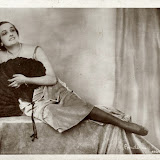
 This card was sent to Mlle Sarah Parent at 1197 St Catherine St Montreal on April 25 1907 and asks if she can still come to the theatre that evening. (Mail was commonly delivered three times a day back then, which is why you can find postcards mailed from Brighton to London arranging to meet that afternoon.) A Sarah Parent turns us in the Quebec records as born in 1893. If this is the same Sarah, she fits the profile. At fourteen she would be going to the theatre with friends and have an interest in fashion. Notice that the girl in the photo is only a few years older, about eighteen; in other words, a suitable role model. This was sent at the height of the fashion postcard era. That ended with the First World War. It wasn’t so much that the war created a break in the culture but that the customers grew up. Post war, Sarah Parent would be twenty five, possibly married and if she were still interested in fashion she would be turning to the magazines that were aimed at older women. Like the extravagant Edwardian hats, fashion postcards belonged to the past.

THIS IS THE MODERN WORLD

Tuesday, 21 October 2014

WINGS OF DESIRE


Transgressive images from Weimar cinema
 "I’m sincere in my preference for men’s clothes. I do not wear them to be sensational. I think I am much more alluring in these clothes."
Marlene Dietrich


 Berlin in the Weimar years: a city rampant with leather wrapped, cross-dressing S&M fetishists, or not. Depending on whom you ask (or what you read), that image is either an invention or a conflation. There were bars like the Silhouette, where a customer could take a table and watch a parade of men in make-up and dresses and women in tuxedos, but reliable advice suggests most of the night spots were a lot tamer than that. Apparently we can thank films like The Night Porter and Cabaret for seizing on a rumour and treating it as fact. If the Nazis were perverts by definition, it was assumed that for night time amusements they’d prefer watching a couple of transvestites spanking each other rather than a blonde fraulein singing banal operetta, but when you think it through, the latter is darker, stranger and altogether more disturbing. One of the hallmarks of the Nazi leadership was an abject lack of imagination. These were people who dreamed of a world where everyone shared their passion for kitsch, which meant blonde girls in gingham singing folk songs, not sexual ambiguity. Goodbye to Berlin, Christopher Isherwood’s original book on which Cabaret was based has no scenes set in a cabaret, but can we really blame Michael York and Dirk Bogarde for helping create the enduring image of Berlin C1930? Not entirely. Thanks to the Ross Verlag postcards we have thousands of surviving images that show the photo studios pushed the idea of a city where taboos were broken as a daily habit. Yet, coming from the cinema world, they were images of what the world could be, not what it was. Lya de Putti’s attire may have looked fabulous but it was impractical, and it was easier to imagine a world where women strolled along the Kurfürstendamm in sheer, glistening black rather than live in one where they actually did. After all, for a lot of ordinary citizens struggling with hyperinflation and massive unemployment, to dress like Ms Putti does in this photo was like waving a red flag at a National Socialist rally. The photograph is by M. I. Boris, aka the Bulgarian Boris Majdrakoff, who arrived in New York in the 1920s with a past respectable thriller writers would have dismissed as too unlikely. 

 
 Look at contemporary fashion images of women wearing suits and ties and we are meant to think of them as daring experiments in gender reversal, but so many of the Ross postcards show women wearing men’s clothing, or a close approximation, that we realize they were a trend back in 1920s and ‘30s Berlin. What makes us think they are about playing a game rather than making a statement is that so many of the actresses portrayed did not have reputations for challenging convention. From what we know of Carola Tölle, she played solid roles in films that are largely forgotten because there is no compelling reason to remember them. Her private life can’t be accounted for but it appears scandal free.

 
 Henny Porten’s fame and reputation have endured, for her roles as a gentle or long suffering earth mother type. Comparing the photo of her with that of Ms Tölle, we begin to see a pattern, or rather, a style. Only a decade earlier the notion of a woman wearing a suit and tie would have still caused a stir. In 1919 however, German women won the right to vote.  What had changed had less to do with Weimar Berlin’s free thinking than fashion designers’ understanding of how to accommodate radical into chic. Ms Porten’s sleeveless waistcoat has a decidedly feminine cut. She is not wearing a business suit. In the 1970s Diane Keaton revived the suited look in Annie Hall. If it didn’t make the jump to the pages of Vogue that was because it was too idiosyncratic: it was one thing to look like Diane Keaton, another to look like Annie Hall. And maybe the crusty old editors at the magazines took one glance, recalled their youth in Vienna wearing Papa’s silk ties and thought it had all been done before.

 
 Having never seen Marcella Albani in a film, commenting on her strengths as an actress is pointless, but in every other photograph of her in the collection she is portrayed as the embodiment of graceful elegance; a woman with a preference for haut couture and intelligent conversation. That doesn’t mean she lacked a sense of humour. When she fronted up to the studio on this particular day, she might well have been bored with the idea of yet another soft focus study suggesting she had just emanated from the mists. Perhaps Herr Binder was bored too and together they concocted an image the very opposite of what was expected. She was an actress; it was her job to be out of character. 

 
 Russian born Hella Moja dressed as a baroque era noble (or Mozart) looks to be having the last word on androgyny here, and in a way she is. We know from photographs by Walery and Reutlinger that the Ancien Regime look was popular around the Parisian music halls a generation before Karl Schenker took this portrait. So too were the matador, the Gypsy and even the blacksmith. They were too exaggerated to be subversive, more like fancy dress, and never began with the premise that other women might want to dress that way in the street. Also, it was always more acceptable for women to dress as men than the other way around. How many of the leading male stars were willing to don corsets and bustles?

 
 Sigmund Freud’s nephew Edward Bernays famously turned up in the U.S and turned women on to smoking. He took his lead from home, where the habit was already associated with modern sophistication, added a bit of volume and general crassness and earned the undying gratitude of his employers. A lot of the Ross postcards show women smoking; by the mid 1920s a cigarette in the hand was a sign of elegance, of adulthood, but not necessarily of rebellion. Ms Haake’s forte was light comedies and socially concerned dramas and she’d go on to a long career, appearing in films into the 1980s. If the idea of a woman smoking was as scandalous in Germany as it was in America, she’d be one who’d put hers out before the photographer was ready with the camera.

  Not so Fern Andra, the great, unsung heroine of early cinema. American born but European by preference, she promoted herself as a woman who liked a cigarette and a stiff drink and would be disappointed by any man who did not offer her both. In reality she was an intensely serious worker who understood the dangerous gulf between public image and private life. She paid a price, but not for smoking or dressing in men’s clothing or any of the standard contraventions. As actor, director, producer and even photographer, she controlled her image so closely that when it began to fade no one was on hand to help her revive it.

 
 Which brings us to that most infamous figure of the early screen, the vamp. Her modern history began with the nineteenth century music halls, she came of age with silent film and died with its passing. It was difficult to be a real vamp in the 1930s. The Hays Code in Hollywood was very much opposed to any young woman who thought a man’s marriage was a speed hump not a stop sign. According to the new rules she had to pay for her crimes, which was an obligation no genuine vamp ever considered. The Nazis weren’t keen on her either. For all the bondage and S&M imagery bestowed upon them, publicly their ideal woman was blonde, virtuous and enthusiastic about the outdoor life. She could suffer but never inflict pain herself. The vamp was dark, saturnine and came alive when the sun went down, like Valerie Boothby in this image from Iris cards. Despite her very English name, Ms Boothby was German. Her career was short but included such titles as Girls on the Cross (1929), Adam and Eve (1928) Inherited Passions (1929) and Marriage in Name Only (1930); all which suggest some poor fool learns a lesson about love the hard way. 

  The vamp and the femme fatale were subtly different creatures; though the man who fell victim to either was seldom astute enough to know that. Both depended on exploiting male vulnerabilities but where the first was essentially amoral the second had principles and objectives. Sometimes she was looking for a way out and figured the man would lead her to it, and sometimes she was genuinely in love with him. If the last scene saw the vamp heading down the street with a man in her arm, you knew they were going back to her lair. If it was the femme fatale on the other hand, she may well have been persuaded that the path to true happiness lay in marriage, children and a home in the suburbs. Lissi Arna is one of the many German actresses of the silent screen forgotten now by all but the most devoted fans of the era, yet throughout the 1920s she was one of Weimar cinema’s most popular stars. Her reputation today, such as it is, rests on several films where she played the prostitute (hard hitting exposé) or the seductress (comedy, melodrama) but as it transpires she made more of the routine romances that were the bread and butter of the film business. The Kiesel Studio was located at Kurfürstendamm 11, meaning the address was fashionable but real information beyond that is hard to find. Alongside the celebrity portraits are many more showing children with oversized Easter eggs, or (that other inexplicably popular genre) dressed as their parents. What we see here is one of those minor shifts in the way women were portrayed that don’t raise the number of eyebrows today that they should. There is nothing vulnerable in Ms Arna’s expression. She knows what she wants and how to get it. 

  The secret had less to do with women discovering an independent spirit than technicians realizing the power of lighting. Photographers were learning that a shift in angle to throw a shadow could do more than animate a portrait. It could transform Elizza La Porta, generally sensible star of such morally didactic films as The Right of the Unborn and The Vice of Humanity (abortion and drugs respectively) into a siren of the night. Silent Hollywood gave the vamp fame and notoriety but in Los Angeles she was a European construction. Think of the number of famous Hollywood mantraps from the silent era, how many have ‘European’ names, and what their actual names were: Theda Bara (Theodora Goodman), Dita Naldi (Mary Dooley), Olga Petrova (Muriel Harding). She was by definition exotic because part of the danger of becoming involved with her lay in being unable to penetrate her closed, enigmatic mind. In Germany, America was a strange, distant land (witness the popularity of Karl May’s Native American novels), but so too were places just beyond its borders. The Balkans, home of the vampire, Oriental Turkey and the Arab lands, the Russian steppes; they were all breeding grounds for women who could crush a man’s soul with as much thought and effort as it took to flick a cigarette into the gutter. Romanian born Elizza La Porta may not have played the seductress on screen but she knew how to for the Manasse studio. Operated by Olga Solarics and Adorjan von Wlassics, it specialized in glamour photography and in surreal, modernist erotica. After years of relative neglect, the erotica was rediscovered and in the process became representative of decadent Berlin. The studio was equally adept at portraying actresses as sweet and wholesome as a strudel. But any fool with a camera can do that.

WINGS OF DESIRE

Friday, 26 July 2013

ICH BIN EIN BERLINER

Weimar photographic studios
 “People of Berlin - people of the world - this is our moment. This is our time.”
Barack Obama, 2008


Between 1924 and 1935 the Ross company (Ross Verlag) published over 40 000 real photo postcards of European, American and especially Weimar German actors. It’s surprising then that few film historians have done work on the company. The most thorough resource can be found on the Ross Cards website, but what’s missing is the commerce. The company was instrumental in promoting cinema stars throughout Europe and promotion wasn’t just about churning out thousands of postcards. It had as much to do with the cultivation of an image and the presentation of a look. It would be good to know how closely Ross worked with the studios in creating the image, who bought the cards and who collected them.
The relationship between Ross Verlag and the film studios isn’t clear. If Heinrich Ross bought a concession from the studios then the use of some of the same images by other German companies such as Photochemie doesn’t make sense. But it doesn’t either that the studios would pay him to publish postcards when they could do that themselves. If it operated according to regular publishing models, which vary between countries, the cards were produced and distributed then percentages were divided up. If that was the case then Ross had a close role in marketing and could presumably reject some images for being outside its interest.


What is also noticeable is that cards usually carried the film studio stamp (UFA, MGM) or the photographer’s but it is unusual to find both. That suggests that Ross Verlag bought images directly from the photographic studios. Most surveys of German photography from the era concentrate on the obvious names, ignoring some studios because it is assumed they were commercial and don’t represent the avant-garde of German modernism. Whether the studio principally worked in portraiture or advertising, familiarity with the new aesthetics was essential. The clients demanded it so every photographer knew the basic principles. What about the customers? How much was Ross working to demand and how much was he creating it?
A recent post was devoted to Alex Binder, the photographer most commonly associated with Ross Verlag but work from studios across Europe was used. The Ross cards website lists over fifty studios from Berlin alone. Assuming that most of the actors who sat for portraits were well known enough to pick the studio, that gives us an idea of how active the business was at the time.
 Below are examples from some of the Berlin studios most likely to be found on Ross cards.  A couple have long been recognized as being at the forefront of German modernism and some have recently become the focus of revived interest. Others remain neglected. 


Becker & Maass

One of the unjustly forgotten studios, it was probably established in the 1870s by Otto Becker with Maass joining as a partner some time in the 1890s. If Becker was still alive when these cards were produced he had been in the business for fifty years. More likely then a family member inherited the business or its success meant that new owners kept the name.
The Becker & Maass name appears on Sterne cards, the precursor to Ross, and early Ross Verlag cards, C1925 but not in the 1930s. It has one of the most distinctive styles. Strongly influenced by the soft focus painterly style of Pictorialism, Becker & Maass avoided the sweet, wholesome look some film studios preferred. Ross cards often hinted at eroticism while very, very rarely being explicit but Becker & Maass suggested something even more troublesome; the independent, self-possessed woman.


Emil Otto Hoppé (1878-1972)

Hoppé was the most famous photographer whose work appeared on Ross cards, as well known in the 1930s as he is today as a leading figure in German modernism. The British also lay claim to him as he lived and worked in London throughout the 1920s and ‘30s but for my money the most interesting book of his work is devoted to his Australian photographs taken in 1930. He travelled across the country, from Tasmania to the Northern Territory and Queensland, the south-west forests to the central desert at a time when these regions were only barely connected to one another. The Australian photographers he met, like Harold Cazneaux, were still excited by ideas that had become outdated a generation earlier. His celebrity portraits however are rarely exceptional. You could argue the difference between this portrait of Lucy Doraine and one Alex Binder might have taken but the distinction is fine. It is clear however that whoever took it was astutely professional.


Angelo Photos

Pál Funk (1894-1974) is better known today in his native Hungary than outside of it though in the 1930s he was recognized as one of the most prominent studio photographers throughout Europe. His connections through work with Hoppé, Leopold Reutlinger and Rudolph Dührkoop and as a cinematographer for Michael Curtiz are impressive as is the list of awards bestowed on him in his later years. These days it is his highly stylized Pictorialist nudes that are most sought after. You can see why in this study of Vilma Banky. Few studio photographers really understood that artificial lighting was meant to evoke rather than expose. Funk did.


 Frieda Riess (1890 - C1955)

It’s surprising how many rediscovered photographers weren’t lost at all. Everything; photographs, documents, biographical information is there, waiting for someone to eventually give it some attention. There has been a revival of interest in Reiss lately, in Germany at least, with a biography and a major exhibition at the Berlinische Galerie. When you consider her sitters included Einstein, Mussolini, Josephine Baker and Jack Dempsey, her social connections extended through Berlin’s art world and she worked as the stills photographer on Fritz Lang’s films, you could wonder why she doesn’t rate a mention in histories of German photography until recently. Part of that was through her design. Around 1930 she married the French ambassador, Pierre de Margiere, and moved to Paris, retreating from photography and Berlin society.  Note the abstract design on the backdrop in this portrait of dancer and actress Grit Hegesa. There are several portraits of dancers Reiss took against such backdrops but it is hard to say whether they were part of a series or if she just liked the effect.


Karl Schenker (C1880-C1952)

Around 1930, Schenker took a series of fashion portraits of store mannequins carefully painted and arranged so that at first glance it is easy to mistake them as real women. Schenker is another who apparently disappeared from view. His work never appears in the surveys of German photography despite adjectives such as ‘famous’ and ‘highly regarded’ occurring before his name. Like a lot of the photographers here, his best known works today are his Pictorialist nudes. Here’s the problem. Having been away from the spotlight for so long, you might think his return would excite more interest: who was this photographer who took these extraordinary nudes? Unfortunately for Schenker the world is awash with Pictorialist nudes and if he was something of a radical experimentalist in 1913 he no longer is. 


Atelier Manassé

Polish couple Adorján von Wlássics (1893 - 1946) and Olga Spolarics (1896 - 1969) began the Manassé studio in Vienna during the 1920s and relocated to Berlin in the late 1930s. Maybe they tired of Pictorialist nudes early on because although the erotica is their best known work it is highly surreal; women in birdcages, crawling out of snail shells, trapped in bottles, pursued by giant beetles – you get the idea. Monika Faber published a book of the studio’s surrealist images, Divas and lovers: the erotic art of Studio Manassé, in 1998.


Ernst Schneider

If a single magazine represented Weimar Germany it was Berliner Zeitung Illustrirte. Not as experimental with graphics as its later rival AIZ (Arbeiter Illustrierte Zeitung) it was still the place to get your work seen and most photographers here had images appear in it, including Ernst Schneider. In 1908 he published The Human Form and Beauty: templates to study the naked human body, which as the title suggests was erotica wearing the thinnest gauze to disguise itself as art. It came out just after Heinrich Pudor published Nacktkultur in three volumes, which espoused the virtues of nudity, vegetarianism and racial purity. Historians can’t help but make the association between books like Schneider’s and the rise of Nazism. 


Martin Badekow (1896-1983)

These days a vintage print by Badekow will set you back a few hundred dollars but you can still buy a Ross real photo postcard for the price of a bus fare. Overlooked for a long time, his photographs from the Berlin cabarets have become emblematic images of Weimar Germany. Like Funk and Reiss he is frequently referred to in the press of the time as famous or world renowned yet post-war he disappeared from the radar. Today, with the increasing interest in fashion photography, it would be an oversight to leave him out of an exhibition.


Balázs Studio

Nothing can be found about this studio despite its work appearing frequently on Ross cards. Balázs is a common Hungarian surname and Berlin in the 1920s was full of émigrés from central and eastern Europe who had either escaped for political reasons or had moved to where the money and the ideas were. Considering how popular a lot of the actors were when they sat for the studio it must have had a good reputation, in a city full it seems of world class photographers.


WEIMAR PHOTO STUDIOS

Monday, 27 May 2013

ALEX IN WONDERLAND

Weimar Portraits by Alex Binder

"Yes, I was correctly quoted in saying I introduced sex into films in the 20's, but it was sex in good taste and left a great deal to one's imagination."
Pola Negri

 
The few sources of biographical information about Alex Binder online repeat the same notable detail about him: up until his untimely death he ran the largest photographic studio in Europe. By largest we presumably mean the most commercially profitable as distinct from the biggest building, but that being the case we might wonder why so little information otherwise exists about him. He has no citations on Oxford Art Online, the Union List of Artists’ Names via Getty or Art Full Text and, they being the three most authoritative, that pretty much leaves him out of the picture. Consider this portrait of Lya de Putti for a moment then ask yourself how it is that within the huge and ever growing pile of scholarly work on Weimar cinema and its images of women especially, no one apparently mentions him. Why? Anybody casting an eye over the world of Weimar film will inevitable encounter his images, and anybody writing a history of it ought to be aware of his central role in creating the image of the Weimar woman. Part of the problem might come down to bad timing.


He was born in 1888, in Alexandria (some sources suggest the Ukraine) and moved to Berlin with his family when he was young. In Munich he attended the Teaching and Research Institute for Photography and the Reproductive Processes, which despite the awkward translation was one of the leading educational centres for photography in Europe. Frantisek Drtikol studied there and may have been one of Binder’s contemporaries. Binder opened his first studio in 1913 and by the mid-1920s had moved to 225 Kurfürstendamm. Here he was producing portraits of cinema stars, among them the images best known for their appearance on Heinrich Ross’s Ross Verlag postcards. As a publisher Ross would have had direct contact with Binder but which images were licensed from the film studios and which he commissioned isn’t always clear. Two of the portraits here of Lya de Putti bear the UFA stamp but this one doesn’t. If Ross was buying his images from Binder’s stock then Binder’s chief clients would have been the actors themselves, who had to pay for studio sessions or film studios like UFA. It isn’t such a small detail. If the relationship between Ross and Binder was that of client and vendor then it suggests a particular collaboration. Ross wanted a certain look to his portraits and Binder was capable of producing it. In other words they deserve more of the credit normally given to the film studios for some of the emblematic images of Weimar cinema. The alternative was that it was the studios directing the image. Binder was merely pressing the shutter. 


Binder was only 41 when he died in 1929. The circumstances aren’t clear but the timing might contribute to his neglected reputation. When he began working professionally in 1913 the dominant aesthetic was Pictorialism with its fuzzy textures and tones. He would never quite abandon it, yet when we think of German photography in the 1920s what comes to mind is either the deadpan documentary style of August Sander or the sharp modernist style of Moholy-Nagy. These are the techniques that get all the attention and Binder’s straddles them without being either. You can see the problem in this portrait of Helena Makowska. She has that gothic gloom we associate with Weimar cinema but stylistically the portrait could be placed at the tail end of Pictorialsm or the very beginning of German Modernism, For art historians who like their categories neat it belongs everywhere and nowhere at the same time. In other words, it’s easy to bypass it and settle for something more obvious.


When Binder died the National Socialist Party was still a fringe player in German politics, holding just a handful of seats in the Reichstag and less than it had two years earlier. At that point few Germans would have imagined that within three years it would be in a position to usurp power. To read his work as any way marked by what lay in the future is false. We have no idea what would have happened to Binder had he lived, but he was Jewish so his choices were limited. In 1938 the manager of Atelier Binder (as the studio was known after his death), Baroness Elisabeth von Stengel was sent to the concentration camp at Theresienstadt. Heinrich Ross on the other hand escaped to America but not before the Nazis had taken control of his publishing house. Like Ross, Binder might have survived but he would not have escaped the notice of the Nazis.


Running the largest studio in Europe was an achievement no doubt but what is in his work that merits our attention? I think it has already been established that we are not talking about someone with a radical vision. As a commercial photographer he worked to his clients’ demands. Consider this portrait of Marcella Albani; elegant, beautiful and only the most rigidly puritanical would find offence with it …


 Now compare it to this one of de Putti. There would have been plenty of middle-aged middle class Berliners in the 1920s who found the idea of a woman smoking crass and even offensive but for younger people just the way she held the cigarette was the epitome of modern sophistication. Since the older bürgerlich weren’t dictating style any longer, no one was listening too closely to them but it would be wrong to think that Binder shot this portrait because he wanted to capture the essence of the contemporary woman. Someone else wanted that, possibly de Putti herself.


Maybe it is a mistake to search for ‘the Binder style’. But if he didn’t create anything so personal or distinctive, he was there as Weimar culture took wing, and he was a participant. As for emblematic images of glamour and liberation from the era; what about this portrait of Lil Dagover or the top one of Lya de Putti?  Maybe the only reason he is not considered one of the principle photographers of the era is that no one has thought to for look him yet. 

ALEX BINDER

Wednesday, 17 March 2010

GOODBYE TO BERLIN


Photographs by a Turkish Student in Berlin, 1929 - 1930


“I am a camera with its shutter open, quite passive, recording, not thinking …”
Christopher Isherwood. Goodbye to Berlin


Driven to be a writer, in the late 1920s Christopher Isherwood believed he had two options. One was to remove himself to a farmhouse and work in solitude. The other was to stand at the centre of the world from where he could study the chaos of its detritus furiously spinning around. That meant moving to Berlin, the city any intelligent observer at the time realized was where Europe’s fate was about to be determined.


Whether or not he was a capable analyst, Isherwood had one quality that would give his observations a vividness lacking among seasoned professionals. Throughout the two books that came from his stay, Goodbye to Berlin and Mr Norris Changes Trains, he comes across as a fish out of water, bemused and somewhat naïve. From this position, he learns things in Berlin others take for granted. Neither book explains what is unfolding as the Weimar Republic collapses but, in line with his famous quote about being a camera, he presents a series of tacit images. Isherwood began writing his ideas down in 1930. By the time the six pieces that make up Goodbye to Berlin were assembled into one, nine years later, war was just a breath away and the book had taken on a sibylline quality.

At exactly the same time as Isherwood was blithely moving between apartments and collecting his thoughts, a student from Turkey arrived in the city. He had a real camera, a Kodak or a Voigtlander with a folding bellows and a little ground glass window which allowed him to hold the instrument at waist height to compose his shots. If he was a good student, he understood he was there to observe.


The Turkish Republic was just seven years old and in the middle of its own cultural revolution. Ataturk was tearing down the remnants of the Ottoman Empire and assembling a modern, secular state. It’s quite likely the student was sent abroad with the idea that what he learned in Europe he would bring back to the new republic, that he was expected to be in the vanguard of modernism.


Whatever knowledge he brought back about law or science or the arts, his photographs, the only tangible remains of his experience, correspond with some of Isherwood’s sentiments. Isherwood, for example, never mentions modernist art, but it is clear from the way he structured his writing that he was aware he could say things in new ways. Whether or not student was aware of the Bauhaus before he arrived in Berlin, his photographs of the tower and the harbour and window scenes are not coincidences. He is playing with contemporary ideas.

The most apparent comparisons however are in their portraits. Isherwood ranged across a wide spectrum, from the inhabitants of cheap boarding houses to millionaires who never quite explained the source of their wealth, from the gay milieu to upright Jewish department store owners, with the developing theme that their ideas and lifestyles will damn them. A similar sense of doom infects the photographs. Maybe it’s because there is a whole set of images and everybody is expressively affectionate and happy but there is a poignancy to these photos that has everything to do with time and place. Beneath the smiles these people may have a sense of unease but we know for sure what will occur in a few years. 


Up to a point, that is. We actually don’t know anything about these people, whether they graduated and served as officers in the SS, were sent to concentration camps or watched the war and wrung their hands from the sidelines. Then again, that’s the whole point about anonymous photographs; wondering rather than having answers. Presumably the student returned to Turkey. After he died, somebody must have glanced at the photos and thrown them into a discard pile from where they were passed about until ending up in a suitcase outside a particularly grimy second hand store in Istanbul. Luckily for us, no one ever bothered looking too closely at them.

VIEW THE GALLERY HERE
GOODBYE TO BERLIN