And furthermore ...

One Man's Treasure encourages the use of anonymous photographs posted here to illustrate books and album covers.
If an image appeals to you, contact John Toohey at johntoohey@hotmail.com.
Showing posts with label Orientalism. Show all posts

Friday, 29 November 2013

IDENTITY ISSUES


5 Portraits of European film stars and their strange stories.
“A girl should be two things: who and what she wants.” 
Coco Chanel


The idea of the silent film star rescued from obscurity has been played out often since the arrival of sound in cinema, when hundreds of actors discovered they were no longer wanted and sent off to seek their fortunes elsewhere. It’s the motif in Sunset Boulevard, of Paul Auster’s Book of Illusions and I recall reading an Alfred Hitchcock and the Three Investigators mystery with a reclusive genius who’d been wronged by the studios, though that was years ago. The point to all these stories is that the actors use their seclusion as a way to get attention. In the real world they tended to vanish, and that was that.
Vera Voronina’s whole life is a mystery. She existed – we have the photos to prove it – but who she really was and what happened to her are unknown. All the records on her, such as they are, say she was born in Russia in 1905, though the date always has a question mark after it. Having acted in three films in Germany, she arrived in Hollywood in 1926, the publicity describing how she had escaped the Bolsheviks by the skin of her teeth. Naturally there were references to her noble birth. She made four films in the U.S and one in Britain. The best known of them, The Patriot, was directed by Ernst Lubitsch and had Emil Jannings in the lead, and like Voronina, it has vanished from sight. She left Hollywood, made four more films in Europe and that was the last heard of her.
What actually happened may not be that mysterious. As sound came in, foreign accents went out, even in Europe, and she could have retired, married, taken on her husband’s name and lived out her years in quiet domesticity. But tracking her down could be impossible. We don’t know that Vera Voronina was her real name, when she was born or even that she was Russian.
The photo incidentally is by Eugene Richee, one of Hollywood’s top portraitists in the 1920s and 30s. I thought I’d find a bit about him too but the one source who would know these things, John Kobal, admitted in his book, The Art of Great Hollywood Portrait Photographers 1925 - 1940, that Richee was a bit of an unknown to him. Two riddles for the price of one. 


In the early 1930s Hollywood realized that its public loved a certain type of foreign woman. She was blonde, sultry, mysterious, and Germanic. Everybody was out searching for the new Greta Garbo, even MGM, which had Garbo under contract. Samuel Goldwyn took the credit for discovering Sigrid Gurie. She was beautiful, blonde (or could be) and Norwegian. She never quite lived up to Goldwyn’s hopes but then she was cast in a string of ordinary films. The best known was Algiers (1938) in which she played someone called Inez. For all his boasting, it didn’t seem to occur to Goldwyn to cast Gurie as a Norwegian, or at least a Northern European. He was probably sitting at his desk in 1941 and grumbling over her failure to overtake Garbo when the scandal broke.
Gurie was born in working class Flatbush, Brooklyn. True, her parents were from Norway and they had moved back there when she was three. Her passport acknowledged her dual citizenship and she had spent longer in Norway than America, but that wouldn’t have satisfied Goldwyn. He promptly dumped her, muttering at how he’d been fleeced.
So: here is Sigrid Gurie in The Adventures of Marco Polo. She is playing Princess Kukachin, the daughter of Mongolian emperor Kublai Khan. MGM had no problem casting her as a Mongolian but refused to recognize she was Norwegian. Some people still think Samuel Goldwyn was a genius.


In the early 1920s aspiring actress Kathe Dorsch was engaged to World War 1 fighter ace and morphine addict Hermann Goering. She broke the engagement off, which sent Hermann into a tailspin. How could any woman spurn one of the only living heroes of the war?
Fifteen years later, Ms Dorsch was an acclaimed star of cinema, the stage and opera and Goering was the head of the Gestapo. He was also still her friend and would do anything she wanted. By now Jews could not marry non-Jews let alone leave Germany without a pass officially signed by Goering. The actual number of passes Goering signed for Dorsch isn’t known but the evidence suggests she frequently went to his office, got what she asked for and saw that many of her Jewish friends and acquaintances escaped to safety.
We could phrase that another way and speculate on how many Jewish people Goering knowingly arranged safe passage for except that it doesn’t exonerate him. If anything it shows what a fool he was and how easily Kathe Dorsch could manipulate him: not so much Schindler’s List as Hogan’s Heroes.


On May 18, 1945 U.S Army officers went to Leni Riefenstahl’s villa in Austria and arrested her, not to face criminal charges but rather to assist them with their investigations. Hitler had killed himself just over a fortnight earlier and Germany had surrendered on May 8. They wanted information in order to draw up a list of suspects and charges as quickly as possible. Riefenstahl was just one of hundreds who would be brought in for questioning and she was an obvious target as her friendship with Hitler had been well known since the international release of her films Olympia and Triumph of the Will in the mid-1930s.
The man in charge of the arrest team was Budd Schulberg, not yet known as a scriptwriter but well aware of Riefenstahl’s reputation as a director. He would later say that he had been given reels of footage and needed someone to help him identify people and events. In the car, Riefenstahl began to talk, of her own free will, or more accurately she began to complain. It wasn’t her fault. She’d done nothing wrong. She knew nothing of the Final Solution. She was not a criminal, only a film director. Back at headquarters she protested that had she said anything, Goebbels would have had her sent to the gas chamber. Schulberg pounced. If she knew nothing, how did she know about the gas chambers? The world's greatest female film-maker had just damned herself.
According to the caption on the back, this wire photo was taken by Associated Press photographer James Pringle at Riefenstahl’s villa as she was being arrested. Pringle’s World War 2 work is well known but look at this image. This isn’t a woman facing interrogation for one of the worst genocides in history. At this moment she still believes she is a glamorous star and an internationally famous film director: so does Pringle. 


In Viking lore a dead nobleman or woman or great warrior was placed on a longship, it was set alight and pushed out into the sea or the lake. Bear this in mind.
Like Sigrid Gurie, Danish born Gwili Andre arrived in Hollywood on the tails of Garbo and Dietrich having either been convinced or persuading herself that with the fashion for blonde Germanic or Nordic women she was a natural star. Her acting career was not spectacular; a handful of unremarkable films, but she did become reputedly the highest paid model in the U.S in the 1930s. It was as a model that she was photographed by Cecil Beaton, regarded then and today as one of the great fashion photographers. Gravures from the 1932 Beaton sessions – this is one – are relatively common, probably because they were cut from high quality mass circulation magazines.
To be a highly paid model in the era of Beaton, Steichen and Blumenfeld might strike some people as a dream come true but we only have snippets of information about Andre and none of the underlying causes behind what happened on the night in 1959 are ever considered.
On February 5, after years of reported alcoholism and frustration at her failed acting career, Andre gathered together a bundle of press clippings, photographs and other souvenirs from her career, piled them in the middle of her apartment and set them alight, then she lay down. It was reported that only after her body was pulled out of the apartment and identified did her neighbours have any idea of her past. The comparison to a Viking pyre isn’t crass; it appears that was exactly what she had in mind.

VIEW THE GALLERY HERE
IDENTITY ISSUES

Saturday, 20 July 2013

FANCY DRESS

Images of fancy dress

“If you asked me now who I am, the only answer I could give with any certainty would be my name. For the rest: my loves, my hates, down even to my deepest desires, I can no longer say whether these emotions are my own, or stolen from those I once so desperately wished to be.” 
Evelyn Waugh: Brideshead Revisited


At a recent conference in Nottingham Verity Wilson from Oxford gave an engaging presentation on fancy dress in photography. A historian of fashion and textiles rather than photography, she admitted the topic was broader than she had first anticipated. Well, yes. Once anyone started talking about fancy dress in photography they would quickly have to set out parameters and enforce definitions before they were swamped. Here are just a few of the types, genres if you like, of photographs where people not only dressed up for the camera but assumed roles for it: theatrical, tableaux de vivant, family snapshots, glamour, fashion, folk costumes for the tourist market, tourists in folk costumes, fancy dress balls and costume parties, national identity, the erasure of identity and with all that we haven’t left the 19th century yet. Someone asked how we could tell the difference between a fancy dress photo and one of an acting troupe. Often we can’t though the distinction matters. We think actors in costume are less interesting than ordinary citizens in fancy dress because they are only doing their job. The photo above was taken in Winnipeg, C1910. I think it is a group of actors because most of them look like actors but I say that not knowing what exactly an actor looks like. And if it is a group of actors, does it matter if they are amateur rather than professional? Fancy dress in photographs is a form of amateur theatre.


For the purposes of the presentation Ms Wilson excluded actors. She was more interested in that basic desire we have to slip into another character and how the camera was the perfect machine to help us achieve that. It gives us a record that verifies the memory but more than that, from the very beginning there was the idea that the camera was a truth machine and the photograph a fact, so what better use was to be made of it than to manufacture evidence? You could assume any identity you wanted; the camera would vouch for it. 


From the Edwardian era into the 1920s, costume parties were incredibly popular at Oxbridge colleges, particularly among the arts students. A whole mythology has been built around the parties Stephen Tennant and his circle of bright young things threw and cameras were essential. The various images we have of their parties don’t suggest the behaviour was particularly wild but then, people tended to stop what they were doing as soon as the camera came out and hold that pose (Cecil Beaton was often the photographer). Evelyn Waugh’s descriptions of them usually amount to scenes of giggling groups in retarded adolescence recklessly driving around dressed as playing cards, or something to that effect. Fancy dress was part of being liberated. Some social historians relate it to the passing of the Victorian era, others to the end of the First World War, though both seem to be missing something. Just as important was a conscious effort among younger generations to engage in adult games like masked balls that had once been reserved for the very wealthy. The people in this photograph look too rough around the edges part of the Bright Young Thing set; notice how the two men are wearing carpets for togas. 


Tableaux vivant were also a popular Victorian then Edwardian pastime, but unlike costume parties the photograph was the whole point. A scene like this could take hours to put together, given that first it had to be imagined, people had to dress for it and then it had to be arranged. I can’t explain the thinking behind this though it may have had its origins in some fairly trashy artwork. It is possible the children were in a school play but we know Charles Dodgson took a lot of these staged scenes with children and there’s no reason to think he wasn’t following a fashion. During the era when tableaux vivant were popular, people didn’t shy from the morbid or grotesque. For a series of tableaux vivant look at Luminous Lint here.   


This image appears to combine elements of the costume party and the tableau vivant. If it is a costume party I doubt it was very decadent since there appear to be young children in this scene – and no sign of alcohol. They are dressed as Japanese. No idea why they are all pretending to be asleep unless the photographer wanted the impression this was a dream. Despite the costumes, something about this photo tells you immediately it was taken in England.


When it came to fancy dress, other cultures were high on the list, and the more exotic the better. The gut reaction to call it colonialist, or worse, needs to be tempered with the huge number of images we have of Chinese dressing as westerners, Turks as Arabs, Arabs as Chinese and so on. If the motive for dressing as another culture is a joke in bad taste it is also universal. This was obvuiously taken in a photo studio. Was dressing up as Arabs one of the services the studio offered? It isn’t so strange when you think how popular studio cowboys were (see here) or even sitting in a papier maché boat. It is possible too that they are soldiers on the North African front in the Second World War. When he was in Constantinople after the Crimean War, Roger Fenton wanted to photograph some of the locals in their native dress but was too shy to ask. When he returned to England he got his friends to dress up instead.


This is by Theodore Servanis, a Greek photographer working in Constantinople from the 1900s to the 1920s, and it is obviously from a school play. If the play is a French classic by Moliére, Hugo or one of their cohorts, the school was most likely Armenian as French was often the language of instruction and these were the schools that taught European classics. French wasn’t just the language of commerce; it distinguished high from low culture. If the intention was to present the façade of sophistication you could argue that was another form of fancy dress. The wristwatch the girl on the far right wears is a nice touch.


Compare the Servanis photo to this one. The man’s costume indicates he is Meskhetian Turkish, from Georgia, which when this was taken was part of the USSR. Technically this is traditional rather than fancy dress but he wouldn’t have worn this costume in his daily life. The date this was taken is important. In 1944 Stalin began a purge of Georgia and the Meskhetians who weren’t killed fled to the Black Sea region of Turkey, Trabzon in particular. If this was taken at that time he is probably a refugee making an obvious political point.


Speaking of national identity, this woman was photographed at an Elizabethan fair in England on July 30, 1924. Some quick research suggests that the Elizabethan theme was popular for fetes and fairs at the time; several examples of advertisements pop up on the internet. Historians who like symmetry might find it revealing that at one end we have the beginning of the British Empire, at the other its end, but it isn’t really clear that in 1924 most English people accepted the Empire was over. More likely; Elizabethan suggested not only elaborate costumes but also Merrie England, that hard to locate halcyon era that apparently existed sometime after the Black Death and before industrialization. These days we associate Elizabethan with ruthless machinations at the court, religious persecution and the prelude to revolution. History can take the fun out of the past.


What is it with the Far East? As often as not, fancy dress has meant the Orient, for women especially. Around 1880 Japanese style started to become fashionable. One reason was that the country had only recently opened its ports to the West and designers discovered the concept of style with minimum appearance. Teapots, bureaus and vases turned Japanese and kimonos and bamboo umbrellas became fashion items. Ancient Egypt had been popular at the same time but interest waned until Tutankhamen’s tomb was discovered in the 1920s. Japan however never went away. If its allure remained mysterious it might be because the country was never colonized by Europeans. Its stuff never belonged to the West so it never lost its glamour. And if you think about it, there are a lot of things we Europeans can’t do these days; it is crude to wear black face or dress as Native Americans, Arabs, Sikhs, Turks, Zulu or Inuit but even now, when a group get together for fancy dress you can be guaranteed that at least one male will be a cowboy, one female will come Japanese.


Anyone who collects vernacular photographs will have a sizeable proportion devoted to fancy dress, whether they set out with that in mind or not. Some collectors specialize in it. As subjects go these photos are hard to pass over. They are about people having fun for the camera and more than one scholar has pointed out that’s what we think the Kodak was invented for. But there is more, because if all vernacular photos are inherently mysterious, fancy dress adds another layer to the riddle. Philosophically speaking, it is about identity, the construction of truth and reality and so on, with the implicit understanding we are not going to get a single categorical answer. It’s that paradox that the more a photo tells us the less interesting it becomes.

FANCY DRESS

Saturday, 29 September 2012

BLACK MISCHIEF


Stereographs from the 1931 Colonial Exposition in Paris.

"Colonization is legitimate. It is beneficial. These are the truths that are inscribed on the walls of the pavilions at the Bois de Vincennes."
Marcel Olivier, Delegate general to the 1931 Colonial Exposition


It was the last, and if size means anything the greatest colonial exposition, and it was in Paris in 1931, which was fitting because the French had really invented the idea of the world fair devoted to colonial power and all that entailed; civilization, power, human zoos. Spread across the 1000 hectares of the Bois de Vincennes, Parisians called it Lyauteyville after Marshall Hubert Lyautey, who ran the whole show and knew a bit about colonialism having served in Algeria and Indochina, led the 1902 invasion of Madagascar and been Governor of Morocco for some thirteen years. The nickname is revealing. Outside of the military Lyautey was considered as something between an imperialist throwback and a megalomaniac. He never hid his political belief; he would die in three years but not before boasting he was on the verge of overthrowing the socialist government with his cadre of young fascists. You could say he was the perfect man for the job of running the exposition.


The key to success for any world’s fair lay in its architecture. It was the expression of everything the event stood for. Pushed for time and money, the directors of the 1893 Columbian Exposition in Chicago made the sudden decision to render all the buildings white. Knowing nothing of their motives, visitors were astonished at how modern and visionary everything looked. Each expo had to have its centrepiece, the Crystal Palace in London in 1851, the Eiffel Tower at Paris in 1889 and the Colonial Exposition would have its own, a seventeen metre high cascading fountain built of steel that was soon labelled ‘le cactus’.  That single nod to the 20th century aside, Paris’s leading architectural firms were called on to built faithful copies, of grand monuments such as Angkor Wat but mostly more traditional structures such as a Buddhist temple, a mosque or a street in Tunisia. You can come up with a few reasons why that was but you can’t discount lack of imagination. The effect wasn’t that different from the claims made for early stereographs; you didn’t have to go to Senegal or Laos to experience it. Of course you couldn’t smell Senegal or feel the tropical heat of Laos but you weren’t going to catch blackwater fever either.


By 1931 colonialism was a disreputable word across Europe. You could thank King Leopold of Belgium for that; no other single person did so much to stain the concept, but World War 1 had also made a lot of people aware of how rotten the heart of the aristocracy was, and now the international economy had collapsed it didn’t take complicated arithmetic to work out that the loudest supporters of empire were also responsible for the mess the continent was in. The French Communist Party reasoned it could respond to the Expo with its own it called La Verité sur les Colonies. It turned out to be only a little more popular with the general public that it was with the authorities. That may have been because instead of fake Asian temples, exotic dancers, food stalls and bars it would run a series of panels and lectures dedicated to racism, slavery and other forms of exploitation. What humour the left had was provided by L’Humanité, the only Parisian newspaper consistently critical of the expo. It published heavy handed cartoons showing Lyautey on display in a cage and a circus woman standing over the expo entrance, a guillotine. The African and Asian students liked the idea of an alternative expo but the government jailed most of their leaders until the real one was over. Another problem was that La Verité sur les Colonies was getting a lot of its funding from the Soviets so it was inclined praise the workers’ paradise while ignoring reports of Siberian labour camps. All up it was dismissed as a failure, except by a group of African and Vietnamese students who came away convinced that the future for their countries lay in Marxist theory.


Meanwhile back in the real world, or what passed for that in the Bois de Vincennes, the architects had discovered that it wasn’t so easy to build faithful replicas. Size was an issue; some great monuments – Angkor Wat was one – would have swallowed up most of the park grounds while others couldn’t be accurately reproduced without resorting to construction methods that were either lost to time or required such attention to detail that the buildings wouldn’t be finished until long after the expo had also faded from living memory. In the end it would become a compromise; sun baked mud replaced with quick drying plaster and intricate sculpturing with readymade moulds. It wasn’t a complete disaster. The Tunisian village was given a careful patina of decayed and crumbling brickwork and if the Parisians let themselves they could just about imagine they were in North Africa; just about because as every architect knows a city is made of people and the Tunisians in this village were for display purposes only.


One of the visitors during the opening weeks was the Belgian cartoonist Georges Remi, there with his parents and his girlfriend who constantly moped because he was more interested in sketching than paying attention to her. As Hergé, Remi was barely known outside of Belgium but his second Tintin adventure, Tintin au Congo, was just weeks away from publication in Le Petit Vingtième. It was too late then for any claims the expo had any influence on Tintin au Congo but it would have its effect for years afterwards. The sketches weren’t a waste of time. As Tintin flew around Asia, the Middle East and Africa they would provide the basis for street scenes and buildings, Hergé instinctively knowing we’re inclined to recognize something authentic in the fake while the real often disappoints.
In the 1970s Hergé would confess his depictions of Africans were naïve (not in time to stop the book being banned in British libraries) but after June 1931 any French or Belgian boy visiting the expo had his impressions of Africa from Tintin au Congo confirmed.


For Lyautey and his committee the expo was intended to be proof that colonialism was a mutually beneficial transaction. We took the minerals and the agricultural products but we gave back education and modernization. That was an argument the communists could have shot down without trying, but they wouldn’t necessarily win public sympathy. Colonialism might have brought to mind images of slavery but empire was a word that could still get people standing to attention with their hands over their hearts. You can see all of that in the cyanotype stereographs taken of the expo at night. They transform ancient ruins into 20th century monuments; Had Angkor Wat ever looked this spectacular? For sure, nobody who actually lived there ever saw it lit up against a backdrop of searchlights.


One another thing about these photos: according to reports the expo was pulling in crowds of 60 000 a day. So where are all the people?

1931 Colonial Exposition, Paris

Saturday, 21 April 2012

A LA TURCA


Oriental fashions
 “Just as I was about to speak, Atatürk clapped his hands and, as he had orchestrated it, the dancing girls appeared, their multicoloured veils floating suggestively in the coolness of the room. As they danced their slow, sensuous dance, wordlessly Atatürk motioned that I sit on the red velvet and copper-collared cushions next to him. Mesmerized, I complied.”
Zsa Zsa Gabor, One Lifetime Is Not Enough, 1991


When this photo was taken in about 1905, modern A La Turca had been a fashion statement in Paris for just a few years. It didn’t have that much to do with Turkey, or more precisely, if the clothes conjured up images of the Orient they were A La Turca, and the Orient in a lot of peoples’ imagination was anywhere east of Italy. As fashion trends went it was a hard one to kill. Just when it should have faded, something would come along – Mata Hari, a new Rudolph Valentino film, the discovery of Tutankhamen’s tomb and Oriental fever flared up again. Women put on turbans, scarves and long strings of beads and let it be known they were more exotic than their day job suggested they were. Zsa Zsa Gabor wrote two autobiographies, the original, tamer version when her first husband, the Turkish politician Burhan Belge was still alive, and the less discreet account where the quote above was drawn from. Did Ataturk really clap his hands and a troupe of dancing girls appear? It’s possible, although the scene as Ms Gabor tells it reads like she was confusing a memory with a Bob Hope film. 


There’s a common misconception that Ataturk outlawed the headscarf when it was the veil, the niqab, or to be specific, clothing associated with religion that was proscribed. Perhaps he would have liked to get rid of the headscarf but not for any particularly religious reasons, rather because of its associations with peasantry and all that it didn’t represent; education, sophistication, modernity. His vision for the Turkish Republic was that it would be run by self-possessed professionals who could distinguish between science and superstition, but then he hit the nationalist’s dilemma. How far can you go when the elements you want to transform are essential to the culture’s identity? Take the woman above: on the one hand everything she represents is the antithesis of the ideal woman in the new republic, on the other the image she projects is so quintessentially Turkish that to discourage its depiction was to challenge the national character. 


One way around the problem was to think counter-intuitively and instead of suppressing the folklore promote it, being careful to make it obvious that the imagery wasn’t portraits but typologies. No one looking at this photograph would think the woman was an authentic villager; the studio well gave the game away. It belongs to a genre (is that the word?) that began in the 1860s, when European studios producing CDVs found there was extra money to be made out of the local folklore. Some of the very best studios weren’t too proud to play this game, especially when all they needed was a costume and a model and both could be procured cheaply. By the time this photo was taken the idea had pretty much run its course, or more accurately, the traditions had faded from view. Turkey was one of the few countries where most of the population was still rural based and folk traditions survived.


And then there was the new republic’s wealthy, urban and secular elites, which clearly is where this woman came from. There are several possibilities to explain this photo, but whether she dressed for something like a small scale fashion shoot or if the headscarf was part of her daily wear, was she aware that she was drawing on a Western European fashion which originally had found inspiration in Turkey? It’s a great image though irony doesn’t seem the point here. 


But it is here. On the back of this 1930s snapshot is an inscription written in Spanish. “A mia Turca (the mid section is mostly indecipherable) Mil abrazos (a thousand hugs)”. Spanish tourists? Probably. Most of the fun in visiting a foreign country is imagining you have some connection to it, so why not dress as you imagine Turks do, or ought to? 


As discussed in a previous post, in Bulgaria the independence movement was driven by people who wanted to kick free of all Ottoman influences including dress sense. At the turn of the century anything that looked like a celebration of the Ottoman era was a tribute to its worst elements and an image like this was only a reminder of them. A few years on however and folk traditions were considered intrinsic to national identity. Identifying what was indigenous and what was borrowed was a part of the process but after 500 years of occupation there was a lot that no one could be sure of.

A LA TURCA

Saturday, 14 January 2012

CURSE OF THE PHAROAHS


Postcards of Egyptian monuments
 
“He died in great agony, raving of mummies, pyramids, serpents, and some fatal curse which had fallen upon him.”
Louisa May Alcott, Lost in a Pyramid (1869)


 Little Women would make Louisa May Alcott famous and relatively wealthy but while she was writing it she needed money so she pumped out some lurid tales including Lost in a Pyramid, which some critics credit as the first story about an Egyptian mummy’s curse reaping what it had sown. By 1922, when Howard Carter discovered Tutankhamen’s tomb the idea was already a boilerplate so when people associated with the discovery started dying off others took it for granted that ancient curses existed. The finger of suspicion regarding Tutankhamen’s curse is often pointed at Arthur Weigall, a respected Egyptologist who was offended that Lord Carnarvon had given the story to the London Times and not to him. Weigall was also a journalist and theatrical set designer so he knew how to spin a convincing story. He didn’t have to try hard. Back in 1909 newspapers around the world had speculated on the strange events around mummy case number 22 542 held at the British Museum. Several people who came into contact with it, whatever that exactly means, suffered horrid fates. It was claimed that a photographer who photographed the casket killed himself after his developed plates revealed the cold, hateful face of an ancient priestess staring back at him.


 Before Edward Said got hold of the word, an orientalist was a scholar interested in ancient Egypt and the Near East. An authentic orientalist was supposed to be fluent in several dead languages and an astute art historian as well, able to date artifacts at a glance and spot anomalies. Despite having one of the most exotic job descriptions on the planet, orientalists spent a lot of time painstakingly deciphering fragments of papyri and if they were good enough to be given charge of an excavation that meant months in the disease ridden desert caught in the negotiations between British and Egyptian authorities. Given a limited season to work, they often had to call a halt to the excavation and wait for some detail to be worked out in London. The images of the orientalists as either toffee-nosed eggheads in linen suits or rugged adventurers in khaki shirts are wildly wrong. Most of them came from the epicentre of the middle class and their interest in the ancient world reflected a quiet alienation from the mainstream. Weigall’s story of Tutankhamen’s curse was scurrilous but he believed that Egypt’s antiquities should remain in the country and fought for that. Carter was also fired from his job as inspector for the Egyptian Antiquities Service when he took sides with the Egyptian guards against foreign visitors. They were also in the habit of upsetting long held biblical doctrines and weren’t to be trusted.


Too little is known about Mohamed Aboudi. He was one of the few Egyptian orientalists working in the 1920s. His guidebooks to the ruins of ancient Egypt carry a scholarly authority, well mapped and frequently advising the visitor to pay attention to small details whose significance could easily be overlooked. A photo online suggests he came from a wealthy family, which is a given since only very wealthy Egyptians could afford interest in ancient history. Also, the British authorities kept Egyptians at a distance in case they got any ideas about national rights.  He was also a photographer and used his images to illustrate his books. It can seem sometimes as though it was impossible to take a bad shot of an ancient monument, or an original one. Lehnert and Landrock produced photos of this statue of Rameses II at Luxor taken from almost the same position as the one above. The emphasis in photographs of ancient monuments was always on size and scale. The figure just behind Rameses is of his most beloved wife, Nefertari. She is probably twice the size of an average person so does it need to be said that Rameses had a high opinion of himself?


In the 1920s orientalism was still a highly regarded discipline, people were making discoveries that rewrote history, several important languages still required decipherment and governments and educational institutions weren’t yet infected by the doctrine that business was their sole raison d'être. So what did orientalists think of all the European studios setting up business in Cairo and photographing the ‘essence’ of Egypt for customers back home? As long as romantic interest in Egypt was sustained the orientalists kept their prestige, but then they also had to contend with tourists who were often both bored and amazed by how tedious the work of an archaeologist appeared in real life. Lehnert and Landrock never produced an image that wasn’t a cliché. You couldn’t seriously consider them great artists, not against some of the photographers who had already documented Egypt nor against the standards of what was being produced in Europe at the time, but the point of clichés is that they meet assumptions. They depict what people want to believe in. The photo above came from the Scortzis Company, preceding Lehnert and Landrock by a decade though the work of both companies is almost indistinguishable. In the popular imagination, Egypt was a land still dominated by ancient mysteries. A study of a shepherd and his flock resting at an oasis with the pyramids in the background said it all.


Osiris, god of the underworld, was killed by Set, god of the desert and of chaos. Isis gathered all the remnants of her late husband - except his penis, which she threw into the Nile – and assembled Horus, the falcon headed god of the sky. For centuries Horus was the chief deity of southern Upper Egypt and Seth of the northern delta -Lower Egypt, and the two gods engaged in a long metaphysical war. Around 3000 BCE the two states united, which finally brought the gods to the negotiating table. The temple to Horus at Edfu was completed during the reign of Ptolemy XII, making it one of the last great monuments of ancient Egypt. The figure in this photo is usually reckoned to be Ptolemy, It is on the entrance wall to the temple, a building which, in photos at least, could pass for a late 20th century government office block.

EGYPTIAN RUINS

Saturday, 25 September 2010

ORIENTALISM REDUX

Turkish Orientalist Images


“It is part of morality not to be at home in one's home.”
Edward Said


His central thesis of Orientalism being that the Orient - specifically the Islamic Middle East - was a European invention; Edward Said had no shortage of evidence to make his point. Descriptions of Constantinople by 18th and 19th century quickly become tiresome in their use of every cliché available. It was dirty of course, sinister, bustling, primitive and so on, and its allures belonged to the senses. One smelt, one heard, one saw, inhaled, drank in and so forth, etcetera. Describing a wizened Jewish book dealer in the bazaar or a fat, lugubrious merchant was enough to convince readers the author had actually been in his presence and probably smoked opium in a dingy bordello. 


Said was most interested in literature and didn’t consider photography, which was a small oversight because European photographers generally sought to confirm all the stories were true. The beggars were grotesque, the streets dangerous mazes, the women sultry and mysterious. It was all grist for the mill and no one was about to deny the proof that photographs laid before their eyes. Orientalism was the first book to give intellectuals the base to really shift defence into an attack. These days, ‘orientalist’ is a slur with a different resonance in Istanbul than it has in Western Europe.


But there’s a problem. If the Orient was really a creation motivated by European hegemony, where do the photographs employing Orientalist imagery that Turks took fit in? Are they evidence that people were so subjected to Western ideas they could only imagine their culture according to European rules, or was Said’s theory blindsided by its own vehemence? Could self-deprecating humour have nothing to do with what others thought but be a part of how people regarded themselves? Could it also be a form of resistance?


If the image of Turks as lazy, dishonest, saturnine and slippery didn’t originate with the people themselves, like a lot of cultures they have always been their own harshest critics. That said, the arsenal Turks draw on to make fun of themselves is the same that Said railed against; Western stereotypes. The arrival on stage or screen of an obese slob with a flourishing moustache is always the signal for the laughs to begin. The appearance of his girlfriend, sultry and conniving in her belly dancing costume, makes the performance a real riot. It’s dumbass humour for sure but the point is, if what people were laughing at was, as Said would apparently suggest, two European stereotypes entrenched with racist attitudes, then logically Turks are incapable of discerning when they are being mocked. If instead they subverted that image then what they are laughing at is something of their own creation. Edward Said was noted for several things but not his sense of humour.


All the photographs in this post show Turkish people making fun of the Orientalist idea. In one small way or all of them challenge Said’s thesis.


ORIENTALISM 2

Wednesday, 2 June 2010

ORIENTALISM: PORTRAITS

19th century portraits from Egypt and North Africa


One curious thing here is the respect, or rather the terror, that everyone displays in the presence of the Franks, as they call Europeans.
Flaubert in a letter to his mother from Alexandria, dated November 17, 1849


When Gustave Flaubert accompanied the photographer Maxime du Camp to Egypt in 1849 he wasn’t yet a famous author but he was a diligent writer. He took notes, kept a diary and sent letters home. Those he sent to his mother described visits to ancient ruins, the heat and encounters with various characters; everything she’d expect to hear from a dutiful son broadening his mind with travel. The letters he sent to his friend Louis Bouilhet had a somewhat different focus:

At Kena I had a beautiful whore who liked me very much and told me in sign language that I had beautiful eyes … and there was another, fat and lubricious, on top of whom I enjoyed myself immensely and who smelled of rancid butter.
(June, 1850)

Flaubert was hardly establishing a tradition – hundreds, perhaps thousands of 19th century travellers had explored Egypt’s ruins and brothels before him – but their descriptions tended to the asinine or only hinted at what they got up to in the evening when they returned from sightseeing. He was one of the earliest writers to depict the somewhat schizophrenic attraction of Egypt. On the one hand it was the land of an ancient civilization still influencing European culture, on the other, cities like Cairo offered all manner of sins and iniquities at bargain prices. The Islamic veil, supposedly intended to protect and distance women, became a symbol to Europeans of exotic, sensual mystery.


For Europeans, access to the world beyond the street was usually difficult to obtain. They were left to wonder what lay behind the walls of the harems, or rather, they left that to their imaginations, were rarely permitted to enter mosques let alone photograph the interior, particularly when people were at prayer, and there are so few accounts of Westerners entering ordinary homes it can be assumed it never happened. It’s not surprising then that so many portraits from the period are of poor tradesmen and workers. These were the people Europeans came into contact with most often and they would have been happy, at least willing, to pose on the offer of a few piastres. What they weren’t to know was that their portraits would appear in expensively produced albums for the European market and they would become representatives from the Arab world. Cairo and the other cities were dusty, squalid places full of beggars and thieves. The dim, narrow streets contained hidden dangers. The intrepid adventurer risked his or her life going there.


It’s worth remembering that people weren’t any kinder towards the denizens of London’s slums. The world Dickens described was every bit as depraved as Cairo and Henry Mayhew’s three volume London Labour and the London Poor catalogued a vast economy of street operators. Mayhew couldn’t illustrate his accounts with photographs but he could use lithographs based on them. The difference was that Dickens and Mayhew were reformers. The photographs here show types whose poverty and physical debilitations were less affecting than their confirmation of everything exotic, sinister and strange about the Middle East.

In 1869, some years after she’d broken up with Flaubert, the writer Louise Colet was in Egypt and went looking for one of the prostitutes he had eulogized. She had a name and a location but wherever she went she met ignorance or indifference. What did she expect? Kucuk Hanim (‘Little Lady’ in Turkish) had probably died abused and neglected years earlier and who was likely to remember her? Only a Frenchman obsessed with his own prowess.


VIEW THE GALLERY HERE
ORIENTALISM PORTRAITS

Tuesday, 9 February 2010

DEATH ON THE NILE


The photographs of Lehnert and Landrock

“If I had been a moderately good otter I suppose I should get back into human shape of some sort; probably something rather primitive – a little brown, unclothed Nubian boy, I should think.”
Saki: Laura


Dixieland bands - white, middle aged men wearing straw boaters and candy striped shirts - are a travesty of jazz. They take all the necessary elements yet somehow leave out the soul. The Lehnert and Landrock Company were the Dixieland artistes of Oriental photography. From 1904 to the 1930s they exploited the image of Egypt, from its antiquity to the eroticism of the veiled Muslim, the sunless medieval jumble of the cities to the simple dignity of the peasant, and made it accessible. Whether we accept their photographs as realistic interpretations or reject them as colonialist stereotypes, we are familiar with their Egypt. We saw it in Raiders of the Lost Ark and just about every other film set in Egypt before World War 2. There are no florid European men in white linen suits and panamas or straitlaced wives of British diplomats loosening their bodices in Lehnert and Landrock photographs, but in a way they are full of them. In a way, when we look at Lehnert and Landrock photographs, we become either of those two types. Much more than the earlier, monumental landscapes of Francis Frith or Maxime du Camp, Lehnert and Landrock’s impressions infused the European imagination for most of the 20th century.


Rudolf Lehnert was the photographer, Ernst Landrock the business manager. They met in Switzerland in 1904 and later that year moved to Tunis to open their first studio. In 1924 they relocated to Cairo, two years after Howard Carter had uncovered Tutankhamen’s tomb in the Valley of the Kings. If Carter’s discovery had no influence on the company’s decision to relocate, the move was fortuitous. Tourists were returning after the hiatus imposed by the war. Popular novelists like Agatha Christie and John Dickson Carr took murder out of the English manor and set it in the desert. Art deco designers rediscovered Egyptian form. Lehnert had a gift for depicting Egypt the way westerners wanted it to be.

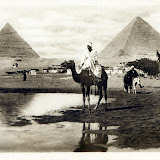
Tourists went to Egypt to have their expectations fulfilled. They came to see antiquity and exotic landscapes. No one really went there because the political situation was interesting. In a typical Lehnert view of the pyramids they are placed in the background, often slightly out of focus. The foreground is given to an Arab, his camel and a date palm. This was about a complete picture of Egypt as anyone wanted. To ask for more would have been greedy, to give it would have risked raising questions; ‘what’s that doing there?” “Are there really such things running around Giza?” Naturally, the people in a Lehnert and Landrock photograph are poor but happy, and look remarkably healthy.


Today the image of the veiled woman evokes negative connotations; fundamentalism, oppression, terrorism. In the 1920s it seems a more important question was what lay underneath her garments. Lehnert and Landrock told us. Their nudes remain their most sought after images. The market back in Europe may have been select but from the sheer number of images still circulating it was also insatiable. Of course, the Orient always had that allure; Flaubert’s Egyptian journals from the 1850s amount to a brothel crawl with occasional, obligatory investigations of the ruins, and he was hardly the first to visit with more than history on his mind. Lehnert and Landrock also catered to the pederast market. Androgynous semi-naked boys lounging against doorways were a specialty. The image on view in the gallery, “Good Friends”, is borderline. It could pass as a shot of typical native boys but it could also be an invitation to ageing European males of a particular inclination.


When Edward Said published Orientalism in 1978, he made no mention of Lehnert and Landrock but he gave their nudes an intellectual credibility. Once they had merely been exotic soft porn. Now people could buy them as artifacts of cultural analysis their value shot up. Said might say that has only confirmed his argument that all westerners were imperialists but what was he expecting? Thanks to his book, exhibitions and catalogues of orientalist art (particularly of the academic variety) had a new cachet.     

Lehnert and Landrock published an enormous number of images in several formats, from archival fine art prints to lithographs, photogravures, postcards and miniature snaps. The fine art prints (particularly the nudes) can sell for several thousand dollars. Postcards and snaps can easily be found in European antique stores and junk shops. The images in this post include a heliogravure, medium format prints, postcards and snaps. 


DEATH ON THE NILE