And furthermore ...

One Man's Treasure encourages the use of anonymous photographs posted here to illustrate books and album covers.
If an image appeals to you, contact John Toohey at johntoohey@hotmail.com.
Showing posts with label World War 1. Show all posts

Tuesday, 17 June 2014

THE OTHER SIDE

German propaganda in World War 1 postcards
"...among the calamities of war may be jointly numbered the diminution of the love of truth, by the falsehoods which interest dictates and credulity encourages."
from The Idler magazine, dated November 11, 1758, 160 years before Armistice Day.


On the little chalkboard at the front the message reads, “Kriegsjahr 1914/15”, or “Year of the War” then something indecipherable and what could be Eisenfeld, which would be a small town north of Frankfurt. An expert could interpret the variety of caps and tell us more, but for the time being it looks like a battalion or regiment has been billeted in the town. The sign on the door at the back is for Odam camembert cheese, which obviously makes us think they are outside a store or bar. The middle aged couple at the back could be the owners and the two younger women their daughters or staff. Everything so far has been self explanatory, but what of the mug of beer on the table? Thousands of German postcards just like this one are floating about and the mug of beer is a common element. There’s a simple explanation – someone just ordered a beer, and as the man at the very rear left is also holding a beer that looks straightforward and evident – but simple explanations aren’t always satisfying. Could it have stood in for absent friends? After all, the toast to lost comrades has been common across all armies through the centuries, and though it is somewhat atavistic, the idea of having a glass of beer to stand in for them is not illogical.


The two predominant images of World War 1 are the bodies in the trenches and the fools in charge. As the centenary drew closer there was a spot of revisionism, a few suggestions that as First Lord of the Admiralty during the Gallipoli campaign, Churchill wasn’t quite the disaster he has been made out to be, but even the worst leaders have their ever faithful supporters. Here’s a postcard of Counts Häseler (on the left) and Zeppelin. The caption at the top tells us they are the oldest commanders of the German army. This and several others in the same series were made in 1910, when war was a certainty though no timetable had been drawn up. Neither man had an active role in the war, both being in their 80s, but something about this image says a lot about the state high command. It wasn’t just that so many of the generals were old men who should have been pensioned off, but most of them had come through the various officer corps during an era when class distinctions were so strong they might never exchange words with a single ordinary soldier. It was an era when officers were gentlemen, hoped to engage in at least one legendary cavalry charge and had no clue how to deal with irregular Sudanese, Boer or other upstart militias out in the colonies. Look at these two. What silly hats. What pompous outfits. As for the sabres; what good would they be in the trenches? The photo is by Alfred Kuhlewindt, an official photographer for the German High Command and a man whose job was to make the ridiculous pass for the sublime.


There is a publisher’s stamp on this but no photographer credited. That doesn’t matter. Variations on this image, the young frau wearing the soldier’s cap with a (painted) horse behind her, were among the most popular postcards sent to the soldiers at the front. Thereby hangs a tale, or an idea at least. Wir halten durch! In English: ‘We came by’, or ‘We stopped by’. Who is ‘we’? Well, it is the young women of Germany, but more specifically, the young women who rode horses. In Germany C1914 to 1918, that really meant the young women from good middle to upper middle class families, der junge frauen der mittelschicht (I think): well bred, wholesome, cultured, for whom horse riding was a pleasure, like reading Goethe or going to the museum on Sundays; in other words, the ideal German woman, she whose honour the boys in the trenches are fighting for. Wir halten durch! Why? To offer words of encouragement? To remind young Kurt that trenchfoot, dysentery and good odds of a premature death were but small sacrifices for the greater ideal? There’s a study waiting to be made of this young frau, and her English, French, Belgian, Dutch and Russian equivalents, because they are the same, but different in their subtle ways. You won’t find many images of British lasses with painted horses because horse riding didn’t have the same cultural resonance in England. Ditto the French mademoiselle, who likely as not is holding a flag in one hand, a tray of pastries or a bottle and wine glasses in the other.   


Happy Easter, 1915. It is postmarked April 2nd but even Germans have trouble reading the handwriting, because it is so flowery they can’t tell if they are looking at a t, an f or a j. The message, or what they can work out from it, seems fairly pedestrian. Someone is going to Cologne soon and thinking warmly of the recipient. It is the image that matters in any case, and how strange it is. The egg itself is easy to understand, not so much a symbol of fertility as one of the family. And look at the trench the soldiers are in. It looks more like a culvert, a neat, shallow and well constructed channel. Did the people back home really believe the trenches looked like this? They may have. In early 1917 disillusion with the German army was so strong that several cities were paralysed by riots. It wasn’t just the death toll that made people angry; it was also the discovery that they were being lied to. Their boys weren’t winning magnificent victories, and just like the Allies, they couldn’t retreat if they wanted to, the war being stuck in the trenches. Despite all the evidence in the form of the war wounded wandering the streets it took two years for that message to affect enough people that civil unrest became possible. The day this postcard was mailed off, a German cavalry unit was badly beaten in Poland by a Russian force but the chances were slim the author of the postcard knew that. Only the Russian news services would have published that information, and as every German knew, they weren’t to be trusted. In 1915 Easter fell on Sunday April 4. This postcard was mailed on Good Friday.


While we are on the topic of truth being ignored, misconstrued or overlooked, here’s one the Allies may have conveniently forgotten. On the back the message reads, in German, “Three Tonkinese soldiers captured 5. 6. .18.” It also says where, though that isn’t clear. ‘Tonkinese’ was the common term for people from North Vietnam, but often enough anyone from what was then French Indochina, which included Cambodia. Consider the background. The palms suggest an exotic, tropical location. Brief research (Wikipedia) has uncovered the detail that some 92 000 Vietnamese soldiers served in the French army on the Western Front. That’s an awful lot of people to leave out of the standard histories, especially when you remember that approximately 103 000 New Zealanders served. The French could argue that, coming from the Colonies, they were part of France anyway, but perhaps France has always been troubled by the Indochinese contribution. The history of the Indochinese wars that began in 1946 and ended with America’s defeat in 1975, properly begins in the First World War when the initial anti-colonial uprisings took place. Vietnam wasn’t just sending soldiers but being taxed to support the French effort, and when you study the expressions on these men’s faces you get an inkling of why the King of Vietnam, Duy Tân, would leave his palace to join the protestors in the streets in 1916. Ho Chi Minh later claimed his political ideologies first formed during the war.

THE OTHER SIDE

Thursday, 25 April 2013

THE WAR TO END ALL WARS


Some portraits from World War 1, most with a sense of tragic irony
“One day the great European War will come out of some damned foolish thing in the Balkans.”
Otto von Bismarck (1888).


There’s a painting by John Singer Sargent at the National Gallery in London called General Officers of the Great War. Twenty two of the British and Allied commanders are standing together; William Birdwood, Douglas Haig, Edmund Allenby, George Milne and so on, and unless you still get teary at the idea of the British Empire, you have to ask; did any of them feel just a twinge of shame at being asked to pose? Too bad Winston Churchill wasn’t asked to join in. Then Sargent could have titled his painting 23 men whose ignorance and incompetence led to the unnecessary deaths of hundreds of thousands, but that’s perhaps a bit unwieldy. 


Here’s one of the French culprits; well he looks like he had a walk-on part in Kubrick’s Paths of Glory, which was incidentally based on a novel, itself drawn from actual events when four soldiers were executed for mutiny. For the record, Australia was the only country in the First World War that did not have an official policy of executing deserters or soldiers accused of cowardice. The British executed 306 soldiers, including 25 Canadians, 22 Irish and 5 from New Zealand. The Americans executed very few (so too the Germans) but US High Command wasn’t averse to punishments of public humiliation, including sentencing deserters to wear placards. The French outdid everyone. Over 600 soldiers were shot. Worse, there was a policy of decimation in place, which meant that when a unit rebelled and refused to follow a reckless order, one of every ten men could be shot as punishment for all. The most infamous case was on December 15, 1914 in Flanders when several French-African soldiers were executed. To make things even worse, in the French and American armies the soldiers called on to carry out executions were most likely to come from the soldier’s own regiment. They were his brothers in arms.


The mythology that England, France, Germany, Turkey and Australia have developed around the First World War reduces the enemy to simple terms. If you were Australian he spoke German or Turkish. The fact he may have been Bulgarian gets lost in the lack of detail. Bulgaria’s part in the war has been discussed in earlier posts but it is worth reiterating. After all, in the First Balkan War of 1912 Bulgaria was allied to Serbia and Greece against the Ottomans, went into the second Balkan War against its earlier allies and by 1915 had joined the First World War on the side of the Ottomans. There’s a tendency to describe Balkan politics as complex, as though too much thought went into them, but there’s another possibility; they were as thoughtless as they were self-serving, visceral and absolutely lacking in foresight. These men, photographed in 1916, are cannon fodder.


The Americans came in late, or as they would put it, to clean up the mess. They weren’t there at Gallipoli, Ypres or the Somme, which explains why there is no great American novel about the war. This may not be a bad thing. There’s been a proliferation from Britain in recent years and the plots quite frankly have become predictable: Irish boy goes off to fight for England and returns to the troubles at home - The Soldier's Song, A Long Long Way – episodic narrative of young soldier’s road to awakening and disillusion – Birdsong, Regeneration, etc. Worse, they appear to have identical covers of soldiers silhouetted on a ridge. Nothing so odd as this photo then. Not that there was anything at all strange about a soldier having his portrait taken before he shipped out, but it is somewhat to pose in front of a painted backdrop of a military barracks, and he has the expression of the rabbit in the headlights.


Something similar is going on in this portrait of a nurse. Was she put in front of the backdrop of the military tents because it needed to be reinforced that she was going off to the front? For a long time, at least up to the mid-1980s, the idea that nurses also served in battle wasn’t taken too seriously, as though having to tend to soldiers who’d been shot, gassed, had bits blown off or were suffering shell-shock was all in a day’s work. Read some of the nurse’s accounts from Gallipoli: working for days without rest while a stream of the wounded poured in and knowing there wasn’t much they could do for a lot of them. All that while an officer was screaming that they weren’t doing a good job. Something like 400 American nurses died at the front, though only very few from weaponry. Disease killed most of them. 


Fraulein Feldweber: Miss Sergeant. She’s not one of course. She represents the cause the Germans were fighting for, or so they were told. There are a few postcards floating around with this same portrait although the backgrounds are different. She was probably one of the faces of the home front, mailed out to the troops to remind them what they stood to lose if the enemy succeeded in its aims.


On the back of this postcard the author has written: “A ma chere Marraine Alda Drouin Souvenir de guerre de votre petit ami Belge”, which translates as “To my dear godmother Alda Drouin, a souvenir of the war from your little Belgian friend.” Presumably it was taken in Belgium but the soldier, whose signature in indecipherable, is Canadian. The card is undated but join the dots between Canada, Belgium and World War 1 and the conclusion is almost certainly Ypres. In the first battle between October 19 and November 22 1914, over 170 000 were killed on both sides. During the second battle, April 22 to May 25 1915 the Canadians took the brunt of the first poison gas used in war. It was a Canadian, John McCrea, who wrote In Flanders Field, probably the most famous poem to have been written in World War 1. He wrote it for a friend who was killed at Ypres but in that perverse way things work it was used in Britain to recruit soldiers. 


“Men, I am not ordering you to fight, I am ordering you to die.” This was Mustafa Kemal’s command to his soldiers on the morning of April 25 1915, and that is pretty much what his soldiers did. Turkish casualties were higher during the Gallipoli campaign than the Allied losses (approximately 250 000 opposed to 208 000), but who was counting? Victory or defeat has never depended on the body count. There’s something in this photo that tells you what was at stake for the Ottoman Empire - dignity if nothing else. Of the options open to the Ottomans at the start of the war, neutrality or alliance with either the Allies or the Central Powers, it chose what now looks like the worst but in the end the other two would have only changed the timing of its inevitable collapse. When this photo was taken these two must have known the writing was on the wall for empire. Would that have influenced their willingness to die for it? 


This snapshot was taken at Camp Cody, Deming, New Mexico in 1918, then the training headquarters for the 34th Division. The Division arrived in Europe in October 1918 and wasn’t involved in fighting. That would have to wait until the Second World War when its soldiers made up the bulk of William Darby’s Rangers. Was this boy, clearly enjoying his role as camp mascot, among them? He looks to be about seven or eight and that would put him in the age bracket. 

VIEW THE GALLERY HERE
THE WAR TO END ALL WARS

Saturday, 5 January 2013

DANGER ZONE


 Disasters, natural and otherwise
“It’s a recipe for disaster when your country has an obesity epidemic and a skinny jean fad.”
Anon.


Volcano
Everybody knows about Vesuvius blowing its stack in AD79 and burying Pompeii under lava. In 1944 a smaller eruption wiped out several towns in the foothills and killed 28 people. It also destroyed or damaged 88 US aircraft at a nearby base, which in military terms was a catastrophe. Planes still airworthy were sent up to photograph the eruption. This photo was probably taken after the eruption but while Vesuvius quietly smouldered away. 


Volcano
Mount Asama on Honshu Island blows up so frequently no one bats an eyelid if a chunk of molten lava lands near their feet. In fact there is a museum near the base full of cute and furry Japanese characters ready to explain the science of vulcanology in their high-pitched electronic voices. This stereocard is copyright 1904 but the photograph could have been taken in any year back to 1899, when Asama had an annual eruption. Before then it was approximately every five years. The man on the left is described as ‘an English friend of the photographer’s’. He is carrying a large stereographic camera. Back then, the only way to really understand volcanic eruptions was to get as close as possible to the vent, and a relatively moderate example like Asama was considered safe. The big risk everyone up there faced was suffocation by sulphuric fumes. The actual photographer of this image isn’t named but presumably everyone got back to ground level as there are several stereographs available from the series of close up scenes of Asama.


Fire
In 1909 Nampa was a middling sized railroad town in Idaho. On July 4 that year a fire that started in a warehouse gutted the town centre and destroyed 60 buildings. Lee Jellum was a well known Nevada photographer so it would be fortuitous that he happened to be in Idaho that day. Of course, he may not have been but merely licensed this image from the photographer and applied his name to it. Whatever the case the scene is full of detail. We can see a fire truck in the far background with men feeding a hose and the workers in their bib and brace overalls who have come out to watch the drama. Of special interest is the woman just behind the crowd who appears to be sitting on a chair near the sidewalk. You couldn’t call it entertainment; some of these people were watching their livelihoods go up in flames, but it was a spectacle and she has taken a front row seat so to speak.


Flood
Disaster scenes are one of the features that distinguish early American real photo postcards. The photographers really regarded it as their job to record the big news stories of the day and while that may have mostly been town parades or the school’s annual theatre performance sometimes it did involve news that reached the outside world. In other countries it seems postcard photographers thought more money was to be made out of charming views. Only occasionally do you see the calamities the Americans recorded as though they were news photographers. On March 30, 1912, the Platte and Elkhorn Rivers broke their banks. The waters in some parts were said to rise thirty feet and the town was almost literally washed away. There are several photos from the aftermath in Nebraska’s archives, possibly taken by the one photographer though it is just as likely that numerous people grabbed their cameras and went out to record the scenes.


Tornado
There is a documentary about the Pryor Tornado of 1942 on YouTube. Witnesses describe the sudden rise in air pressure followed by a loud bang. One woman recounts how she was taken to a hospital and left for dead in a room. Fifty two were actually killed from what was a particularly powerful and acute twister. It ripped apart the main street but left houses only metres away intact. Martial law was declared. The aftermath of the tornado was one of the most thoroughly documented local disasters at the time. Apart from photographs there was extensive news footage, detailing the destruction that occurred over just a few blocks.


Blizzard
Blizzards happen every year and most of the time so long as you are indoors you are safe - most of the time, because a blizzard can knock out electricity and make access impossible. Occasionally, as happened in Iran in 1972, the snow is so heavy it buries homes and people freeze to death; 4000 in that case. In this scene we have a rotary snowplough attached to a locomotive. Not surprisingly, the inventor of the rotary plough was a Canadian; well why would a Hawaiian invent one? They are still used in Canada and Alaska though they must have been much more impressive in the age of steam when the train belched clouds of white vapour in the air as it rammed tons of snow off the tracks. What you’d get was a photo like this; a cross between J. M. W Turner’s Rain Steam and Speed and Kasemir Malevich’s White on White. 


War
As museum staff around the world are well aware, the centenary of the beginning of World War 1 is almost upon us and commemorative exhibitions have already been planned down to the least significant artifact. This photograph was taken in France around the time of the war but does it show an actual scene or simply some military exercises? If it is only a scene from some exercises it has the blurred intensity of actual war. The figures in the background are over-exposed but they appear to be dissolving under the cannon smoke.


Famine
The caption reads: ‘Long queues of sickly and starving people waiting for assistance’. It comes from a wallet of 20 miniature snapshots showing scenes of India and sits alongside images of the Taj Mahal and the Red Fort. If India’s starving weren’t considered a tourist attraction in the 1950s they had come to represent the country with the same immediacy as the landmark buildings. Every traveller who returned from India with a book in mind described the magnificent temple architecture, the mystical allure and the extreme poverty. One effect was to inure outsiders so Indian famines were thought to be as cyclical and inevitable as the seasons. Whoever published these miniature albums might have assumed customers wanted an authentic photo of India’s poor. Looking closely, it is clear the people are lining up for something but it isn’t necessarily for welfare. They could just as well be buying bread off a street vendor.


Forced relocation

On the back of this postcard it reads: “S.S Sakarya/ Selanik Rihtimi/ Aralik 1923”, which translates as “SS Sakarya, Thessaloniki pier, December 1923”.  The battle of Sakarya was a turning point in the war between Turkey and Greece that had ended a year earlier and led to the establishment of the Turkish Republic. In July 1923 the Treaty of Lausanne was signed between Turkey, Greece, Britain, France, Italy, Romania and Japan. It laid out the peace terms including the borders of the new Turkish state. Part of the treaty included the notorious Convention Concerning the Exchange of Greek and Turkish Populations signed between Greece and Turkey. It was agreed that Greeks living in Turkey and Turks living in Greece would be repatriated. This was supposed to keep the peace. What actually happened was that more than 1.5 million non-Muslims were expelled from Turkey, which received about 500 000 Greek Turks in return. Not that Turkey was the only ruthlessly opportunistic party involved. The League of Nations was behind the deal and like the later UN, once the treaty was signed it stood back and watched the disaster unfold. Most of the Greek families expelled had been living in Turkey for generations and while Greece might have been a homeland of the mind it was no more a part of peoples’ personal experience than distant America. The refugees who arrived in Piraeus were called Turks and treated accordingly. The refugees who arrived in Constantinople were suspected of being secret Christians. You can still see the legacy today in Istanbul. There are hundreds of ruined properties in the city centre that legally still belong to expelled families.


VIEW THE GALLERY HERE
DANGER ZONE

Friday, 18 May 2012

GERMAN HUMOUR


German cartes from the 1900s

“There are no facts, only interpretations.”
Friedrich Nietzsche


The idea that there might have been something called a unique or native German photography doesn’t get much attention until the 1920s when an essential form of modernism took off in the Weimar Republic. Until then German photography is regarded as a variation on a general European theme, but around the very end of the 19th century German studios began producing portraits that are so distinctive you only have to glance at one to know where it came from. One of the keys is the tonal range; muted greys are preferred over the contrasts of black and white. Another is the colour of the card mounts, olive, drab brown and pearl grey replace the cream of earlier times. Dimensions matter too. Once CDVs and cabinet cards came in standard international dimensions. Now studios begin utilizing card sizes with specific names: the Mignon (45x67mm), the Melanie (90x120), the Promenade (105x210) and so one, some 40 that are officially recognized above what studios came up with on their own. This portrait of a woman is a classic example. Actually it is a standard cabinet card but you know at once it comes from Germany, or at least the Germanic speaking lands east of France. It is also (speaking relatively here) very modern. You would say at once that it was taken sometime around 1910. Partly it’s her expression, which admittedly isn’t that vivid but rather more subtle than earlier photographers would have been allowed, and one reason for that is that it is obvious she is being lit by electric lamps. Historians might dither over where to place it on the timeline. Is it a remnant of 19th century portraiture, Pictorialist or early Modernist? We don’t have to concern ourselves with such details. It is enough to look at it to know it is good.


Going back a few years, we have a typical example of an1870s CDV. It could have come from anywhere – France, the US, Australia or even Turkey. It is a rather excellent study of a boy but the most interesting part may be that it was taken in a studio belonging to Anna and Minna Kohnke, in Mehlbye, near Kappeln, close to the border with Denmark. Studios run by women weren’t unusual, just uncommon, but Mehlby was just a village. You feel there is more to the story of Anna and Minna Kohnke but what exactly that is remains unknown for now.


Moving on to the turn of the century and another portrait that could come from just about anywhere, which doesn’t detract from its quality. Some people might be drawn to the tow boat, the fake rock or the boy’s sailor suit but for me the best part is the backdrop. It is so quietly done it almost disappears but looking closely we see a yacht on the horizon and a dune and grasses just behind the boy. It is an attempt to make the scene as natural as possible. Borkum is a resort island in the Frisians and like most resort photographers, Hans Kretschmann constructed an elaborate effect for what existed naturally just outside his window,


Americans are in the habit of claiming that modern photography began around the end of the First World War, when Alfred Stieglitz and Edward Steichen ditched the soft focus of Pictorialism in favour of sharp, clean lines but there is a lot of evidence to show they weren’t the first; like this 1912 photograph. The woman is using a chair as a prop, as millions had before her, but here instead of merely being a device to add detail to the composition, the back becomes integral to the design, corresponding to the pleats in her skirt. Karl Lützel, the photographer, was fairly prolific in Munich but he wasn’t renowned for his experimentation. A commercial portraitist, he used ideas that were already in place. German, or to be absolutely pedantic, Central European photography, was already developing its own aesthetics when the Americans made their move.


Sometimes the most interesting part of a German carte is its back. Information on Hartmann is scant but it is obvious that by 1902 he had embraced the Jugendstil aesthetic, employing its typography and decorative elements. Well, he was hardly alone in that; just about every photographic studio in Germany was doing it too. 


Here’s another example, by the better known Heinrich Axtmann of Plauen. Like most studios he has dispensed with the traditional and difficult to read Gothic font in favour of several others that are simple and clear. This is the modern world after all and in typography as much as architecture, the ridiculously elaborate pretensions of the Baroque and Neo-Classicism have no place in it. Jugendstil was the German version of Art Nouveau but whatever you want to call it, it was a very feminine movement, with tendrils instead of sharp angles and flowers replacing solid shapes.


None of this was necessarily reflected in the photographs themselves although in Axtmann’s portrait here and Hartmann’s above there is more emphasis on the woman’s shape than earlier portraitists would have considered. Notice the way she appears to blend with the background and dissolve at the base; whatever her intentions for having her portrait taken he wanted a study in contours, stripped of extraneous detail. To his eye she could represent the idea of modern sophistication, less an attitude than an appearance.


Germany in the first decade of the 20th century has a somewhat schizophrenic reputation. Berlin was the centre for the most radical ideas and behaviour in Europe and Weimar had been a home for Goethe, Nietzsche and Rudolph Steiner, but away from those places the impression was of a rigid, humourless Protestantism, somewhat like Scotland, and a disciplined militarism. At first glance this couple look to be the epitome of dour, Germanic severity, but look again and you realize she gives off that aura, he’s a little more ambiguous. Something about him suggests a familiarity with the less sophisticated side of Kolberg, which then was in Germany and now is in Poland. If this was taken, as I guess, around 1910, he would have been too young to take part in the Franco-Prussian War and would have had only vague memories of Germany before the declaration of empire in 1871. Compared to what his parents and his offspring experienced, his life was relatively free from turmoil, Germany was rich, he looks prosperous and, judging from her expression, the wife was probably happy to stay at home with her Bible and her knitting while he trawled the streets.


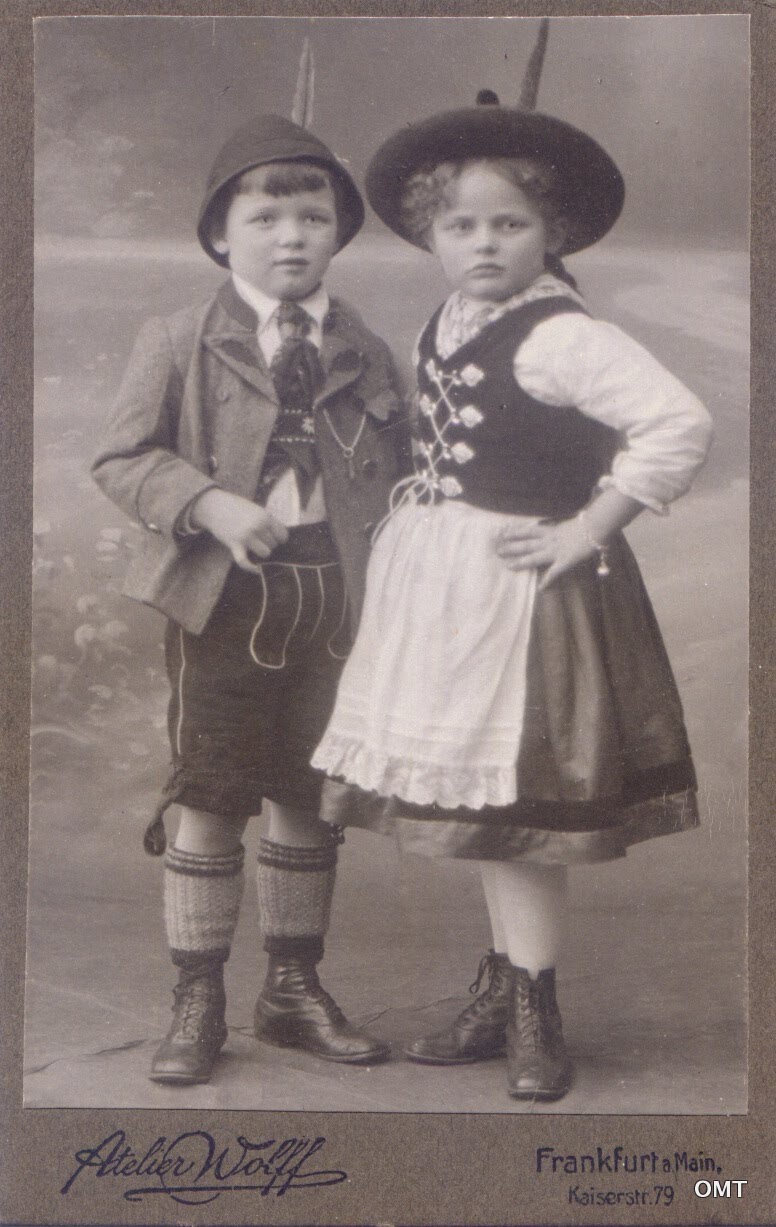
At the turn of the century Germany was producing the best cameras and the sharpest in the world but commercially they failed at photography because unlike the French, the British or the Americans they could not do cute. In other countries photographers had no problem giving a boy in a sailor suit a toy boat and extracting an expression of winsome innocence from him. The Germans tried, like the Wolff studio in Frankfurt did here, but most German children appear to have found it repugnant to put on airs for adults’ sake. The boy looks bemused, the girl frankly irritated at having to dress like Hansel and Gretel, and why not? They’d obviously feel stupid wearing those clothes out on the street so why should they feel different in a photographer’s studio. The girl will go through life getting her own way. Her brother will make one compromise after another until he longs for the sweet mercy of oblivion.


The portrait of this soldier was taken in Berlin, probably between 1905 and 1914. He isn’t wearing any discernable insignia, which suggests he was at an officer training academy. At any time after 1910 he would have known war was inevitable though he might have assumed it would be located in the Balkans and Germany’s main role was to shore up the collapsing Austro-Hungarian Empire. Even in the first months of the war he could have been forgiven for believing an officer’s first role was to provide a model of dignity and poise to his soldiers. After all, everyone around the Kaiser was confident this was a just an argument that would quickly be resolved. 


And what of this polished individual? He looks like officer material too though he is young enough to be a student photographed before a ball. Whatever the case, he’s of an age that made frontline action almost inevitable – almost because if his family had money or influence he could have secured a desk job in Berlin. When you think of what was happening in photography and what would come after, it’s easy to dismiss this German period as commercially ordinary but right at the time these portraits were taken August Sander was running a studio in Cologne and producing work of much the same standard. He was also at the beginning stages of his massive compendium of portraits of the German people. A lot of those early efforts depend on the now accepted formula of clean lines, even tones, muted, angled lighting and a complete absence of artificial sentiment. The difference was that Sander didn’t just rely on whoever came through his door but went out looking for his subjects. It isn’t far fetched to see in these portraits a missing link between the 19th century and modern photography.


GERMAN HUMOUR

Saturday, 26 February 2011

PATHS OF GLORY

World War 1 French propaganda images of women and children


‘"If," they cried, " you are weary of these ties of kindred, these marriage-bonds, then turn your anger upon us; it is we who are the cause of the war, it is we who have wounded and slain our husbands and fathers. Better for us to perish rather than live without one or the other of you, as widows or as orphans."’
Livy, The Rape of the Sabines, from Ab Urbe Condita


Three classical accounts of women and war to keep in mind when considering propaganda images of women are Livy’s account of the rape of the Sabine women (rape in its original use meaning abduction, not sexual assault), Aristophanes’ play Lysistrata and The Trojan Women by Euripides. All three informed the imagery even if the publishers and the customers weren’t aware of them. In Livy and Lysistrata the women intervene to put an end to war, humiliating the men into realizing that they (the women) are ultimately responsible to the survival of the society. In The Trojan Women they pay the consequences for the ignorance of their menfolk. In all three women are the civilizing force. In the postcards displayed here the message is just as blunt though slightly skewed; the women are telling the men they have a duty to protect civilization from an enemy that wants to destroy it. All these cards are French though Germany used near identical imagery for the same purpose.


Propaganda is never intended to be subtle and the imagery here isn’t. During World War I women in the British Empire were encouraged to send a white feather to men they suspected of shirking. These postcards had a similar intent. Not that they were accusatory or that they were always sent to men but they were an explicit and banal reminder of what the war was being fought for, hence the classical militarism and the invocations of Joan of Arc and Boadicea. Several of the cards show women wearing the traditional black bow, the schlupfkàpp, of Alsace-Lorraine. Germany had annexed the region during the Franco-Prussian War in 1871 and since then had become a symbol to France of what had been stolen from its national identity. The woman trampling the German border post and the teacher instructing her pupils on their true national identity are unambiguous in their meaning. Even an illiterate peasant would have got the message.


The most macabre image is the photomontage of the babies sprouting in the cabbage patch. “Graines de Poilus” – “Seeds of our Soldiers” was a common metaphor that various postcard publishers used and you could say it is somewhat alien to our way of thinking, for what are these children if they are not ready for the harvesting? The depiction of children in these postcards veers towards the grotesque. In none is there any sense that children might be innocent victims of war. A baby in a crib can’t wait to join his (presumably deceased) father’s regiment and a girl holds a flag under the slogan, “bruised but victorious”. In “Duty before all” the boy in the sentry box looks askance as the girl tempts him with flowers. It’s cute, if you believe a child’s destiny is to be cannon fodder.


Most of the postcards shown here use real photographs as the foundation for montage. Others are photogravure or collotypes. We know a little about the companies however they rarely acknowledged the photographer or the source, which could be a studio that sold the image on to them. A couple of the identified creators made names for themselves. Maurice Boulanger was already well known in France for his saccharine postcards of kittens. Alfred Noyer meanwhile stuck with photographing women. During the 1920s he was one of the most prolific producers of erotic postcards in the country.

VIEW THE GALLERY HERE
PATHS OF GLORY

Sunday, 7 November 2010

THE GOOD SOLDIER


Portraits from Word War 1

“It's all a terrible tragedy. And yet, in its details, it's great fun. And - apart from the tragedy - I've never felt happier or better in my life than in those days in Belgium”
Rupert Brooke, Christmas 1914.
 Walking abroad, one is the admiration of all little boys, and meets an approving glance from every eye of elderly.
Wilfred Owen, 1914


Until immigration shifted the demographics in the 1950s and 60s, you could count on most Australian families having one photograph in their family album of a grandfather or great uncle wearing his ANZAC army uniform. More often than not the photograph was taken in someone’s backyard. He stood to attention or saluted, grinning somewhat foolishly as though he was in on the same joke as everyone else; he was no soldier. The same ritual was taking place all through Europe between 1914 and 1918. World War 1 was the first major war where photographers and cameramen ventured into the frontlines to shoot the action so to speak, but it was also the first war where people at home picked up their cameras and photographed it from their point of view. Fifty years before Vietnam supposedly became the war that entered our living rooms, people around the world were sharing their living space with a photograph of a son or a brother who had been killed in places they’d never heard of before.


There are thousands of these photographs out there. Once they belonged in photo albums or on mantelpieces but as time puts distance between us and events they appear more often in antique shops, often unceremoniously dumped in a pile of snapshots and cheap postcards. That point where memory transmutes into desire, the way it has with daguerreotypes of the American Civil War, hasn’t quite been reached. The portraits in this post are of anonymous people; we have absolutely no idea what happened to them during the war or if they survived it but they all tell pretty much the same story in the way that Wilfred Owen and Siegfried Sassoon were English poets yet we know that the things they described were also seen through German, Bulgarian or Turkish eyes.


For all its horrific statistics, the First World War has entered our consciousness devoid of any deep cultural animosities. Nobody seriously blames the Germans or Serb nationalists for starting it. It has no sinister iconography like the swastika to evoke reactions. If anything, we see the real culprits to be the generals and politicians from our own side and historians pay more attention to the internal class wars that rived the various nations involved. In his paintings Otto Dix made it clear who he thought the war had been against. Kubrick’s Paths of Glory, Eric Bogle’s song And the Band Played Waltzing Matilda, Sebastian Barry’s novel A Long Long Way and Pat Barker’s Regeneration trilogy are all about the class conflict at home. The enemy occupying the trenches across the way are barely seen, certainly not the focus of hate. 


WORLD WAR 1 PORTRAITS

Saturday, 27 February 2010

ALL QUIET ON THE WESTERN FRONT


Hapsburg propaganda postcards from World War One


Or you'll be dozing safe in your dug-out -
A great roar - the trench shakes and falls about
You're struggling, gasping, struggling, then ... hullo!
Elsie comes tripping gaily down the trench,
Hanky to nose - that lyddite makes a stench -
Getting her pinafore all over grime.
Funny! because she died ten years ago!
It's a queer time.
Robert Graves; “It’s a Queer Time”


Erich Maria Remarque’s All Quiet on the Western Front opens with one soldier coveting another’s flying boots. It sets up a basic image that will run through the novel; the German soldiers - they are about 19 years old - imagine the smallest comfort would make a huge difference. Battle is only one of their tribulations. Boredom, hunger and the pointlessness of the war wear them down just as much. A few chapters later the soldier does inherit the boots, when their owner, Kemmerich, is wounded and has a leg amputated.


This post’s gallery contains thirteen Austro-Hungarian propaganda postcards from the First World War. Every country involved in the war produced postcards extolling the virtuous efforts on their own side and the moral turpitude of the enemy. These particular images use a montage of photography, painting and text to depict the glory of serving your country. Technically they weren’t difficult to produce and could be churned out by the thousands. Even today they are relatively cheap to buy, but their price and availability isn’t what makes them interesting, although perverse may be the more accurate term.


Religion is a common motif in these photographs. A soldier shares bread with two children, guardian angels hover over soldiers, a nun stops to talk to two patients, the nurses wear crosses and crucifixes. But religion wasn’t a cause in the war. Even at Gallipoli the notion that Christians were fighting Muslims didn’t get traction. It’s not surprising though; propagandists always make a connection between dying for your country and dying for God. Religiosity however is not the most macabre element in these photographs.


That dubious honour belongs to their bloodless sentimentality. These soldiers aren’t really wounded. Their bandages and sheets are as pristine as the girls tending them. Perhaps the men in these scenes were genuine soldiers but if so, they were photographed before they’d seen battle. This is war as imagined by little boys, except that the people responsible for these images are adults, who must have had some idea what was unfolding on the front lines. By late 1917 citizens in Berlin were rioting against the war. On the other hand, around the same time, Baumer, the narrator in AQOTWF returns to his hometown and meets a local bore who still regards the conflict as a game of strategy. He at least would have seen no irony in these postcards.


The battles of the Somme, Gallipoli and Passchendaele created a whole new iconography of war. The death’s head and the rotting corpse chased the angels away from the trenches and it was easy to subvert the militaristic aesthetic of sharp diagonals and vibrant colour into morbid satire. By 1916 a Hapsburg soldier seeing a postcard of a soldier and nurse must have been baffled by its simple message. That year George Grosz and Tristan Tzara were using the same collage techniques as in these postcards to produce scabrous indictments. Instead of young, mooning conscripts their central figures were fat industrialists, cripples and dehumanized automatons. Could postcards like these have been an influence on Dada? The media with its raucous and saccharine nationalism was a part of the war machine, and it was a much more accessible target than the generals and factory owners. Whether or not these postcards directly influenced Dada, they were emblematic of the attitudes it damned.


In the late 1920s John Heartfield (born Helmut Herzfelde) began producing anti-fascist posters also using photomontage. In November 1932 he produced one of two skeletons lying in a pit. All that remain of their uniforms are their boots, still in excellent condition. The caption reads, “And again?”


ALL QUIET ON THE WESTERN FRONT