Some more negative paper prints
“Ghosts are a metaphor for memory and remembrance and metaphorically connect our world to the world we cannot know about.”
Leslie What

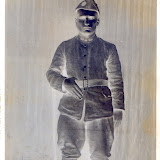
In a previous post on negative paper prints I described the process as an extension of the original calotype process, where a negative print was made, a chemically treated paper was placed over that and exposed. Sean Foley at the Afghan BoxCamera Project pointed out another method still used in Afghanistan. The negative paper print is made in the camera then replaced in the camera with another treated sheet and the negative re-photographed. In Afghanistan, where supplies of film are in short supply (when they are available at all) photographers have adapted and done away with them altogether. They also build their own filmless cameras by cannibalizing parts from others. This is interesting enough but more so when you realize that in the 1940s and 50s it was common practice across West Asia, from India and Afghanistan through Iran and Iraq to Turkey. In small towns and villages, the photographers had limited access to materials and the way to make prints affordable was to cut down on them. These strange and ethereal negative prints are the cast offs from the most practical form of their trade.

Building your own camera wasn’t as hard as it might sound. All you needed was an old bellows camera like an early Kodak and a lightproof box, which could be constructed from the panels off fruit crates. Remove the back of the camera and fit the bellows and lens to the box. A few experiments would tell you where to set the focus and what the exposure time should be and once they were sorted there was no need to make another adjustment. Maybe the hardest part was making sure everything was lightproof. Even a gap a fraction of a millimetre would be enough to spoil the print. Once the machine was in working order it was low maintenance and most repairs could be carried out with glue or tape. Sometimes these cameras turn up in second hand shops around Istanbul. If the lens mechanism still works the whole apparatus should. Unfortunately, they are big and can look impressive and because the shop owners regard them as antiques (well, some of them are) they attach a price more applicable to a factory built machine.

A history of West Asia’s itinerant village photographers deserves to be written but it probably can’t. The businesses were often ephemeral, just one in several other services on offer unregistered and they didn’t keep records. All we have are a few of their photographs and maybe some villagers’ memories of the days when the photographer turned up. Maybe history is the wrong word. What we really want to describe is an entrepreneurial spirit in the face of adversity, human ingenuity and the vast and scattered records of others’ existence these people left behind. The photo above is the only one in the collection that shows the studio’s name. ‘Foto Ṣen’ translates as ‘the cheerful photo studio’. The camera might have been brightly painted and dressed with ornaments and amulets and the photographer’s shop was too small to have a studio.

There are a couple of ways to identify the positive prints. The white borders are often irregular because the print didn’t fit neatly into the bracket. The focus is aberrant because the original negative or the paper used for the positive print was slightly warped. The positive prints are often a muddy brown or splotchy because the developing was quick and slipshod, the idea being to get a print out for the customer as quickly as possible. Quite a few of the prints have the sitters’ faces tinted red. This was because the positive print, being itself a negative image, recorded the face as a neutral grey so if the exposure on the background was out, the face could still be printed with reasonably accurate tones.

A ghost is defined as the apparition of a dead person and in that sense a lot of photographs are ghosts but especially negative prints. They aren’t portraits. They don’t reveal anything about their subject, rather the opposite, abstracting them to a ghostly reflection. They become anti-photographs, only hinting at the image we are supposed to see. And they can elevate the image into strange places. This postcard comes from Bulgaria and was probably taken in the 1940s or 50s. The positive print would be a utilitarian photo of a group of soldiers without much aesthetic interest but the negative is spectral, unearthly and much more compelling.
 |
| GHOSTS |


