And furthermore ...

One Man's Treasure encourages the use of anonymous photographs posted here to illustrate books and album covers.
If an image appeals to you, contact John Toohey at johntoohey@hotmail.com.
Showing posts with label Australia. Show all posts

Friday, 13 November 2015

THE BACK COUNTRY


Back stamps and design on cartes de visite and cabinet cards.
 “Of all of our inventions for mass communication, pictures still speak the most universally understood language.”
Walt Disney


For some people, the pleasure in collecting cartes de visite and cabinet cards lies entirely on the reverse, in the stamps that identify the studio and sometimes advertise the range of services. This is understandable. The images on the other side are often commonplace and uninteresting while the back carries an intricate design that can also be a code. This stamp on the back of a cabinet card from the Phebus studio in Constantinople is dominated by Apollo, the god of the sun and of light – AKA Phoebus Apollo - an obvious choice for a photographic studio. Apollo could also be a god of truth, which again makes sense for a photographic studio, since that was what they purported to offer. Note the idealized Ottoman script at the top and the French Photographie. Without knowing who runs the studio we can tell from the French that he was Armenian, because French was the lingua franca of the Armenia business community in Constantinople. Sure enough, Phebus was run by Boğos Tarkulyan, one of the better known photographers in town around the turn of last century. The Art Nouveau pattern was a deliberate nod to contemporary ideas in Western Europe, identifying Tarkulyan as someone less, or even not, interested in Ottoman traditions. The choice of flower in the frames at the top would have been conscious too. It may be amaryllis, which has some connection with Apollo, but that’s only a guess.

 
 The study of the backs of CDVs and cabinet cards is a branch of iconography, specifically one that can trace its origins back to the frontispieces found in books from the sixteenth century through to the beginning of the nineteenth. The frontispiece could be a declaration of intent or an acknowledgement of a patron’s greatness but were never just random images. It was intended to be read in minute detail and required knowledge of biblical imagery as well as more demotic symbols. By the 1860s, when this carte was produced, the art and meaning of frontispieces had fallen out of use but Theophile Gastonguay evoked them with the image of a beaver. Although the beaver did not become the official emblem of Canada until 1975, it had been commonly used as a symbol of Canada since the seventeenth century.

 
 Archibald McDonald ran a photography studio in Melbourne throughout the gold rush. Like every other studio photographer in Melbourne at this time he came from another country, from Nova Scotia in fact, just a spit away (in Canadian distances) from Theophile Gastonguay. You might wonder why St George and not a kangaroo but there we see the difference a century and a half of colonization can make. Although by the 1860s people around the world recognized the kangaroo as Australian, it wasn’t a national symbol. Australia (AKA “The Colonies”) didn’t have such a thing, or if it did it was likely to be St George’s dragon, which, like Australia, was proudly British. Archibald McDonald: logic tells us he was of Scottish background and he might have been the type to give a Glasgow kiss to anyone who called him British, but St George here doesn’t stand for England so much as a landmark in Melbourne. Long gone now, once upon a time everyone in Melbourne knew where St George’s Hall was.

 
 A similar thinking may have been behind Louis of Paris’s depiction of the Porte St Martin, which then as today was close by the central shopping district. Firstly it told customers the studio was located in one of the more salubrious areas, and then it told them how to get there. Notice it was opposite the Theatre de l’Ambigu, a place made famous by Louis Daguerre’s set designs.


Migevant’s studio may not have been at such a desirable address as Louis’ but no Parisian had to ask where the Place de la Bastille was. When this CDV was produced in the early 1870s there couldn’t have been too many people around who remembered the Revolution and the storming of the Bastille in 1789 but enough would have recalled the glorious revolution of 1830, which the July Monument seen here honoured. Essentially the French replaced one monarch with another, which is a little like stumbling from one failed relationship with a drunken philanderer straight into another. Today the Boulevarde Beaumarchais is lined with shops selling antique cameras.


The back stamp can be evidence. In 1876 Alfred Mayman took over the Temple Photographic Gallery at 170 Fleet St in London. Two years later the City of London dismantled the Temple Bar on account of Fleet Street needing widening and the structure was dilapidated. The sections were carefully stored and in 1880 Henry Meux bought it and reassembled it on his estate in Hertfordshire. In 1984 it was bought back from Meux’s descendants and re-erected in Paternoster Square. All this to say that there was only a two year period between 1876 and 1878 when there was any practical purpose for Mayman to have an illustration of the structure on the back of his CDVs. We don’t need any other information to date the image.  

 
 Images of cherubs with cameras are common, as is the inclusion of an artist’s palette, but what does it mean? Strictly speaking, these round and flabby infant creatures are Putti: cherubs have several heads and bits of eagle and lion attached to them. The precise symbolic meaning of the Putti is not understood but since the late Renaissance they have had an association with the arts, and music in particular. Originally the true artist had his muse, a goddess, who inspired him and for whom he created. The little toddlers might have been intended to suggest the playfulness every serious artist needs but also, babies were the inevitable result of creative coupling. In the way that a red and blue barber’s poles once indicated a place to have a bit of bloodletting and these days means a haircut, Monge, and every other photographer who used the imagery saw it as an icon not a symbol.

 
 Just to reinforce the point (somewhat), we find exactly the same image on the reverse of a CDV by a studio located on Rue de la Sabliere. The companies that printed the blanks for CDVs usually have their name in small letters down the bottom. We don’t get any such on either Monge or the Sabliere studio card and while we could assume the same company produced the blanks, it is also possible that several bought their designs from another source. Somebody could have produced this image of the putto, sold it on to the printers who then customized it for the various studios who used them.  

 
This palette is also very common, with a fairly obvious interpretation although it ought to be pointed out that few commercial photographers thought of themselves as artists in the way that people used that word even in the relatively staid 1860s. ‘Artist’ was a kind of password for quality of technique rather than ideas. Apart from being a photographer, Camille Benoit was an art dealer, so he may have seen the image as a pun. 


 Harrison Nathaniel Rudd ran his studio in Costa Rica around the turn of last century, as board mounted photographs were giving way to postcards. Costa Rica was relatively prosperous and peaceful at this time, meaning an American could operate a studio with some confidence it would not be closed down or he would have to get out at short notice. This rather elegant design may have also come from a template customized to his requirements. Or not. There is a pun here as well, in the idea of the woman’s hand holding out a carte or cabinet card. A camera is depicted at the top of the crest.  Maybe Rudd also had cartes with the same back design that the hand holds out.


THE BACK COUNTRY

Friday, 9 January 2015

IMAGE/TEXT

A (very) brief history of typography, design and real photo postcards
“Design can be art. Design can be aesthetics. Design is so simple, that's why it is so complicated.” 
Paul Rand


A statistic from 1903 tells us that an average of 1 446 938 postcards were mailed in Germany every day that year (You have to love German precision). Basic maths tells us that was in the vicinity of 376 203 880 for that year, and given a certain percent of the population of 56 000 000 were too old, too young or had no interest, clearly some people were very busy. Not all the postcards were photographic but 1903 was also the year that the real photographic postcard emerged as the latest fashion in mail culture. It seems that images of stage actresses were the most popular but so were postcards that amateur photographers made themselves, and then there were images like these, where studios and publishers took current ideas in design and transformed them into photographs. It’s not hard to see why: the only reasons a studio wouldn’t embrace the new process were that it was too expensive or that the studio had established some success with the half-tone process, and neither made much sense businesswise considering those figures from Germany. This card with its obvious religious message comes from an unidentified studio. Though the message is in French the studio could have been based in Germany: studios were never constrained by political boundaries. It could have been running a profitable line in soft porn images as well. With the kind of money involved in the photographic postcard trade, it paid to be pragmatic. If there were a market across the border for Catholic imagery a hard headed Lutheran in Berlin would have no trouble responding to it.

 
John Beagles & Co was one of the most prolific publishers of photographic postcards in Britain up to the 1930s and specialized in stage stars. This was published before World War 1 so the idea of remembrance is uncertain. The tulips (?) generally refer to love – which makes sense in an image filled with beautiful women – and the horseshoe of course means luck, but ‘remembrance’ normally implies mourning and while it wouldn’t be strange to publish a series of cards intended to be sent to the recently bereaved it would be odd to design such a card filled with a collage of famous actresses. Possibly it refers to John Beagles himself, who died in 1909. The company could have produced a series commemorating its founder showing portraits from some of its best known cards.


 Barnstaple is a small town in Devon, which at the beginning of the last century only had a developing reputation as a tourist destination. The postcard was published by J. Welch & Sons of Portsmouth. If the publishers were using templates sourced from elsewhere they may have had little to do with the design of the finished product and may not have even supplied the scenes of the town. The motifs could have been used for any town in Britain and it is also possible that the letters with their collages of women and girls were created elsewhere. The price for a photographic postcard in England was a penny and even though some are on record as selling in the hundreds of thousands, it’s unlikely that Welch & Sons would invest any time on the typography for a card selling in small town Barnstaple. Note the collage of the girls and women. It is a feature that can always date a postcard to being pre World War 1; not because the war had anything to do with it but because fashions changed.

 
 No account of typography and design in photo postcards can be complete without examples from the Reutlinger studio. They produced the most sophisticated examples and dominated the French market. A comparison with the Barnstaple card is enough to show why. Even though the studio mass produced images and recycled the photographs - this portrait of Gilda D’Arthy would appear on at least half a dozen other designs - there was always a sense that if the postcard wasn’t unique it was different. This comes from a series employing the Art Nouveau typography and featuring a woman against the backdrop of a lake. Together the letters spell out ‘Reutlinger’ and the idea was for people to collect the full set. Another statistic from 1903 indicates that of the nearly 200 000 000 postcards bought in Britain that year, only a quarter were posted. The real market lay with collectors and the trick was to make sure they always returned to buy more. 

 
 Postmarked 1930 but most likely produced in the 1920s, this Freudian double entendre urging Dad to use his cane and repopulate France was a response to the huge loss of life in the First World War and the 1918 flu epidemic, which together accounted for over two million deaths, or around five percent of the population. Even before the turn of the century, France’s population had been considered too low for full economic prosperity. It wouldn’t fully stabilize until the 1960s, when with independence millions of immigrants from former colonies in Africa and the Middle East arrived. We don’t know how successful this campaign was but it’s doubtful Mum would have been too thrilled at the prospect of thirteen children. 

    
 The Rose Stereograph Company was founded in Melbourne in the 1880s by George Rose, a man who realized that for a stereographic company to thrive it needed international scenes and the best way to get them was to do the travelling himself. By the 1920s the market for stereographs was in decline and the company turned to producing postcards. Mostly, it appears, the postcards were standard topographical scenes but this is an inspired example of what could be achieved with a little imagination. I can’t say I’ve seen anything else quite like it and the inclusion of the waratah with the eucalyptus flowers suggests the template may have been particular to the company and not sourced from elsewhere. Note the sign on the building at the right for Martin and Pleasance Homeopathic Pharmacy. Like the Rose Postcard Company, it is still in business.  

 
 From the 1930s onwards the strongest challenge to the real photo postcard came from brightly coloured linen cards and in the U.S the Curt Teich Company ruled that roost. There’s good research on the company with stories of a small army of salesmen travelling desert highways and offering lonely gas stations and motels such tempting ideas as the addition of a couple of girls in bikinis to the image at little extra cost. The large letter linen postcard with the name of the place, town or city writ large is a distinctly American vernacular. Large letter photo postcards are not as common though in some ways they are much better. The photos in this postcard were taken by the Nevada Photo Service but we are more interested in the illustrations. Lew Hymek was a newspaper cartoonist in Reno during the 1930s and 40s, the era when the town suddenly boomed on account of relaxed gambling, and divorce laws before mob town Las Vegas took all the attention. Obviously there was a collaboration between Hymek and Lawrence Engel, who operated the Nevada Photo Service, and because this is a photographic postcard it could have been produced and published by the Nevada Photo Service. A linen card version would need to be sent to somewhere like Curt Teich that had the printing technology. This is better than a linen card because it displays Hymek’s skills and it has that cowboy glamour we associate with Reno when North Virginia St was still worth visiting.

IMAGE/TEXT

Friday, 5 September 2014

NOTHING TO IT


Minimalist snapshots of the landscape
 “Landscape photography is the supreme test of the photographer - and often the supreme disappointment. ” 
Ansel Adams


One of the several annoying things reading Ansel Adams is that he basically thinks there is only one way to take a photograph. If you don’t have a certain lens, with a particular filter attached, and you are not shooting on 4x5 sheet film or larger, forget it. Your picture might be pretty, but that’s all. It’s a bit like sitting at the lights in your Fiat Bambino when a guy in a Bentley pulls up alongside, winds down the window and tells you your car is crap because it doesn’t have multi point fuel injection. As the lights change and he roars off, you’re left wondering how it is some people know so much and get so little.
 Scattered throughout the collection are snapshots of the landscape with a particular quality that Adams would have dismissed without a second glance. It isn’t that they are pretty pictures; some of them are that but what makes them work may not be what the photographer was hoping for. In their minimalist aesthetic they are all about space and light, the two qualities Adams believed were sacred to landscape photography, and the most elusive. 


 One of the general assumptions about landscape photography is that everything in a professional’s image is there by intention, while in an amateur’s it only may be. Professionals don’t make happy accidents. Here’s a snapshot taken in Canada, which has more than 31 000 lakes, so forget about exactly where. We can see why the photographer might have taken this; the scene has a still, quiet atmosphere, but we cannot be absolutely sure that he or she met the intentions. On the one hand it is a non-image; it looks like a random shot. On the other, the placement of the figures, especially to the left, is almost perfect. The image has harmony and balance. 


 Another from the school of less is more. Without the car the photo would be boring. If the car had been framed properly, it would be too perfect. In the middle foreground, and too small to be seen without zooming in, is another car crossing the open ground. Just above the main car, also only obvious by zooming in, is a barn or stable. A fence runs alongside the trees at the right foreground and some indeterminate object is emerging from them. How much of this the photographer was conscious of doesn’t matter. An apparently empty scene reveals a wealth of detail. 


 If you asked Ansel Adams what he thought of this photo, he may just deign to give an answer but it would be rude. If you asked Robert Adams, he might pause and contemplate what would have transpired had the photographer used a decent camera. Being a photographer who likes symmetry and the absence of it, he might approve of the way the three important elements, the power pole and the two kiosks, are framed, barely nudging the bottom of the image. The photo was taken at Port Noarlunga, a resort on the outskirts of Adelaide (Australia, if you need to know). At the time holiday towns like Noarlunga amounted to a scattering of fibro and asbestos shacks, a shop that sold fishing equipment and a milk bar. Not much else was needed. The kiosk on the left advertises Alaska and the one on the right Amscol, the two big rivals for South Australia’s ice cream market in the 1940s, 50s and 60s. More poignant to anyone old enough to remember is the sign for pies, pasties and cool drinks on the side of the Amscol kiosk. Some people lived through the summer on nothing else. 


 Big oil. Robert Adams almost certainly would approve of the ethereal, discarnate appearance of the rigs; Ansel Adams might too. There is nothing accidental here. The photographer was struck by the number of oil wells receding to the distance and that the only way to distinguish the water from the sky is the thin ribbon of land at the left. This was taken in North America in the 1950s or 60s, when oil was cheap, everyone was told it would be around for years and concerns about pollution were only mentioned in passing. To the photographer, this scene was not only visually beautiful, it represented American power. Today, a photographer like Richard Misrach would look at the scene from a similar vantage point but emphasize the sickly yellow taint of the water or the gathering rust on the rigs.


This photograph comes from the same set of Mississippi landscapes posted a few months earlier.  I said then that the photographer had the eye. This photo confirms that. The composition can’t be improved on. The barrier and the ground in front occupy precisely the space they ought to. The atmosphere with the heavy clouds moving in from the sea speaks of an uncomfortable but not oppressive humidity. Like some of the other photos here, ultimately what makes it work is its sense of quiet solitude. There could be a tiki bar full of raucous Americans in Hawaiian shirts and a car park lined with Cadillacs and Thunderbirds just behind the photographer, but you would never know it.

 Alaska in the summer is said to be wretched; stifling heat, and swarms of mosquitoes and black fly bring no relief from the long winters. What it does have going for it, apparently, is spectacular light. Filtered through the polar atmosphere, it possesses qualities found nowhere else. This actually befuddled early photographers. They wanted to record the brilliant sunrises and sunsets and all they got was a disreputable mess of blurred outlines and muddy tones. We can say our photographer understood how they felt. Technically, this is a failure, but so what? If our parameters for success include the rendering of the landscape into abstract patterns of tones, this qualifies. 

 
 Funny how some critics have to defend accusations that Hiroshi Sugimoto’s seascapes are boring by admitting first off that they are, only to contradict themselves and insist that they are not. By any intelligent person’s judgement the works are boring or they are not. Vacillating is a sure sign said critic is in the wrong job. This writer has seen a few in real life and thought they were mostly beautiful, but there are many beautiful photos out there. He prefers this photo to any of them. The problem with the Sugimoto seascapes is that they are contrived to the degree you sense he looks out upon the sea and feels, well, nothing much, beyond a calculated understanding of how to render the scene in ways that appear delicate and fragile. With this photo on the other hand, we have the feeling our photographer was genuinely moved. In the process he or she took a photograph that is banal yet visually compelling.

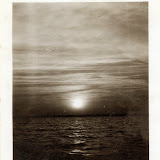
  How many of us have stood at the sea’s edge at sunset and wished for a camera? There are approximately 7 billion people on the planet. If we say (a random guess) that a quarter live by the coast, that roughly a tenth of them have access to a camera or some kind of recording device, then we are still talking millions. Somebody with more time on their hands could work out a more precise figure, but we get the picture, right? This snapshot was taken in Turkey in 1933. Historically, Alfred Stieglitz took the last of his cloud studies known as the Equivalents series just two years earlier. What would he have thought of this one; that he had wished he had taken it himself? It is old and a bit knocked about but the clouds have a muscular power.

 
 Another Turkish snapshot, and one that reconciles everything this post has been about. It was taken from a moving vehicle, (car, bus or train) and again it is a technical failure, again it transmits something that may have fallen short of the photographer’s intention yet holds our eye. I am reminded in a way of the vast abstract paintings that hang in commercial offices. The streak off light at the left (it could be the galvanized tin roof of a building) is not meant to be there, but only a painter with an eye on the market would think of putting it there. At first glance we see shapes, at second they begin to form into vaguely recognizable objects. Like all the photographs here, what’s interesting about it lies in that space between what the photographer saw and what he or she wanted to say.


NOTHING TO IT

Monday, 1 September 2014

SEVEN LITTLE AUSTRALIANS


 Cartes de visite from gold rush era Melbourne
“A portrait is not made in the camera but on either side of it.”
Edward Steichen

 
Here’s a coincidence of absolutely no historical importance. In 1835 William Fox Talbot made his first successful paper negatives, marking for some the birth of the invention of photography (purists prefer to look back a couple of decades earlier). The same year but on the other side of the world, John Batman, a grazier from Sydney via Van Diemen’s Land, had raised interest among investors for a settlement at Port Philip Bay on Australia’s south coast, making the case that it was excellent country for sheep. He wasn’t the only one with an eye on the land. Purists also argue that the real credit for the foundation of the settlement that became Melbourne should go to John Fawker. All Batman wanted was enough land and a good port to make a sheep industry viable. Fawker was the one who imagined a city. Without him Melbourne might have remained a big farm, called Batville, which is of course an excellent name for a state capital. Not a lot happened, certainly not much worth photographing, until 1850, when gold was discovered in the nearby foothills. Within a year the population had quadrupled, from approximately 10 000 to 50 000 and it kept growing. By 1854 the local newspapers were calling Melbourne the cultural capital of the British Empire. Quite a few in London were inclined to agree. As a new city fuelled by new money it sparkled next to London, which was old, polluted and generally thought to be hopelessly riddled with crime.  


Naturally, the gold rush city needed a few photographic studios. The best known of the portrait photographers was Perez Batchelder, subject of a post a couple of years back, but his story is worth recapping. Operating out of San Francisco during the Californian gold rush, when news of the Victorian gold discoveries broke he packed up, sold off and boarded a ship. The ‘flying studio’ that Eadweard Muybridge made famous in the 1860s may have been bought off Batchelder. Perez’s brothers followed him and Batchelder’s, at 41Collins St, became what today we’d call a name brand.
One of the (few) interesting details about the studios in gold rush Melbourne has to do with the connections that emerge. Actually, this is true of studios around the world. People start working for one, break away to start their own, employ someone else, who sets up their business a couple of years later and before long there is a web of relationships spread across town based on commercial photography. Originally employed by Batchelder’s as a miniature painter, John Botterill was one of the driving forces in creating an official Melbourne arts society. By the late 1850s he had a solid reputation as a commercial photographer and a society painter. This is a statement that requires some elucidation. To be a society artist in Melbourne in the gold rush era meant acknowledging that no matter how many claimed it was the most exciting place to be right now, the real centres of the art world, London and Paris, were on the other side of the planet. One heard of new ideas in art months after Parisians had forgotten them. Cartes de visite from the Botterill studio are fairly common. Unfortunately, the work he probably wanted to be remembered for, his landscapes and society portraits, are not. The stamp on the reverse of the first image, from the Batchelder Studio, lists Botterill as one of the proprietors.

 
Most Australians have not heard of Charles Nettleton, though they probably know his portrait of Ned Kelly, taken the day before the outlaw/national hero was hanged. Nettleton began his photographic career working for Townsend Duryea, who like Batchelder arrived from America at the height of the rush, realized what a drag digging for gold was and promptly made his fortune in photography. Duryea is one of those people whose personal contribution to culture is not as impressive as the debt a long line of artists owe to him. He could plausibly claim that one of the leading art schools in the world, the Art Institute of Chicago, would not exist today had not one of its founders, Henry Spread, had his start in Duryea's Melbourne studio. Nettleton then belongs in a long line of grateful acolytes, but that is not to belittle him. Unlike Botterill, who it seems had standards when it came to what he would photograph, Nettleton covered the whole waterfront, meaning he was often the only photographer available to record important events, such as the prelude to Kelly’s execution.  

Photo-historians spend their lives chasing down information on obscure commercial photographers, all the while knowing that what attracted them in the first place wasn’t the person behind the camera but the people in front of it.  This woman is identified on the back of the carte as “Christina Elizabeth Smith, wife of William Smith and daughter of J. McPherson”. Searching genealogical records for the surname Smith is too tedious to bear thinking about, made harder because, during the gold rush, Melbourne was a city of immigrants. Her family could have arrived from Tasmania, Scotland, the USA, Canada, South Africa or even India. Suffice to say, a search for her records requires a professional commitment, but the really interesting thing about Christina Elizabeth is that she looks so typical. The ringlets in her hair and lace collar tell us at once she is a woman of the 1860s. We’d know the look at once if the photo had been taken in Chicago or Edinburgh. 

But there was something special about Melbourne. Up until the 19th century most cities in the world had long histories; if they possessed something as dubious as a personality it had been created over centuries. Like San Francisco, Melbourne’s birth as a city came about through exceptional events. By 1860s it had the appearance of having arrived fully formed. When people called it the cultural capital of the Empire, they were also saying it was more British than any actual British city. That idea persists. People used to compare Sydney and Melbourne by saying the first was hedonistic and the second reserved, or prudish (or Victorian). Maybe that had nothing to do with any supposedly definable character but that it looked like a British city ought to with a new coat of paint; like London without the mistakes.

Yet if Melbourne was politically part of the British Empire, culturally it was one of the new international cities, so full of Irish, Chinese, Russians, French. Italians, Swedes, Dutch and Americans that it was normal to assume your neighbour did not speak your language. Just like San Francisco, as soon as people disembarked from their ship they reinvented themselves and assumed new names and life histories. These portraits might look like they could have been taken anywhere, but being Melbourne C1860 we have to assume that nothing is what it seems.

 Anybody searching through boxes and albums of Australian cartes de visite will quickly realize that most of the early one come from Melbourne. It is a sign of the city's prosperity and of its population boom. Reports from Sydney at the time describe how the city suddenly emptied of people. Most of the cartes come from the Batchelder, the Botterill and Nettleton studios. Someone mad enough could attempt to track down all the surviving examples. There are probably tens of thousands out there; enough to give us a comprehensive visual record of the city's population. It sounds like an admirable project and ought to be encouraged.


SEVEN LITTLE AUSTRALIANS

Saturday, 28 September 2013

HOUSE OF SEVEN GABLES


Six hand-coloured studies of a house

"I don't divide architecture, landscape and gardening: to me they are one."
Luis Barragan


I bought these six postcard sized photos about six years ago in Perth Australia. Though I doubt they were taken in Perth, certain details make me think the house is, or was, in Australia. The most convincing is the corrugated tin water tank attached to the side of the house, something so typically Australian we could call it vernacular. Another is that the trees on the distant horizon in this image have the distinct appearance of eucalypts. This is one of those details you can’t really call evidence but as with some species of pine and fir, you get a feeling what the tree is from a distant silhouette. It’s a very Australian house, which is to say it’s also very English.


The house is built in the classic arts and crafts style known in Australia as Federation, which would put it anywhere between 1895 and 1920. As the name suggests, it was the prevalent style around the time of federation in 1901, which was British in outlook with some native improvements. One of them was the verandah, essential for keeping the sun out, but note the timber facing in the Tudor style. Well into the 1940s Australia was still measuring itself against the old country and to build a mansion meant building something British, especially if it sat on a couple of acres. 


The hand colouring is exact, indicating a trained colourist or artist was responsible for that. Most likely, once the garden was established, which could be a couple of years after the house was built, a professional photographer came in to take photos for a presentation album. These in the post might only represent a portion of the photos in that album, which would be kept in a cabinet and brought out on special occasions. 


If I were a botanist I could identify the plants here, say more than they were trees and ferns and possibly give the house a precise location. What matters more to us however is the Italianate - we could go further and call it faux Italianate – scene here. It tells us a lot about the owner; a person (the man of the house may have had the money but the woman was as likely to hold power when it came to issues of design) for whom that all important word ‘culture’ belonged anywhere but Australia. They wanted it all. The house would be British, set in a landscape of cultivated lawns and rose gardens, but it would have annexes devoted to those elements a cultivated mind should turn to: the Italian Renaissance being an obvious inclusion. I once read an account of the house the American tycoon Leland Stanford built, with its Middle Eastern room, its Chinese area and French quarter. In designing the house, Stanford and his wife consulted a Sears catalogue and so the Persian carpets, Ming vases and Italian brocade wall hangings arrived on the same day, which was convenient. That statue of the girl in the hood? There were probably thousands of casts scattered around Sydney and Melbourne suburbs.


Full marks to the photographer and the colourist, but I think gnomes placed around a fountain say as much about the house owners then as they would now. This wasn’t just a place for a family to live; it was a fantasy, a weirdly romantic English pastoral set in the Australian landscape. Le Corbusier famously said that a house should be a machine, a functional organism whose primary purpose was to make the lives of its inhabitants easier. Frippery only distracted from that. I think the occupants of this house would have disagreed.


And this? A whole space given over to a ceramic fantasy of England? Well, not entirely. Another detail that makes me think this is an Australian house is the white cockatoo. In fact I’d say it establishes beyond doubt it is Australian, but the hunting dogs and deer? The issue of feral deer is a lesser known fact about New South Wales but they were introduced so wealthy settlers in love with home could carry out one of their essential pastimes. This last photo really brings home the image of a homeland the house’s inhabitants may never have visited.

HOUSE OF SEVEN GABLES

Saturday, 7 September 2013

MAN WITH A MOVIE CAMERA

  Itinerant film still photographers
 “The film drama is the opium of the people…down with bourgeois fairy-tale scenarios…long live life as it is!” 
Dziga Vertov


There’s a long history of commercial street photographers who worked city centres taking candid snaps of pedestrians and selling them the prints, and it’s only just started to catch the attention of photo-historians. As a genre it is related to restaurant photographers, who the historians have also only recently begun examining. In both cases the photographs themselves are rarely as interesting as the idea that semi-itinerant photographers were shooting the inhabitants of our cities as they walked to the office or the department store or sitting down to dinner. A vast record of our parents and grandparents lies scattered and underappreciated among collections and archives. If you want to know what Dublin was like in the mid-20th century, you could look in a lot of places but the photos of Arthur Fields, who hustled on the O’Connell Bridge for fifty years, might tell you more than a selection of beautiful prints of beautiful buildings (You can see some of his work at Jacolette here). Within that huge and unruly world there is a sub-genre that deserves its own place in the history. Working alongside, even competing against the regular street photographers were a small group carrying portable 16mm cameras who set the shutter on single image and took ‘movie snaps’. There are only two examples in the collection and an envelope advertising the service, but they come from Istanbul, Perth Australia and Toronto, so we know the idea was worldwide.


This one is credited to the Filmograph Company, located at 378 Murray St Perth. A quick look on the internet reveals similar photos from the same company being taken in Brisbane and Christchurch, New Zealand in the 1930s. It’s hard to believe a company survived let alone conquered Oceania on the singular idea that people would want a candid sequence of themselves walking along the street. The feeling is this was just a sideline and the real business was probably in film processing or editing though we’re ready to stand corrected. After all, some of the street photographers in the US were operating franchises for national companies. 


This is the front of the envelope from Movie Snaps in Toronto. The phrasing; ‘As you walked along we have just taken a moving picture of you’ suggests it was spontaneous and the subject had little idea they were being filmed. On the back it reads, “Remember, your photo has been taken.” Is it just our age of CCTV cameras on the street corner and internet surveillance or would that have sounded just a little like a threat back then as well? The company is reminding potential customers that we don’t just have your image; we have your movements on our files.
There’s also the reminder that the print will be ready in 48 hours. As a commercial proposition this sounds risky, relying on pedestrians to first of all be interested and then care enough to turn up two days later. 


Note how the price on the front is 25 cents and on the back we find that a postcard enlargement costs 35 cents. There’s a little bit of deception going on here. The 25 cents print is probably small and cropped. The 35 cents postcard is the one you would really want, plus the copies. It wasn’t a huge amount of money back then, according to records 35 cents could get you a sandwich or a cup of coffee at a diner in the mid 1930s, but that was enough to pass on the offer if things were tight.
These companies didn’t offer portraits. They are so small and indistinct that when the clients turned up two days later they could be forgiven for wondering if that was actually them under the big hat.  Movie Snaps’ language implied that you might not get to Hollywood though here was an idea of what you’d look like if you did yet that is just sales pitch. The idea, the gimmick of sequential images only worked so long as motion pictures were still mysterious and exclusive. People still found them fascinating. Standard 8 home movie film was around in the early 1930s but that was about people having fun at barbecues and distant fuzzy figures chasing footballs on a school oval: home movies weren’t really popular until the 1960s when Super 8 was released. When these were taken it was a little like the early days of photography. The customers found the process fascinating because they didn’t quite understand it.

MAN WITH A MOVIE CAMERA