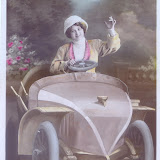
And furthermore ...

One Man's Treasure encourages the use of anonymous photographs posted here to illustrate books and album covers.
If an image appeals to you, contact John Toohey at johntoohey@hotmail.com.
Showing posts with label studio props. Show all posts

Saturday, 20 July 2013

FANCY DRESS

Images of fancy dress

“If you asked me now who I am, the only answer I could give with any certainty would be my name. For the rest: my loves, my hates, down even to my deepest desires, I can no longer say whether these emotions are my own, or stolen from those I once so desperately wished to be.” 
Evelyn Waugh: Brideshead Revisited


At a recent conference in Nottingham Verity Wilson from Oxford gave an engaging presentation on fancy dress in photography. A historian of fashion and textiles rather than photography, she admitted the topic was broader than she had first anticipated. Well, yes. Once anyone started talking about fancy dress in photography they would quickly have to set out parameters and enforce definitions before they were swamped. Here are just a few of the types, genres if you like, of photographs where people not only dressed up for the camera but assumed roles for it: theatrical, tableaux de vivant, family snapshots, glamour, fashion, folk costumes for the tourist market, tourists in folk costumes, fancy dress balls and costume parties, national identity, the erasure of identity and with all that we haven’t left the 19th century yet. Someone asked how we could tell the difference between a fancy dress photo and one of an acting troupe. Often we can’t though the distinction matters. We think actors in costume are less interesting than ordinary citizens in fancy dress because they are only doing their job. The photo above was taken in Winnipeg, C1910. I think it is a group of actors because most of them look like actors but I say that not knowing what exactly an actor looks like. And if it is a group of actors, does it matter if they are amateur rather than professional? Fancy dress in photographs is a form of amateur theatre.


For the purposes of the presentation Ms Wilson excluded actors. She was more interested in that basic desire we have to slip into another character and how the camera was the perfect machine to help us achieve that. It gives us a record that verifies the memory but more than that, from the very beginning there was the idea that the camera was a truth machine and the photograph a fact, so what better use was to be made of it than to manufacture evidence? You could assume any identity you wanted; the camera would vouch for it. 


From the Edwardian era into the 1920s, costume parties were incredibly popular at Oxbridge colleges, particularly among the arts students. A whole mythology has been built around the parties Stephen Tennant and his circle of bright young things threw and cameras were essential. The various images we have of their parties don’t suggest the behaviour was particularly wild but then, people tended to stop what they were doing as soon as the camera came out and hold that pose (Cecil Beaton was often the photographer). Evelyn Waugh’s descriptions of them usually amount to scenes of giggling groups in retarded adolescence recklessly driving around dressed as playing cards, or something to that effect. Fancy dress was part of being liberated. Some social historians relate it to the passing of the Victorian era, others to the end of the First World War, though both seem to be missing something. Just as important was a conscious effort among younger generations to engage in adult games like masked balls that had once been reserved for the very wealthy. The people in this photograph look too rough around the edges part of the Bright Young Thing set; notice how the two men are wearing carpets for togas. 


Tableaux vivant were also a popular Victorian then Edwardian pastime, but unlike costume parties the photograph was the whole point. A scene like this could take hours to put together, given that first it had to be imagined, people had to dress for it and then it had to be arranged. I can’t explain the thinking behind this though it may have had its origins in some fairly trashy artwork. It is possible the children were in a school play but we know Charles Dodgson took a lot of these staged scenes with children and there’s no reason to think he wasn’t following a fashion. During the era when tableaux vivant were popular, people didn’t shy from the morbid or grotesque. For a series of tableaux vivant look at Luminous Lint here.   


This image appears to combine elements of the costume party and the tableau vivant. If it is a costume party I doubt it was very decadent since there appear to be young children in this scene – and no sign of alcohol. They are dressed as Japanese. No idea why they are all pretending to be asleep unless the photographer wanted the impression this was a dream. Despite the costumes, something about this photo tells you immediately it was taken in England.


When it came to fancy dress, other cultures were high on the list, and the more exotic the better. The gut reaction to call it colonialist, or worse, needs to be tempered with the huge number of images we have of Chinese dressing as westerners, Turks as Arabs, Arabs as Chinese and so on. If the motive for dressing as another culture is a joke in bad taste it is also universal. This was obvuiously taken in a photo studio. Was dressing up as Arabs one of the services the studio offered? It isn’t so strange when you think how popular studio cowboys were (see here) or even sitting in a papier maché boat. It is possible too that they are soldiers on the North African front in the Second World War. When he was in Constantinople after the Crimean War, Roger Fenton wanted to photograph some of the locals in their native dress but was too shy to ask. When he returned to England he got his friends to dress up instead.


This is by Theodore Servanis, a Greek photographer working in Constantinople from the 1900s to the 1920s, and it is obviously from a school play. If the play is a French classic by Moliére, Hugo or one of their cohorts, the school was most likely Armenian as French was often the language of instruction and these were the schools that taught European classics. French wasn’t just the language of commerce; it distinguished high from low culture. If the intention was to present the façade of sophistication you could argue that was another form of fancy dress. The wristwatch the girl on the far right wears is a nice touch.


Compare the Servanis photo to this one. The man’s costume indicates he is Meskhetian Turkish, from Georgia, which when this was taken was part of the USSR. Technically this is traditional rather than fancy dress but he wouldn’t have worn this costume in his daily life. The date this was taken is important. In 1944 Stalin began a purge of Georgia and the Meskhetians who weren’t killed fled to the Black Sea region of Turkey, Trabzon in particular. If this was taken at that time he is probably a refugee making an obvious political point.


Speaking of national identity, this woman was photographed at an Elizabethan fair in England on July 30, 1924. Some quick research suggests that the Elizabethan theme was popular for fetes and fairs at the time; several examples of advertisements pop up on the internet. Historians who like symmetry might find it revealing that at one end we have the beginning of the British Empire, at the other its end, but it isn’t really clear that in 1924 most English people accepted the Empire was over. More likely; Elizabethan suggested not only elaborate costumes but also Merrie England, that hard to locate halcyon era that apparently existed sometime after the Black Death and before industrialization. These days we associate Elizabethan with ruthless machinations at the court, religious persecution and the prelude to revolution. History can take the fun out of the past.


What is it with the Far East? As often as not, fancy dress has meant the Orient, for women especially. Around 1880 Japanese style started to become fashionable. One reason was that the country had only recently opened its ports to the West and designers discovered the concept of style with minimum appearance. Teapots, bureaus and vases turned Japanese and kimonos and bamboo umbrellas became fashion items. Ancient Egypt had been popular at the same time but interest waned until Tutankhamen’s tomb was discovered in the 1920s. Japan however never went away. If its allure remained mysterious it might be because the country was never colonized by Europeans. Its stuff never belonged to the West so it never lost its glamour. And if you think about it, there are a lot of things we Europeans can’t do these days; it is crude to wear black face or dress as Native Americans, Arabs, Sikhs, Turks, Zulu or Inuit but even now, when a group get together for fancy dress you can be guaranteed that at least one male will be a cowboy, one female will come Japanese.


Anyone who collects vernacular photographs will have a sizeable proportion devoted to fancy dress, whether they set out with that in mind or not. Some collectors specialize in it. As subjects go these photos are hard to pass over. They are about people having fun for the camera and more than one scholar has pointed out that’s what we think the Kodak was invented for. But there is more, because if all vernacular photos are inherently mysterious, fancy dress adds another layer to the riddle. Philosophically speaking, it is about identity, the construction of truth and reality and so on, with the implicit understanding we are not going to get a single categorical answer. It’s that paradox that the more a photo tells us the less interesting it becomes.

FANCY DRESS

Friday, 15 March 2013

SEVEN CHARACTERS IN SEARCH OF AN AUTHOR

Some postcard portraits

“We are all potentially characters in a novel--with the difference that characters in a novel really get to live their lives to the full.” 
Georges Simenon


 All of these photos could have come from the same novel; something by Simenon perhaps, where sailors, chorus girls and boxers resided on the top floor of a seedy doss house. Or one by a more obscure Hungarian author; a study of the characters in a struggling nightclub during the months before the outbreak of World War 2. The blurb on the back would describe it as a dark comedy though three quarters through you’d still be waiting for just a glint of humour. It could be American, but at a pinch. The country was still too optimistic in the 1930s to match the British when it came to urban despair. Nathanael West, maybe – these two look could have minor roles in The Day of the Locust - but most of the others still thought America was almost great and an angry writer could iron out the flaws. The English on the other hand had given up hope, as if unrelieved bitterness was the only thing getting them out of bed every day. This comes from the International Settlement, San Francisco’s innocuous name for its red light district in the 1940s. Post-war America had a handle on sleaze by then. 


A Parisian prostitute, C1910. How many featured in French novels of the era? Or to put it another way; if your novel didn’t have a prostitute, presumably you were writing for very young children. 19th century French novelists did something for prostitutes last seen in the New Testament; they wrote openly about them and while this sounds far more preferable to the British way, which was to hint that a woman had a sullied occupation, they also romanticised them to a wearisome degree (Most of France’s literary talent of the era died from the pox before hitting middle age). Postcards like this one were readily available, advertised in the classified ads of magazines, but if a novelist couldn’t afford the francs, they were pasted to boards outside brothels in the Pigalle. This meant that C1910, a budding Flaubert no longer needed actual experience to emulate the great man. He could skulk around the doorways of brothels pretending to be a prospective customer then hurry back to the garret to write about Lou Lou with her coarse laugh and gentle hands.  


The French might have been writing about her earlier but no one captured the shabby little chorine so well as Patrick Hamilton. The Midnight Bell, the first novel in his 1930s London trilogy 20 000 Streets Under the Sky, sees Bob fall for Jenny and sacrifice everything for her even though we the reader can see that he’s not going to get a skerrick for his efforts. Quite obviously, she’s a tough piece of work. Not nasty, mind you, for if Bob manned up she was willing to give. At first we see a decent but pathetic man make some human mistakes for the sake of a smart, cheap girl who clearly has her own interests at heart. By the end we’re shaking our heads the way we would if we watched a drunk try and cross a busy highway. I look at this photo and I see Jenny. Whatever loyalty she has goes to the girls she works with, and she would care about their happiness, though not for long.


The moment you see the lines; “She was sitting at a table, talking to a sailor” or, “The bar was empty save a couple of sailors down the far end” you know the action is about to pick up. Sailors are the wood lice of 20th century fiction. Any book that shines a light into the darkness sees them scuttling away. A sailor is never far away from a seedy bar, tacky bordello or a motel room where something indescribably sordid is going down. Read enough true crime accounts and you begin to wonder why the chief suspect in every boarding house murder appears to have worked in the merchant navy at some point. There’s no information on this postcard that gives a precise date but it’s an uncommonly good example of hand-colouring and an excellent portrait of a sailor with a smile that suggests he knows places where you won’t be bothered by normal society.


At first glance I thought she was indulging in a bit of cross-dressing, in which case she is a shoo-in for any German novel written between 1929 and ten years later, but especially one about a pallid young man with philosophical leanings and nothing remotely like a sympathetic character. However, the lettering on her cap reads “Marynarka Wojenna” or Polish Navy and I’m inclined to think that’s her job. What makes it ambiguous is the backdrop. What makes it special is the casual way the backdrop hangs over the floorboards. She could be the girlfriend who goes off to the navy but, frankly, she looks too self-possessed to bother with a pallid philosophical type.  


There are two types of boxers in European novels. One is the thug who works for the local gangster. He usually has a minor role, glowers from a car, cracks his knuckles as his boss explains the situation, that sort of thing. The other is the decent but simple man who pays the price for protecting the woman. He has what you might call a speaking part and is invariably tough and dependable but naïve. It’s a common flaw among novelists to confuse slow wittedness and naïveté. I think they like to imagine they can’t ‘do’ stupid. Our fighter might not be the quickest off the mark but for authenticity’s sake he’s probably seen more than most people in the room. This man definitely belongs to that second category. I’m actually not sure if he is a boxer. He has the physique but this looks as if it could also be a portrait from a medical examination. It’s by P. Kodatschenko of Riga, but it could easily be by A. Sander of Cologne. 


In fiction, sailors, prostitutes and circus performers inhabit the same world. They are marginal, transient and tend to emerge around twilight. In Simenon’s novels they are involved in the crime but rarely central to it. In Hamilton’s, the sailor and the acrobat might be the only two men the prostitute calls friends. Even then it isn’t certain that she actually likes them. In German novels, when the circus arrives in town it’s a sign that moral decay has set in. The residents rush off to the fairground heedless of the dark clouds gathering above. When the circus exits stage left, we know the Nazis are about to arrive stage right. This circus performer is actually from Quebec but he could be from anywhere and he has the small wiry frame of someone who could climb into difficult places, steal things or spy on people.

SEVEN CHARACTERS IN SEARCH OF AN AUTHOR

Saturday, 16 February 2013

TRAINS AND BOATS AND PLANES - RETURN FARE


More studio props

“People think of the inventor as a screwball, but no one ever asks the inventor what he thinks of other people.”
Charles Kettering


On my way, where? On the back of this postcard is a date, Jan 1919, some indecipherable initials and what appears to be “Co. N 57th”. A quick and not very thorough check shows there was a 57th Artillery Brigade, a 57th Infantry Regiment and a 57th Engineers among the U.S forces in World War 1. “The History of the 57th Regiment, 2nd Battalion, 31st Brigade, Coast Artillery Corps During World War One” has this line from an unidentified source: “No cheers, not even a smile to send us on our way to an unknown land, to fight for and protect that which we all love best, ‘Liberty.’” It’s a good image to bear in mind if you’ve been brought up on images of flags and streamers and weeping wives and girlfriends waving from the dock as the troop ships departed for Europe. The US entered the War in April 1917, by which time the awful horror of the Western Front was common knowledge. What’s more, thousands of German and Irish Americans were opposed to entry. It wasn’t as though England was an ally; if anything it was a war between degenerate empires. Does all of that explain the sadness in this soldier’s face? Probably not but he does look like he is asking what the point of it was.


Dominion Park opened in Montreal in 1906 and closed in 1937, a short life for what was claimed to be Canada’s largest amusement park. It was located on the north east of the city, with one edge on Ave Notre Dame, the other on the water facing the Îles-de-Boucherville. Nothing remains now of course, though if photographing industrial wastelands is your thing a wonderful collection of gas tanks has replaced it. One of the highlights of the park was a water chute that sent riders in boats down a long slide into an artificial lake. Another was the photo studio. Quite a few artifacts from the studio are still floating around. One thing that was nice about it; instead of customers getting into in a cardboard cut-out of a motor boat, they boarded a liner. Another thing to notice: Montrealers were self-consciously different to other Canadians. It was a French city after all. You can see that here. These people don’t look like they’d call themselves Anglo-Saxon.


Miami, 1938, or so we can surmise from the date on the boat. Before it became a gangsters’ haunt, before Little Havana, before the spivs in white suits moved in, Miami was a resort town. Looking at news footage from the year we find Santa Claus water-skiing, a lot of footage of young women in the latest bathing costumes and various golfers, tennis players and high divers with a skin tone we could describe as ‘rust’ if it wasn’t so evenly spread. If you want to know how the rot set in, take a look at Miami circa 1938. You can see the car crash looming. It’s a city that sold itself on pleasure without discrimination. At least Chicago, Detroit, Philadelphia, even LA had a work ethic. Miami was just golf and cocktail bars. It’s apparent in this image, isn’t it? Incidentally, 1930s Miami would later become famous for its Art Deco architecture. The prominent building on the right, to the left of the palm tree. Is now known as the Freedom Tower. Back then it was still the Miami News and Metropolis Building.


The backdrop in the Miami photo is a reasonably faithful rendition of the city, close enough at least for tourists to recognize it. You could make the case that it isn’t just a photo, it’s an advertisement for everything great about Miami. In a similar way this one celebrates France. The photo was taken before 1920 and the plane is an approximation of one of Bleriot’s models, the XXVII Racer to be about as precise as we can be. Back then, if the French were going to use a plane as a studio prop it had to at least resemble a Bleriot. He’d been a national hero ever since he flew across the Channel in 1909 and up to the First World War it appeared that he, that is to say France, could dominate aircraft technology. A detail much glossed over in America is that the Wright brothers turned out to be such vexatious litigants, suing anybody who dared build an aeroplane, that the federal government had to step in to protect the industry from the brothers. Technically, the Racer was a single-seater, but most of the fun in posing for a photo like this lay in sharing the experience. And by the way; if you look closely you can see how they made this image. The plane is in two halves, the bottom half at the front so the two boys just have to stand behind it. That was how most of them were made but magicians seldom reveal their secrets so crudely.


In a previous post on studio props it was suggested that a lot of people who posed for these photos were drunk, which would explain the common expressions of sullen bafflement. This looks like damning evidence. Note the way he appears to be staring down the photographer. The drinking might also explain why the plane is back to front.


All photos with aeroplanes as studio props are great but some are more interesting than others; like this one. It appears the man first sat in a studio prop then it was montaged onto the landscape. Most of these postcards come from fairgrounds and carnivals but this could have been something a regular studio thought up since it would take a bit more time and effort than fairground operators were prepared to put into one. It makes you wonder; was the plane more than a prop? Could it have been a prototype for some failed experiment? 


This one comes from the United Photo Stores of Denver, Colorado. It had three addresses when this was taken; 1109 16th St, 1513 Curtis St and 1625 Curtis St, attached to the Majestic Theatre. Doing a Google images search for “United Photo Stores” throws up a few of these images. All have a carefully detailed background and a wry message on the front of the car. My guess is the studios had these props on hand for any customers who wanted them. A good thing it’s the man who’s driving. The woman in the middle looks like she’d intentionally drive into a brick wall. Nice hats.


Finally, what do you do when you’ve been out on a studio boat, up in a studio plane or driven about in a studio car? Naturally, you head to a studio bar. No clue where it comes from but the couple are identified as Erwin and Jean Heider. Another Google search, for Erwin Heider, brought up an image for one Barbara J Dippold Heider sitting with her son, Erwin, and his un-named wife. No doubt they are the same people. Erwin was born in 1896. His wife was Isabel and according to the 1940 census they lived at 5624 N Campbell Avenue, Chicago. With some people, it feels like you’ve just met them and already you know their life story.


TRAINS AND BOATS AND PLANES - RETURN FARE

Saturday, 22 December 2012

WOOLY CHAPS


Studio Cowboys

 “Get off your horse and drink your milk.”
Attributed, incorrectly, to John Wayne


Here’s some statistics to get your head around. The number of cowboys, which is to say men that worked with cattle, who were black has been estimated to be around 50%. Since no one in the 1870s kept data the actual figure is unknown but we know it was high. In Arizona Territory many more are reckoned to have been Mexicans and Native Americans. It suggests that if you drove cattle to Abilene in the 1870s and you were a white man whose first language was English, you were somewhat unusual. It tells you something else; it must have been a rotten job wages wise; how many ranch owners were that enlightened that they’d pay a recently freed slave or an Apache the same rate as a white man? We haven’t even considered what it was like to ride tall in the saddle for eight or more hours a day. People who have had to do that will tell you it makes such everyday activities as sitting in a chair painful. Reading between the lines, it becomes apparent that cowboy wasn’t a long term career choice. Assuming that you weren’t thrown from a horse, suffered heat stroke, snow blindness, TB, snakebite, fever, typhoid, syphilis or smallpox, you’d want to get out of the business by your mid twenties. After that you either had no choice, were pushing your luck or you were a sucker for punishment. So how did what’s beginning to sound like the worst job a man could ask for become so mythologized? How is it that barely had the sun set on the range so to speak than men were lining up at photographers’ studios to look the part of a ruthlessly exploited, prematurely aged and poorly educated labourer?


There are cabinet cards and tintypes of office workers dressed as cowboys but the fashion seems to have really taken off at the turn of the century, when the real photo postcard first appeared. That coincided with the publication in 1902 of Owen Whistler’s The Virginian, which cultural historians mark as the birth of the cowboy legend in literature.  1903 marked the release of Edwin Porter’s The Great Train Robbery, which was the first western movie but more properly the first serious dramatic film made in America. This was also the era of Theodore Roosevelt, the closest to a real cowboy America ever had as president and a man who believed New York’s flaccid inhabitants could learn a few things from the cowboy’s simple, direct philosophy. His favourite artist was Frederic Remington, who we’ll get to later. America stood at the cusp of world power and it needed foundation myths. Forget Columbus, the Pilgrim Fathers and Valley Forge. America was born in the Wild West, and there were still a lot of people around who had lived through it. 


One thing to bear in mind: in the real Wild West a man either wore chaps or he carried a six gun; he didn’t do both. Only cowboys – men who worked with cattle – wore chaps, to protect them from the thorns as they rose through the brush, and while a rifle had its uses if you wanted to guard the herd from coyotes or wolves, strapping on a revolver was pointless and only added to the health risks in an already hazardous job. For sure there were times during the Montana sheep and cattle wars when cowboys could expect a bit of violence on the range but mostly it was kept to the towns, where they turned up, crawled out of the mess of rags they’d been wearing for the last few weeks and went off to a bar for a few drinks, and maybe a fight. The fact that guns might be drawn and someone carted off to Boot Hill didn’t mean he was in his sheepskin chaps at the time, though wearing a set into a bar in Tombstone or Abilene would have helped get him there. 


Reading about the legendary outlaws one soon notices a few patterns. Some, like Jesse James and Clay Allison, were veterans of the Civil War and if it’s too late to find out for sure it is still worth wondering how many emerged from that conflict so psychologically damaged that perpetuating the violence made sense. Billy the Kid and Wild Bill Longley were sociopaths who needed no justification for killing a man other than they didn’t mind doing it. A few – and I don’t know why this should be surprising – started their gun-fighting careers as lawmen, which didn’t mean they were on the side of good, merely paid by it. A glance at Wyatt Earp’s life story is enough to know he was familiar with the concept of moral ambiguity long before it became a literary term.


Speaking of Earp, the people in these photographs might not have been aware of how much they owed to the man. He was still alive when most of these were taken and was earning a living as a consultant to Hollywood. The producers wanted the truth but they weren’t too fussed by facts and here was a man who could tell them exactly what it was like to stride down the sun baked main street of Tombstone, fingers just above the Colt poking out of his holster, ready to draw against one of the toughest gunslingers west of the Pecos. Best of all, no one was alive anymore to contradict him. His only rival for Hollywood’s attention was Emmett Dalton, on the straight after years in jail, and he wasn’t about to cast aspersions on Earp’s grasp of the truth when a little fabrication made them both look good. The Wild West that Hollywood concocted in the 1910s and ‘20s came pretty much straight out of Earp and Dalton’s mouths, or imaginations. 


It seems there were a considerable number of shootouts at high noon, enough to give them a legitimate place in the folklore, but what we know about most of them is that they were spontaneous and often ended in a no contest on account of both players missing with their shots. Famed gunfighter Doc Holliday once drew on a man in a saloon and shot a bystander in the toe. Not only did the bystander risk lead poisoning from the bullet, there was a strong chance he’d die on the operating table when the bullet was removed. Holliday of course could not in all fairness notch that kill on his gun though he probably did.


Another myth of the Wild West was the crack shot, the man who could shoot from the hip and plug his opponent straight through the heart. Gun experts agree that for that to happen the gunslingers had to be about four feet apart or lucky. In the 1890s one circus sharpshooter explained how he got so accurate shooting a playing card that had been flicked in the air. Beforehand he would remove the lead bullet and fill the casing with buckshot then replace the bullet with a papier maché substitute. When he drew and fired the papier maché exploded into dust but one of the pieces of buckshot was sure to hit the card. The hard part was spinning the revolver and putting it back in the holster in one smooth move. 


The sad reality of the Wild West was that you were more likely to die at a dentist’s hands than a gunslinger’s. And if you survived the dentist’s chair there was a strong chance you’d emerge on to the street with the beginnings of a pernicious drug habit. Again, the figures are a little vague but it seems a high number of cowpokes were addicted to morphine, invariably as a result of visiting a dentist, though if they broke a wrist falling from a horse and needed some quick attention that could do it too. It doesn’t seem right, does it; stepping into a Tucson saloon and realizing the unfriendly silence is because everyone’s too doped up to do much else besides stare into their whisky glass. 


Another man the people in these photos owe something to is Frederic Remington. It’s common for art critics and historians to brush him off but if you’ve ever felt the lure of the West it is impossible to hate him. Give him his due. He heroized the cowboy – he was probably responsible for the notion that the Colt revolver was part of the cowpoke’s stock-in-trade - but in fairness the figures in his paintings are rarely the loud, swaggering John Wayne types. They look more like the men here, out of place and sorts. Remington was New York born and bred and only went west during the dying days of the frontier. Suffice to say he never saw a Pony Express rider in action and the closest he got to trouble with Indians was when he turned up to Wounded Knee a few days after US soldiers had massacred 150 men, women and children, most of them unarmed. He nevertheless believed that old story about the ethos of individuality, self reliance and fundamental justice, what we’d call true grit, being the source of America’s greatness and the answer to its problems. Give the West the boy and it would give you back the man. He was deluded of course. By the time he died in 1909 America’s success was much more dependent upon the millions of office workers who kept the government’s wheels turning, the kind of men who escaped the tedium by pretending for a few minutes they were cowboys.


America didn’t own copyright on the cowboy. Studios, often found at fairgrounds and carnivals, that offered the Wild West experience sprang up all over the world and it would be remiss here not to mention Karl May, the German author who recreated the image of the cowboy for millions of Europeans. Einstein and Hitler claimed him as their favourite author when they were boys. Though he died a century ago, Wild West re-enactments based on the Karl May vision have been hugely popular in Germany since the 1950s. In Eastern Germany during the Cold War they took on a particular slant. If the cowboy represented American capitalism, it was logical, and permissible, to sympathize with the Indian. Thousands of East Germans spent their wages on outfits and their weekends dressed as Tonto. The irony was lost on everyone. This postcard was taken in Turkey. You can see a few details are amiss, the hat for example is wrong, but the checked shirt and vest are close enough.  You don’t need to know much about America to know what a cowboy is. With his holster strapped over his chaps he is the epitome of the rugged individual, the man who stands tall, in or out of the saddle, the embodiment of freedom. When the Village People wee deciding on their costumes, you can bet which was the first they thought of.

VIEW THE GALLERY HERE 
WOOLY CHAPS

Friday, 23 December 2011

TRAINS AND BOATS AND PLANES


 transport as studio props

“The car has become an article of dress without which we feel uncertain, unclad, and incomplete.”
Marshall McLuhan 


Self respecting books on the history of photography ignore or avoid but in any case stay right away from examining the long tradition of studio photographs using imitation transport as props. It’s frustrating because there is plenty of room for speculation but a few hard facts wouldn’t go astray. It would be useful to know something about the photographers. Most of the photographs here look like they come from fairground midways but were the photographers typical carnies who based the value of their work on the dollars they counted at the end of each day? Was this a viable environment for a beginner to cut his or her teeth on or was it more likely dismissed as assembly line work? If the answer to that is the second, then how did such a system produce some of the most unconventionally compelling images in vernacular photography? People who collect snapshots and postcards will tell you they keep an eye out for them, also that they have seen a lot in poor condition but they’ve never seen a bad image. There are people who find them intensely irritating, but that’s their problem.


There is a genteel history to these photographs. It begins with the invention of collodion plates, the carte de visite and the cabinet card in the late 1850s, when photographers began treating the studio as an element in the photograph rather than just the space the image was recorded in. The first photographers used stage boats and the idea was to make the scene as naturalistic as possible, so even though the viewers knew it was artificial they were supposed to appreciate the photographer’s dexterity (you can see some examples here). By the late 1880s the trick had lost its magic, so to speak, and no one needed to maintain a pretence. It didn’t matter that the background was so obviously painted since the photo was now a joke that everyone could be in on. In the same way that studios used composite printing to place the sitter in Egypt or against Niagara Falls, it wasn’t a case of ‘special’ so much as ‘novelty’ effects. The best place to find studios that carried out this work was at seaside resorts or carnivals.


From the first decade of the 20th century photographers also had trains, planes and cars to play around with, and quick-to-produce postcards. It’s tempting to see the arrival of these new modes of transport on the photographic stage as a response to modernity but if that’s the case we have to ask why so many of the cars are clapped out jalopies and why, even into the 1920s, the most common type of aircraft was still a pre-Wright brothers flying machine. Well, obviously, that was supposed to be funnier, and maybe we don’t need to read anything more into it. If it really were a comment on the marvels of modern technology then we would have to assume that everyone, photographer, subjects and audience, was conscious of the statement being made. Appearances suggest otherwise.


And speaking of appearances, there is some mystery as to why, if being photographed in a studio car was supposed to be fun, people seldom look amused. In Folk Photography, Luc Sante says that “enjoyment was conceived of primarily as an activity and only secondarily an emotion (so) it was not necessary to show yourself laughing”. I’m sceptical and can think of a couple of other more convincing explanations. One is suggested by the man on the right in the photo above. He holds a bottle of cheap looking liquor in his hand. It’s my guess a fair few of the men in these photos were either drunk or most of the way there when they climbed into the props. This was at a fairground after all, and what was that but a place to wander through looking for desultory fun. That doesn’t account for all the families wearing the same stunned mullet expressions.
My suspicion is what looked like a good idea was actually intimidating once you started. The photographer was shouting at you to keep still while glancing over a shoulder at the queue outside and trying hurry it along. He or she had already done the technical work of framing the scene, setting the focus and rigging the lights hours earlier. The only people who were going to mess the shot up were the sitters and they weren’t given the luxury of a second try.   


Not quite a mode of transport, unless you were planning to go over Niagara Falls, the barrel was almost as popular a studio prop as the car and the boat. The oddest thing about this sub-genre is not what point anybody would see in pretending to be in a barrel - that was their choice - but that so many feature the snarling little bulldog chained to it. Most that you see will have it. The dog bears a passing resemblance to Spike the bulldog in Tom and Jerry but that doesn’t mean much. It could be some forgotten piece of folklore but there is also the possibility that one company was producing a lot of the props and this was by way of a signature. The props in the photo of the two men in the speedboat – one with his tie askew and looking like he has already taken a few slugs from the hip flask – look almost identical to others I’ve seen, the big difference being the name of the state on the banner. That also supports the notion one company was producing a lot of the scenery. If that was the case, their place in American folk art is sadly unrecognized


The last in this series is a photo that doesn’t come from a fair and doesn’t use a prop but is actually a piece of artful photomontage. It is postmarked 1906, just three years after the Wright brothers flew at Kitty Hawk and three before Louis Bleriot flew across the English Channel. Powered dirigibles were still more popular than aeroplanes for getting about in the skies and for some people remained the most feasible form of powered flight. Only ten years earlier persons still unknown had flown across parts of the southern and mid-western United States in a powered dirigible and been witnessed by thousands. Even in 1906 a dirigible in the sky was likely to draw crowds. This French postcard is obviously intended as a cutely romantic gesture but at the time it would also have been a very contemporary image.

VIEW THE GALLERY HERE
TRAINS AND BOATS AND PLANES