And furthermore ...

One Man's Treasure encourages the use of anonymous photographs posted here to illustrate books and album covers.
If an image appeals to you, contact John Toohey at johntoohey@hotmail.com.
Showing posts with label bathrooms. Show all posts

Tuesday, 26 May 2015

HIDDEN PERSUADERS

Canadian advertising photos from the 1950s
 “Advertising is fundamentally persuasion and persuasion happens to be not a science, but an art.”
William Bernbach


A collection of Canadian advertising photographs, of everyday household objects, of stuff. They were taken in the 1950s, something the packaging tells us at once. They tell us things we don’t think we need to know but are the very fine details without which we couldn’t understand the past, such as what products Mr and Mrs Average Canadian bought at the supermarket and what did they keep on the shelf behind the bathroom mirror. This is a world so ordinary it looks alien.

 
 Madmen was set in the same period these photos were taken, when the middle classes became prosperous in a way they hadn’t been able to for a generation, when ad agencies started making serious money, and when advertising became associated with a kind of ruthless creativity. At least that was the way it was in the top end magazines like Esquire and Vogue, who pushed the notion that brands mattered to the modern man and woman, as though they might as well be be naked without Johnny Walker in one hand and Philip Morris in the other. But same time, different world. Down in the real world of mid level incomes and struggling aspirations, advertising was still about product more than image. TV dinners, deodorants and lingerie could be depicted according to the same formulae because there was no need to vary. (Most of these photographs would have ended up in catalogues or newspaper ads.) 

 
 Whatever Madmen might suggest, the accounts that photographers have left us suggest most of them treated advertising as hack work, done only to pay the bills. A handful achieved a glamorous status but most disavowed the very idea. Technically all that was needed to fulfill the Bionet contract was knowledge of the basic rules, mainly what the lighting set-up should be. Madmen is actually about people in our contemporary TV world. Acutely, even cynically aware of how dull and shallow that place is, they are trying to sell the image of glamour, not to us but to themselves. 

 
 A stamp with the name Jack Markow appears on the back of two of these prints. The Markow studio address was at 1827 St Catherine St Montreal. The building still stands, now occupied by an art supply store and a martial arts gym.  Some quick research reveals that Markow was born in Montreal in 1921 and died there in 2001. As with a lot of commercial photographers, his legacy is scattered throughout various archives yet it tells us little about him. A man on hire who prolifically photographed medicinal products, bar mitzvahs, evangelical meetings, Quebec nationalists and new buildings in the CBD will tell us less about himself than someone whose output was narrower and in shorter supply. To understand Markow, we need to find the snaps he took of his family, but maybe they don’t exist. Maybe the busman’s holiday didn’t appeal to him; the mere thought of picking up a camera became physically painful for Jack Markow. Would you be that excited if you had just spent all week photographing diuretics.  

It is just coincidence that so many of the two dozen photographs bought in this collection are of pharmaceutical products, yet it may not be. The 1950s were the beginning of the modern age of the pharmaceutical industry, when there was not only a product for every minor complaint but it had the imprimatur of various government departments. This was a time when the side effects of drugs were often discovered once they had been on the market a few months. Today, conscientious doctors advise us that a little pain is not necessarily a bad thing but in the 1950s discomfort of any intensity was something to be avoided. We can thank the war for that. Firstly it had necessitated a series of pharmaceutical breakthroughs, and also the postwar peace encouraged the avoidance of pain. It was as though the Government was leaning over and asking, in a kindly voice, haven’t you suffered enough?
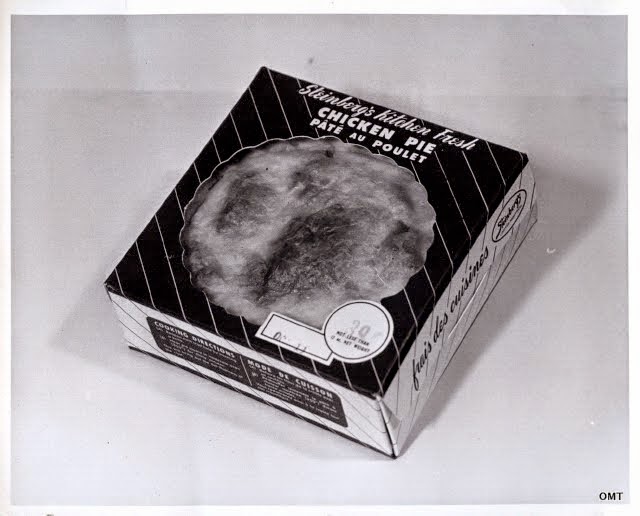
 

But back to the original point, the one about stuff. Those of us born too late to experience the 1950s can be persuaded that things were better back then, and by things we mean stuff, not politics or lifestyles. Well it’s true that in the 1950s cigarettes didn’t give you lung cancer and Coke wasn’t responsible for diabetes, and we’re always being told that a new packaged pie tastes like pies used to, which means like they ought to. When we look at the Steinberg’s ‘kitchen fresh’ (whatever that means) chicken pie, do we not wonder if it would taste more like a chicken pie should to our jaded senses? You can bet it was horrid: a sludgy confection of artificial pastry and gravy surrounding some pink cubes of former chicken, but at a time when the world feels harder, more insecure and less generous place than it was when these photos were taken, nostalgia for a non-existent taste sensation stands in for other illusions as well.


 So, did all the things we see here come about because we wanted them, or was it because advertisers told us that we did? Was BO a problem before deodorants appeared or did it become one only after a solution had been found? In 1957, contemporaneously with these photos, Vance Packard published The Hidden Persuaders, which didn’t just expose some of the tricks advertisers used but argued that the real danger was that political machines were beginning to use them. Half a century of wonder drugs and lotions later, the question is more refined: have we become inoculated?

HIDDEN PERSUADERS

Friday, 1 June 2012

THE GRAND TOUR


Snapshots of interiors

“Step right up, come on in. If you'd like to take the grand tour, of a lonely house that once was home sweet home. I have nothing here to sell you, just some things that I will tell you. Some things I know will chill you to the bone.”
George Jones ‘The Grand Tour’


Seventy years ago, the largest piece of furniture in the living room was likely to be the radio. It was also the centrepiece. To own a polished mahogany valve wireless set bigger than an armchair said a few things about you. One was that you had a little money; though the radios weren’t prohibitively expensive they were a luxury. Another was that you had enough time to afford leisure and taste. Most of all it was a focus of your social life. Whether the family sat around listening to the hiss and crackle of thrilling dramas, if your friends came over to listen to football matches or you sat alone with the classical hour as your only company, the radio reflected what you valued about your home. It was probably a good thing radios quickly began to shrink in size. They never needed to be that big and once television came along there was a crisis of competing interests.


Anybody who lets themselves be photographed is obviously lending some part of their identity to the photographer, which is why they so often affect a mask. But something more happens when they allow themselves to be photographed at home, surrounded by their possessions. Even, or especially, if they are playing a game for the camera, the objects around them give away much more about their inner lives than they might want to admit. You might look quite the house-proud man of means but that hideous lamp in the corner wasn’t just a lapse in judgement, it is proof that behind your calm façade lurks a desperate and vulnerable social climber. The furnishings look grand but the wallpaper is cheap. The people you work with have no idea how many books you have on your shelf and that far from the impression you give them, your idea of a perfect night is a glass of wine by your side and a heartbreaking romance in your hands. 


If you can’t let your guard down at home, where can you? Left alone in the refuge of your own house, it won’t be long before you do something you’d rather others didn’t see. The telephone, the push button ashtray and the modular chairs date this photo to the mid to late ‘60s. So does its sparseness. For her parents, the signs of middle class comfort were dark stained furniture and fittings, with cabinets and shelves filled with sentimental objects. The 1960s were a minimalist age. The modern home had aluminium frames on the windows and sliding glass doors and the sunlight streamed in through polyester net curtains. The ambience worked against excessive decoration. A cheap Matisse print mounted on cork or chipboard was enough to bring life to a room and it probably set off the Pyrex dishware and Marimekko tablecloth quite well. She has her purse and sunglasses ready. They’re off to an event that will also be spare in detail or description but intellectually satisfying.  


And here we have another bare looking room in an image full of details. Isn’t it great? The cigarette hanging casually from the mouth of the woman on the right, the look of concentration on everyone’s faces, the purse, the bowl; this is bridge night, or it could be poker. Whatever game they are playing, you know it’s a regular event, a ritual and men aren’t allowed anywhere near it because it’s part of the glue that holds these women’s marriages together. You also know it’s been going on every Wednesday night for some time and will continue into the future. That’s why somebody thought it important to capture on film. 


Every room is a work of art. Stripped bare or full of clutter, cheap or expensive furnishings, plain white walls or something more elaborate; the self-expression of the occupant is on display. Everybody has an idea of what their ideal home should look like inside. Sometimes it becomes an obsession as they neurotically shift the furniture about from one part of the room to another or consult coffee table books on Mexican or Neapolitan style, the paradox being that the Mexicans and Neapolitans who could afford those interiors are looking to New York or Paris for inspiration. Sometimes we get it but more often we accept a compromise. What we want is often at odds with who we are.


The bedroom, we’re told, is where a lot happens, but it doesn’t really. We sleep, which is hardly active, and sometimes we lie there reading a book. It’s the place we go when we are so exhausted that we have no other choice. Mostly the bed is the best place to think. 


You can see why the photographer took this snap. He or she was standing in the living room and suddenly struck by the afternoon light filtering through. The glimpse of a light fitting tells us it is the ceiling reflected in the mirror but it could almost be the sea with waves quietly landing on the shore. A professional would have fixed things to remove any anomalies but the result wouldn’t have been so strange or felt so empty.


We have countless photos of people in the kitchen, the living room, the bedroom, the study but photos from the bathroom are rare. No doubt there were couples who shot off rolls of film of each other sitting on the toilet or taking a shower but they tended to be very private and kept away from the regular photo albums. It’s too bad really because in a lot of countries the toilet is the only room a house must legally have. The closest we have here is a woman washing her hands in the bathroom. This being a typical Turkish apartment bathroom the toilet is probably right behind her, though it may not be the reason she came in here. Note the tin on the soap dish. If it wasn’t here this photo would be missing something.


The concept of the home bar was as American as a Chevy in the carport. No other culture really thought it necessary that the man of the house ought to have his own space to entertain his golfing buddies, but like a lot of things American in the 1940s and 50s it caught on like syphilis and spread quickly. By the 1960s a proper home bar had to be built entirely out of Swedish pine, which didn’t mean the timber came from Sweden, just the look; a cross between a sauna and the sleeping quarters in an expensive yacht. Most likely the bar has only recently been installed; said Man on the House hasn’t had time to put up any tacky decorations, and he shouldn’t either. With a home bar built from Swedish pine and a glamorous wife/girlfriend to occupy a stool, he has everything he needs for the perfect life. What’s that drink by her side? It could be a white wine though the point of the home bar was to serve up cocktails.


VIEW THE GALLERY HERE
THE GRAND TOUR