And furthermore ...

One Man's Treasure encourages the use of anonymous photographs posted here to illustrate books and album covers.
If an image appeals to you, contact John Toohey at johntoohey@hotmail.com.
Showing posts with label cabinet cards. Show all posts

Friday, 18 May 2012

GERMAN HUMOUR


German cartes from the 1900s

“There are no facts, only interpretations.”
Friedrich Nietzsche


The idea that there might have been something called a unique or native German photography doesn’t get much attention until the 1920s when an essential form of modernism took off in the Weimar Republic. Until then German photography is regarded as a variation on a general European theme, but around the very end of the 19th century German studios began producing portraits that are so distinctive you only have to glance at one to know where it came from. One of the keys is the tonal range; muted greys are preferred over the contrasts of black and white. Another is the colour of the card mounts, olive, drab brown and pearl grey replace the cream of earlier times. Dimensions matter too. Once CDVs and cabinet cards came in standard international dimensions. Now studios begin utilizing card sizes with specific names: the Mignon (45x67mm), the Melanie (90x120), the Promenade (105x210) and so one, some 40 that are officially recognized above what studios came up with on their own. This portrait of a woman is a classic example. Actually it is a standard cabinet card but you know at once it comes from Germany, or at least the Germanic speaking lands east of France. It is also (speaking relatively here) very modern. You would say at once that it was taken sometime around 1910. Partly it’s her expression, which admittedly isn’t that vivid but rather more subtle than earlier photographers would have been allowed, and one reason for that is that it is obvious she is being lit by electric lamps. Historians might dither over where to place it on the timeline. Is it a remnant of 19th century portraiture, Pictorialist or early Modernist? We don’t have to concern ourselves with such details. It is enough to look at it to know it is good.


Going back a few years, we have a typical example of an1870s CDV. It could have come from anywhere – France, the US, Australia or even Turkey. It is a rather excellent study of a boy but the most interesting part may be that it was taken in a studio belonging to Anna and Minna Kohnke, in Mehlbye, near Kappeln, close to the border with Denmark. Studios run by women weren’t unusual, just uncommon, but Mehlby was just a village. You feel there is more to the story of Anna and Minna Kohnke but what exactly that is remains unknown for now.


Moving on to the turn of the century and another portrait that could come from just about anywhere, which doesn’t detract from its quality. Some people might be drawn to the tow boat, the fake rock or the boy’s sailor suit but for me the best part is the backdrop. It is so quietly done it almost disappears but looking closely we see a yacht on the horizon and a dune and grasses just behind the boy. It is an attempt to make the scene as natural as possible. Borkum is a resort island in the Frisians and like most resort photographers, Hans Kretschmann constructed an elaborate effect for what existed naturally just outside his window,


Americans are in the habit of claiming that modern photography began around the end of the First World War, when Alfred Stieglitz and Edward Steichen ditched the soft focus of Pictorialism in favour of sharp, clean lines but there is a lot of evidence to show they weren’t the first; like this 1912 photograph. The woman is using a chair as a prop, as millions had before her, but here instead of merely being a device to add detail to the composition, the back becomes integral to the design, corresponding to the pleats in her skirt. Karl Lützel, the photographer, was fairly prolific in Munich but he wasn’t renowned for his experimentation. A commercial portraitist, he used ideas that were already in place. German, or to be absolutely pedantic, Central European photography, was already developing its own aesthetics when the Americans made their move.


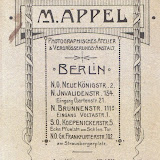
Sometimes the most interesting part of a German carte is its back. Information on Hartmann is scant but it is obvious that by 1902 he had embraced the Jugendstil aesthetic, employing its typography and decorative elements. Well, he was hardly alone in that; just about every photographic studio in Germany was doing it too. 


Here’s another example, by the better known Heinrich Axtmann of Plauen. Like most studios he has dispensed with the traditional and difficult to read Gothic font in favour of several others that are simple and clear. This is the modern world after all and in typography as much as architecture, the ridiculously elaborate pretensions of the Baroque and Neo-Classicism have no place in it. Jugendstil was the German version of Art Nouveau but whatever you want to call it, it was a very feminine movement, with tendrils instead of sharp angles and flowers replacing solid shapes.


None of this was necessarily reflected in the photographs themselves although in Axtmann’s portrait here and Hartmann’s above there is more emphasis on the woman’s shape than earlier portraitists would have considered. Notice the way she appears to blend with the background and dissolve at the base; whatever her intentions for having her portrait taken he wanted a study in contours, stripped of extraneous detail. To his eye she could represent the idea of modern sophistication, less an attitude than an appearance.


Germany in the first decade of the 20th century has a somewhat schizophrenic reputation. Berlin was the centre for the most radical ideas and behaviour in Europe and Weimar had been a home for Goethe, Nietzsche and Rudolph Steiner, but away from those places the impression was of a rigid, humourless Protestantism, somewhat like Scotland, and a disciplined militarism. At first glance this couple look to be the epitome of dour, Germanic severity, but look again and you realize she gives off that aura, he’s a little more ambiguous. Something about him suggests a familiarity with the less sophisticated side of Kolberg, which then was in Germany and now is in Poland. If this was taken, as I guess, around 1910, he would have been too young to take part in the Franco-Prussian War and would have had only vague memories of Germany before the declaration of empire in 1871. Compared to what his parents and his offspring experienced, his life was relatively free from turmoil, Germany was rich, he looks prosperous and, judging from her expression, the wife was probably happy to stay at home with her Bible and her knitting while he trawled the streets.
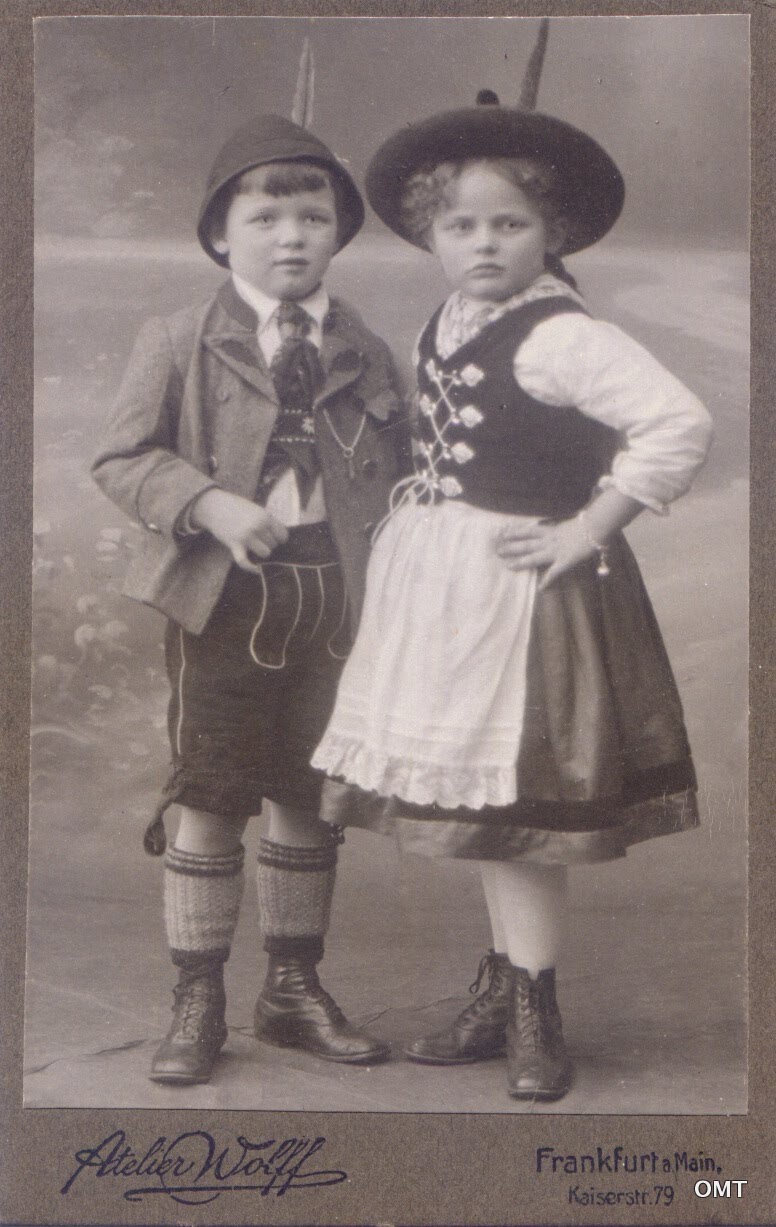


At the turn of the century Germany was producing the best cameras and the sharpest in the world but commercially they failed at photography because unlike the French, the British or the Americans they could not do cute. In other countries photographers had no problem giving a boy in a sailor suit a toy boat and extracting an expression of winsome innocence from him. The Germans tried, like the Wolff studio in Frankfurt did here, but most German children appear to have found it repugnant to put on airs for adults’ sake. The boy looks bemused, the girl frankly irritated at having to dress like Hansel and Gretel, and why not? They’d obviously feel stupid wearing those clothes out on the street so why should they feel different in a photographer’s studio. The girl will go through life getting her own way. Her brother will make one compromise after another until he longs for the sweet mercy of oblivion.


The portrait of this soldier was taken in Berlin, probably between 1905 and 1914. He isn’t wearing any discernable insignia, which suggests he was at an officer training academy. At any time after 1910 he would have known war was inevitable though he might have assumed it would be located in the Balkans and Germany’s main role was to shore up the collapsing Austro-Hungarian Empire. Even in the first months of the war he could have been forgiven for believing an officer’s first role was to provide a model of dignity and poise to his soldiers. After all, everyone around the Kaiser was confident this was a just an argument that would quickly be resolved. 


And what of this polished individual? He looks like officer material too though he is young enough to be a student photographed before a ball. Whatever the case, he’s of an age that made frontline action almost inevitable – almost because if his family had money or influence he could have secured a desk job in Berlin. When you think of what was happening in photography and what would come after, it’s easy to dismiss this German period as commercially ordinary but right at the time these portraits were taken August Sander was running a studio in Cologne and producing work of much the same standard. He was also at the beginning stages of his massive compendium of portraits of the German people. A lot of those early efforts depend on the now accepted formula of clean lines, even tones, muted, angled lighting and a complete absence of artificial sentiment. The difference was that Sander didn’t just rely on whoever came through his door but went out looking for his subjects. It isn’t far fetched to see in these portraits a missing link between the 19th century and modern photography.

GERMAN HUMOUR

Friday, 16 December 2011

MORE CABINETS OF CURIOSITY

Four cabinet cards that deserve a closer look


“Photography deals exquisitely with appearances, but nothing is what it appears to be.”
Duane Michals


At the beginning of the 20th century Azerbaijan was the world’s largest exporter of oil and Baku was a boom town, thanks in no small part to the Nobel brothers, one, Alfred, being responsible for dynamite and the peace prize. Still part of the Russian Empire, this was both good news for Baku – it became wealthy – and a case of bad timing. The automobile had been invented but it was yet to be mass produced, there were only a handful of aeroplanes airborne and modern plastics were a few years off. The world needed oil but it wasn’t yet dependent on it the way it soon would be. Azerbaijan made money but not nearly so much as Texas would start to in the 1920s.
These men are engineers or chemists in Azerbaijan. At a guess they are either working on the design of a new storage facility or a method for distilling petroleum. The cabinet card comes from the English Studio. Was it a studio run by English people or a studio that used the name because at the time England and the British Empire evoked a sense of power and sophistication? No idea. The British presence in Azerbaijan was apparently strong, helped by the fact that the Tsar was first cousin to the King. The study is posed; the man sitting on the right is not looking at the page he is writing on. Was it used top promote Azeri advances in technology? Possibly.


On the cusp of full independence from the Ottoman Empire, educated and middle class Bulgarians rejected the ties to their Turkish heritage. Because that was so ingrained after 500 years, nationalism meant in part looking westward. Rather than embracing those elements intrinsic to Bulgarian identity, some people adopted French styles and attitudes.  This man is an example. Dressed in the typical outdoor clothing of the Western European rambler he has subtly defined himself as a modern sophisticate. But the most interesting detail is the camera in his hand. It is a folding bellows camera. With a bit more expertise we could probably identify the make and model. Set against a fake outdoor setting, he is also depicting himself as a man of leisure. Whether his favourite subject was flora, fauna or landscapes, he has the time to pursue his hobbies. In other words, compared to a lot of Bulgarians he is free.


At first glance a man who has resolutely clung to his Ottoman heritage, but it is only the fez and the moustache that give that impression. From the neck down he is every bit the European gent. The head and facial wear are signs he was probably a clerk and may well have been Armenian or even Greek, given the fez was part of the standard uniform for civil servants in the late Ottoman era. At the turn of the century Phebus was one of the best known studios in Constantinople, run by Boğos Tarkulyan, an Armenian who had begun his career under the Abdullah Freres. In the 1890s he was one of the photographers commissioned to provide work for the Abdulhamid collection and in the 1920s he was appointed an official photographer to Kemal Ataturk. He is an example of how slippery categories are when analysing photographs from the era. An Armenian who moved from the Sultan’s court to that of the first president of the secular republic would need to be pragmatic in his social and business dealings, aware yet discreet. This portrait captures something of that ambivalence. If the subject is a Turkish Muslim he has already adopted Western modes. If he is an Armenian Christian he is comfortable with Turkish symbols.


Great Falls, on the border of New Hampshire and Maine, was a town built on textile mills so even though that part of the world was famous for its brilliant autumn colours and the forests that ran all the way into Canada, you can bet that at the turn of the last century it was choked with smog and caked with industrial filth.
This man has the fierce glare of the Protestant fanatic in his eyes and there is something God fearing about his beard too. His clothes are well cut. If he was a mill owner or had a managerial position, you assume he knew how to make the workers cower when they came in with their demands. First impressions matter but if you look closer you realize the intensity of his stare may not come entirely from a black heart or belief in damnation. His pupils are tiny and at equal points above them sit two pinpricks of light. This is very likely an early example of photography under electric lamps. Between 1895 and 1905, which is the estimated date range for this image, electric lighting was becoming more common in studios but it was still expensive, first to install and then to use. This might explain the subject’s stiff composure as well. He may be used to being photographed but this process is new to him and he doesn’t quite go for sitting still and staring at a light globe. Who’s to say that when Etters indicated he had finished, our subject didn’t inhale deeply, smile and grant his workers the afternoon off?

MORE CABINETS OF CURIOSITY

Saturday, 12 November 2011

THE GREAT MOUSTACHE MYSTERY


Some great moustaches

“Since I don't smoke, I decided to grow a moustache - it is better for the health.
However, I always carried a jewel-studded cigarette case in which, instead of tobacco, were carefully placed several moustaches, Adolphe Menjou style. I offered them politely to my friends: "Moustache? Moustache? Moustache?"
Nobody dared to touch them. This was my test regarding the sacred aspect of moustaches.”
Salvador Dali


Actually, there are several mysteries regarding the moustache. One is its erratic place in our history. Today’s moustache would be a joke if it were actually funny. On most men it’s not much more than a puddle of fuzz across the upper lip, biologically something between a nicotine stain and a pipe cleaner, especially when in it’s most fashionable form, attached to a neatly trimmed goatee. Not a hundred years ago however, a moustache could be a thing of great and audacious beauty. A man tended to his the way he would a garden, lovingly clipping, pruning and shaping it. He devoted time to it. After all, it was his identity.


For the Edwardian gentleman serious about cultivating his facial hair, the investment wasn’t just in time but money. Alongside the various clippers and razors he needed curlers, which needed to be heated to a precise temperature that would allow the ends to be shaped without burning the whiskers. Wax was essential, as was a snood, a netted mask that retained the moustache’s shape during sleep. Moustache cups and soup bowls had a bar across the lip that protected the whiskers from liquids and if he had the money he could think about a silver moustache spoon that had a guard to stop soup clinging to his face, saving others the indignity of having to avert their eyes during conversation. When travelling, a comb and a dab of grease would suffice for his hair but he’d probably need a small bag for all the accoutrements necessary to keep his moustache in working order.


Research (Wikipedia) suggests the earliest documented free standing moustaches – i.e. not backed up by a beard – belonged to the Pazyryk of the Altay Mountains, which is no surprise.  The Pazyryk were ancestors of Turkic tribes and had strong cultural affinities with the Scythians who inhabited regions west to the Ukraine. The finest, at least the most ostentatious moustaches have always been associated with Turkey and the Balkans, heirs to both ancient races. Still, the moustache has a patchy history.  Maybe some Gaulish chieftains of the late Roman early Middle Ages wore them but since our visual records are all later impressions that could be conjecture. For most of Western Europe’s history the free standing moustache was out of favour. Charles I, England’s least manly king, sported a dashing and fashionable Van Dyke but after the 17th century the moustache all but vanished, until the mid-19th when it suddenly returned with a flourish.


Why exactly is one of those historical problems for which any theory proposed has scant evidence to support it. Personally, I think it had something to do with industrialization fragmenting long entrenched social orders. By the mid-19th century entirely new social classes of factory owners, engineers and other self made men had emerged. It was the beginning of the great shift to the cities. If scholars and peasants alike still preferred the antique looking full beard and Protestant firebrands the preposterously ugly chin strap, a 19th century man who wanted to show he belonged to the modern world wore a moustache, particularly something as visually arresting yet impractical as the handlebar. Wearing one let the viewer know two things; you took care of your appearance because you had self-respect.


Whatever a beard may be, a moustache is a badge. The style a man chose – the English, the handlebar, the imperial, the walrus, the pencil, the toothbrush – was his way of letting people know his station in life, When he walked into the saloon one only had to glance at his moustache to know his class, occupation, political views, sense of humour, whether he was a thinker or a fighter, a family man or a rake. It saved time and made conversation a lot easier. You wouldn’t go up to a man wearing a walrus and ask what he thought of last night’s opera performance but you could try that if he was wearing a handlebar. A man with a toothbrush on his upper lip might not have a vivid imagination but if you wanted some common sense on business he was the one to go to.


Several moustaches have fallen out of favour. Thanks to Hitler the toothbrush is finished for the time being. The handlebar and the English with their waxed tips look more pretentious than colourful these days. In the late ‘60s the walrus made a comeback, especially among Californian country rockers. It evolved into the horseshoe but survives in small pockets where the full extent of modern technology has yet to make a real impression. Some are decidedly ethnocultural. The pencil is Latin and looks inconsequential on a blonde man, in the same way that an imperial can look entirely natural on a Croatian waiter yet pompous on an English comedian. At one time a European man looked to his royal family for advice regarding facial hair. These days it’s only the minor royals, by and large an unsavoury bunch of drug addicts and tax dodgers, who sprout the stuff and no one cares to follow their examples. Ironically, given the moustache’s long identification with overt and very heterosexual masculinity, it is the gay community who have rescued some of its finest forms from ignominy.


The rebirth of the moustache coincided with the invention of photography and it followed that a man who had spent months cultivating the growth on his upper lip would not be shy about hiding it from the camera. There are thousands of splendid examples out there. Here are just a few.


GREAT MOUSTACHE MYSTERY

Saturday, 29 October 2011

CABINETS OF CURIOSITY


Reading 6 cabinet cards

“Photograph people as they really are - do not dress them up”
Henry Peach Robinson


1:What we see isn’t always the whole picture.
There are probably hundreds of thousands of cabinet card portraits taken in studios using elaborate backdrops. The photographer, Whittemore, went to a lot of effort or expense with his studio stages; note the fake grass and the landscape behind disappearing into mist. Still, it’s not that remarkable, except that Whittemore was based in Ashland Nebraska, about as mid-west American as you could ask for in the 1890s. Reading Ashland’s local histories it quickly becomes apparent that the chroniclers struggled to come up with anything interesting to say. This was a farming town, hemmed in by snow in the winter, prone to unpredictable weather the rest of the year, a place for sodbusters who wanted to do it hard. Even at its height, when the railroad brought in more trade, the population barely exceeded a thousand. This cabinet card is a portrait but it is also a highly contrived fiction. From the cheap plaster plinth and faux moss on the wall to the woman’s elaborate hairstyle, it is a fantasy about a world far removed from Ashland. There doesn’t appear to be a lot of information about a photographer called Whittemore in Ashland though a Frank Whittemore ran a saloon in town and the name crops up in 19th century Nebraska registries, suggesting the family were early settlers or at least were successful in business. 


2: We are not always sure what we are looking at.
Is this a man or a woman? His or her face is sufficiently ambiguous and though the hands look more masculine than feminine it is the hairstyle that begs the question. Note the painted art nouveau dresser on the left, the floral decorations and the bust on the table. If it is a he then he is stating his position as an urbane sophisticate, an arts student possibly and nothing too remarkable about that. If it is a she then the implications are obviously much more subversive. Note the ring on the middle right finger, or don’t. Some brief research via Google indicates that for some people a ring on this finger is a sign the wearer is gay. There are just as many who see no significance in it. There does not seem to be any evidence it was worn as a symbol of sexual preference in turn of the century Germany but there is a tradition that when a woman bought the ring herself this was the finger she should wear it on. This is a photo you could look at for hours, analysing the significance of every detail without being confident you had arrived at an answer. It is of course possible that this was what the photographer and the sitter wanted.


3: The devil is in the details
Here are late 19th century Balkan politics boiled down to less than 100 words: four empires, the Russian, the Ottoman, the German and the British, have their own motives for maintaining influence in Bulgaria, the only common ground two of them sharing being a desire to keep the other two out. Serbia and Greece want a say in affairs too. The Bulgarians meanwhile want their own state, which the four powers are very keen to see happen, but on their individually specific terms. One sop to this mess was the Principality of Bulgaria, established in 1878 and nominally subject to the Ottoman Empire, a situation that satisfied no one.
The capital of the short lived principality was Turnovo, which was where Adolphe Bornfen set up his studio some time in the late 1880s. He probably took this photo in the early 1890s. At first glance it follows all the rules for a typical family or wedding portrait but several details are important. The first are the crucifixes the women wear. In opposition to the Ottomans who had ruled Bulgaria for 500 years, Christianity was inextricable from the Bulgarian National Revival. By wearing the crucifixes the two women appear to be making a quiet though pronounced stand. The woman on the right, presumably the man’s wife, also wears national dress, not something she’d put on in daily life. Is it a wedding dress? The man’s costume is typically Bulgarian though it is borrowed heavily from Ottoman traditions. This may not be a political image though its politics are everywhere.


4: Or not, as the case may be.
Another cabinet card by Bronfen. It appears to have been taken a few years later. To call yourself supporter of Bulgarian independence might not have been such a big deal in the 1890s. If you were Bulgarian you were, the only issue being which faction you supported; populist and democratic or a sympathiser with more militaristic ideals. We can’t say what side Bornfen belonged to. Though the man on the left wears a sword he doesn’t appear to be a soldier; an aide de camp perhaps or a government man in ceremonial dress. If so, the man on the right would be a politician or bureaucrat. Once you start looking for political meaning it crops up all over the place. The clouds could suggest some celestial ideal, but then they may just be a studio trick. 


5: Truth is stranger than fiction
Henry Peach Robinson is one of the most significant photographers of the 19th century. His composite images such as Fading Away and When the Day’s Work is Done are considered landmarks and he is credited with coming up with the term ‘Pictorialism’. The several books he wrote on photography were manifestos for establishing photography as a fine art, but like thousands of others in Britain his main business was in the studio. Interesting, you might think, that for someone famous for using a battery of special effects, this portrait relies on entirely natural props. Information on the back dates this as post 1878, a period when Robinson was at his most dogmatic in declaring how and why photographers should aspire to art, but then his theories were always somewhat anachronistic. He still believed for example that art should reflect truth.    


6: Less is more.
At first glance this woman appeared to be in the throes of emotional disturbance but it was her dark velvet top with its sharply angled shoulders and her somewhat aversive posture that gave that impression. She doesn’t look entirely comfortable with being photographed, otherwise she seems the image of the prim and respectable teacher or governess; someone well versed in Latin or French history and worn down by a succession of pupils who couldn’t care less. If this were a standard carte de visite, about a third the size, certain details such as her pince-nez and the texture of her clothes would be lost. The large format of cabinet cards gave us more information, in this case just enough to want to look twice.

VIEW THE GALLERY HERE
CABINETS OF CURIOSITY

Sunday, 29 May 2011

MAIN STREET

C. L Hunt: small town studio photographer

“A person can stand almost anything except a succession of ordinary days.”

Goethe


As photographs they aren’t particularly interesting, being typical of millions of cabinet cards produced in the US in the 1880s, but precisely because of that we can use them as a starting point to consider what it meant to be a small town photographer in America in the late 19th century. At a time when there was a debate in the cities as to whether or not photography was an art, people like Clarence Hunt regarded themselves as tradesmen. Success depended entirely upon the number of customers and in a town like Franklin Falls, which today we’d think of as a village, there wasn’t much chance of getting rich or famous. Once a town reached a certain size a studio photographer became essential but it was an occupation for people of middling ambitions.


C. L Hunt was born in 1852. By 1881 he was operating as a watchmaker and jeweller on Central Ave, Franklin Falls, and by 1888 he had branched into photography. The move wasn’t unusual. It was common for photographers to run two or three businesses out of the same shopfront and jewellery and photography had certain affinities. Both involved a working knowledge of chemistry, the use of mechanical instruments and detailed work. A jeweller working with electroplating and engraving should have easily adapted to photography. Economically it made sense. Neither occupation could have been sustained on its own and being a merchant by disposition he would have understood the logic in diversifying. The elaborate studio backdrop in the group portrait indicates he had at least a moderate sized studio. He would have had a staff as well; a receptionist and at least one assistant in the studio and/or the darkroom.


Franklin Falls was a mill town just outside Franklin on the Merrimack River in New Hampshire. Maps and photographs from the 1880s suggest there were probably no more than 3000 people living in Franklin, a population large enough to sustain one photographer, two at the most. Other photographs by Hunt online show he took a few landscapes and did some advertising work but mostly he was a portraitist who followed orthodox procedures. Prices for photographs varied between towns and states and by the 1880s they had fallen considerably over the previous 25 years but a working figure would be between 25 and 50 cents per cabinet card. Cost of living figures for nearby Connecticut show that in 1880 the average wage there was $1.75 per day. At a very rough guess, Hunt would have needed 5 or 6 customers a day just to stay afloat. Presumably he got them because he was still registered as a photographer at Central St in 1895 and worked at least another 7 years.


Go to a newspaper archive from New York or Chicago in the 1880s and search for ‘photographer’ and ‘suicide’. There are a few entries and they tell much the same story. A photographer doing alright for himself in a small town decided to try his luck in the big city. Things didn’t work out and one night he returned to his room in a shabby boarding house and put an end to his suffering. Photography was a cutthroat business, particularly at a time when the technology was rapidly evolving. The shift from albumen to gelatine based prints for example required a whole new investment in equipment at the same time as the new processes were making the production of photographs much cheaper. One way to survive was not to innovate. Keeping to a formula his customers were familiar with, he could turn out a steady number of portraits and the only adaptations required were in small technological advances. Electric lighting for example was around in the 1890s although he might not have used it because it was expensive and the studio skylights worked just as well. By the turn of the century albumen printing was redundant but still available. The cabinet card was also on the way out. If Hunt, now in his fifties, thought he was too old or close to retirement to change he would have watched the arrival of the Kodak camera with a somewhat indifferent resignation, realizing that in a few short years his most important clients were likely to be the mills and local businesses needing advertising.  The real legacy of people like Hunt is that we have an archive of images of ordinary citizens from small towns, people who, like Hunt, had no ambitions to immortality but have been bestowed with something resembling it.

VIEW THE GALLERY HERE
C L HUNT

Saturday, 12 March 2011

THE BIG SLEEP

"All photographs are memento mori. To take a photograph is to participate in another person's (or thing's) mortality."
Susan Sontag, On Photography

On July the 20th 1874 the New York Times reported a story, originally from a Kentucky paper, of a trader working the Ohio River who had fallen ill and decided to recuperate in a town called Ripley. Among his possessions was a small iron casket containing the bones of two of his children who had died twelve years earlier. According to another of his children he never let the casket out of his sight. Would he have been satisfied with a post mortem photograph of the children? Probably not. A photograph is merely a representation and the physical proximity of his deceased children was what mattered to him.


Susan Sontag and Roland Barthes claimed to see a connection between the act of photography and a form of death, or an affirmation at least of mortality. In freezing a moment of time the photographer acknowledges it has passed, hence a simple snapshot is a reminder that all of us must die. 19th century post mortem photographs don’t fit this argument. If anything, they were an attempt at immortality, to preserve the subject’s brief life beyond death. There are thousands of post mortem photographs still circulating today and most of them are of unidentified, unknown or untraceable people. All the photographs tell us is that at some point this person was alive. As it happens, post mortem photographs are often the last definitive proof of an entire family’s existence. All other possessions have been dispersed and lost. Rather than acknowledging mortality they confirm life.

It is easy to imagine our 19th century ancestors as gloomily obsessed with death. The evidence presented by portrait photographers is of a dour, unsmiling people dressed in dark clothes that cover the body, and we have been left a proliferation of photographs of death and illness. Not just post mortem portraits for the paying public but autopsies, the famous in their satin lined coffins, remains dug up from archaeological sites, medical studies and then there are spirit photographs, which aren’t of the dead because they were faked but they are about death. If not most then a considerable percentage were taken out of scientific curiosity. It is worth remembering that in the 1860s Etienne Jules Marey conducted an experiment on a decapitated criminal to identify the moment death took place. A satisfactory medical definition of death wasn’t available and there were all those chilling stories from the Revolution of blinking eyes and moving lips to deal with. Anthropology was a new social science and to be taken seriously it needed to overcome old prejudices about barbarism in non-Western cultures. That meant an objective study of funerary practices and to be objective it was useful to have that disinterested recording machine the camera on hand. It wasn’t a case of obsession so much as having a lot of unanswered questions to deal with.


Ever since photography was invented the camera has been on hand to document death but then the presence of death has always been an intrinsic feature to being alive. Inevitably life in all its forms and expressions couldn’t be documented without death. If any one person deserves the blame for the death of post mortem photography it was George Eastman. Once he put cameras in the hands of ordinary people they were able to photograph each other very much alive. We didn’t need post mortem photography anymore although there was plenty of death about to keep documenting.

VIEW THE GALLERY HERE
THE BIG SLEEP

Saturday, 20 November 2010

ART FOR ART'S SAKE


Photographic Curiosities

“Whoever produces kitsch ... is not to be evaluated by esthetic measures but is ethically depraved; he is a criminal.”
Herman Broch, 1933


Baudelaire was blunt in his opinion of people who thought photography was art; they were idiots. Real art was about the imagination and had nothing to do with machines. These days his invective sounds quaint, especially as most art now involves some form of technology. It’s as though someone insisted – they probably did – the typewriter would never replace the quill pen.


The argument as to whether photography is art or not became boring about twenty three years ago. At the same time it has never really been resolved. At some point we stopped wondering and decided some photos deserved to be, some didn’t. Still, it was a fight that went on longer than it should have and one result is the vast amount of photography churned out in the name of art where the only justification is its massive size, its reference to other well known works of art, the exorbitant price attached to it or its otherwise crude banality.


Back when the argument still raged people had more inventive ways to make the case. They painted on photographs, used mattes and multiple prints as if to say ‘I know this is only a photograph but it looks like art’. If they felt especially inspired they’d use multiple processes. The world is full of examples of this work and the odd thing is, they occupy a place that doesn’t quite sit with straight photography but we can’t call it art. It’s something else.


Maybe it’s kitsch but that word usually implies mass production and vulgarity whereas some of the works here are neither mass produced nor ugly. ‘Folk art’ is a more horrible term and it also suggests the creator is some backwoods naïf. Several of the people whose work is displayed here were working for a market they probably understood quite well. 


That’s one of the great things about photography. Economics demands that we attach definitions to objects; if we don’t we can’t give them a proper value. So much good photography however avoids categorization. Our response to it is purely instinctive. We like it, we can’t say why and we don’t actually need to.  The so called proto-modernist Baudelaire never realized that in the future art would be what we wanted it to be, which meant we’d never have to worry whether something was or it wasn’t. Meanwhile, like some huge toad watching insects swarm above it, a grossly indulgent art market gazes out through hooded eyes, wondering if this strange species carries a sting in its tail.

ART FOR ART'S SAKE

Friday, 9 April 2010

ISTANBUL, CONSTANTINOPLE

Buildings and portraits from Constantinople 1860s to 1920


Take me back to Constantinople
No, you can't go back to Constantinople
Now it's Istanbul, not Constantinople
Why did Constantinople get the works?
That's nobody's business but the Turks'
“Istanbul not Constantinople” lyrics by Jimmy Kennedy, music Nat Simon


“I am ever haunted in my sleep by this vision which is always the same. My ship puts into Stamboul, a hurried, stolen visit; this Stamboul which I see in my dreams is strange to me, bigger, distorted, sinister … Oh, that strange Stamboul, the oppressive spectral town which I have seen in my dreams! Sometimes it was a long way off, only just its outline to be seen on the horizon; I would land upon some desert shore in the twilight, seeing in the distance its minarets and domes. Heavy with sleep I would make my way across great melancholy wastes full of graves.”
Pierre Loti, Phantom of the Orient


Flaubert contracted syphilis in Constantinople, which gave the disease an exotic lustre when he returned to Paris. To Pierre Loti the city was a seductive but cruel mistress (He was French.). It was inevitable that Madame Blavatsky would turn up in Pera. No 19th century seeker of spiritual truth could leave the city off their itinerary. For these travellers, highly educated and modern thinking, the fractured wail of the muezzins offered a metaphysical awakening. In Constantinople Christianity, a religion most of them had grown up with and reviled, still had an ancient demeanour, as though its essence survived intact. Talmudic scholars sat in doorways running their fingers over ancient texts. Armenian traders offered rugs and silverware from distant places whose uttered names conjured images of desert cities and caravans winding along the Silk Road. The few Muslim women they saw on the street were hidden behind veils, which only added to their allure.


Naturally, the natives of the city had a different perspective. The facts regarding the political health of the empire may not have been on public record but they were apparent. The squalid chaos that excited foreigners was a symptom of imminent collapse. Constantinople’s position at the point where east met west meant that cholera always announced its entrance into Europe by decimating one or another quarter in the city. If by the 1890s the European enclave in Pera was beginning to look somewhat Parisian, it was because a succession of fires had razed the area. Once masters of architecture, the Ottomans had to rely on European skills and money to rebuild. This dependence gave Europeans licence to cheerfully slap the city on the back one minute, kick it the next.

The London Times was particularly adept at urging the Ottomans to sign treaties and engage in peaceful solutions in its editorials while printing articles that depicted a filthy and dangerous city inhabited by cutthroats. The descriptions of Turks with hooked noses and hooded eyes bear an uncanny resemblance to those of Arabs. Meanwhile the Arab states regarded the Ottomans as colonial overlords. Pan-Arabism was a cogent idea in the late 19th century, pan-Islamism not so because it would have necessarily involved an alliance with the Ottomans.


A story from the New York Times, September 26, 1880, condenses European attitudes in one paragraph. A young Frenchman catches sight of a veiled beauty and falls for her. He attempts correspondence, eventually succeeds and heads off one night for a rendezvous. Following the directions she has sent in a letter, he goes to a cemetery where he meets an enormous black servant. He is led to a doorway. A friend watches him step inside. He is never seen again. There are no names, dates or any other evidence to give the story substance, most likely because it never happened. It is a moral fable: beware of those veiled women, and beware of the Turks; they cannot be trusted. Still, there is just the chance he survived and the reason contact can’t be made is because he doesn’t want it.

There was nothing enviable about Constantinople’s geographic position. Both Europe and Asia yet neither, it was trapped on the fence. Meanwhile, to the north, Moscow repeatedly made clear its intentions to invade. One of the enduring positive images of late Ottoman Constantinople is of Muslims, Christians and Jews cohabiting peacefully. This isn’t entirely true. There were several religious riots in the city in the 1880s and ‘90s, not to mention a popular opinion in Greece that, having thrown off the Ottoman shackles, it could one day reclaim the jewel that was originally its own. Surrounded by enemies, Constantinople was under theoretical siege. Given these conditions, choosing friends becomes a luxury and cultural differences lose their significance. One has to make do with what one has.


The foreigners returned home with tales of Sufi magicians and other mysterious encounters in the labyrinthine streets of the European quarter. They filled their poems and travelogues with images of minarets and harems. It’s a fair bet the locals would have been bemused by their city’s reputation as a mystic melting pot. For them religion would have been one of the few constants and probably the only thing that offered hope of salvation.

VIEW THE GALLERY HERE
ISTANBUL CONSTANTINOPLE