Real
photo postcards from the Edwardian stage
“Romance at short notice was
her specialty.”
Saki; The Open Window

Real
photo postcards of actresses are one of the enduring legacies of the Edwardian
era; ‘enduring’ to mean lasting although the general impression from a recent
visit to the Spitalfields Market was that interminable would be more apt. Not
surprising when you read how many thousands of millions of postcards were
published then sent each year of the 1900s and how photos of stage actresses
were far and above the most popular category in Britain. But amidst the glut of
portraits of women in ubiquitous broad-brimmed, feathery hats and puffy
blouses, with their stiff composures and curiously sexless expressions, there are
occasional images that catch the eye. Just about every one of Hettie King will
do that. She was one of several actresses who made an art of male
impersonation. It seems that while transvestitism among the citizenry could
always create an absolute scandal in the late Victorian and Edwardian era,
gender impersonation in the theatre was a specialized skill and in demand, with
none of the connotations of sexual or political transgression apparent
today. Of course, Ms King was a
comic actress: she played the man for laughs, and laughs in the Edwardian
theatre were often of the double entendre type.

It was already a convention in pantomime that the crotchety widow or the scheming
stepmother was played by a man; this was comedy after all. When J. M. Barrie’s
play Peter Pan debuted in 1904 it was
standard for the lead character to be played by a young actress. The play’s
subtitle was the boy who wouldn’t grow up
and gender ambiguity was a useful metaphor for somebody trapped in a physical
and emotional cocoon. Zena Dare was one of the first actresses to play Peter
Pan. Here she is as Napoleon, another comedic role for which the English
typically cast women. Well that must have stung Gallic pride, or perhaps not
since the Paris music halls had long taken cross-dressing to places the English
theatre nervously avoided.

Zena Dare
is one of those people, like Gabrielle Ray. Lily Elsie and Marie Studholme, who were
prolifically photographed for postcards in the 1900s yet whose name barely
stirs a hint of recognition today. This is inevitable when we think of the
thousands of actresses and advances in technology since the 1900s, yet it might
be also reflect a particularly British attitude. Where the French loved scandal
and their theatre stars made the most of that, over the Channel the female
artistes were presented as having much more sensible private lives. If the
reputations of Cléo de Mérode and
Caroline Otero live on it is for their behaviour off-stage whereas someone who
enjoyed a few years in the West End limelight then married well and retired
from the stage to cross breed apples on the Sussex Downs would at best be
damned with faint praise by being heralded as a national treasure.

Not
everyone was so apparently blessed. During the first decade of the last
century, Gabrielle Ray was reckoned to be the most photographed woman in the
world. Though she was acclaimed as an actress and dancer, a look at her résumé
suggests she wasn’t being called to play Lady Macbeth or Juliet or any of the
other roles that defined a special talent. It may have been her looks alone
that attracted so much attention, in which case her tragedy was as typical as
it was awful. Agents, directors, producers – especially fat, white and ugly
ones – can love a face without caring what lies behind. Even a casual reading
of Ray’s biographical details suggests her alcoholism had something to do with
her being marketed for her face not her acting. In 1936 she suffered yet
another breakdown and spent the rest of her life – all thirty seven years of it
– in psychiatric institutions.
Here’s a good quote from
Ray found on the Footlight Notes page. As she makes clear, kissing was fun in
1906, but not as much as tearing about the countryside in a motor car: I
have done a lot of motoring, but very little kissing. At the same time, I think
it would be a pity to discourage those who like kissing because it seems to
please them very much. If I have by accident kissed anyone I have never heard
any complaint about my mouths; but there, you see, I put cream on my face when
going out in a motor-car, because before I used to do so the wind made my face
very dry.”

We’ll get
back to the subjects but we can’t ignore the photographers: William Downey and
his son Daniel, Alexander Bassano, the sisters Rita Martin and Lallie Charles (previously
discussed HERE) and Francis Foulsham and Arthur Banfield, whose work Cecil
Beaton dismissed as “rather quaint in (its) woodenness”. To be fair, that same
criticism could have been levelled at most of the photographers, and to be fair
again, it wasn’t always their fault. You get the impression with some people
that they couldn’t make the intellectual jump between appearing on stage and
before a still camera. Maud Jeffries was an international star, pulling in full
houses from London to New York to Sydney, especially for the faux biblical epic
The Sign of the Cross. You wouldn’t
know it from this image. She looks like someone shoved a papier-mâché crucifix in her hands and told her
to look fearful of the Lord. This inability to perform for the camera is a
common complaint from the period, and comes from photographers, producers and
actors. Numerous Edwardian performers will spurn the cinema while others will
take it on and fail. The typical explanation is that the actor needs the human
presence, the applause and even the heckling, in order to perform.

Being a photographer
to the stars carried responsibilities. The studios above also photographed
royalty and anyone else who required an official portrait. What mattered most
to their non-theatrical subjects – royals, politicians, etc – was that there be
no surprises. Politicians showed gravitas, the prince dignity. They were
expected to be a lot more creative with stage performers, which could be hard
when the process was a treadmill. Faced with a client list of several dozen
performers, each demanding the special touch, even the best photographers could
exhaust their repertoire. In the same way, some tricks could startle at first
but quickly became clichéd. Phyllis Dare was Zena Dare’s sister. Born in 1890,
she began acting when she was nine and by the time she was fifteen was a star
in light comedies. When she was seventeen (around the time this photo was
taken) she published her autobiography and became one of the first in a long
line of juvenile performers to author a necessarily thin and vacuous account of
a life so far unlived. The title was From
School to Stage, which sounds like it covered everything.

For some
of us, the very definition of a perfect Friday afternoon involves sitting down
with a pile of century old directories and tracking down long forgotten
photographic studios. No matter what joys the exercise holds, there are times
when running into brick walls becomes tiring. Who was Kilpatrick? It was usual
though not compulsory to attribute the photographer or studio on the postcard
but Rotary, which published the card, only licensed the image. There was a
studio belonging to a Kilpatrick in Dublin and if Ms Studholme travelled to
that city for a performance and the studio paid to photograph her, it could
have sold the image on to Rotary. Given that Ms Studholme performed in America
and what the English quaintly refer to as ‘the colonies’, the studio could have
been anywhere in the English speaking world. Her costume here looks Wagnerian,
but operetta rather than opera.

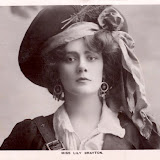
Here’s another
minor mystery. This portrait of Lily Brayton is credited to Johnston and
Hoffman, recognized as one of the leading studios at the time – in Calcutta.
The National Portrait Gallery in London have 52 portraits by the company in
their archives, mostly of theatrical stars. Either we are talking about two
companies having the same name or Johnston and Hoffmann opened a branch in
London. The latter seems more likely, but if so you’d think that would warrant
a mention in the entries found in various encyclopaedias. Once again we have a
case of the gender role reversals and while there is a passably interesting
history of women dressing as eighteenth century highwaymen, what’s really
interesting about this is that we see a really professional use of electric
lighting. This was uncommon in the early 1900s. Electric lighting was still too
expensive for a lot of studios and even those who could afford it needed to
relearn photography to understand how to use it properly.

Dover
Street Studios are another commonly encountered name. Interesting that among a
dozen or so sighted, variations on the Gibson girl look are prominent. It looks
like the studio had an agenda. The GG’s identifying features were her hairstyle
and the long, tight dress or gown, both seen here in Ms Gertie Sinclair. It was
actually a North American fashion. The graphic artist who designed the look,
Charles Dana Gibson, wanted to capture the essence of the ideal American women,
whose very modernness he attributed to a composite of cultural ethnicities and
attitudes. I don’t know how successfully the Gibson Girl caught on in Britain.

The cabbage
is a nice touch. Here Ms Millar wears the costermonger’s outfit that inspired
the original pearly kings and queens, Like Peter Pan, Aladdin was an obviously
male figure commonly played by women and the musical, The New Aladdin transplanted the oriental story to London.

Here’s a
well-known study of the Moores, theatrical family of course, of whom Decima and
Eva became the best known. As discussed in the post on Rita Martin, the
relationship between the theatrical world and the suffragettes was more convoluted
than you might think, and thanks in no small part to the suffragettes habit of
throwing gas bombs into theatres and ruining performances. The Moores however
were firmly behind the movement to give women the vote and were among the
founders of the Actresses’ Franchise League, which among other activities
produced the plays, How the Vote was Won
and Votes for Women. I want to say
more but do the research yourself. It’s worth the effort.

And here
is Eva Moore with her son in an image that is strange on several levels though
in Edwardian England it would have met with widespread approval. These
portraits of actresses with their children are more than commonplace. They are
a reminder of the sharp distinction between London and Paris, where it was
advisable for an actress not to indicate she had a family. They were also a
protest against the popular image of the stage as the home of outcasts and
other ne’er do wells. How better to show the world that the theatre was not
only glamorous but also respectable than by showing actress mums with their
kids. Except of course that young Master Moore looks miserable, as you might if
Mum had made you put on a clown costume then dragged you before a camera.

There are
of course many postcards of male actors and there is a world waiting to be read
in the differences between the two, but let’s end with an image of one of the
best known female impersonators of the age, Malcolm Scott. Like Hettie King,
his choice of role was no indication of his orientation and it seems he lived
an otherwise ordinary life with wife and family in the suburbs. What’s to like
about this photo of course is its various assumptions. We are told that is Mr
Scott but we don’t know for sure. For all we know it could be Hettie King playing
Malcolm Scott playing Hettie King; a conundrum we think made perfect sense to
the Edwardians. We are lucky that so many of these photographs lie scattered
throughout flea markets in abundance. In an age when some people think they can
charge small fortunes for snapshots they didn’t take but bought for 25 cents,
it’s great to have so many images from the Edwardian theatre, a world that is
both familiar and disruptive.
 |
| THE IMPORTANCE OF BEING EARNEST |