11 cartes de visite based on characters from de Maupassant short stories
“Our memory is a more perfect world than the universe: it gives back life to those who no longer exist.”
Guy de Maupassant

Guy de Maupassant’s grave at Montparnasse Cemetery is modest and surrounded by others of much the same dimensions, so even with a good map you have to search for it. Visitors have attached various mementoes including a small teddy bear and a china dove that look out of place on the tomb of someone whose most famous stories are about cruelty and madness. Across the road, Baudelaire’s grave is littered with whiskey bottles, beer cans and dead flowers, which seem more appropriate to the writer, even if Baudelaire wanted to be remembered as a great aesthete and art critic, not a laudanum addict.
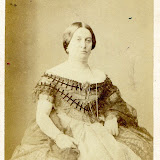
Trying to find a dozen carte de visites in the collection that could resemble characters from Maupassant’s short stories turned out to be difficult, partly because the restrictions – French, between 1860 and 1890, and not used in a previous blog post – precluded some better examples. No one remotely matched Boule de Suif, “round as a barrel, fat as butter and with fingers tightly jointed like strings of small sausages (and with) two magnificent dark eyes shaded by thick black lashes”. The woman above could pass for another passenger on the coach, Madame Loiseau; “tall, stout and determined looking, (with) a shrill voice and a brisk manner”, but then she could be any one of the stolid, middle class matrons who never suffered in his stories but observed the misery inflicted on others with smug indifference. The portrait incidentally is from Bayard and Berthall. Hippolyte Bayard was one of the pioneers of photography, famous for his self portrait as a drowned man, who went on to a distinguished career in photography and has a chain of islands off Antarctica named after him.

A survey like this must include a Prussian officer since so many of Maupassant’s short stories were set during the Franco-Prussian War, and here is one, photographed by a French studio in Metz, a city close to Alsace that was captured by Prussia and not returned to France until 1918. Part of the popularity of Maupassant’s short war stories was in his ability to show the French as either victims or perpetrators of atrocities with a directness that made their actions understandable. The problem is that Maupassant’s Prussians tend to be of two types, the simple minded conscript or the heartless boor and this man appears to be neither. He could be one of the soldiers billeted with Mother Savage, who “behaved as good sons would towards their mother”, but that would assume he escaped the revenge the mother extracted from the soldiers for her son’s death in another theatre of the war.

And here could well be Mother Savage’s son, or one of the many others who paid the price for a French officer’s stupidity or a Prussian’s military obligations. A popular theory after the war was that France’s defeat was brought about by a crisis in masculinity; a nation of once strapping men had become weak and listless, the result of growing up in cities that encouraged pleasure and dissolution. However strongly Maupassant subscribed to the idea, most of his young men are not fit or ready for war. Lacking the brute pragmatism of the Prussians they often bring on their own deaths by showing an unnecessary moment of compassion. The carte has no photographer’s stamp but a look at the records shows that A. Jorda operated from 10 Rue Villedo during the 1860s.

“Oh! Yes; you understand me well enough. It is now three months since I had my last child, and as I am still very beautiful, and as, in spite of all your efforts you cannot spoil my figure, as you just now perceived, when you saw me on the doorstep, you think it is time that I should think of having another child.” In contests involving romantic love women always succeed in making the men look like fools. In ‘Useless Beauty’ the countess schemes against her husband by insinuating one of their many children is not his, then watches him stew as he tries to work out which one. Though the woman in this portrait is not a countess, she matches Maupassant’s description in every other way. Look at the child. The photographer has arranged a distraction off camera in order to keep her (or it could be him) still. Back then a distraction could involve anything from a bird on a stick – “watch the birdie” – to firing a pistol. Some studios were also known to dose children up with opium, which also worked.

I was born with all the instincts and senses of primitive man but these have been tempered with time by both the reasoning and the sensibilities of his civilized successor. I am passionately fond of hunting yet a bleeding animal, a bird with blood on its wings, or even the sight of blood on my own hands often makes me feel faint. This is from the opening paragraphs to ‘Love; three pages from the diary of a hunting man’ and it could describe most men from Maupassant’s social circle, they being an urbane bunch who boasted of their masculine prowess yet often came up short when it was put to the test. Though he was taken under the wing by Flaubert, Maupassant didn’t think much of the famous author’s friends, particularly the Goncourt brothers who struck him as vain and pretentious. Not to label the subject of this portrait by Lefevre as such but he does come across as a typical Parisian, chasing pleasure before duty and, in Maupassant’s view, sure to have one of life’s cruel lessons inflicted on him …

… Like the central character in ‘Tombstones’: One of the most lively of them was Joseph de Bardon, a bachelor living the Parisian life in its fullest and most whimsical manner. He was not a debauche nor depraved, but a singular, happy fellow, still young, for he was scarcely forty. A man of the world in its widest and best sense, gifted with a brilliant, but not profound, mind, with much varied knowledge, but no true erudition, ready comprehension without true understanding, he drew from his observations, his adventures, from everything he saw, met with and found, anecdotes at once comical and philosophical, and made humorous remarks that gave him a great reputation for cleverness in society.
Bardon thinks he is on to a good thing when he meets a young woman wracked with grief in Montmartre Cemetery. By the story’s end he is more mystified by human behaviour than a self-proclaimed man of the world ought to be.

Maître Hauchecome, economical like a true Norman, thought that everything useful ought to be picked up, and he bent painfully, for he suffered from rheumatism. He took the bit of thin cord from the ground and began to roll it carefully when he noticed Maître Malandain, the harness maker, on the threshold of his door, looking at him. They had heretofore had business together on the subject of a halter, and they were on bad terms, both being good haters.
This from ‘A Piece of String’, one of hundreds of stories Maupassant wrote about the peasants of Normandy. He is mostly unsparing. They are possessed of a stupid cunning and utter lack of curiosity and if they get what they want it is often through pig-headedness or sheer chance. What’s more, like the above paragraph suggests, they can be consumed by a rivalry that has no known or a completely trivial source. This portrait is by Claudius Couton, a Nice photographer better known for his work in Algeria. He was working there when Maupassant toured through the country though the chances they met are slim. In the 1870s Algeria was full of Frenchmen seeking artistic inspiration. Most of them came back with something, usually the pox.

And here is a lumber merchant or some other business operator from Normandy. Note how he looks well dressed though could hardly be described as having the sophisticated style expected of a Parisian. Maupassant came from a well off Norman family and he is more sympathetic to men like the one above than to any other from the region. They are inevitably sensible, practical and above the petty demands and grievances of the peasants. In a typical story, a man like ours above will sit at a bar and recount some tale from the district that has a meaning he doesn’t quite grasp.

What, you might ask, is a nun doing here? Well, apart from it being an uncommonly good portrait from the era, we can talk about the clergy because Maupassant scarcely does. Given the authority the Church still held over France, especially in the provinces, you’d think a considered atheist like Maupassant would be ready to expose its hypocrisy and dishonesty but then even his supernatural stories are set in the real world. God and religion have no place there, not even as enemies. His parents divorced when he was young and he was sent to a seminary, a grooming yard for the priesthood but had himself expelled within a few months, indicating his lack of belief was already established. On Good Friday the critic Sainte-Beuve and the illegitimate son of Napoleon III would get drunk and throw sausages at a crucifix yet it is what Maupassant didn’t say that marked him as subversive.

It is usual to associate Maupassant’s tales of madness with his decline into insanity brought on by syphilis but he was writing stories about the profoundly psychologically traumatised long before he knew he was afflicted. Madness was a popular image in French literature, thanks partly to Dr Jean-Martin Charcot, whose public lectures at Salpêtrière Hospital Maupassant and most of the Paris literati attended every Tuesday. Charcot’s most significant breakthroughs in the study of hysteria were in linking it to a trauma – though he resisted the obvious association with sexual trauma such as incest, leaving that to his student, Freud – and in declaring that men too suffered from it. The portrait above was taken at an unidentified French hospital in the 1880s. She has been diagnosed with hysteria.

Maupassant’s most famous story is ‘the Horla: Modern Ghosts’, which like earlier stories such as ‘Who Knows?’ linked the supernatural to paranoia and psychosis rather than the paranormal. The portrait above comes from the same hospital as the previous image. Though he is dishevelled his mental state isn’t immediately apparent. Neurology was still an uncertain science and a paranoid could be entering the tertiary stage of syphilis, suffering trauma as the result of war experiences or injury, be homeless or he could be an agitator the police or other authorities arranged to have locked up. In his last years Maupassant was severely afflicted, attempted suicide several times and spent his last months in the psychiatric hospital run by Esprit Blanche where the poet Nerval and composer Gounod were also treated.
 |
| DE MAUPASSANT |


