And furthermore ...

One Man's Treasure encourages the use of anonymous photographs posted here to illustrate books and album covers.
If an image appeals to you, contact John Toohey at johntoohey@hotmail.com.
Showing posts with label erotica. Show all posts

Thursday, 30 October 2014

THIS IS THE MODERN WORLD

Edwardian era fashion postcards 
“Fashion is made to become unfashionable.”
Coco Chanel


 I have been informed, politely and otherwise, that I am unqualified to discuss fashion. It is true that when the words ‘fashion’ and ‘photography’ appear next to one another a yawn needs stifling. It is the least interesting genre, one reason being that it is so pervasive. It is one thing to encounter fashion photography in the cosmetics department at the local pharmacy, another when it turns up in hardware stores, as though using this power drill will bestow some kind of glamour upon us. Also, the genre has run out of ideas. People speak of a golden age of fashion photography that lasted from 1920 to the 1950s, which was a long time ago now.


 This ‘golden age’ began with technological processes that made it possible to reproduce photographs to a high standard in magazines. Previously they had to rely on line drawings. It coincided with the rise of Parisian fashion houses such as Chanel, the diffusion of modernist principles in photography and suffrage for women, which shifted the balance of power so they were not just portrayed as elegant but having authority as well. But if we look to the years immediately before, we discover that the most important medium for transmitting the latest ideas about fashion was the common postcard.

 
 What made the postcard special was that it was cheap, intended to be sent, and also collected. Typical messages on the backs of these postcards from the first two decades of the twentieth century are: “What do you think of this?” (meaning the costume) or: “Here’s another for you”, meaning the recipient – inevitably a young woman - collected fashion postcards. With the popularity of postcards, studios were pumping them out so someone in Paris could send a postcard to someone in London, who got that season’s fashion tips hot off the press. If her mother was relying on Tatler for fashion advice, she might have to wait weeks for what her daughter received in a few days.


Another advantage postcards had over magazines was that they could be hand-coloured. Fashion advice from the era places a lot of emphasis on colour; gowns and robes are not merely green but chartreuse; burgundy is in; vermilion is out. Japan had been a source of inspiration for European designers since at least the 1880s. Japan meant delicate, which itself meant pastel shades rather than bold colours. When Hermann Kiesel’s studio photographed this model, it most likely received specific instructions on what shades of ink to use. 

Despite the postcard publishers promoting fashion, labels are rare to non-existent on the postcards, suggesting that the designer didn’t matter. We know that in the 1910s the fashion house was still emerging as a distinct force but another explanation for the absence is that the outfits on postcards weren’t strictly haute couture but copies. Department stores in New York imported fashion items from Paris but they also copied the designs. If a broad-brimmed hat complete with ostrich feathers and silk bands direct from Paris cost too much for anyone but the wealthy, most middle class women could afford an accurate replica. Also, the market for the postcards belonged to young, unmarried women. We know that because on the back the cards are usually addressed to Miss or Mlle Someone. Actual haute couture was out of their reach financially, and also maturity-wise, since that was supposed to arrive with the debutante ball, or if they couldn’t afford that, marriage.


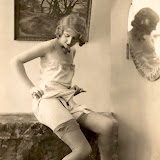
Which brings us to that borderline between fashion and erotica. The frontier has always been vaguely marked out, given that one is often an intrinsic element of the other, and there are postcards that make us wonder whether the real attraction was the fashion or the impertinence, but young women were supposed to have thresholds. They might have gone for the flapper look, with the cloche hat and the woollen outfit. Showing the suspenders however was perhaps too indecorous. The risk of sending a postcard like this to a friend is that the parents could find it, so casting her in their eyes as an immoral vixen. It isn’t the evidence of the suspenders that would have necessarily caused offence but the woman’s posture. In fashion, a woman’s expression could be sultry, provocative or downright lubricious but her physical pose was always supposed to be demure. 


 In 1931 Jeanne Jullia of France won the Miss Europe beauty contest. Some time later it was discovered that in the 1920s she had posed nude for Julian Mandel, the infamous and mysterious producer of erotic postcards. The revelations created a minor scandal but they were handled with more savoir-faire than they would be today. She was not stripped of her title, bundled off to rehab or made to grovel before the press, probably because a sullied past was nothing to get excited about in 1930s France; everybody had one. As with the designers, the women who appeared in these fashion postcards were unnamed but look at enough postcards and certain faces become familiar. Usually they were actresses or singers without the status to warrant a caption. Although some women worked as professional models the job was so poorly paid it was something they’d do on the side. Like acting, it was still a disreputable occupation for a woman but at least in the theatre she could redeem herself by becoming a star. 


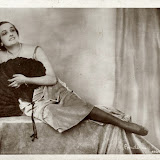
 This card was sent to Mlle Sarah Parent at 1197 St Catherine St Montreal on April 25 1907 and asks if she can still come to the theatre that evening. (Mail was commonly delivered three times a day back then, which is why you can find postcards mailed from Brighton to London arranging to meet that afternoon.) A Sarah Parent turns us in the Quebec records as born in 1893. If this is the same Sarah, she fits the profile. At fourteen she would be going to the theatre with friends and have an interest in fashion. Notice that the girl in the photo is only a few years older, about eighteen; in other words, a suitable role model. This was sent at the height of the fashion postcard era. That ended with the First World War. It wasn’t so much that the war created a break in the culture but that the customers grew up. Post war, Sarah Parent would be twenty five, possibly married and if she were still interested in fashion she would be turning to the magazines that were aimed at older women. Like the extravagant Edwardian hats, fashion postcards belonged to the past.

THIS IS THE MODERN WORLD

Tuesday, 21 October 2014

WINGS OF DESIRE


Transgressive images from Weimar cinema
 "I’m sincere in my preference for men’s clothes. I do not wear them to be sensational. I think I am much more alluring in these clothes."
Marlene Dietrich


 Berlin in the Weimar years: a city rampant with leather wrapped, cross-dressing S&M fetishists, or not. Depending on whom you ask (or what you read), that image is either an invention or a conflation. There were bars like the Silhouette, where a customer could take a table and watch a parade of men in make-up and dresses and women in tuxedos, but reliable advice suggests most of the night spots were a lot tamer than that. Apparently we can thank films like The Night Porter and Cabaret for seizing on a rumour and treating it as fact. If the Nazis were perverts by definition, it was assumed that for night time amusements they’d prefer watching a couple of transvestites spanking each other rather than a blonde fraulein singing banal operetta, but when you think it through, the latter is darker, stranger and altogether more disturbing. One of the hallmarks of the Nazi leadership was an abject lack of imagination. These were people who dreamed of a world where everyone shared their passion for kitsch, which meant blonde girls in gingham singing folk songs, not sexual ambiguity. Goodbye to Berlin, Christopher Isherwood’s original book on which Cabaret was based has no scenes set in a cabaret, but can we really blame Michael York and Dirk Bogarde for helping create the enduring image of Berlin C1930? Not entirely. Thanks to the Ross Verlag postcards we have thousands of surviving images that show the photo studios pushed the idea of a city where taboos were broken as a daily habit. Yet, coming from the cinema world, they were images of what the world could be, not what it was. Lya de Putti’s attire may have looked fabulous but it was impractical, and it was easier to imagine a world where women strolled along the Kurfürstendamm in sheer, glistening black rather than live in one where they actually did. After all, for a lot of ordinary citizens struggling with hyperinflation and massive unemployment, to dress like Ms Putti does in this photo was like waving a red flag at a National Socialist rally. The photograph is by M. I. Boris, aka the Bulgarian Boris Majdrakoff, who arrived in New York in the 1920s with a past respectable thriller writers would have dismissed as too unlikely. 

 
 Look at contemporary fashion images of women wearing suits and ties and we are meant to think of them as daring experiments in gender reversal, but so many of the Ross postcards show women wearing men’s clothing, or a close approximation, that we realize they were a trend back in 1920s and ‘30s Berlin. What makes us think they are about playing a game rather than making a statement is that so many of the actresses portrayed did not have reputations for challenging convention. From what we know of Carola Tölle, she played solid roles in films that are largely forgotten because there is no compelling reason to remember them. Her private life can’t be accounted for but it appears scandal free.

 
 Henny Porten’s fame and reputation have endured, for her roles as a gentle or long suffering earth mother type. Comparing the photo of her with that of Ms Tölle, we begin to see a pattern, or rather, a style. Only a decade earlier the notion of a woman wearing a suit and tie would have still caused a stir. In 1919 however, German women won the right to vote.  What had changed had less to do with Weimar Berlin’s free thinking than fashion designers’ understanding of how to accommodate radical into chic. Ms Porten’s sleeveless waistcoat has a decidedly feminine cut. She is not wearing a business suit. In the 1970s Diane Keaton revived the suited look in Annie Hall. If it didn’t make the jump to the pages of Vogue that was because it was too idiosyncratic: it was one thing to look like Diane Keaton, another to look like Annie Hall. And maybe the crusty old editors at the magazines took one glance, recalled their youth in Vienna wearing Papa’s silk ties and thought it had all been done before.

 
 Having never seen Marcella Albani in a film, commenting on her strengths as an actress is pointless, but in every other photograph of her in the collection she is portrayed as the embodiment of graceful elegance; a woman with a preference for haut couture and intelligent conversation. That doesn’t mean she lacked a sense of humour. When she fronted up to the studio on this particular day, she might well have been bored with the idea of yet another soft focus study suggesting she had just emanated from the mists. Perhaps Herr Binder was bored too and together they concocted an image the very opposite of what was expected. She was an actress; it was her job to be out of character. 

 
 Russian born Hella Moja dressed as a baroque era noble (or Mozart) looks to be having the last word on androgyny here, and in a way she is. We know from photographs by Walery and Reutlinger that the Ancien Regime look was popular around the Parisian music halls a generation before Karl Schenker took this portrait. So too were the matador, the Gypsy and even the blacksmith. They were too exaggerated to be subversive, more like fancy dress, and never began with the premise that other women might want to dress that way in the street. Also, it was always more acceptable for women to dress as men than the other way around. How many of the leading male stars were willing to don corsets and bustles?

 
 Sigmund Freud’s nephew Edward Bernays famously turned up in the U.S and turned women on to smoking. He took his lead from home, where the habit was already associated with modern sophistication, added a bit of volume and general crassness and earned the undying gratitude of his employers. A lot of the Ross postcards show women smoking; by the mid 1920s a cigarette in the hand was a sign of elegance, of adulthood, but not necessarily of rebellion. Ms Haake’s forte was light comedies and socially concerned dramas and she’d go on to a long career, appearing in films into the 1980s. If the idea of a woman smoking was as scandalous in Germany as it was in America, she’d be one who’d put hers out before the photographer was ready with the camera.

  Not so Fern Andra, the great, unsung heroine of early cinema. American born but European by preference, she promoted herself as a woman who liked a cigarette and a stiff drink and would be disappointed by any man who did not offer her both. In reality she was an intensely serious worker who understood the dangerous gulf between public image and private life. She paid a price, but not for smoking or dressing in men’s clothing or any of the standard contraventions. As actor, director, producer and even photographer, she controlled her image so closely that when it began to fade no one was on hand to help her revive it.

 
 Which brings us to that most infamous figure of the early screen, the vamp. Her modern history began with the nineteenth century music halls, she came of age with silent film and died with its passing. It was difficult to be a real vamp in the 1930s. The Hays Code in Hollywood was very much opposed to any young woman who thought a man’s marriage was a speed hump not a stop sign. According to the new rules she had to pay for her crimes, which was an obligation no genuine vamp ever considered. The Nazis weren’t keen on her either. For all the bondage and S&M imagery bestowed upon them, publicly their ideal woman was blonde, virtuous and enthusiastic about the outdoor life. She could suffer but never inflict pain herself. The vamp was dark, saturnine and came alive when the sun went down, like Valerie Boothby in this image from Iris cards. Despite her very English name, Ms Boothby was German. Her career was short but included such titles as Girls on the Cross (1929), Adam and Eve (1928) Inherited Passions (1929) and Marriage in Name Only (1930); all which suggest some poor fool learns a lesson about love the hard way. 

  The vamp and the femme fatale were subtly different creatures; though the man who fell victim to either was seldom astute enough to know that. Both depended on exploiting male vulnerabilities but where the first was essentially amoral the second had principles and objectives. Sometimes she was looking for a way out and figured the man would lead her to it, and sometimes she was genuinely in love with him. If the last scene saw the vamp heading down the street with a man in her arm, you knew they were going back to her lair. If it was the femme fatale on the other hand, she may well have been persuaded that the path to true happiness lay in marriage, children and a home in the suburbs. Lissi Arna is one of the many German actresses of the silent screen forgotten now by all but the most devoted fans of the era, yet throughout the 1920s she was one of Weimar cinema’s most popular stars. Her reputation today, such as it is, rests on several films where she played the prostitute (hard hitting exposé) or the seductress (comedy, melodrama) but as it transpires she made more of the routine romances that were the bread and butter of the film business. The Kiesel Studio was located at Kurfürstendamm 11, meaning the address was fashionable but real information beyond that is hard to find. Alongside the celebrity portraits are many more showing children with oversized Easter eggs, or (that other inexplicably popular genre) dressed as their parents. What we see here is one of those minor shifts in the way women were portrayed that don’t raise the number of eyebrows today that they should. There is nothing vulnerable in Ms Arna’s expression. She knows what she wants and how to get it. 

  The secret had less to do with women discovering an independent spirit than technicians realizing the power of lighting. Photographers were learning that a shift in angle to throw a shadow could do more than animate a portrait. It could transform Elizza La Porta, generally sensible star of such morally didactic films as The Right of the Unborn and The Vice of Humanity (abortion and drugs respectively) into a siren of the night. Silent Hollywood gave the vamp fame and notoriety but in Los Angeles she was a European construction. Think of the number of famous Hollywood mantraps from the silent era, how many have ‘European’ names, and what their actual names were: Theda Bara (Theodora Goodman), Dita Naldi (Mary Dooley), Olga Petrova (Muriel Harding). She was by definition exotic because part of the danger of becoming involved with her lay in being unable to penetrate her closed, enigmatic mind. In Germany, America was a strange, distant land (witness the popularity of Karl May’s Native American novels), but so too were places just beyond its borders. The Balkans, home of the vampire, Oriental Turkey and the Arab lands, the Russian steppes; they were all breeding grounds for women who could crush a man’s soul with as much thought and effort as it took to flick a cigarette into the gutter. Romanian born Elizza La Porta may not have played the seductress on screen but she knew how to for the Manasse studio. Operated by Olga Solarics and Adorjan von Wlassics, it specialized in glamour photography and in surreal, modernist erotica. After years of relative neglect, the erotica was rediscovered and in the process became representative of decadent Berlin. The studio was equally adept at portraying actresses as sweet and wholesome as a strudel. But any fool with a camera can do that.

WINGS OF DESIRE

Friday, 21 February 2014

BACK TO THE BEACH


Photos from the seaside
 “The sea, the snotgreen sea, the scrotumtightening sea.” 
James Joyce; Ulysses


The snow is a metre deep and such a drag to walk through that little things like a litre of milk from the shop 50 metres away need decisions and planning. It has been cold for so long that when the temperature rises to minus 5 we believe that things are looking up. After all, a month ago it was reported that the Prairies were colder than Mars. Down in North Carolina a state of emergency has been called because an inch of snow has fallen, which might suggest that they aren’t that educated down there. Even in Istanbul, world capital of traffic accidents, (or maybe that’s Mumbai) they still know how to drive through a couple of inches of snow without wiping out every nearby vehicle. Then again, snow falls so seldom in North Carolina that we can forgive them what looks like unnecessary anxiety. 


Inevitably thoughts turn to the beach, that stretch of long white sand that people in Western Australia take for granted, or did until their government told them there were schools of man-eating sharks waiting off shore for the first fool to dip his toe in the water. Thousands don’t believe the Government but it isn’t entirely making things up. Marine biologists agree that sharks are more of a problem than they used to be, though the Government conveniently dodges the issue that its own bad management of the environment has led to conditions where sharks’ natural diets are disappearing. It’s not that sharks dislike us; they have nowhere else to go for food but the shoreline. But not to worry: if anything will keep those predators at bay it will be the toxic sludge leached into the water.
The beach: it used to be the place to go to rid oneself of worries. 


There are plenty of photographic books about the beach, from historical accounts of seaside resorts full of postcard reproductions made to look as dull as their subject is interesting, to others that are basically porn spelled A R T. Yes, to some of us the beach means Edwardian ladies walking along the promenade in enough clothing to repel a tank; to others their descendants wearing nothing but a few grains of sand. What seems to be missing from all this is a book about “The Beach”, or as the English prefer to call it, “the Seaside”: a place but also an idea. 


For some reason the history of the seaside begins with the English. To be absolutely historically accurate, it should start with the French and the Riviera, the Cote d’Azur, since they were the first to turn the seaside into a tourist venue, yet that detail usually gets lost. Possibly because the French resorts were for the upper classes whereas in England they started out for everyone. Responsible factory owners might pay for the workers to have a bank holiday by the sea, once they realized that one day’s largesse could buy them a few months of respect. Also, if you were living in places like Leeds and Nottingham, where the air alone was toxic enough to raise infant mortality rates to one in four, the seaside with its fresh breezes became a kind of mythical sanctuary.


Is it the same idea of sanctuary that also leads the broken hearted and the generally troubled to the beach? Some people instinctively head there the moment things turn wrong. Filmmakers have understood this for years. Want to show that the romance has ended? Put one of the characters on an empty beach and let them walk alone until they become a small speck on the screen. It’s a perversion of the idea of sanctuary, being out in the wide open and all alone, but we know that it is here that a person is safest with their thoughts. And it’s also a a perversion because the beach is a world where the sun shines, mostly, and the people who inhabit it have no body fat, arteriosclerosis or stiff joints. 


Of course, it would be silly to think of the beach as only a place where the broken hearted went to cure their inner heartaches. If that were the case our coastlines would be crowded with victims of existential misery. Who’d want to go near them then? Of course they are places for fun. No doubt those early pioneers who sat in a studio in their well constructed swimsuits thought they were having that, but as everyone knows, actual fun, the real stuff, begins when you strip down and charge into the water. The beach is a place where hang-ups aren’t left at the door, so to speak, but thrown on the ground This is a great photo: all about fun but strangely gloomy, and that construction in the background suggests they are somehow way out to sea, in the middle of nowhere.


My research, admittedly light, indicates that during the 19th century thousands, maybe even millions of Britishers flocked to the seaside, but taking the waters apparently meant getting close though not getting in them. There was a reason for that. Most people couldn’t actually swim. If they went in the water, they’d sink like a stone and that would be the last we’d hear from them, save a headstone in the local cemetery. ‘Taking the waters’ usually meant standing knee deep in the sea and breathing in the air, which would have helped if you had spent the rest of the year in a town like Leeds, sucking in the triumphs of the Industrial Revolution. 


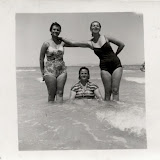
His name is Bill and he is a G.I. Her name is Velma. It is 1944, and a story with a G.I named Bill and a girl called Velma has more or less written itself. It won’t end well. One of them will be holding the gun at the end. Let’s enjoy their happiness while we can.


Collect snapshots and before you know it you’ll have dozens like this one, of people with their head above water. It is one of those scenes we can’t resist buying partly because people couldn’t resist taken them. It is a self-created genre. The greatest gift George Eastman gave us wasn’t the camera but the means to photographs moments like this.


Any book devoted to the seaside has to include advertising and swimsuit models. These days thanks to colour, cheap printing processes and possibly a general decline in taste the images are mostly routine. In Turkey the 1940s you could buy a bar of Golden chocolate and get an actual photo of a Hollywood star, photographed by a leading studio photographer, a ridiculous notion today to most people in marketing, who’d reason it was too expensive and the public wouldn’t appreciate the gesture.


Finally we come to the seaside of the mind. While the Edwardian English stood on the promenade breathing in the sea air, convinced they were better off than their choleraic and typhoid riddled parents, a tribe of landlocked Paris and Berlin photographers were wondering why they had to travel so far when they could construct the seaside in their studios. In their imaginations, which they would say were also the public’s, whatever that meant, the seaside was the arena, what we might call the canvas, for an eroticism that was fey and artificial, and vivid because of that. 


The scope for such a project is vast, and we haven’t yet considered where Asia, Africa and South America belong in it. The feeling is that whoever took it on would soon find that one image on its own can’t account for the enormous variety of ways the seaside is represented. There are genres within genres and they themselves contain subtle distinctions. A thorough history of the beach must amount to thousands of images, showing us how people from Brooklyn thought of the seaside different to how people in Blackpool or Beijing did; what people who lived by the sea and those who never saw it thought of it; what the beach was like after hemlines went up, and before Jaws; why the English wore their clothes in the sand and why thousands of Australians are lining up to have growths removed. It’s something to leave to our descendants, so that they can look out across that putrid, acidic wasteland we'll leave to them and think that once we worshipped it.

VIEW THE GALLERY HERE 
BACK TO THE BEACH

Monday, 27 May 2013

ALEX IN WONDERLAND

Weimar Portraits by Alex Binder

"Yes, I was correctly quoted in saying I introduced sex into films in the 20's, but it was sex in good taste and left a great deal to one's imagination."
Pola Negri

 
The few sources of biographical information about Alex Binder online repeat the same notable detail about him: up until his untimely death he ran the largest photographic studio in Europe. By largest we presumably mean the most commercially profitable as distinct from the biggest building, but that being the case we might wonder why so little information otherwise exists about him. He has no citations on Oxford Art Online, the Union List of Artists’ Names via Getty or Art Full Text and, they being the three most authoritative, that pretty much leaves him out of the picture. Consider this portrait of Lya de Putti for a moment then ask yourself how it is that within the huge and ever growing pile of scholarly work on Weimar cinema and its images of women especially, no one apparently mentions him. Why? Anybody casting an eye over the world of Weimar film will inevitable encounter his images, and anybody writing a history of it ought to be aware of his central role in creating the image of the Weimar woman. Part of the problem might come down to bad timing.


He was born in 1888, in Alexandria (some sources suggest the Ukraine) and moved to Berlin with his family when he was young. In Munich he attended the Teaching and Research Institute for Photography and the Reproductive Processes, which despite the awkward translation was one of the leading educational centres for photography in Europe. Frantisek Drtikol studied there and may have been one of Binder’s contemporaries. Binder opened his first studio in 1913 and by the mid-1920s had moved to 225 Kurfürstendamm. Here he was producing portraits of cinema stars, among them the images best known for their appearance on Heinrich Ross’s Ross Verlag postcards. As a publisher Ross would have had direct contact with Binder but which images were licensed from the film studios and which he commissioned isn’t always clear. Two of the portraits here of Lya de Putti bear the UFA stamp but this one doesn’t. If Ross was buying his images from Binder’s stock then Binder’s chief clients would have been the actors themselves, who had to pay for studio sessions or film studios like UFA. It isn’t such a small detail. If the relationship between Ross and Binder was that of client and vendor then it suggests a particular collaboration. Ross wanted a certain look to his portraits and Binder was capable of producing it. In other words they deserve more of the credit normally given to the film studios for some of the emblematic images of Weimar cinema. The alternative was that it was the studios directing the image. Binder was merely pressing the shutter. 


Binder was only 41 when he died in 1929. The circumstances aren’t clear but the timing might contribute to his neglected reputation. When he began working professionally in 1913 the dominant aesthetic was Pictorialism with its fuzzy textures and tones. He would never quite abandon it, yet when we think of German photography in the 1920s what comes to mind is either the deadpan documentary style of August Sander or the sharp modernist style of Moholy-Nagy. These are the techniques that get all the attention and Binder’s straddles them without being either. You can see the problem in this portrait of Helena Makowska. She has that gothic gloom we associate with Weimar cinema but stylistically the portrait could be placed at the tail end of Pictorialsm or the very beginning of German Modernism, For art historians who like their categories neat it belongs everywhere and nowhere at the same time. In other words, it’s easy to bypass it and settle for something more obvious.


When Binder died the National Socialist Party was still a fringe player in German politics, holding just a handful of seats in the Reichstag and less than it had two years earlier. At that point few Germans would have imagined that within three years it would be in a position to usurp power. To read his work as any way marked by what lay in the future is false. We have no idea what would have happened to Binder had he lived, but he was Jewish so his choices were limited. In 1938 the manager of Atelier Binder (as the studio was known after his death), Baroness Elisabeth von Stengel was sent to the concentration camp at Theresienstadt. Heinrich Ross on the other hand escaped to America but not before the Nazis had taken control of his publishing house. Like Ross, Binder might have survived but he would not have escaped the notice of the Nazis.


Running the largest studio in Europe was an achievement no doubt but what is in his work that merits our attention? I think it has already been established that we are not talking about someone with a radical vision. As a commercial photographer he worked to his clients’ demands. Consider this portrait of Marcella Albani; elegant, beautiful and only the most rigidly puritanical would find offence with it …


 Now compare it to this one of de Putti. There would have been plenty of middle-aged middle class Berliners in the 1920s who found the idea of a woman smoking crass and even offensive but for younger people just the way she held the cigarette was the epitome of modern sophistication. Since the older bürgerlich weren’t dictating style any longer, no one was listening too closely to them but it would be wrong to think that Binder shot this portrait because he wanted to capture the essence of the contemporary woman. Someone else wanted that, possibly de Putti herself.


Maybe it is a mistake to search for ‘the Binder style’. But if he didn’t create anything so personal or distinctive, he was there as Weimar culture took wing, and he was a participant. As for emblematic images of glamour and liberation from the era; what about this portrait of Lil Dagover or the top one of Lya de Putti?  Maybe the only reason he is not considered one of the principle photographers of the era is that no one has thought to for look him yet. 

ALEX BINDER

Saturday, 19 January 2013

BEYOND THE PLEASURE PRINCIPLE

 
Erotic postcards
 “An intellectual is a person who’s found one thing more interesting than sex.”
Aldous Huxley


 A scholarly history of the erotic postcard would be an admirable undertaking, particularly as it is full of problems obvious before even beginning. One is that actual facts are rare. People didn’t keep open and detailed records, so the statistical data that would reveal how popular or lucrative the market was doesn’t exist. Another is that most photographers didn’t identify themselves on the cards and the best known studios, Julian Mandel and Yva Richard, didn’t have a look they could call their own. Also, it’s hard to find information that isn’t weighed down with ideological encumbrances. Not being a topic for polite society, it’s no surprise that the greatest amount of information comes from the organizations dedicated to suppressing the trade. The various committees against vice found in America and Europe were good at accounting for the number of magazines and photographs they had destroyed in the last month. A problem is that their definition of pornography was broader than the general population’s, so a lot of images considered filth in their eyes were mild by most other standards. The example above by Reutlinger wouldn’t have survived the flames. When Anthony Comstock’s New York Society for the Suppression of Vice announced it had put 5000 photographs to the torch, how many of those would have met the definition of depraved in most people’s opinion? And let’s not forget, these societies worked on the message that the country was under assault by pornographers dangerously close to corrupting the entire society. When it came to publishing figures, exaggeration was required. They not only had to give the impression that a wave of obscenity was sweeping the country but that despite their best efforts they were in imminent danger of losing the fight. In that situation big numbers would get reactions even if they were completely false. 


A place to start might be to ask who were the photographers behind the trade. The answer appears to be pretty much all of them. Anybody who ran a decent sized studio in a major city regarded the erotic postcard market as a legitimate aspect of their business, well, so far as they were prepared to take it on. There must have been some who considered it a matter of principle not to get involved but generally speaking, whenever the archives are investigated it isn’t long before the erotica comes to light. Some companies, like Reutlinger, made it a stock in trade but it sat alongside their chaste and sentimental line in portraits of children and animals. Basically they responded to customer demand, whatever that meant. The photographer dedicated to manufacturing pornography, inevitably a man of dirty appearance and habits (and frequently a foreigner), was an image concocted by moral guardians. What we know is that some of the most respectable studios in Europe ran a sideline in erotica, and some of those were operated by women.


So what about the women who posed? First hand accounts tend to come from two sources. On the one hand there are the women like Kiki of Montparnasse who not only openly admitted that they posed but knew it added another frisson of scandal to their reputations. A typical story from the age is that the woman arrives in Paris – having been deserted by her lover from the ranks of the minor nobility – and desperate for some money takes on a bit of work that in normal circumstances she thinks is beneath her. Either that or, yes, before she became recognized across Europe as a great dancer she too was forced to do things she is not proud of. It might have sounded like a chapter from a cheap novel but terms of self-promotion it only added to her allure. 


The other side of the coin is the model as innocent victim. Oddly (not really), this one tends to emerge in court trials where the vice committees had a hand in the arrest of the photographer. Apart from protecting society against pornography, one of the self-appointed jobs of the vice committees was to save young women from its clutches. Typically, she had arrived in the city with no money or friends and soon felt the wicked grip of the unscrupulous photographer. Given the attention some of these trials attracted, it served the woman well to also portray herself as victim, especially if family, friends or her official employers were likely to read about it. Sometimes a small detail muddies the story; it emerges that she has form, she assaults the police when they barge in, some point between the original account of the arrest and the trial she undergoes a transformation of character. There are reports of women turning on their so-called saviours, of being taken to a safe location only to escape at the first opportunity. What bothered people then, and still does, is that being an artist’s model might not have been respectable but that didn’t mean women were unwilling.


What about the customers? In his book, Erotic French Postcards, Alexandre Dupony says that a lot of cards were sent by French women to their boyfriends at the front during World War 1. This sounds so typically French; it’s difficult to imagine Australian women doing that, still there’s a hint that Dupony might be trying to let the customer off the hook. It is rare to find these postcards with messages on the back, such as you would therefore expect: “Tu me manque, Pierre”. Not that we can base much of an argument on that but we do know that companies usually advertised their photos for sale in magazines using language that made it obvious what was on offer: ‘artist model photos for sale’, that sort of thing and it was normal, or common, to buy them in sets. That leads us to think the standard customer was a man looking to add to his collection. He was probably married, with children, wore a bowler hat and handlebar moustache and considered himself an aesthete. The really expensive stuff, the limited edition large format photogravures, was beyond the reach of his wallet.


You might wonder why Paris was the centre of the industry. There is plenty of evidence to support the usual arguments that it was a more liberal city than London or New York but there’s a couple of things to consider. Firstly, there’s a point where ‘liberal’ and ‘exploitation’ start to merge. Paris was also famous for its human zoos, where under the guise of education the citizens could go and stare at African villagers who were literally behind cages. And there’s a reason why Nazism and fetishism became entwined. The upper echelon of the party was dominated by men with stunted attitudes to sex; the type who watched porno films but couldn’t look a real woman in the eye. Also, it’s easy to think of the Casino de Paris and the Moulin Rouge and forget that most Parisians didn’t set foot in those places. On Sunday mornings they were more likely to be on their way to Mass than nursing a hangover with some chorine they’d met backstage. What it might be about isn’t Parisian openness so much as strident prudishness in other places. America in the 1920s had prohibition. People could be forgiven for thinking anything went in Paris. 


If you have seen Auguste Belloc’s stereographs from the 1860s you’ll think this one from the 1930s is moderate, even discreet (If you haven’t, go to Courbet’s Origin of the World, painted at the same time. It is tame in comparison.). You will also realize that any talk of historical development in photography of the nude is largely ephemeral; Belloc’s work is as hardcore today as it was then. The notion that the real photo postcards that flourished in France between the 1900s and the 1930s represent some kind of shift in aesthetics is nonsense. The only shift to speak of is commercial, which is a problem if you were writing a serious history because it wouldn’t be long before you found yourself examining technical production, modes of transmission and economic processes, all of which, your viewers would agree, are beside the point. Not that they’d mind if the book was lavishly illustrated.

BEYOND THE PLEASURE PRINCIPLE

Saturday, 21 July 2012

BODY DOUBLE


Reutlinger and Walery postcards from the Belle Époque

“Beauty and femininity are ageless and can't be contrived, and glamour, although the manufacturers won't like this, cannot be manufactured.”
Marilyn Monroe


In Paris at the turn of the last century, female dancers employed at one of the premier theatres or music halls needed to have their portrait taken and the best known studios in the city were Reutlinger and Walery’s. The artiste was expected to pay for the portraits herself and these studios weren’t cheap but they had cachet, and something else. Given the proper treatment, an appearance in one of the studios’ postcards could be enough to transform a dancer from one among the thousands into a star. 


The careers of Leopold Reutlinger and Stanislaw Julian Ignacy were mirrors. Both were born in 1863, into wealthy families that had left Germany and set up photographic business in France and both inherited their studios from their fathers, who had established reputations as portraitists to theatrical stars and minor royalty (Walery also inherited a title, Count Ostroróg of Pomerania, though he seldom used it). In portraits taken of the two men in the 1920s they even look uncannily similar, with the same clipped, steel grey hair, stiff and alert appearance and impeccable dress. Presumably they knew each other, since they operated in the same milieu, but you wonder whether they were friends or not. It’s one thing to admire another photographer’s work but when that photographer is in competition for the most reputable studio in Paris egos can get a little sensitive. 


The sons came on to the scene just the bohemian era of their fathers was passing and the Belle Époque was beginning. During their fathers’ time notoriety was expected from actors and writers but it was accepted because they were an exclusive group and widely if thoughtlessly assumed to be geniuses. During the Belle Époque the axis shifted from genius to beauty.  At its centre were the music halls like the Folies Bergère and the Casino de Paris where thousands of young women from Europe and beyond applied in the hope of becoming stars. In the 1860s George Sand had scandalized Paris by smoking and wearing men’s clothing. By the 1890s the George Sand look was everywhere in the theatres; all that was missing was a sense of rebellion.


In the 1860s and 70s the bohemians kept a discreet distance from the nobility, in public, either because they were politically opposed to each other or in Sand’s case, flaunting of her noble lineage would have damaged her credibility. By the 1890s backstage at the Folies Bergère was a meat market and dukes, princes, ageing fat bankers and wealthy, indolent sons of industrialists jostled each other for a place. There was scarcely a queen in Europe who didn’t have to step in and tell her son that his very public affair with a young starlet had to end now. Reutlinger and Walery didn’t photograph this world in the sense that Toulouse Lautrec painted it. Their job was not to expose its reality but sustain the fantasy of a magical land full of beautiful and glamorous young women, closer to the exteriors of the theatres with their elaborate Art Nouveau façades of classical goddesses than any of the stuff that went on behind the doors.


By the time Reutlinger and Walery took over their respective businesses the technology of photography had advanced to the degree the style of portraiture their fathers had built their reputations on was passé. Electric lighting for one gave them much more freedom in the studio and the carte de visite and the cabinet card had been superseded by the photo postcard, which were cheaper and more disposable. More crucially, the cheap, portable amateur camera had arrived. Anyone could take a photo of a starlet with their five dollar camera if she let them. Studios were pushed to create work amateurs couldn’t reproduce and this might be one reason why Reutlinger especially embraced photomontage.
Once a re-toucher’s job was to remove blemishes or add some coloured inks to a portrait. Upstairs from where Reutlinger took his photographs and the maquettes were made was a room employing women whose job it was to receive the portrait, apply combination printing, montage, hand colouring, even paste jewellery and turn it into a small triumph of Art Nouveau design. He could also come up with an idea, a woman floating on a butterfly’s wings for example, and apply it to portraits of dozens of women, creating sets that encouraged collectors to buy twenty cards at a time. 


In their more standard portraits Reutlinger and Walery images are often indistinguishable save the studio autograph. It takes practice to tell them apart at a glance yet it’s usually very easy to spot either one among the lesser competition. They took greater care in the production of their images than most, beginning with the photography, which was sharp and clean and both had a practiced sense of how to photograph costumes. The hand colouring was assiduous with little to no leakage of colour and they knew how to apply colour, that muted pastels worked better than bold primaries on photographs and sometimes only the barest amount was needed. It’s pushing things to call either man a great artist since they were obviously more interested in business than art but they understood aesthetic principles better than any of their rivals. 


One thing that distinguished Reutlinger’s portraits from Walery’s was that he put women on a higher pedestal. In Reutlinger’s world, and this was true across the Art Nouveau movement, women were ethereal creatures devoted to high culture, for whom living was apparently a work of art in itself. The truth, need we say, was more complicated than he let on. Some of his most popular subjects had sex lives that put famous rakes to shame and a lot came from backgrounds far removed from sophistication. All that was easy to disguise behind a tendrilled border or a classical Greek backdrop, but he also sought a particular demeanour from the women. They ought to have been aware of their beauty of course but too absorbed in art or nature to attach much importance to it. Walery’s women were more likely to play the gamin for the camera. As a general rule, (very general; between them they produced thousands of images) Reutlinger’s women were dangerous because they were unobtainable, Walery’s because they weren’t.


Walery was less interested in the special effects - he rarely used any apart from hand colouring – but the notion of erotic fantasy was just as strong, especially lesbianism. Actresses in male attire became one of his specialties. The source may have been the theatre – cross-dressing was popular in the music halls – but he understood something sharp minded photographers have since the beginning; two fully dressed women getting passionate with each other can excite some men more than a naked man and woman will. At the time postcards were the main source of income for both men they were running profitable sidelines in soft porn for more exclusive customers. Mostly they kept within particular boundaries for while France was considered freer than either Britain or the U.S there were morals agencies about and an arrest could set back business. The closest most customers were likely to get to the real erotica were in images like the one above, that left little to the imagination yet remained within the law. 


A mistake they usually avoided was to suggest cuteness. One of the most popular motifs in photo postcards of the time was of a young woman coyly gazing out from behind a posy of flowers or about to slip a letter in the post box, usually embossed with some message about as deep and sincere as, “ je pense a vous”. They sold by the truckload back then and turn up in truckloads today at second hand stores, where a dollar for one can seem a bit steep. Some of Reutlinger and Walery’s models may have only been seventeen years old but they never played the sweet little girl next door. There was always an edge. Well, the women at the Paris music halls were seldom innocent for long anyway and they learned what the photographers wanted and how to give it.


After World War 1 and the death of his son, Leopold Reutlinger began to retire from photography and did little work in the 1920s. Walery on the other hand was to produce his best known work. Beginning in the war erotic postcards appeared in Paris bearing the signature Julian Mandel, a name now assumed to be an alias. In trying to identify Mandel people have pointed the finger at Walery. The postcards were more explicit than anything he had produced for general consumption but as they fell within his métier he was a logical suspect. In the 1920s he also produced a book of photogravures of nudes that straddled the line between Pictorialism and modernism, this time under the pseudonym Yrelaw. His fondness for aliases was another causer for suspicion; that and his middle name being Julian left some in no doubt who Mandel was. 


Walery died in 1935, just two years before Reutlinger. It seems strange now that when so much attention is given to the history of photomontage and fashion photography they are often overlooked. Part of the problem was their popularity. Neither has ever been taken seriously in any artistic sense and after the First World War Art Nouveau was regarded as an embarrassing indulgence, especially compared to the stripped back clinical approach of modernist architects. All those pretty women framed within folding fans, turned into domino chips or set against painted backdrops of classical landscapes suddenly looked anachronistic. When you look at their work now you realize they were ahead of their time, pushing the idea of what a photograph could be beyond what had come before.

VIEW THE GALLERY HERE
BODY DOUBLE