And furthermore ...

One Man's Treasure encourages the use of anonymous photographs posted here to illustrate books and album covers.
If an image appeals to you, contact John Toohey at johntoohey@hotmail.com.
Showing posts with label Interiors. Show all posts

Thursday, 28 May 2015

TRUTH AND CONSEQUENCES

Discarded sequences
“Murderers will try to recall the sequence of events, they will remember exactly what they did just before and just after. But they can never remember the actual moment of killing. This is why they will always leave a clue.”
Peter Ackroyd


 Sequences of photos snipped from proof sheets, cut out of albums or otherwise cast off, leaving us with what may be mysteries, or not, or clues to a bigger story, or not. Murderers may always leave clues, but so do photographers. The problem is that they seldom tell us what to. Notice how these two images above move from a kind of order to a kind of chaos, suggesting some force outside the photographer’s control is at work.


 All of these were bought Turkey, which explains one or two details in the scenes. Other than for those however, they could have been taken anywhere. This zoo for example doesn’t look Turkish (except for the lion’s tiny cage). Sometimes we are able to read a very apparent narrative in a sequence, as with some below where people are playing for the camera, and then there are others like this one that tell a story like some French film from the mid-sixties; well there might be a plot and it could be logical, but should you care that much?

 
 So, is this five photos or just one? I say it is one because you can not consider any of the portraits here on its own without physically cutting it free from the others. 

 
 This one on the other hand is interesting because all snapshots taken at Giza are interesting, yet I think the middle photo stands up on its own and the two bookending it do not. Remove them and the surviving image is not diminished. 


Here the photos complement each other thanks to the way the child on the right looks at itself on the left. We can see how the photographer would have been pleased with either and printed the proof to compare them. The one on the right wins because of the balance between light and shadow.


Four photos – or do we mean two? – of the same three people. There’s a strong impression here that the three are actors, because they perform so professionally for the camera. The printing isn’t first rate but good enough to see how each frame has its own intriguing details, from the floating hat in one to the expression on the faces of the man and woman in another. 


It’s not rare to read that the source of many snapshots’ enigmatic quality is the absence of a surrounding context, without which we cannot understand the relationship between photographer and subject. Here’s a sequence that is all the more difficult to read because of its surrounding context. We get the three women sitting together, but what of the first photo in the sequence? The radio makes sense, and the book on the left is a medical encyclopaedia, which may help us understand the cut out naked woman on the right, but that is a mere assumption.


Back to a diptych from the same source as the first image, and a reminder of that brief era between the late 1960s and the mid 1970s when the combination of two images on the same panel was considered outré, or at least cool. Robert Frank is the best known exponent and he liked to include a cryptic text on one or both photos. What was good about this style, movement, genre or whatever word fits best, was the way it obliged us to look for and think about the connection. We ended up talking about it, and though the conversations could have been lifted from Annie Hall, their absence is noted these days. In this case we might note how the two women appear in both while the person in the centre is different. During the long and tedious 1990s-2000s the placement of two images together could only mean issues of identity or the self, but in the 1970s the photographer could shrug and say, ‘whatever you see is there’.

TRUTH AND CONSEQUENCES

Sunday, 17 November 2013

COUNTRY ROADS

 
Some postcards of rural America
“The past is a foreign country; they do things differently there.” 
L. P Hartley: The Go Between


At a conference a few months ago we were asked to consider the argument that in the future history will be based around images. Central to the case is the idea of the photograph as trace, a concept that is open to interpretation within academia so hard to understand outside of it. Anyway, we are familiar with one of its basics, that the photograph is a subjective record of an event and when we look at one we are obliged to consider various elements outside of it, such as who we are and what we respond to in it.  The devil is always in the details. We can see the above photograph was taken around the beginning of the last century and we can think of several reasons why it was taken, but note the woman second from the left. Not only does she have a holster strapped to her waist, she shares holding the rifle with the man, as though both claim ownership of it. Most of us would assume it would be the man who’d wear the holster. Why she does however seems to me to be part of the issue around this idea of the trace. She’s presenting us with a piece of evidence that might challenges our assumptions but we can’t treat it as categorical. We don’t know she didn’t strap on her husband’s holster just for the photo. Behind the woman second from the right is a sign painted on the wagon. The complete sign would read, “New Stoughton Wagon”. The Stoughton Wagon Works was in Stoughton, Wisconsin. Well, that answers a question, but not an important one.


Here’s a different type of problem. Which Locust Grove was this photo taken at? There are quite a few across the U.S, mostly in the Midwest, and all of them small farming towns. There’s a lot to read in this image: most of the kids look like they are in lower primary and come from poor farms, which would fit with what we know about children at that time being taken out of school early to go to work. The schoolhouse looks like it has one classroom. You can read a lot into the individual faces but beyond that, until we know which school it is and who the people are, all that is speculation.


Watching Disfarmer: A Portrait of America it was easy to understand the point of view of some of Heber Springs’ inhabitants. They’d seen people from the big cities turn up and turn their one and only famous resident into an industry. In some cases, you think, they’d been persuaded to hand over photographs only to see them suddenly get a massive price tag attached to them. It probably reminded them of various real estate and insurance agents who had blown into town over the years. And some of the rapturous analysis of Disfarmer wasn’t that persuasive. One commentator explained the Disfarmer style as though it was his and his only. Ask anyone who collects studio portraits: there were hundreds of small town studios using the Disfarmer approach, putting the customer in front of a plain backdrop and telling them to behave.
I think this portrait is the equal of anything by Disfarmer. Here you have the straight and unaffected portrait from small town America, and something more. There’s just enough information to tell you she probably drives this car out on the farm, but where that would be exactly, who knows. The postcard was bought in Nevada but it didn’t have to be taken there. It has a cold feeling to it, as if there isn’t much to scrape from the earth once the snow thaws.


Another postcard that shows how widespread the Disfarmer approach was, although, when I see a dusty workspace like this I also think of Walker Evans. Both are false allusions. What is striking about this image has to do with how carefully arranged everything is. It could be a theatrical stage shot except no theatre could make the dust authentic.


When I bought this card I did the usual brief research and discovered two things that had not occurred to me. The first is that there is a sub-genre in postcards based around telephone and electricity poles. The other is that there are groups dedicated to collecting them. We’re inclined to think that the modern world made its entrance in an automobile but for small towns it really arrived with the telephone. And it wasn’t a case of bringing the world to Main Street but the other way around. Towns that once could be isolated for weeks following a flood or a blizzard could now make contact with the outside world. I don’t share the passion for old postcards of telephone poles but it is to be encouraged. It beats watching videos of Miley Cyrus.


The early postcard photographers often functioned as provisional news agencies, recording events such as the erection of telephone poles that were of little interest outside the local community. They were also the local advertising service. There are a lot of postcards of shop interiors, and a lot, like this one, are beautifully lit, full of sharp detail and have some element that would appall modern ad men. If photographs of events tell us something of the unfolding history of small towns, these scenes of shop interiors reveal more about the society. Note the way the cans and bottles behind the counter have been so neatly stacked. From our point of view the design is apparent. Someone didn’t just want to show what goods were on sale, they wanted a beautiful display. So what about the nun at the right? 


The moment I saw this postcard I thought of Michael Lesy’s Wisconsin Death Trip, but only because I recall odd scenes of men and horses being part of a recurring theme. Partly because he is photographed outside of the bakery, we might think this is an odd image too, though at the time neither subject nor photographer would have thought so. What really gives it its strangeness is the slight tilt of the horizontal plane. When film-makers want to suggest altered states they subtly tilt the horizon to about the same degree. On the back someone has written ‘Overland Park Ks’. At the turn of last century Overland Park was about ten miles outside of Kansas City. You could ride in but it would take most of the morning. He carries a crop so he must be going somewhere. Today Overland Park is a suburb of Midwest middle America, lined with wide, neat green verges.


This is from Brattleboro, a mill town in Vermont. F. L Shaw pops up in the town’s archives, mostly as a member of the Vermont Wheel Club, which started off as bicyclists but by the 1910s had become the regional advocate for automobiles. My guess is either Shaw or Hartmann is the man immediately to the left of the horse and the people are getting ready for a July 4th celebration. The world has many images of people standing outside stores. They always tell us more than whatever it is we are looking for.


Speaking of history and the trace. It occurs to me that I’m fairly well up on the U.S 1848 to 1890 and 1920 to now, but that bubble in between remains a mystery. I recall an episode of Twilight Zone where a man stumbled into small town America C1910, and I watched the Disney version of Pollyanna when I was young. Both inform the idea that small town America at the century’s turn was a gentle paradise. I suspect otherwise. The real Pollyanna would have had to deal with polio or typhoid and if it was your fortune to slip back in time to small town America it might strike you how poor a lot of the citizens were. So, welcome to the Santa Rosa Rose Carnival, California’s ongoing celebration of all that was worth preserving and has since vanished. We know that every time corporate America raises its head some part of the nation’s soul dies, but let’s not fool ourselves. We are talking about the trace, that subtle, mercurial element of photography that suggests we are looking at history then tells us it wasn’t necessarily that way. Look at the faces of these women: some smile but the others look stony, as if to tell us they can dress like Greek nymphs but frankly, they’re not in the mood for playing the game. They have other things on their mind. But maybe that’s my interpretation. You see things otherwise.

COUNTRY ROADS

Friday, 5 April 2013

THE CAMERA AS HISTORIAN


Frith & Co and the English Survey projects

“People take pictures of the Summer, 
Just in case someone thought they had missed it, 

And to proved that it really existed.”
Ray Davies, “People take Pictures of Each Other”, from The Kinks Are the Village Green Preservation Society


 All but one of the photographs in this post were taken by Frith & Co in the 1880s, but they aren’t the real point under discussion. A relatively new book (May 2012) by Elizabeth Edwards, The Camera as Historian, takes its name from a part manifesto, part manual of the same title written by H. D Gower, Stanley Just and W. W Topley and published in 1916. They were members of the Photographic Survey and Record of Surrey, which had been set up in 1902. It was one of dozens of similar groups across England that encouraged amateur photographers to go out and document the historical sites in their counties. By amateur we mean in the 19th century sense; non-commercial but owning their own darkrooms and often more interested in technique and aesthetics than commercial photographers were. The Survey and Record photographs match what you see in the subject matter and standard of the Frith photographs.


The archives weren’t lost; some of them have been available on online databases and have been discussed in journals dedicated to local history and heritage for years, so you might wonder why it has taken this long for someone to see the value of the survey groups as a whole. I think I might have just given the answer to that. By tradition, local historians have always been more interested in the vicinity so if they were working on Suffolk, Norfolk and Yorkshire didn’t hold their attention. Blame the social historians then for being slow off the mark. And maybe the situation was that local and social historians were the wrong people. It would take a photo-historian to realize that thousands of photographers documenting heritage across the country was a phenomenon worth investigating.


 Edwards talks about the disruption in time the late Victorians felt and how this tied in with renewed interest in history. It’s a common interpretation, and dubious, there being very little on record of people describing a sense of time slipping from their control. What we do get a lot of, especially up to the start of the 1914-18 war, is the notion that Britain is the greatest empire in history and will be for decades to come. It is more logical that with this to inspire them, ordinary citizens tended to read their history as an inexorable march of progress, from the ancient Britons through the Roman and Anglo-Saxon periods and onwards. A photograph of a ruined church was a milepost showing the people how far they had come.


But awareness of empire explains only part of it. Frith & Co and the survey groups appear at the same time as transport is making the country accessible. It’s no coincidence that dozens of small books dedicated to churches in Nottinghamshire, ancient monuments in Wiltshire or rural walks through small villages are being published. People have the opportunity to get out and visit them and heritage is the big attraction. Whether they are aware that the new modern world means their whole response to history will change is uncertain. There is a  range of jobs for example that people think of as traditional that will soon vanish. Quite a few of them aren’t, traditional, but, like the nuclear family today, it’s reassuring to think they’ve been with us a long time. They provide a sense of identity, especially regarding rural Britain, which as a population statistic is rapidly diminishing.


There are photos online of groups of survey photographers standing around charter buses, outside churches or on country lanes. Edwards mentions how symbiotic cycling clubs and camera clubs were – you owned a camera, you probably rode a bike too - and the various councils and camera clubs also organized exhibitions of survey photographs. Clearly it was a social event as much as a documentary project, which might also explain why it slipped from critical attention. There’s something about the British on local heritage tours – they need to know this, really – that immediately evokes images of toothy grins, horn-rimmed glasses, argyle socks and shouts of “Jolly good!” Some of the group photos of them outside churches give this credibility. They look too quaint to be involved in serious work, even though the records in The Cameras as Historian show that photos were annotated in detail, giving names dates, printing processes and even the aperture and speed used.


Back to Frith & Co. At a glance it is hard to see much difference between their work, other companies like Valentine’s and the general imagery of the surveys. Subject was the first consideration and this was inextricable from the idea of place as memory. The title of both books makes clear that the camera was the historian, the photographer was more or less a passive functionary whose only necessary role was to set up the view so that the essential information was recorded. The V&A has a print by Frith of the Norman Stair that is almost identical to this one with the one difference being a mound of rubble by the lower step. That suggests that Frith returned to Canterbury with the image already in mind. He or his staff knew exactly where to stand to get the best shot. There was little notion of interpretation in the photographs.  


Like any good documentary project the survey project went beyond its brief. Though the original idea was to photograph buildings, some groups found England’s heritage in disappearing rural occupations and local festivals and traditions. During the war the Norfolk Survey photographed soldiers before they went off to the front. Some photographers even allowed a touch of pictorialism to creep into their pictures. The best of them transmit an idea of what mattered to the photographer about the heritage, which wasn’t merely that a building was old, an exceptional example of architecture or that it was significant to some historical episode. It is best described as an abstract sense of Englishness.


Which brings us to this photo. It is a snapshot, taken in the 1930s, of a house on the corner of Long Mill Lane and The Street in Plaxton, Kent. The building, or most of it still stands and you can find it on Google Maps. No idea who took the photo but it has that abstract sense of Englishness we mean. The house and the sign contain the whole idea of an English village. You know at once what country you are in and you can imagine the kind of people you are likely to meet on the road. This is just one of the legacies of the survey projects; they were supposed to be a straightforward documentation yet they helped reinvent the England of our imagination.


THE CAMERA AS HISTORIAN

Friday, 1 June 2012

THE GRAND TOUR


Snapshots of interiors

“Step right up, come on in. If you'd like to take the grand tour, of a lonely house that once was home sweet home. I have nothing here to sell you, just some things that I will tell you. Some things I know will chill you to the bone.”
George Jones ‘The Grand Tour’


Seventy years ago, the largest piece of furniture in the living room was likely to be the radio. It was also the centrepiece. To own a polished mahogany valve wireless set bigger than an armchair said a few things about you. One was that you had a little money; though the radios weren’t prohibitively expensive they were a luxury. Another was that you had enough time to afford leisure and taste. Most of all it was a focus of your social life. Whether the family sat around listening to the hiss and crackle of thrilling dramas, if your friends came over to listen to football matches or you sat alone with the classical hour as your only company, the radio reflected what you valued about your home. It was probably a good thing radios quickly began to shrink in size. They never needed to be that big and once television came along there was a crisis of competing interests.


Anybody who lets themselves be photographed is obviously lending some part of their identity to the photographer, which is why they so often affect a mask. But something more happens when they allow themselves to be photographed at home, surrounded by their possessions. Even, or especially, if they are playing a game for the camera, the objects around them give away much more about their inner lives than they might want to admit. You might look quite the house-proud man of means but that hideous lamp in the corner wasn’t just a lapse in judgement, it is proof that behind your calm façade lurks a desperate and vulnerable social climber. The furnishings look grand but the wallpaper is cheap. The people you work with have no idea how many books you have on your shelf and that far from the impression you give them, your idea of a perfect night is a glass of wine by your side and a heartbreaking romance in your hands. 


If you can’t let your guard down at home, where can you? Left alone in the refuge of your own house, it won’t be long before you do something you’d rather others didn’t see. The telephone, the push button ashtray and the modular chairs date this photo to the mid to late ‘60s. So does its sparseness. For her parents, the signs of middle class comfort were dark stained furniture and fittings, with cabinets and shelves filled with sentimental objects. The 1960s were a minimalist age. The modern home had aluminium frames on the windows and sliding glass doors and the sunlight streamed in through polyester net curtains. The ambience worked against excessive decoration. A cheap Matisse print mounted on cork or chipboard was enough to bring life to a room and it probably set off the Pyrex dishware and Marimekko tablecloth quite well. She has her purse and sunglasses ready. They’re off to an event that will also be spare in detail or description but intellectually satisfying.  


And here we have another bare looking room in an image full of details. Isn’t it great? The cigarette hanging casually from the mouth of the woman on the right, the look of concentration on everyone’s faces, the purse, the bowl; this is bridge night, or it could be poker. Whatever game they are playing, you know it’s a regular event, a ritual and men aren’t allowed anywhere near it because it’s part of the glue that holds these women’s marriages together. You also know it’s been going on every Wednesday night for some time and will continue into the future. That’s why somebody thought it important to capture on film. 


Every room is a work of art. Stripped bare or full of clutter, cheap or expensive furnishings, plain white walls or something more elaborate; the self-expression of the occupant is on display. Everybody has an idea of what their ideal home should look like inside. Sometimes it becomes an obsession as they neurotically shift the furniture about from one part of the room to another or consult coffee table books on Mexican or Neapolitan style, the paradox being that the Mexicans and Neapolitans who could afford those interiors are looking to New York or Paris for inspiration. Sometimes we get it but more often we accept a compromise. What we want is often at odds with who we are.


The bedroom, we’re told, is where a lot happens, but it doesn’t really. We sleep, which is hardly active, and sometimes we lie there reading a book. It’s the place we go when we are so exhausted that we have no other choice. Mostly the bed is the best place to think. 


You can see why the photographer took this snap. He or she was standing in the living room and suddenly struck by the afternoon light filtering through. The glimpse of a light fitting tells us it is the ceiling reflected in the mirror but it could almost be the sea with waves quietly landing on the shore. A professional would have fixed things to remove any anomalies but the result wouldn’t have been so strange or felt so empty.


We have countless photos of people in the kitchen, the living room, the bedroom, the study but photos from the bathroom are rare. No doubt there were couples who shot off rolls of film of each other sitting on the toilet or taking a shower but they tended to be very private and kept away from the regular photo albums. It’s too bad really because in a lot of countries the toilet is the only room a house must legally have. The closest we have here is a woman washing her hands in the bathroom. This being a typical Turkish apartment bathroom the toilet is probably right behind her, though it may not be the reason she came in here. Note the tin on the soap dish. If it wasn’t here this photo would be missing something.


The concept of the home bar was as American as a Chevy in the carport. No other culture really thought it necessary that the man of the house ought to have his own space to entertain his golfing buddies, but like a lot of things American in the 1940s and 50s it caught on like syphilis and spread quickly. By the 1960s a proper home bar had to be built entirely out of Swedish pine, which didn’t mean the timber came from Sweden, just the look; a cross between a sauna and the sleeping quarters in an expensive yacht. Most likely the bar has only recently been installed; said Man on the House hasn’t had time to put up any tacky decorations, and he shouldn’t either. With a home bar built from Swedish pine and a glamorous wife/girlfriend to occupy a stool, he has everything he needs for the perfect life. What’s that drink by her side? It could be a white wine though the point of the home bar was to serve up cocktails.


VIEW THE GALLERY HERE
THE GRAND TOUR

Sunday, 24 January 2010

A GHOST STORY

Let’s dispense with the technical information first. These nine photographs come from a small, rectangular olive green album. The prints measure 5x4 inches and are probably contacts, the glass plate negative placed directly on the printing paper. They were made in the very last years of the 19th century or the first of the 20th. The quality of the prints, their depth of field, the careful use of natural light, the tonal range, suggest they are the work of a professional or a highly skilled amateur. They were bought from the USA.

One Man’s Treasure could devote thousands of words to a description of these photographs but recommends you go to the gallery, zoom in and explore them for yourselves. Pay attention to the background details; the pictures on the walls, the fittings, the lamps and crockery on the sideboards. Among the several photographs on display, none appear to be of children. There are other details a sharp eyed expert could use to precisely date the photographs; the model of telephone behind the woman at the desk, the style of wallpaper and the lampshades for example. The house has electricity yet the inhabitants still rely on candles. The picture of the elk looks like one of those images that enjoyed a spectacular fashion for a few years before being consigned to the attic.


The man is a professional, a doctor or lawyer, of no small means anyway. In the photograph captioned ‘Up Stairs Living Room’ he appears to be reading the New York Times. The woman is looking at a picture, an album by her elbow. The pages in this album are black, hers appear to be white, which regrettably rules out the possibility she and you are looking at the same. The paperweight could be a fossil.

Go to the kitchen. A caption cropped from the image reads ‘Our Kate’. The ‘Home Sweet Home’ decoration looks out of place compared to the pictures in the other room. Maybe it is Kate’s and the kitchen is her domain. The range still gleams as though brand new. (Another detail about this house; the abundance of chairs. They are everywhere.)


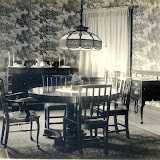
This post has been titled ‘A Ghost Story’, in part because the photographs without people are so compelling. The rooms are alive with an invisible presence. In a small way, the photographs bring to mind Eugene Atget, who could photograph a deserted Paris street yet impart a sense of bustling activity. The old chestnut that Susan Sontag and Roland Barthes pondered, that we photograph the passage of time, hence death itself, seems resonant here in a way it isn’t always with very old photographs. The intimacy of these photographs, the neatness of the rooms and the studied quietude of the people, will be broken, and lost.
VIEW GALLERY HERE
A GHOST STORY