And furthermore ...

One Man's Treasure encourages the use of anonymous photographs posted here to illustrate books and album covers.
If an image appeals to you, contact John Toohey at johntoohey@hotmail.com.
Showing posts with label Cities. Show all posts

Sunday, 29 May 2016

ANCIENT HISTORY


Panoramic postcards of Egypt by Lehnert & Landrock
“Give me my robe, put on my crown; I have immortal longings in me.”
Shakespeare: Antony and Cleopatra


 When Rudolph Lehnert and Ernest Landrock moved their photographic studio from Tunis to Cairo in 1924 they were announcing to anyone listening that Egypt’s capital was also the cultural capital of the Middle East. Not that they decided this: the year before, Howard Carter and his team had broken into Tutankhamen’s tomb and Ancient Egypt had once again become the most exciting idea on the planet. In far off Hastings, builders excavating a basement discovered some odd glyphs in a dingy tunnel and for a moment the theory that ancient Egyptians or Phoenicians had visited the place was kicked around. The place called Ancient Egypt, or at least the idea of it, had seldom been out of fashion’s eye in the last fifty years but now it was back centre stage. There were at least half a dozen other companies in Cairo producing real photo postcards for the European market but Lehnert & Landrock would become the best known.

 
 Lehnert, the photographer, had certainly worked in Egypt before the company opened shop there but once it did, business flourished. We can think of its halcyon years as coming between 1924 and the beginning of the war. Although a great enthusiasm among the British for German product seems unpatriotic, even love of country has its limits. There was a booming international market for shots of L&L’s most renowned genre: nude Bedouin women, and the British were driving demand as much as anyone else. But anyway, we’re not here to talk about that, or even more dubious genres the company marketed but rather the flip side; Egypt as a phenomenon of cultural sophistication.  

 
 From the beginning, postcards were the familiar size by which we know them, approximately 3½ x 6 inches, because they fitted the standard envelopes for informal correspondence. In some countries the laws sounded specific; the post card had to be ‘no more than’ or ‘less than’ or ‘at least’, but this only meant that anything that fitted within the required dimensions was legitimate. Publishers produced midget size and giant size postcards but the most common irregular format was the bookmark size, and though bookmarks of stage stars were popular, landscapes and street views have become the most enduring, especially the bookmark postcards from Cairo that Lehnert and Landrock produced.
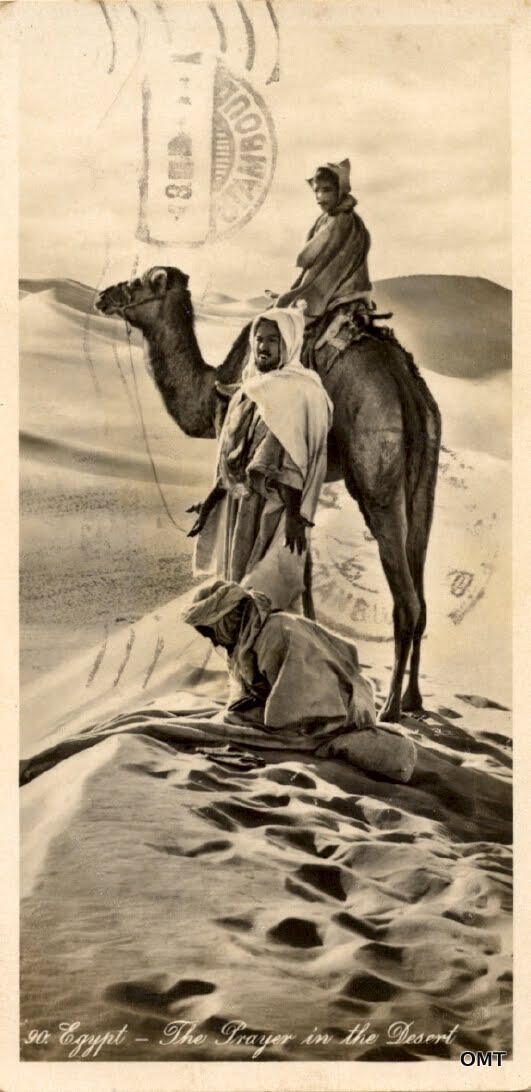
 
 One of the company’s achievements was that it managed to make Egypt look how everyone imagined it to be; a land still touched by its ancient past, with oases of palm trees providing shade from which to contemplate the pyramids, maze-like souks, the stalls piled high with ornate rugs and silverware, and watched over by hawk-eyed Muslims. One hundred years ago, the abiding image of Muslims was of devout, silent and impassive people. Of course, not long before in the Sudan and southern parts of Egypt Muslims were fanatics who needed to be suppressed with violence if necessary, but that was now the past. In popular culture the siege of Khartoum was just another heroic chapter in the history of the British Empire.  

 
 From 1882 until 1922 Egypt was officially a British protectorate (and less officially into the 1950s). This explains why Cairo, a city inhabited by Egyptians since 969 CE would have a ‘native quarter’.  This was both a ghetto and a slum – neither being necessarily the same thing – separate from areas occupied by Europeans, Armenians, Alexandrine Greeks, Jews and Ottoman Turks. Egypt at this time, well, until 1914, was also a khedivate of the Ottoman Empire. The condition for Egyptians was something like being the child of two parents whose contempt for each other was outmatched by that for their offspring. Said children are usually destined for a miserable adulthood.

 
Cleopatra, Khartoum, The Greatest Story Ever Told: in the 1960s Egypt became the canvas for epic visions, though ‘bombastic’ might be a better adjective. There’s a suspicion, and maybe nothing more, that one influence was these panoramic views; well they share the same format and there is something about the panorama, no matter how small, that speaks of the vast – in time as well as space. To create this image the studio simply took a standard format negative and cropped what wasn’t needed. There isn’t the distortion a genuine panoramic camera would produce. Still, removing whatever was extraneous and leaving the palms, the camel, the cart and the porter suggests a scene that could take place anytime in the last 200 years. Interestingly this is titled Kasr el Nil Bridge but it may be the one it replaced in 1931, the Kobri el Gezira. Photos of that one have the palms but they are absent in views of the later bridge. 


 The Orientalist argument says that these views tell us more about the consumers than the place, which should be beyond dispute by now, but what after all do they tell us about Cairo? Where, for one thing, are the crowds? Today the city is so densely packed that a view like this one seems impossible even at unlikely hours. Was it really so magically empty in the 1920s? No. As far back at the 1500s, when Europeans began arguing over the biggest, the richest and the most powerful cities in the world, three were inevitably ignored: Peking, Bombay and Cairo. As engines of civilization they were derided, despite the monumental evidence opposing that, and despite the popularity of Ancient Egypt stemming from the great desire of London, Paris, Rome etc to be seen as the inevitable heir to its culture. So no; this is not the vast, hectic and noisy city tourists encountered but somewhere ancient and austere: the place they came to find.


ANCIENT HISTORY

Thursday, 31 March 2016

GODS GRAVES AND SCHOLARS

Archaeology and postcards
“The past is still, for us, a place that is not safely settled.”
Michael Ondaatje


 There is now a long, visible and well researched history of the relationship between archaeology and photography. Mostly it is framed by concepts of power, so the first studios in Cairo and Constantinople that sold albums of images of pyramids and temples understood the connection between the places that European societies claimed to have come from and the places they now claimed as their own. The history of Postcards and archaeology follows the same course, with crucial derivations. The most important happened when institutions including state run and private museums took control of the images. All their archaeological postcards are political. The customer who bought a postcard from the Acropolis Museum in Athens and the person who received it were being offered a state sanctioned view of Greece’s long history; not just a statue but a reminder of Western Civilization’s origins, and its debts.

 
Archaeological photographs used to depend on two simple definitions. One was that the object pictured was dug up, or somehow recovered. The other was that it was old, preferably pre-historic, or before the written word. So long as one of these could be applied then the image at hand was archaeological. That has changed. Archaeology today has to be neither dug up nor particularly old. Even the most encompassing definition, that the item in question is tangible doesn’t matter anymore. Some media archaeologists live in a world of pure theory. Contemporary definitions still ride on an old motif however; that image of the archaeologist stumbling across some lost city in the jungle, or wiping the dust from a wall of ancient glyphs, but modern archaeologists have turned out to be a bunch of spoilsports. Not only has Stonehenge nothing to do with druidism, all the evidence unearthed recently suggests it was the winter solstice that drew the crowds. 


Chanctonbury Ring is a famous Iron Age fort in Sussex, hidden behind the copse on the hilltop. There are dozens of hill forts across England, built in the centuries before the Romans arrived, when available technology meant the hill was the easiest position to defend and to seek protection. With this image we see the hill fort’s position within the landscape, from the point of view of either an attacker or someone who would find sanctuary within it. Just how closely it resembles the landscape of the Iron Age is uncertain. There appears to be a large house in the centre just below the ring. Apart from that, the vegetation may be mostly native but we know that one impact of empire on the nation itself was a vast number of introduced plant species. During the late 18th and early 19th century it became fashionable to cultivate a kind of wilderness in Sussex, so areas would be set aside and allowed to grow into what was imagined an ancestral landscape. This would never have been allowed during the Iron Age. One thing we have learned about the Neolithic British is how enthusiastic they were for land clearance.  

 
 In World War 1 Osbert Crawford was attached to a survey corps, reading reconnaissance photographs of the trenches taken from aeroplanes. As an archaeologist in the 1920s he took the same idea, returned to the skies and turned his cameras on to the English landscape. From the air he was able to identify the prehistoric avenue connecting Stonehenge to the Avon River, which apart from everything else, expanded Stonehenge’s place in the landscape. Around the same time, the aerial photographic company, Aerofilms, was established. Aerofilms turned to publishing postcards, with archaeological sites one of the company’s most popular subjects. It isn’t hard to see why. Viewed from the air, the perspective of sites like Maiden Castle was literally transformed. It was more than a matter of reading the shape of the site from a new angle; it was also about reading the site’s context within the landscape. Aerial photography was the most important innovation in archaeology before the advent of LIDAR and its importance was transmitted through postcards.

 
Reading books like Bones by Elaine DeLay, you begin to think there must be no more miserable job on Earth than to be an archaeologist in the Americas. Fights between the traditionalists and revisionists are preliminary bouts compared to what happens once First Nations communities get involved, and it doesn’t require paranoia to detect the hidden hand of government agencies behind some of the biggest disputes. In 1998 the archaeologist Brian Billman said that his research into the Anasazi culture in Mesa Verde indicated an outbreak of cannibalism around the period 1150 to 1250 CE. For decades archaeologists had been seeking answers as to how and why the Anasazi culture collapsed so dramatically during that time. Cannibalism, Billman argued, was a symptom, not a cause, which is usually reckoned to be severe droughts brought on by some localized form of climate change, but it was not news that local indigenous people wanted to hear. A well-worn conflict re-emerged, between archaeologists who believed nothing should be immune to inquiry and First Nations people who responded that aspects of culture were private. Well, those were the basic position, minus the truckload of nuances usually dumped on these situations. For some First Nations people, a postcard view like this is problematic. It brings in tourists and relic hunters when what they would rather have is for history to follow its natural course and these ruins be allowed to slowly return to dust. 


 Call that attitude wilful intransigence if you want, but when you see photos like this, it makes sense. For a long time one of the drawcards to Teotihuacan and other Aztec sites was their association with human sacrifice. The architecture became mere set design. The Aztec Empire existed for a brief time before the Spanish conquest. Before then it was a multi-lingual and fluid confederation of cultures. The first reports of Aztec ceremonies came from the Spanish; to which details were later added by people who may have technically been Aztec but weren’t necessarily loyal to an idea. The spectators seen in the background would have paid to see an ‘authentic traditional Aztec’ performance but since none of the primary sources were trustworthy it was more accurately a recreation of European ideas of what a human sacrifice should look like – think Maureen O’Sullivan tied to a pole while Victor Mature struggles vainly with his captors.  Authenticity is a word archaeologists and historians try to avoid. Inevitably it is used to mean something directly opposite to the dictionary definition. 

 
The question of whether archaeology is an art or a science still raises its fuzzy little head though increasingly the revelations provided by technology such as LIDAR push it towards the latter. A good archaeologist need not know much about oxygen isotope analysis but he or she ought to know someone who does. It wasn’t always the case. Before archaeology there were antiquarians and orientalists, who travelled out to sites like Persepolis, sketched the monuments, collected artifacts and proposed theories. Archaeology was an art because it was romantic. With respectability however came responsibility and by the turn of last century very specific skills were required. Being able to read cuneiform was pretty much useless for everything in this world except an excavation at Persepolis and there it was essential. This image you feel tries to evoke that era when travellers might stumble upon some ruined city on the plain then gaze upon its monuments with a philosophical terror.


 A seemingly innocuous image of some ancient foundations but what it presents is a history of archaeology C1860s to 1940s, and then what was to follow. Not all middle eastern archaeology in the 19th century focused on the Bible but so much of it did that it is hard to tell these days whether we are dealing with scholars or fanatics. Take this scrap of wall and the bare framework of a hole. During the 1850s and 60s Orientalists were busy arguing over the site of the hill of Calvary when a number of tombs, including this one were excavated. Suddenly the world had a tomb just below the place then known as Skull Hill, and this according to some was close enough to the biblical account to suffice. There are dozens of very logical reasons why this cannot be the tomb Jesus was placed after being taken down from the cross, but that hasn’t stopped people visiting it as part of their crucifixion tour. Back around the 1940s when this photo was taken the politics surrounding the site were almost non-existent, or at least treated as such. Today while Jews and Muslims fight their battles, lesser known but often violent episodes break out here between Greek, Coptic, Roman, Protestant and other branches of the Christian faith. It no longer matters whether or not this is the actual site. What does is that some people badly feel the need for one. 

   
For a while there, we in the west could look upon archaeology’s tainted past with righteous shame. Museums throughout Europe were full of plunder that rightfully should be returned. The arguments were complex; there’d be no point in having them otherwise. How, for sinister example, could the British Museum and various medical colleges justify all those crates of remains of indigenous people, shipped out from Australia in the 19th century only to be dumped in the cellars and left unopened? Well it couldn’t, and so some were repatriated and everyone put on happy faces. But what about the Elgin Marbles? That was different. Athens was horribly polluted and returning them (right thing, of course) could see these prized sculptures crumble to dust like Dracula in the sunlight, (so wrong thing). The argument changed in 2015, when ISIS took control of Palmyra in Syria and began looting and destroying it. Palmyra represented the very foundations of Western Civilization; from its origins in the Bronze Age to becoming one of the centres of Eastern Greek culture, to one of the great Roman cities and then a major point on the Silk Road. The tragedy of Palmyra’s destruction was partly ameliorated by all that 19th century plunder on our part. Suddenly it looked like foresight that our museums, archaeologists and sundry scholars had been practising all along. Thank God we got all that stuff out in time. The cases for and against repatriation have ceased for the time being, and it is unlikely we will hear them for a long time, at least so far as the Middle East and Africa are concerned. In the meantime, London dealers will continue to keep the market in looted antiquities alive.


GODS GRAVES AND SCHOLARS

Friday, 6 November 2015

WINDY

Snapshots of Chicago in the 1940s and 1950s
 I have struck a city - a real city - and they call it Chicago... I urgently desire never to see it again. It is inhabited by savages.”
Rudyard Kipling


People will tell you New York used to be the world’s biggest city, the richest or most beautiful, but also the most violent and depraved. It was the cultural capital of the world or its actual beating heart, and so on. One or two of these may have come close to the truth at some point. Chicago never attracted that level of hyperbole but what we were told about it made it more glamorous, in a tough, seedy way: the meatpacking district, the black sox scandal, Al Capone and the outfit, Memphis Minnie and Muddy Waters. If New York was an overdressed hooker preening under Neon lights, Chicago was the snivelling little pimp standing back in the shadows.

  Not that you’ll see that in this collection, centred essentially on this and the next two, being snapshots taken by the same person in 1943. This one in particular is rather special in that we get two military men framing a view down the sidewalk on Michigan Ave, the Stars and Stripes above them creating a triangle while on the right we get a line of Cadillacs under the Pabst beer sign. Pabst is horrid: you wouldn’t feed it to a dog, but the company did build one of the few advertisements deserving praise as an architectural icon. Note the time on the sign: it looks like 7 to 12.

  Which is about two and a half hours before this photo was taken. It’s a shame there aren’t more by this photographer of Chicago in the collection. He or she had an eye for the panoramic view. Consider the way your eye moves from the pole in the foreground to the one at the middle space, and then to the Pabst sign sitting between them in the distant background. Your eye is led in towards the sign; a trick that professionals don’t always understand.

 
 Okay it might be a fluke except that we see it again; less successfully if you want to argue that, but enough to demonstrate our photographer understands the interior design of a photograph. Janet Malcolm in her famous essay on vernacular photography, “Diana and Nikon”, struggled with the problem that an ordinary snapshot could be visually richer than work by professionals; the problem being that she wondered how to judge it without the standard parameters in place. And now the Pabst clock says it is 5:30.

 
 Chicago 1954: Syphilis took care of Al Capone some years back but the Outfit is alive and kicking. Whether Memphis Minnie knows it or not, her career is riding a steep slope downhill, but in a couple of years Muddy Waters and Howling Wolf will shake up England with the blues, and on June 19 the city, being several hundred miles from the coast, is struck by a tidal wave that kills eight people. Is our photographer here aware of any of that? Seems not.

 
 But he/she has time to visit the Chicago Zoo in 1954, and who wouldn’t? Opened twenty(ish) years earlier, it was revolutionary in the way it removed the bars between spectator and animal. All that separated some vicious, slow-witted carnivores from the furrier mammals was a moat and a low fence. We could wonder who benefited most from this – human or animal – and here we see two polar bears sans anything like a protecting fence or safe distance. In other words, we (the people) got to imagine animals as though there was nothing between us and them. What did the polar bears think of this? Who has the foggiest to be honest, but the stretch of lawn is a nice touch. Bet they never saw that on the ice floe back home.

 
 From the zoo to the aquarium, to the Shedd Aquarium to give it its proper monicker, despite ‘Shedd’ obviously being a thoughtless name for the world’s biggest aquarium and an institution that will boast of its size from the moment it was founded in 1930. Shedd was one of those figures common to America C1890-1920 who made a lot of money in ways only vaguely understood by the rest of us but poured a lot of it into public institutions like the eponymous aquarium, libraries and museums. One thinks of such entrepreneurs as being either great men or lesser men that have something guilt-like to deal with, but likable nevertheless for what they bequeathed. It’s possible the photographer wanted an exposure that filled the hall with light while showing the sea creatures floating about in detail but that could never be. What we get instead is something much better – a kind of modernist laboratory. What lies behind the glass in this scene? Something more mysterious than wrasse and perch. 


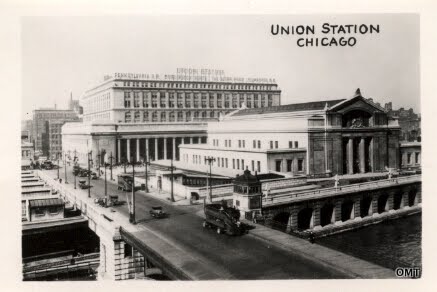
The visit to Chicago has been too short and too shallow. We barely get a sense of the second city. Back in the day, if we were to leave town, presumably because our luck had run out or because the local law enforcement officers encouraged us to, Union Station would be the place to head to. It was the kid of place that required a proper entrance, in a dark suit, grey rabbit fur homburg and a kipper tie. This view vanished years ago. That neo-classical thing in the foreground was replaced by an office tower seven times as high, four times as wide and twenty three times less interesting. This should come as no surprise. Like so many cities busily erasing their past, it is stuck back there and can never be genuinely contemporary.


WINDY

Friday, 11 September 2015

REMEMBRANCE OF THINGS PAST


Snapshots and postcards from Istanbul’s glamorous past
 “It isn't necessary to imagine the world ending in fire or ice. There are two other possibilities: one is paperwork, and the other is nostalgia.”
Frank Zappa

 The discovery of a copy of Cornucopia magazine at a bazaar in Ottawa was timely. Issue 51 from November 2014 has the cover story Istanbul Unwrapped part 2: Beyoǧlu Boogie splashed across a photo of five men in dinner suits laughing over their cocktails. The picture was a message to readers that back in the 1940s Istanbul had been more Paris than Paris, and a lot more fun.


The timeliness has to do with news reports indicating that Washington has finally realized that Ankara’s deeper loyalties lie with ISIS, not the West. Long time observers may wonder why the U.S was so slow to catch on to the bleeding obvious but quite a few Turkish people will nod and remind whoever is listening that it only looks like Washington has acknowledged things very recently. In the grand chess plan, this admission is only a feint hiding darker ambitions. Turkey didn’t invent the conspiracy theory but it made it a work of art. In any case, what Washington is also admitting is that Turkey is no longer that beacon of Western Civ flashing its light across the barren sands of Islamic Asia. It has literally gone over to the dark side. Not so long ago - as in during the Cold War – that was unthinkable. Secularism was actually built into Turkey’s constitution, and it was one of the few countries that proclaimed religion as bad as Communism (How tres Camus!). It was also desperate to be European, particularly in the sense that European meant wearing hats by Dior, smoking Benson & Hedges cigarettes and driving Mercedes Benzes. To President Erdoǧan and his associates secularism was an era that has now ended. Ultimately they want it purged from the national consciousness. Cornucopia is a magazine that wants to preserve that past in aspic. It and the Government conduct their affairs apparently oblivious to each other. What’s interesting to us is the myths they both construct about that era.

  
Cornucopia’s aesthetics lie somewhere between those of National Geographic and Food and Wine. On one page we have a dervish whirling in the afternoon light filtering through a dusty window, on the next an array of white cheeses discovered at a local market. You can imagine. Politically it belongs somewhere between 1920s nationalism and 1950s secularism. Secretly, it longs to be woken at dawn by the graceful ululations of the muezzin (without the crackle of cheap loudspeakers), to sit down to a breakfast of yoghurt, figs and dried apricots before a morning practising on the baǧlama or learning the traditional methods of dyeing wool and spinning it into kilims. Its commitment to history may be sincere though its sentiments are dubious. To Cornucopia the era between the 1923 revolution and the 1960 coup was a golden age of Turkish culture, unrivalled except for that other semi-mythical age when Ottoman Constantinople flourished under Suleiman the Magnificent. 


To President Erdoǧan and his faction in the AKP, this rose-tinted nostalgia isn’t just a longing for an age that may be more legend than reality but a Western attitude that is fundamentally orientalist. They have a case – the magazine advertises itself as “Turkey for connoisseurs”; a warning to lesser mortals to steer clear – but they (the AKP) actually indulge in an even more absurd nostalgia. For them there was an age more fabulous than Cornucopia’s; when Turkish culture was governed by pious asceticism. Concrete evidence for the existence of this time and place is hard to find, except ironically in the writings of European travellers. For writers like Gustave Flaubert and Pierre Loti, the sight of a white robed muezzin calling from the balcony of a minaret evoked something Europe had lost in the Enlightenment. 


Thanks to Cornucopia we learn that Maxim’s of Taxim (sic) was established and run by Frederick Thomas, a black American who had run nightclubs in Moscow during the Bolshevik Revolution: why isn’t he better known? It’s a bit like giving Dooley Wilson the lead role in Casablanca. Instead we got a 1957 remake, Istanbul, starring Errol Flynn and Cornell Borchers. Back in town after a brief spot of diamond smuggling, Flynn turns up to a hotel in Sultanahmet to discover former girlfriend Borchers towing behind her new husband, while Nat King Cole is the house pianist. Well, who wouldn’t be delighted? Of course, when Hollywood portrayed Istanbul as sophisticated, what it really meant was that it was exotic. As usual with all its films set in the eastern Mediterranean, we know the city’s male inhabitants can’t be trusted because they are either slovenly or effeminate. 

  
Istanbul’s music scene of the 1940s was heavily occupied by Turks quick not just to embrace but make a Xerox copy of Western music and especially jazz. Meanwhile black musicians having a tough time in the States were heading over to Europe, which led them to Istanbul, where they discovered eastern modals. In the 50s Turkish jazz bands would be pumping out the very worst of Dixieland while over in the U.S Art Blakey, Thelonius Monk, Miles Davis, and John Coltrane were discovering a whole new way of thinking based on Turkish music. 

A conceit of Cornucopia’s article is that this world can still be found. Turn left here and walk down a laneway that hasn’t changed in half a century. Enter this shop and step back in time. Nostalgia is a form of fraud, as is its opposite (a concept that interestingly enough has no single word for it in English). In post revolution Turkey history was something best to forget, or at least to rewrite, and if they were difficult then laugh at it. 

 
 The past hasn’t completely vanished. Anyone who wanders through the narrow strip of laneways between Istiklal and Cihangir can tell at once that this was once a land of seedy yet staunchly à la mode nightclubs. Until about five years ago some of the old cinema palaces around Istiklal, like the Alkazar and the Emek, survived. The Emek was vast, with elaborate galleries and even the way the curtains drew back on the screen was graceful and majestic. The film might be rubbish but you felt you were at an event. This image was taken at a cinema over in Aksaray in the 1940s. Back then the neighbourhood was a residential area under the shadow of Istanbul’s great mosques and the nearby Grand Bazaar. Today it is ugly and dishevelled, dissected by a highway and best known as a centre for sex trafficking. 

 
The long Ottoman era – but especially the last century – had been defined by exclusion. Women were not permitted here, non-Muslims could not go there, Muslim men could only enter this place so long as they didn’t eat this or touch that eat this and so on, ad nauseum. Even Protestants had more fun than that. As Ataturk understood secularism, people could believe and do as they wanted. To the neo-Ottomans this effectively unleashed a form of anarchy upon a nation conditioned to doing what it was told.

  
Even so, Turkey’s entrance into the modern world remained a celebration for the privileged: wealthy Turks who privately supported westernization, and the still powerful non-Muslim communities of Armenians, Greeks and Jews. In his memoir, Portrait of a Turkish Family, Irfan Orga describes the morning after the proclamation of the republic as quiet and still, the streets mostly empty, the businesses shuttered.  No one was really sure what the end of empire meant.  


 The feeling Cornucopia wants to impart is that Istanbul 1923 – 1959 was about the most exciting city on the planet. The French may disagree but they never had that sense of kicking against the pricks that drove Istanbul’s culture; or as Parisian Jean Cocteau put it: ‘Originality consists in trying to be like everybody else, and failing’. Only when it wanted to be Paris did 20th century Istanbul discover its real identity.

REMEMBRANCE OF THINGS PAST

Monday, 8 December 2014

NEW YORK, NEW YORK


Three postcards and nine snapshots of New York
 “I regret profoundly that I was not an American and not born in Greenwich Village. It might be dying, and there might be a lot of dirt in the air you breathe, but this is where it’s happening.” 
John Lennon


When this postcard was bought from the top of the Empire State Building (as it says on the back), New York was the centre of the world. This was a fact. Only a few Parisians and Londoners who had failed to notice the lights change would have contested that. These days the city is like an old actress who totters about the streets in a fur stole and pillbox hat, defiantly oblivious to the whispers and stares from passers-by. Age and the times have robbed it of something it can never get back. Today, someone could get in a helicopter and take a photo from exactly the same spot but the idea isn’t interesting anymore. It would be like taking a photo of our actress just to tell her how old she looks. 

 
 The three postcards and nine snapshots are all about power. For the postcard photographers the best vantage point for revealing that and the sheer intensity of existence at the centre of the world is from above. The snapshots were taken at street level, looking up They tell the same story as the postcards, only from the point of view of people willing to accept the status quo. The Statue of Liberty doesn’t have to be in focus or the exposure correct to transmit that idea of power. 

 
 Here’s an even more technically challenged view. It looks like a plastic model, but the most important reason for taking snapshots of famous landmarks is that they are a confirmation you have seen them. The second is that they are usually irresistible.  Imagine going to New York in 1952 and not taking a photo of her. There were certain things you had to do if you were a tourist in New York in 1952 and catching the ferry to circumnavigate her was one of them. If for no other reason, it was an act of homage to everything that mattered about America in those times. 


‘Iconic’ being a much abused word, it is hard to use while keeping a straight face, but some cities do have iconic skylines. Remove the Eiffel Tower from a view of Paris, or St Paul’s from one of London and what remain are quotidian views of what could be any large city anywhere. Here however, you don’t need to identify the Empire State Building to know at once that this is an American city, after which New York would be most peoples’ first guess. It was views like this, probably from the North Williamsburg wharf, that made urban planners and architects conscious of the importance in a city’s silhouette. The outlines of buildings were not just distinctive; they were part of a city’s identity. Notice how the people appear to be gazing at them, at a scene that doesn’t change but still holds their attention. 


 The best snapshot in the post, it looks like it was taken from the Naval Shipyard in Brooklyn, sometime in the 1940s. Notice how the RCA Building, the Empire State and the Chrysler give the skyline a distinct pyramid shape. New York used to dominate the statistics. Whether it was the tallest buildings, the most art galleries per square mile or the most murders, it was always up the top. Today it is only one of the most expensive, no longer even in the top ten when it comes to the most dangerous, and in the rankings for most culturally exciting (however they are determined), Miami, Santa Fe and even Boulder Colorado come out ahead. People used to acquiesce to New York. When they heard ‘New York is on the line’, you could see their Adam’s apple pulsate. Now the call is likely to come from Beijing or Bahrain. What happened? 

 
 The economists have an answer, but they can make the barroom drunk sound interesting so let’s skip the theories and return to these snapshots instead. When I try to think of great New York novels from the 1950s it turns out to be a bit of a struggle. Only one comes to mind: John Clellon Holmes’ Go; the book Kerouac could have written if he had sobered up and stopped thinking about his mum. The genuine beat novel – people actually smoke tea, sleep around and hang out in jazz clubs, whereas in On The Road they just talk about doing them – it is set entirely in the city and one of its lasting impressions is of a greyness; not the dismal weather of London but of an ingrained smog. People catch the ferry past the Washington Bridge and instead of pausing to make some claim on the greatness of New York they hurry inside because it is cold and bleak and they don’t have enough cash to think about how great the city is, except that it is obvious they wouldn’t live anywhere else. 

 
 Because Beau Geste was released in August 1939 we can assume this photo was taken around that time. Did New Yorkers think they were living at the centre of the world in 1939? The energy in the photo suggests they had to. My guess is that, if you had a job, money and an education, you sat around talking about Europe as though it was an older brother who’d gone off the rails. Those German intellectuals and artists who had managed it had got out and a lot of them had come to America. New York was the first port of call but most kept travelling westwards, to LA and Hollywood, to Boston, and quite a few skipped America altogether for Canada. Not everybody thought New York was where it was at. This is an excellent scene. At first glance it looks like chaos unleashed but on closer inspection you realize there is a very precise order at work. These days Times Square has those temples to corporate blandness, McDonalds and Starbucks, and little else.

 
 Yankee Stadium in the 1950s, the capital city of baseball. Paris had Picasso, but New York had Joe DiMaggio. My guess is that our photographer took a river cruise and passed a landmark. He (Can we assume that it was men who’d be interested in the Yankee Stadium?) had to photograph it from the ferry because, for various reasons – wife, kids – the chances of actually getting inside and watching DiMaggio play his final season or Rocky Marciano bash some palooka to a bloody mess were slim. We know the feeling. This is an image of desire, not nostalgia.

 
 Another from the same set, all taken from the Hudson River and by someone who owned a cheap camera but had a feel for what mattered about the city. Again, the greyness. New York is like London. Who’d want to photograph it on a bright, sunny day? The results would look drab.


Today the Empire State Building and the Chrysler are ranked 25 and 65 respectively in the list of world’s tallest buildings but that is just a statistic. The competition doesn’t matter. Who can seriously get excited about the Burj Khalifa or the Shanghai Tower? Critics may dribble mindless platitudes about those pointless monuments to competition, but who will ever feel the same rush of excitement everyone does when they first set eyes on New York’s finest? 

  
 I recall watching a TV documentary in the 1980s about organized crime in the U.S that began with an aerial view like this as the narrator solemnly intoned; ‘everything you see here is controlled by the mafia’, or words to that effect. We knew then that corporate America was corrupt but the speed and ruthlessness with which it has broken the nation has been astonishing in its self-destructiveness. If there is nostalgia in this image it is for that idea most people in the world ascribed to in the 1940s that American power was fundamentally good. That might have technically died not so long after this photo was taken but the illusion was on sale until recently.

NEW YORK, NEW YORK