And furthermore ...

One Man's Treasure encourages the use of anonymous photographs posted here to illustrate books and album covers.
If an image appeals to you, contact John Toohey at johntoohey@hotmail.com.
Showing posts with label postcards. Show all posts

Friday, 30 May 2014

ITALIAN JOB

Postcards published by Fotocelere in the 1930s
“There is something majestic in the bad taste of Italy.”
E. M. Forster


A bundle of 50 Italian postcards landed in my lap. All of them are in mint condition, 15x10cm, making them larger than standard, beautifully printed, more so than we would expect from any publisher these days (if postcards are still being produced) and show scenes of Rome, Florence, Bologna and Pompeii. They were published by Fotocelere, active between 1915 and 1942; a company that appears to have held a tight grip on the industry, covering every subject from topographical to celebrity portraits and surreal novelty cards, not to mention the Christmas and Easter side of things. It isn’t exactly clear what their relationship with the photographers was, whether they commissioned work or simply bought it. There is a definable quality to the postcards, a clarity and an attention to detail, though admittedly, when we compare them against some French companies like Yvon, or Valentines’ in Britain, we see a general agreement in style.


The big difference was that from 1922 Italy was under the thumb of fascist dictator Benito Mussolini. While postcard photographers would have found no shortage of scenes showing the glories of Italy’s past, and no doubt focused on them, their point of view has to be filtered through this detail. We can see it in the way that in some of the sets the postcards came in, views of the Foro Mussolini sit alongside others of the Coliseum and the Forum, suggesting not just that these were sites tourists should visit but that the modern was a logical extension of classical Rome.


Interesting that the Foro Mussolini remains more or less intact, known now as the Foro Italico, and that specific monuments to Mussolini on the site remain, including the monolith and the fountain. Tyrants generally have theirs pulled down as soon as they are ousted. One reason Mussolini’s are still standing may be that for a lot of architects the Foro Mussolini has always been an impressive example of pre-War European modernism. Watch Robert Hughes describe it in episode 2 of his 1980 series The Shock of the New and sense his thinly disguised regret that if only Il Duce had moderated his politics while keeping his aesthetics intact, this could have been a great humanist statement, except of course for Mussolini, the politics and the aesthetics were symbiotic. 


The Fountain of the Four Rivers, designed by Bernini in 1651, was considered revolutionary in its day, though it is understandable how someone overwhelmed by the prolificacy of fountains and statues in the city might not appreciate that. There’s a gothic quality to this scene that reminds us the photographer, Enrico Verdesi, followed a specific style that required more than just point and shoot. It appears he was a prolific photographer, his photos turning up in dozens of books on the city’s architecture and others aimed at tourists. Not a genius, perhaps, but someone who knew his craft and what the times required. 


Leaving Rome and heading south to Pompeii, a more vivid reminder of the Empire’s wealth than Rome itself. It seems that every website to do with Pompeii has copied this sentence as it stands: ‘William Abbott explains, "At the time of the eruption, Pompeii had reached its high point in society as many Romans frequently visited Pompeii on vacations."’ I don’t know who William Abbott is, or was, but clearly, since nothing existed of the city post eruption, the statement is meaningless. Who’s to say it wouldn’t have gone on to better things? The photographer in this case was Vicenzo Carcavallo, another who has escaped the discriminating eye of history. This scene of the public bath house is interesting, by which I mean it is and most tourists would be happy if they had had taken it, though anyone wandering through ancient ruins has little trouble finding a photogenic view.


A case in point is this photo of the Gate of Caligula, so called because of a statue of the emperor found nearby. The original name was likely to be something else. The striking detail of course is Vesuvius smouldering in the distance. There’s no date to this postcard though Carcavallo was working in the 1930s and Vesuvius erupted in 1929, so we can narrow it down to a couple of years either side. Just like the scene above, he shows he is capable of giving the customer what’s required.  But we must always hedge out bets. Carvacallo’s postcards may have been commonplace, but if he was like a lot of commercial photographers in the 1930s, he had another portfolio that we may never see but was much more revealing. Besides, since this photo was taken Pompeii has suffered damage from poor maintenance, vandalism and theft. The site is now considered endangered. One day we may have to thank Mr Carvacallo for his photographic record.  


To Florence, and the place most tourists would have entered the city through in the years before the war put that industry to sleep. The Santa Maria Novella train station was built in 1934 and is still considered one of the best examples of modernist architecture in Italy, despite its explicit fascist associations. We forget sometimes that in Italy fascism promoted itself through a modernist aesthetic; the futurists had a demented ideology but what they left us in painting and sculpture is still admired. The frieze on the right side, ‘Anno XIII’ no longer exists. It may relate back to 1922, when Mussolini assumed power.


Stendhal’s syndrome refers to a feeling of dizziness and lassitude that comes from being exposed to too much art and beauty in Florence. Frankly, Stendhal was a ponce. We can handle the beauty; it’s the expectation that we have to see every last bit of it that sends some of us to bed early. This and the following view are credited to Ugo Mugnaini, who once again eludes us in the search for facts. We can say he was by no means the first nor the last photographer to exploit the sharp perspective leading to the Palazzo Vecchio from the Piazzale degli Uffizi, but let’s not forget; there has always been something of a pun in the cliché. Florence was considered the birthplace of perspective in painting so there’s a nod to that in the view from the alley that runs alongside the Uffizi Museum. If you were in the postcard trade, scenes like this were guaranteed crowd pleasers. And this, I might add, is an excellent study of perspective, with proportions balanced by light and shade. 

  
The Pitti Palace and the Boboli Gardens behind would mark a high point in Hitler’s 1938 tour of Florence, pieces de résistance in the display of Florence’s (read Italy’s) cultural power. Observers at the time would remark that while the world’s best known failed artist found the works in the galleries worth a comment, Mussolini looked increasingly bored and irritated as the day dragged on. Museums weren’t his thing. We can see by the long shadows that this view of the Palace was taken in the late afternoon, which explains the general emptiness. The focus is razor sharp. We can also see the tracks where someone has sped across the car park. The building is portrayed to represent power. We always have to wonder; is that how Mugnaini saw it, or was it how he felt obliged to? By 1934, about the time this was taken, photographers were well aware that their images of Italy had to emphasize its grandeur. To suggest anything else was asking for trouble.
While we’re at it, compare this photo to the one of the train station. It shows what a lot of these photos hint at: how for Italian fascism modernism was a continuation of classicism.


A view of Piazza Vittorio Emanuele that at first glance is nothing special, but on close inspection tells us a lot. The first thing to note is the banner under the arch. It reads, "Concorso Ippico Internazionale", or ‘International Horse Show’, which a quick search on Google tells us was held between the 12th and the 20th of May, 1934. Near the centre we see a man standing on a raised rectangle of concrete or brickwork. This is all that remains of the statue of Vittorio Emanuele II, which was moved in 1932. If we took a photo from this same angle today, on the right side we’d have the Column of Abundance, relocated to this area in 1956 and marking the centre of the city. It’s a pity the cars are too far away to identify them better. The one with the extended bonnet, furthest from the camera, could almost be a Mercedes, possibly an Isola Fraschini, one of the few Italian companies prior to World War 2 still making luxury vehicles. Knowing what they were could also tell us whether or not they are Government vehicles. This Fotocelere postcard bears the name “Virdux” on the back, and like the one of the train station above, has a backstamp showing the S.A.F bus company logo. Information on Virdux is sparse so let’s consider instead what has changed in this scene today. Very little as it turns out. Apart from the details already mentioned, the portal and the adjacent building are much as they appear here. The big difference of course is that today we couldn’t take a photo at midday without thousands of tourists filling the frame. 


To Bologna, and again we are observing the modernist aesthetic in the service of authority. Everything is sharp, clear, and consciously composed to show how the Asinelli Tower rises above the city. It was built in 1109 yet here and from this distance it looks at though it could have rivalled the New York skyscrapers in contemporary design and dominance. The photograph is credited to Beretta and Giacomoni. They were active in the city from at least the early 1920s. Obviously some investigation of the various photographers or studios mentioned in this post is needed. Were they merely commercial operators, churning out images like drones, or were they their own people, with their own ideas and fully aware of current ideas in photography? In other words, how much did they see themselves as artists?


Let’s head back to Rome, stopping by the Forum first to take in a view of the Temple of Saturn with the Church of Luce e Martina behind. Here we get the two eras of Roman power together, the Empire and the Renaissance, in a scene that is so transparently about Rome’s power. We can imagine an American tourist in a crumpled linen suit looking across this vista, C1934, and marvelling at the city’s glorious past. "Wow, you guys were great!" His guide murmurss the expected response; “and soon we will be again”, or words to that effect. The road, with the horse drawn cart, another pushed by a man and another man reading a newspaper as he strolls along the sidewalk, has vanished. What’s more, recent photos suggest there has been no attempt to restore it. That would be for the best. The modern traffic passing through would soon turn the Forum to dust.


 Finally, to a photo of a place everyone recognizes, everyone has seen thousands of images of, yet I ask; do you really need better than this? It tells you everything you want to know about the Coliseum, the building that is, not what went on inside. To ask for more is to say you don’t get it, but that’s your problem, not Enrico Verdesi’s. If anything, it’s too successful. It is so limpid and isolated from setting that the structure look like a scale model. One thing that intrigues me about tourist photos like this is how the photographers managed to have no people or cars in the scene. Getting up very early helped, but more than that, good photographers made themselves familiar with the scene. They studied it carefully and knew the best time for photographing it. 

VIEW THE GALLERY HERE
ITALIAN JOB

Saturday, 15 March 2014

CATS


Cat photos
“If cats looked like frogs we'd realize what nasty, cruel little bastards they are. Style. That's what people remember.” 
Terry Pratchett


You can guarantee that right now somebody, or more likely quite a few people, are wracking their brains trying to write a scholarly essay on the phenomenon of cats’ domination of the internet. Statistics, those ever trustworthy numbers, indicate that several thousand cat videos are uploaded to Facebook every minute. People who wrote blogs about poetry and had three viewers a month have discovered that if they write one about cute cats they can get thousands a week. The irony for the scholars is that cat videos are essentially anti-intellectual. You are supposed to sit at your desk for a couple of hours struggling over a difficult issue, every so often switching to a cat video because it relaxes the mind. The other thing to point out is that cats were considered furry little bundles of joy long before we had computers, let along an internet. The difference is that in the old days we sent each other postcards, of someone else’s cat. As for our own little parcels of feline sweetness; we took photos, put them in albums and soon forgot about them.


Another postcard, from prehistory so far as computers are concerned, and a question: who would send this postcard? By that, I mean, which occupation? Librarians, obviously, love cats, so much that most must own at least two, a black one with a personality and a tortoiseshell that thinks life is about lying on cushions. They would have definitely sent this card to each other. Professors of ancient Greek or Medieval history also own cats, but they wouldn’t have sent a postcard like this to their friends, because, back in the day when the arts were valued, they went for whimsical but not cute. Unless of course the recipient owned a dog. Police officers, on television anyway, often own cats. How many have wearily returned home after a long, sordid day dealing with society’s worst and the first thing they do is pour a saucer of milk for their Siamese sweetheart? My experience with hired assassins is limited, but you’ll notice how in novels most of them own cats. It is a clue to their humanity. They might send a card like this, but it would contain a veiled threat: ‘you, and your family, are dead’.


Some postcards of cats may be interesting but most snapshots are; and not always because of the subject. One can understand why someone would want to take photos of their cat – we all do it; most cat owners probably have hundreds – but when said animal looks like this; hateful and diseased, an animal that owes nothing to humans because, frankly, what have they ever done for it, you have to wonder; are there people who just assume all cats are cute. Here's one who isn't.


According to some recent statistics cited by National Geographic, cats in the U.S.A kill “between 1.4 billion to 3.7 billion birds and 6.9 billion to 20.7 billion mammals in each year.” I assume rats figure highly in those astonishing numbers, so I am not too fussed, but that said; the humble squirrel, the innocent groundhog, the neurotic but otherwise non-bothersome chipmunk – which I always assumed was a squirrel but may be more closely related to the plague carrying Rattus rattus, so maybe we’re better off without them – it would be ironic and pathetic if the real blame for the sixth great extinction fell on those dear little soft balls of gentle lovingness, who gaze up at us so expectantly each time we go near the fridge. 

Case in point: a creature with the smug expression of one who has just killed an endangered species for no other reason than it could, yet it is also confident its owner (primary carer?) will ignore the pile of feathers behind the shed because his or her tortoiseshell treasure is the sweetest, most loving thing on the planet.


But an insatiable capacity for murder may not be the most sinister aspect to cats. They have an array of forms of communication at their disposal yet the only time they meow is in the presence of humans. These meows have been measured and amazingly, they fall within the same range as a baby’s cry. Evolutionary biologists are beginning to think that cats developed the meow to mimic a baby’s cry, knowing they would get a positive reaction from humans. Cute? Maybe. Downright deceitful? Absolutely. 


Part of the passage from childhood to adulthood is coming to the realization that cats have no strong feelings regarding being photographed, but they’d rather they weren’t. Also, they don’t like children. Adults feed cats and leave them in peace when they want to sleep on the sofa, which is all cats ask for from humans. Children think cats are better than teddy bears because they can pull their ears and get a reaction. Mother cats love their kittens; watch them care for their newborns and you realize there is no other word for it. This emotion does not extend to other species.


When my cat was in the best of health, an active day meant moving from the bed to the kitchen, with a couple of spells in the lounge room, and time spent on the windowsill or the balcony. Some of us believe this shows an innate curiosity in the outside world. Animal behaviour specialists differ. Cats like high places to view the world because it puts them at an advantage. As hunters they can track the movements of their prey. As prey themselves, they are in a protected place. Imagine a drug dealer who enters a bar, immediately cases the exits then has to face the doorway at all times in case the police make an appearance. That’s how cats think too. 


A few claims have been made lately regarding the difference between cat and dog owners. The basic formula is: cat = introvert, dog = extrovert, which falls apart as soon as you think about the cat owners you know V dog owners. Apart from the determinable detail that most of us hover around the centre with a preference for one state or the other depending on what is happening in life at the moment, quite a few dog owners I know tend towards the introvert, having little in the way of a thrilling social life while looking forward to that long walk with Spot on the weekend. A more accurate equation might be: dog owners value loyalty, humour and generosity while cat owners are content with sophisticated elegance. 


A troublesome photo, because it appears to make a distinction between cat owner and sheep owner that may be a matter of circumstance rather than a generalization, and one I am not well versed in. Notice how she holds the cat, preventing it from making any sudden moves. I don’t know what cats think of sheep, and vice versa (and incidentally, sheep aren’t that dumb; they know very well what they can get away with) but it does seem the relationship here is a little complex. Imagine our drug dealer again, meeting someone who posed no threat whatsoever but bored the pants off him and didn’t look right to boot. Sometimes you just have to put up with stuff you’d rather not.


Dear little things. Wouldn’t you like to pick them up, say, ‘live with me forever, my soft little sugar balls’, take them home and make a litter? Unfortunately, these examples of feline gorgeousness may be dead. It was very common around the turn of last century to photograph cats and dogs or even chimpanzees in all sorts of beguiling positions, made possible because they’d been to the taxidermist first. Far from being scandalous, this was acceptable, because how else would you get cats to pose? It isn’t that they resist behaving for us; they just have a different way of looking at the world.


Speaking of the dead; there are volumes worth of accounts of people who have been obliged to send their little one off to the great beyond, only to see or hear them return a few days later, and what’s interesting is that when you look at the accounts, it seems the number of cats returning considerably outweighs the stories of dogs. Why? I don’t think these cats are ghosts; it seems more a matter of the owners’ psychology, yet it points to something about cat owners we can almost put our finger on yet remains allusive. 


It is like another mystery about cats. When our cat’s health is good, which is becoming less frequent these days, we can play one, particular Bach CD and she will immediately jump on the sofa and nestle down. No other music gets that response from her. I’ve searched on the internet and found owners who swear their cat does the same to just one Black Sabbath LP. Obviously, cats aren’t hearing a structured composition of musical notes but something else. With dogs it doesn’t matter. Play any music and they will lie down, dribble out both sides of their mouth and wag their tails. Cats are different, and how they respond to music is intriguing. They are enigmatic.


CATS

Friday, 7 March 2014

CARRY ON ENGLAND


Postcards from the Bamforth Company
 “A dirty joke is not, of course, a serious attack on morality but …  a sort of mental rebellion.”
George Orwell; The Art of Donald McGill.


 Horrid marriages, drunkenness, cross-dressing, vomiting: what we call the English sense of humour. The Bamforth Company is, (or was: as of only recent times it no longer exists) famous for its ‘saucy’ seaside postcards. From the 1940s onwards they invariably featured a guileless girl with huge breasts and a middle-aged man terrified of sex. Before the drawn cards came out however, around 1903 Yorkshire photographer James Bamforth began producing real photo postcards that were described as comic but they were stranger than that. 

 
 Bamforth was born in 1842 in Holmfirth, a small mill town in the Pennines, and started his artistic career producing lantern slides for public lectures. Most of these lectures were of a religious or temperance bent, what we imagine went hand in hand with a dour, severe outlook on life. The Oxford Dictionary of National Biography describes him as a ‘staunch conservative’ (Conservatives are always described as ‘staunch’) and a supporter of tariff reform, which identified him as a man thoroughly opposed to foreign imports. To think that way in the 1880s meant you backed the Empire to the hilt and liberal ‘laissez-faire’ economics – what today we call the ‘free-market’ – would be the downfall of Britain. Naturally, Socialism, trade unions and suffragettes were also threats to economic stability. 

 
He is most famous as a pioneer of cinema. One of the curious things about Britain’s early cinema is how Yorkshire became a centre for all the innovative work. London scarcely features in the story; the real pioneers were often out in small industrial towns and they were likely to be engineers rather than artists or photographers. Bamforth was a commercial painter and it was that skill he brought to lantern slides, creating elaborate sets that were built outdoors and where members of his family and friends acted in tableaux of biblical scenes. By 1898, only three years after the Lumiere brothers showed their first film, he was producing cinematic shorts. Bamforth is sometimes credited with being the first to use the editing technique of cutting away mid-scene to show a bystander’s expression. The humour is slapstick, more interesting historically than for their content, and some can be found on YouTube by searching for Bamforth.


The cinematic influence is all over these cards. The scenes are dynamic and a lot were photographed as though they were stills from films. Bamforth was also a pioneer of the song card. Parlour songs, which as the same suggests were meant to be sung together in a drawing room while someone hammered at the piano, became popular in the mid 1850s. The lyrics are usually trite and sentimental but they are a gold mine for social historians looking for attitudes to everything from drink to adultery and death. Bamforth’s idea was to print out each verse on a card with an accompanying photo. This was smart. Not only would people buy three cards instead of one, the photos encouraged them to collect sets and because they were postcards customers could mail them around the world. 


Here we have a fairly moderate example of Bamforth humour set in a shop selling song sheets. Of course everything in the scene is constructed but given no one buys song sheets anymore, we get an idea of what the business was like when people would wait for the latest hit to make its appearance as a score with lyrics. In the early 1900s Francis, Day and Hunter was the largest music publisher in Britain. In a few years it would join up with the American publisher T. B. Harms and in the 1920s the U.S Justice Department’s anti-trust department would sue them because they controlled over 80% of the music publishing market and threatened to monopolize it. 


Bamforth postcards are also a mine for social historians, though it can take a bit of searching to realize it. Today “passive resistance” is just one form of political action open to us and often Ghandi is erroneously credited with the idea. In 1900s Britain, a passive resister distinctly meant either a suffragette or a trade unionist who used the tactic of chaining themselves to fences. Anyone looking at this card then would have got that connection at once.


The Art of Donald McGill was an essay George Orwell wrote in 1941 where he took the seaside postcard artist’s work seriously as an insight into English character. (No self-respecting art critic would have gone near the stuff.) McGill, who counted the Bamforth Company as one of his publishers, started out producing drawn scenes with, to us, tame double entendres but by the Second World War his cards featured anatomically incredible women and blatant innuendos. Reading Orwell’s essay, especially when he provides a breakdown of the types of jokes, you could run a pencil through McGill and add Bamforth. “Marriage only benefits the woman”; check. “Sex appeal vanishes at about the age of twenty five”; check. “There is no such thing as a happy marriage”; check. “Drunkenness is something peculiar to middle aged men; check. Policemen are fools, lawyers sharks and women rule the home. We could add a couple more. Work is something working class men go out of their way to avoid, and wealthy men are either sinister or stupid. Orwell points out that McGill’s cards aren’t “intended as pornography but, a subtler thing, as a skit on pornography … Caricatures of the English man’s secret ideal, not portraits of it”. His essay incidentally appeared roughly midway between the last Bamforth photo cards and the high point of the Carry On films in the 1960s. Obviously, British society didn’t evolve; it just grew older. 


One subject McGill never broached but was a staple of Bamforth cards was childhood. When it comes to poverty and death especially, we’re not just looking at a lost world but an utterly foreign one as well. The syrupy mawkishness seems macabre today and if it’s easy to say that the infant mortality rate was high enough to create a kind of inurement to death, it’s worth remembering that in the 1850s the rate in some industrial towns was in the vicinity of one in three children dying before their first birthday but by the turn of the century that had improved dramatically. These cards aren’t a social comment on England. Rather, they reflect a particularly stern religious view. It wasn’t for children to question God’s will but accept whatever he dished out with gratitude.


This card seems almost ghoulish. The lines are from The Better Land by Felicia Hemans. She was a friend of Wordsworth and Walter Scott and apparently a popular poet in her day. The Better Land was one of her best known though these lines are enough to suggest it is also best forgotten. Imagine telling a five year old on her sick bed not to worry because she’ll soon be in a better place. And yes, young as she is, the girl in this photo knows enough to recognize a maniac when she sees one. 


This one on the other hand may have originated as a lantern slide for one of Bamforth’s lectures. There are records of this poem appearing on a series of lantern slides. Get the last line. Mother is dead and “make father love us more than gin and beer”. How sad. This, in a nutshell, is what the temperance movement started off being about. Mothers were dying in childbirth and fathers did turn to drink and neglect their children. It didn’t take advanced mathematics to see the connection between the number of children on the streets and in workhouses and the social erosion brought on by alcohol, but the logic was askew. Drink wasn’t the real devil. In a world of rigid social stratification, where basic hygiene let alone healthcare was denied to the poor, of course mothers died and fathers found the pressure too much to bear. The real problem with the temperance movement wasn’t that it was a collection of prudes and wowsers but their understanding and solutions to social problems were so simplistic they could only perpetuate the situation. Amazingly, there are still people who believe that if we only gave up drinking and listened to Jesus we wouldn’t need government funded health care.   
  

But enough of suffering children. Bamforth’s postcards really come into their own when they turn to the subject of marriage. Orwell pointed out that at the heart of McGill’s images was the absolute faith in marriage as the most important and exciting thing that could happen to a person, which was why he (McGill, but also Bamforth) could make such fun of it. But sometimes the original joke gets lost. This is one about the horrors of marriage, but I see two men. One of them is wearing women’s clothes and he’s about to shove an umbrella up the other’s bum. This isn’t just funny; it’s really weird. 


 And this one. Again the basic message is fairly explicit. He’s been hard at work cleaning the house and she has just come home. Note the role reversals. This might have carried a hidden warning about the danger the suffragettes posed. Give women the vote and before you know it they won’t just be running the household but the nation’s economy. Perhaps that was something to worry about back then, but the real question is; why is he holding a doll?

 
 Here we have a typical policeman. Instead of keeping the streets safe, he’s off in the park meeting his sweetheart. She’s a nanny. No doubt they have carefully planned this assignation. They probably keep to it every afternoon at 3:30. But look at the next card …

 
Isn’t this just a little grotesque? While the two natural forces of social responsibility, the policeman and the nanny, are off looking at the gardenias, the tramp has turned up; to do what exactly?


  Here’s another piece of strangeness. The man is clearly German; he wears that internationally recognized sign of the German, the monocle. This postcard is copyrighted 1907, too early for it to be war propaganda but it does show how much Germany was considered a threat even then. In 1903 Erskine Childers had published The Riddle of the Sands, a thriller based on the premise that war with Germany was imminent. Presumably Childers wasn’t the only one to think this at the time, hence it was acceptable to make fun of the Germans. Politically, Childers, an Irish republican, represented all that Bamforth abhorred. They differed on Germany as well. Childers thought the country was a threat; Bamforth thought it was a joke.  


The Bamforth Company took hundreds of photos and released millions of postcards on the world, which means they are commonplace, easy to find and still quite cheap, but look beyond the content, to the production of the images. Technically they are often brilliant; expertly staged, composed, lit, photographed and printed. The sets are often elaborate and though we see the same backgrounds appearing frequently, that doesn’t detract from them. Even this scene, which belongs more to religious kitsch than art photography, is still an artful production. Too many photo-historians looking at this era fuss over the old and tired question of Pictorialism V Modernism, as though that was all that was happening. Bamforth’s photo postcards are much more interesting than that.

CARRY ON ENGLAND

Friday, 21 February 2014

BACK TO THE BEACH


Photos from the seaside
 “The sea, the snotgreen sea, the scrotumtightening sea.” 
James Joyce; Ulysses


The snow is a metre deep and such a drag to walk through that little things like a litre of milk from the shop 50 metres away need decisions and planning. It has been cold for so long that when the temperature rises to minus 5 we believe that things are looking up. After all, a month ago it was reported that the Prairies were colder than Mars. Down in North Carolina a state of emergency has been called because an inch of snow has fallen, which might suggest that they aren’t that educated down there. Even in Istanbul, world capital of traffic accidents, (or maybe that’s Mumbai) they still know how to drive through a couple of inches of snow without wiping out every nearby vehicle. Then again, snow falls so seldom in North Carolina that we can forgive them what looks like unnecessary anxiety. 


Inevitably thoughts turn to the beach, that stretch of long white sand that people in Western Australia take for granted, or did until their government told them there were schools of man-eating sharks waiting off shore for the first fool to dip his toe in the water. Thousands don’t believe the Government but it isn’t entirely making things up. Marine biologists agree that sharks are more of a problem than they used to be, though the Government conveniently dodges the issue that its own bad management of the environment has led to conditions where sharks’ natural diets are disappearing. It’s not that sharks dislike us; they have nowhere else to go for food but the shoreline. But not to worry: if anything will keep those predators at bay it will be the toxic sludge leached into the water.
The beach: it used to be the place to go to rid oneself of worries. 


There are plenty of photographic books about the beach, from historical accounts of seaside resorts full of postcard reproductions made to look as dull as their subject is interesting, to others that are basically porn spelled A R T. Yes, to some of us the beach means Edwardian ladies walking along the promenade in enough clothing to repel a tank; to others their descendants wearing nothing but a few grains of sand. What seems to be missing from all this is a book about “The Beach”, or as the English prefer to call it, “the Seaside”: a place but also an idea. 


For some reason the history of the seaside begins with the English. To be absolutely historically accurate, it should start with the French and the Riviera, the Cote d’Azur, since they were the first to turn the seaside into a tourist venue, yet that detail usually gets lost. Possibly because the French resorts were for the upper classes whereas in England they started out for everyone. Responsible factory owners might pay for the workers to have a bank holiday by the sea, once they realized that one day’s largesse could buy them a few months of respect. Also, if you were living in places like Leeds and Nottingham, where the air alone was toxic enough to raise infant mortality rates to one in four, the seaside with its fresh breezes became a kind of mythical sanctuary.


Is it the same idea of sanctuary that also leads the broken hearted and the generally troubled to the beach? Some people instinctively head there the moment things turn wrong. Filmmakers have understood this for years. Want to show that the romance has ended? Put one of the characters on an empty beach and let them walk alone until they become a small speck on the screen. It’s a perversion of the idea of sanctuary, being out in the wide open and all alone, but we know that it is here that a person is safest with their thoughts. And it’s also a a perversion because the beach is a world where the sun shines, mostly, and the people who inhabit it have no body fat, arteriosclerosis or stiff joints. 


Of course, it would be silly to think of the beach as only a place where the broken hearted went to cure their inner heartaches. If that were the case our coastlines would be crowded with victims of existential misery. Who’d want to go near them then? Of course they are places for fun. No doubt those early pioneers who sat in a studio in their well constructed swimsuits thought they were having that, but as everyone knows, actual fun, the real stuff, begins when you strip down and charge into the water. The beach is a place where hang-ups aren’t left at the door, so to speak, but thrown on the ground This is a great photo: all about fun but strangely gloomy, and that construction in the background suggests they are somehow way out to sea, in the middle of nowhere.


My research, admittedly light, indicates that during the 19th century thousands, maybe even millions of Britishers flocked to the seaside, but taking the waters apparently meant getting close though not getting in them. There was a reason for that. Most people couldn’t actually swim. If they went in the water, they’d sink like a stone and that would be the last we’d hear from them, save a headstone in the local cemetery. ‘Taking the waters’ usually meant standing knee deep in the sea and breathing in the air, which would have helped if you had spent the rest of the year in a town like Leeds, sucking in the triumphs of the Industrial Revolution. 


His name is Bill and he is a G.I. Her name is Velma. It is 1944, and a story with a G.I named Bill and a girl called Velma has more or less written itself. It won’t end well. One of them will be holding the gun at the end. Let’s enjoy their happiness while we can.


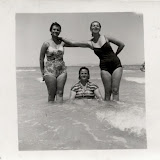
Collect snapshots and before you know it you’ll have dozens like this one, of people with their head above water. It is one of those scenes we can’t resist buying partly because people couldn’t resist taken them. It is a self-created genre. The greatest gift George Eastman gave us wasn’t the camera but the means to photographs moments like this.


Any book devoted to the seaside has to include advertising and swimsuit models. These days thanks to colour, cheap printing processes and possibly a general decline in taste the images are mostly routine. In Turkey the 1940s you could buy a bar of Golden chocolate and get an actual photo of a Hollywood star, photographed by a leading studio photographer, a ridiculous notion today to most people in marketing, who’d reason it was too expensive and the public wouldn’t appreciate the gesture.


Finally we come to the seaside of the mind. While the Edwardian English stood on the promenade breathing in the sea air, convinced they were better off than their choleraic and typhoid riddled parents, a tribe of landlocked Paris and Berlin photographers were wondering why they had to travel so far when they could construct the seaside in their studios. In their imaginations, which they would say were also the public’s, whatever that meant, the seaside was the arena, what we might call the canvas, for an eroticism that was fey and artificial, and vivid because of that. 


The scope for such a project is vast, and we haven’t yet considered where Asia, Africa and South America belong in it. The feeling is that whoever took it on would soon find that one image on its own can’t account for the enormous variety of ways the seaside is represented. There are genres within genres and they themselves contain subtle distinctions. A thorough history of the beach must amount to thousands of images, showing us how people from Brooklyn thought of the seaside different to how people in Blackpool or Beijing did; what people who lived by the sea and those who never saw it thought of it; what the beach was like after hemlines went up, and before Jaws; why the English wore their clothes in the sand and why thousands of Australians are lining up to have growths removed. It’s something to leave to our descendants, so that they can look out across that putrid, acidic wasteland we'll leave to them and think that once we worshipped it.

VIEW THE GALLERY HERE 
BACK TO THE BEACH