And furthermore ...

One Man's Treasure encourages the use of anonymous photographs posted here to illustrate books and album covers.
If an image appeals to you, contact John Toohey at johntoohey@hotmail.com.
Showing posts with label World War 2. Show all posts

Thursday, 10 December 2015

BEFORE THE FLOOD

The Holmfirth disaster of 1944
“Human history becomes more and more a race between education and catastrophe.”
H. G. Wells


During the last week of May 1944 an anticyclone developed over the south western Mediterranean, bringing cloudless skies and above average temperatures. Further north the system created an increase in humidity and storms developed over southern England. As the air currents were pushed northwards in a clockwise direction they brought with them a phenomenon known now as an atmospheric river, which expressed itself (for want of a better description) over the Holme Valley in Yorkshire. None of these events were especially unusual; the fog and drizzle that defines the English summer can be attributed to similar effects. In this case however the rains brought flash flooding to Yorkshire on Whit Monday, a public holiday. That was probably fortuitous. A lot of people would have travelled to nearby coastal resorts like Blackpool so missed the full impact. Three people were killed in the floods but the real damage was measured in the destruction of property, which was enormous.

 
 Holmfirth, a town on the edge of the Pennines better known today as the location for a quaint, rustic sitcom called The Last of the Summer Wine, received the brunt. These photographs were taken by Bray And Son, a photographic company set up in Holmfirth by Harry Bray after World War 1 and continued by his son, Trevor. They were published by the Bamforth Company. Neither Harry nor Trevor Bray considered themselves news photographers as such but realized they had to go out and document the destruction of the Whit Monday Floods, just as the Bamforth Company understood the importance of publishing them. Importantly however, the floods struck just a week before D-Day, when the British Government was heavily censoring all information concerning conditions inside Britain. Very little information on the floods was released at the time. These postcards would have been published months later, if not after the end of the war.   

 
What they tell us about then is not so important as what they say about today. This week storms struck the same area, and wider parts of central and northern Britain. So far another three people have also lost their lives and the damage is estimated in the hundreds of millions of pounds. The real difference is that when these floods struck in 1944 they were half expected as a once in a century event. Storm Desmond as the present catastrophe is called, should be understood as part of what has now become an annual cycle. But although it was seen on the horizon, so to speak, nothing much was done about that.


Despite the Government apparently being caught by surprise, events have unfolded along a predictable course. Firstly, defences against flooding prove inadequate. Reports emerge that standard procedures can’t be enacted because government funding to the responsible departments has been slashed. TV cameras zoom in on the faces of people who have lost everything. The army steps in. A Captain or Colonel tells reporters he can’t believe basic, sensible steps weren’t taken. In a few weeks official reports will, yet again, outline a woeful response by a careless administration. Next year the process will begin again. In 1944 the Government could present a case as to why it was not prepared for the Holme Valley floods, this being a time of war and an era when available technology could at best only suggest something might happen. Seventy one years later all such excuses are indefensible.


 These photographs aren’t just a reminder from the past of Britain’s future today.    During the war the chimes of Big Ben everyone heard on the BBC were recordings played to prevent the Germans from interpreting weather conditions: the more humid the atmosphere the more muffled the sound would have been. This was the level of sophistication the weather bureau was able to exercise. Today meteorologists can not only see atmospheric rivers developing, they can also reasonably predict how much water will be dumped and where. This raises the obvious question of why the British Government is always unprepared for weather disasters. Consistent failings defy common sense. Not to push the conspiracy argument too far, but you could be forgiven for thinking someone sees some kind of advantage in scenes like these.


BEFORE THE FLOOD

Monday, 28 October 2013

ON A WING AND A PRAYER 2

The mystery continues ...
“Pilots take no special joy in walking. Pilots like flying.”
Neil Armstrong

Who took these photos of Canadian aircraft and why? It would be odd for commanding officers of an airfield to let someone wander about with a camera during wartime, yet most of these do not look like official photos. I couldn’t leave a mystery unsolved. The place to start was back at the beginning: the stall at the flea market where the rest of the photos remained. All the proprietor could tell me, as he calculated the price of the snaps while factoring in ‘keen buyer interest’, was that he had bought them about ten years ago. He couldn’t remember the circumstances clearly but he was sure the seller had also been the photographer. Being Canadian, he apologised that he couldn’t be more helpful but actually he had told me a lot. 


Given there were three film formats (four now) and each had their own look and style, I had three immediate possibilities. The first was that one man took every photograph and used particular cameras for certain types (action, still life on the tarmac). If his hobby was photography he was dedicated but owning three or four cameras wouldn’t be unusual. Alternatively, he took the photos because he loved planes. This makes more sense, up to a point. Twitchers I’ve met tend to be very particular about their equipment. They’ll have three pairs of binoculars when most of us think one is sufficient. (This creates an image in my mind of a stout, ruddy faced chap in an undersized t-shirt, Bombay bloomers and thick-lensed glasses. I need to get rid of that.) As a plane spotter he would have seen the value in several cameras too. The third possibility was that he did take the photos in an official capacity, but if so, why would he be allowed to keep them? This plane, incidentally, is an Avro Lancaster, a bomber. It looks like it has a small problem.


And this plane is a Westland Lysander. I recall putting together an Airfix model of one when I was a kid and it was a favourite among my collection. You might think the real man would choose a Spitfire but the Lysander was the photographer’s plane, ideal for aerial reconnaissance, which was of course far more dangerous than flying over enemy territory in a high speed fighter. It was also a trainer. During the war most of the Canadian Lysanders were stationed at Rockcliffe in Ontario, Saint John in New Brunswick and Vancouver Island.  


It seems obvious now but it hadn’t occurred to me that air bases would specialize in one or two types of aircraft, hence you’d find Cessna Cranes at Claresholm and Lysanders at Rockcliffe but not the other way around. Once you realize that, it becomes apparent from these photos that while the backgrounds tend to be similarly flat, anonymous and wintry, our photographer was travelling across the country. Short of spying, that can only mean he was visiting the airfields in an official capacity. What that might have been, we’ll come to shortly, but in the meantime we have the Stinson Voyager, serial number 3467, which according to R. W. Walker’s rather helpful site, was stationed at No. 4 Training Command in Saskatchewan for most of the war. It would go on to have a long life, still cruising the skies of Manitoba in the 1970s.


I’ve always thought that era of early arctic flight was romantic, in the way Saint-Exupéry made those pilots on early mail flights to Dakar cool, unassuming and nonchalant about their slim chances of getting to the other end. Flying medical supplies up to an Inuit village in the 1940s while dodging blizzards and polar bears would be interesting. I’m being flippant. It turns out this very plane – Fairchild 71, serial number CF-BJE – was a film star. In 1941 Michael Powell and Emeric Pressburger made The 49th Parallel, about a group of Nazis on a U-Boat sunk in Hudson’s Bay who then have to make their way across Canada, encountering all its stereotypes in the process (Lawrence Oliver as a Quebecoise trapper is hilarious: they may speak French but that doesn’t mean you have to behave like a Parisian opera singer who just bought a stale baguette). At one point the Germans steal CF-BJE, which takes them across the snowy wastes before they crash it in a lake. Later, CF-BJE would turn up in The Saint episode, The Sporting Chance, where Simon Templar, aka Roger Moore, has his peaceful Canadian fishing holiday spoiled by Russian spies. I notice that on IMDb men rate this episode much higher than women do. 


Back to the real mystery. For the last photo in the previous post I noted that a Facebook friend thought the wreckage was from a Mosquito. Well spotted, I say! The next sequence of photos, all square format and all presumably taken by the same photographer, show firstly a badly damaged Mosquito then one that may have replaced it. The damaged one can’t be the same as the one in the previous post as it has its empennage intact. Alongside the Spitfire the Mosquito was probably the emblematic Allied airplane of the Second World War. It was actually built from plywood, which gave it speed and manoeuvrability though not much protection. Those of a certain age may recall being enthralled by such films as 633 Squadron, which celebrated the wonderful agility of this aircraft when paired with the British stiff upper lip. It appears from this photo that the fuselage has been split in half, most likely in an accident rather than enemy attack. Mosquitoes were prone to accidents, partly because they were so fast and agile that it was easy for pilots with limited training to misjudge landings.


This is the photo that makes me think I know the nature of our photographer’s work. This looks like a crashed Mosquito having its usable parts packed away. Incidentally, thanks to its vast forests of spruce and birch, Canada probably built more Mosquitoes than any other country. I’m not sure that the same person took all these photos but this one provides a plausible clue as to why someone was allowed to wander around the base with a camera. If our photographer was attached to the department responsible for air force acquisitions he would not only have to travel to air bases around the country, he would have to file reports on planes that had been damaged in order to justify their replacement. He’d also be interested in the assembling of aircraft to make certain parts weren’t missing. 


A fully assembled Mosquito on the tarmac. (At least, to my uninformed eye, that’s what it looks like.) An odd story about Canada, Mosquitoes and the Japanese: In 1944 Japan hatched a scheme to send thousands of balloons loaded with bombs across the Pacific, the idea being they would sail on the Jet Stream to North American shores where they would unload their cargo. The balloons were fitted with mechanisms that controlled their descent and triggered a bomb release. They sound like something Wily E. Coyote would dream up but a lot of effort went into design and construction. The miscalculation had to do with the Jet Stream and balloons ended up scattered across the Pacific, most landing in the water. Some did make it to North America and were spotted over Kansas and Wyoming. Six people were killed. In Canada the job of flying out across the Pacific to hunt down the fire balloons was given to Mosquito squadrons. That was probably a difficult job. The balloons were small and it would take more luck than skill to shoot them down.   


This looks like a Fairey Battle – I say having searched diligently using a rudimentary process of elimination. It was designed as a light bomber that would swoop down on slow moving or small targets – German mothers taking their children to school – but such were its weaknesses, too compact to carry a heavy load yet too slow to get out of the way, that by 1940 the surviving machines were sent to Canada to be used in training. This is interesting but I’m not sure what it means. A lot of the planes in the collection were used as trainers. Canada was just out of range to be an effective base for launching assaults but the prairies were a perfect area for military flying schools, being both flat and far away. Germany was no doubt interested in Canadian training schools but there wasn’t much it could do about them. 


Avro Anson Mk V, serial number 11899, and yes, another trainer. I could be wrong; our photographer could have been a flying instructor but you would think, wouldn’t you, that instructors tended to stay with the one aircraft. A pilot ought to be able to fly any plane but knowing the various flaws and graces of particular models would help. 


With my new found eye in place, I’m confident these planes are Harvards, and yes again, they were trainers. These aircraft appear to have inspired their own cult, especially in Canada. There are several websites dedicated to Canadian Harvards, indeed there are still quite a number of the planes still flying, so many in fact that because of a passing similarity to the Japanese Zero they are painted with the rising sun and sent up to take on the role of an old foe when a film set in World War 2  demands it. Harvard incidentally, is the name this airplane was given by the British and the Canadians. The Americans referred to it as the Texan. Think about it. One name evokes genteel intellectuals wrapped in tweed, the other lassoing steers and throwing them on a barbecue. It’s a question Clint Eastwood might ask: “well, do you fly a Harvard, or do you fly a Texan?” The Australians called it a Wirraway. 


One final image, and one of two that could be considered a portrait, of the same man by a plane (The other is at the top of the page). I don’t know the significance of the white coveralls, whether they mark him as an inspector or a mechanic, but you’ll notice he’s about to have a look at the engine. Is it our photographer? You can spend hours studying a collection like this, trying to come to a conclusion, and every so often you have to pull yourself back from the brink of absurdity. There’s a lot we can never know about these photos but one thing is clear: whoever took them loved aircraft and knew how to shoot them so they looked their best.

ON A WING AND A PRAYER 2

Sunday, 13 October 2013

ON A WING AND A PRAYER


 14 snapshots of World War 2 aircraft from Canada
 “If I had to choose, I’d rather have birds than airplanes”
Charles Lindberg
 “There are only two emotions on a plane: boredom and terror.”
Orson Welles


Back in the dark days of World War 2 children, by which we mean boys, were urged to learn to identify planes by their silhouettes. This made a lot of sense in England or France, where distinguishing a Messerschmidt from a Spitfire could be a matter of life or death, but the practice extended to the Australian wheatbelt, where schoolrooms had posters showing German planes, as though the arrival of a squadron of Stukas on the horizon was imminent. Of course, the Government would be remiss if it told everyone out in Merredin they were safe, especially after the Japanese bombed Darwin in 1942, but one effect of all of this is that men in their seventies and eighties can still identify aircraft they haven’t seen in the sky for decades. We youngsters can’t tell the difference between a Lancaster and a Manchester but there are people who can not only read the silhouette, they can remember the precise sound each plane made at night.


These snapshots of aircraft were bought in one envelope in Canada. There are three sizes; the square format, the rectangular 120 format and the slightly larger prints that could be enlargements from a 35mm camera. The difference is important because each has its particular look. The photos from the last category are studies of aircraft; those from the more typical 120 format images have more action in them. This suggests there were three photographers at work and later someone collated all the photos into one album. 


Most of the planes carry the typical Allied insignia of the tricoloured roundel though two have the American symbol of the star within stripes and one is of a German plane. Some of them could have been taken post-war, when air forces around the world were on medium alert. It’s times like these I wish I had the skills of an old plane spotter, or at least the Observer Book of World War 2 Aircraft on hand. The Internet is becoming increasingly useless, jammed up as it is with E bay sales, advertising and irrelevant sites that use a popular algorithm, so it takes longer to find that actually useful site that has clear images and information. 


This plane, for example, looked very familiar. I could tell it was a small transporter or a trainer but I couldn’t quite identify it and I got bored filtering out the dozens of E bay pages advertising photos of World War 2 aircraft. Then, in that state of mind that is part boredom, part curiosity, I wondered if I could identify it from its serial number. At once I was taken to a site listing as many serial numbers of Canadian military aircraft as the owner had found. I had no idea there is a subculture of ‘aeronumeralists’ around the world who collect this information. Thanks to R.W. Walker I was not only able to identify this as a Cessna Crane (Mark 1) but I found out that in early 1942 it was based at the No. 15 Service Flying Training School at Claresholm, Alberta until it sustained damage. After repairs it was sent to the No.2 Air Command near Winnipeg, Manitoba. I found an aerial shot of the training school at Claresholm. Unfortunately there aren’t enough background details in this photo to confirm or refute that this was taken there.


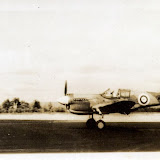
It took a bit of luck but I can say, almost for certain, this rather excellent shot is of a Hawker Tempest taking off or landing. Notice the light outer band on the roundel. This was a type A-1 roundel, used on all aircraft painted with camouflage so that friendly pilots could identify them as RAF. It was one thing for a boy to spot an allied plane from the ground, quite another for a pilot in battle, particularly on aircraft like the Tempest, which has that classic streamlined ‘fighter’ look shared by Focke Wulfs that could easily be misjudged in a dogfight.


This of course is the Spitfire; the plane that won the Battle of Britain, as the English will know. Even people who have absolutely no interest in World War 2 or aircraft know the Spitfire. Though this image doesn’t show off its best side, it was a beautiful looking machine. An interesting aside about the Spitfire: there are various accounts of squadrons of perfectly good Spitfires that in 1945 were dismantled, packed in grease and buried in the Burmese jungle, on Pacific islands and the Australian desert. Men have devoted their lives to reading every skerrick of information they can find and scraping together the funds to mount expeditions in search of them. Disappointment drives them harder. The stories may only be legend but they tell us something about the mythic status of this plane. It’s hard to believe anyone would get that excited over any other aircraft.


The Stuka; the scourge of the skies as any young lad reading comics in the 1940s well knew. It was a dive-bomber, designed for striking at small targets like farmhouses or convoys and it had a sinister attachment, a siren that picked up volume as the plane descended and terrified anyone within range. A captured Stuka like this would be cause for celebration. There’s a bit of history to this scene. Underneath the plane is a placard that is mostly obscured but what can be read is French. Given the photo was bought in Montreal, it would be logical to assume that was where the photo was taken, and a bit of research reveals that during the war a Stuka was parked outside the grand Sun Life building on Dorchester Square and used as an attraction to raise war bonds. Meanwhile, three floors down in a high security vault lay Britain’s gold reserves. Once again: the Internet may be a pain if you want to identify a plane but excellent for discovering trivial yet vital bits of information. 


Aircraft were first used for fighting in the First World War; something you can safely assume everyone knows. Less talked about were the British exercises in Waziristan in the early 1930s, when the Empire decided to train its pilots by having them bomb villages in Afghanistan. Of course this wasn’t genocide. The British weren’t trying to wipe out the Waziris, merely see if bombers could accurately pinpoint a home or a schoolhouse in a raid. Behind their thinking was the inevitable war with Germany and from about 1935 onwards a massive amount of funding and research went into air war technology. For those of us who like to think we know something but can’t call ourselves experts, it’s surprising how far research into aeronautics was before the war. Jet aircraft were practicable and so was the idea of massive aircraft carriers transporting hundreds of planes. Folding wing airplanes like this one that could take up less space on a carrier were being designed as early as the 1920s. Had war been delayed for just a year it is likely it would have been conducted under entirely different terms.


One of the technologies being worked on prior to the war was this curiosity, the Cierva C.30 autogyro, or to give it the British name, the Avro Rota. We have to do that because the inventor, Juan de la Cierva, wasn’t too bothered who bought his patent hence there were British, French, Russian and German variants. Unlike helicopters, autogyros had a rotor at the top and a propeller at the front. Their actual use in the war isn’t clear but they only needed a short runway and were probably useful for low altitude reconnaissance, including photography. Although governments bought and manufactured quite a few they weren’t often used, which explains why they are more common today than some more famous aircraft.


I didn’t need a reference to tell me this was a Mustang. Any boy who wasted a good part of the early 1970s reading Commando comics and watching Richard Widmark turn Japanese jungle hideouts into smouldering ruins would recognize it at once. It was the American fighter, what the Spitfire was for Britain, the Zero for Japan and so on. So it’s a little disconcerting to discover that the US was selling the Mustang to Britain in 1940, two years before it entered the war, and that, while the British thought it good, it wasn’t until they replaced the American engines with their own that it actually became useful. Tell that to the Marines.


The Lockheed Electra: the plane that Amelia Earhart flew partways over the Pacific before she didn’t. Really, I don’t like to excoriate our American friends (not when they are doing a good job of that themselves right now) but when you consider those iconic machines of the 1940s, the Pontiac, the Harley Davidson, the Lockheed Electra, there was always a foreign make that was faster, more fuel efficient and manoeuvrable or, in other words, better. I don’t think you’d call the Electra a beautiful plane the same way you would the Spitfire or the Mustang but it looked rugged and most of the time it was dependable. I imagine Ms Earhart climbed into her particular plane confident it would get her across the Pacific; not realizing it had a weak ticker. 


I’m stuck trying to identify this plane but it’s a good image. It reminds me a bit of Gustave le Gray’s famous photos of the French army doing manoeuvres one misty morning in the 1860s. The figures are just close enough to be definable but too distant to make out exactly what they are doing. It’s hard to say what kind of plane it is. It looks like a Douglas DC3 or a Dakota though the tailplane is noticeably tilted upwards. Let’s just say it’s one of those snapshots that has numerous flaws yet couldn’t be improved on.


Another aircraft an amateur enthusiast could probably identify in a flash, as would a young boy in an Australian wheatbelt town 70 years ago. While this set of images might have been used for some form of government record, it’s worth noting that the photographer made a point of showing the planes best faces, as it were. This makes me think he or she might well have been someone on ground crew who loved the planes for their beautiful design. Who can blame them? The war might have been hell but its technology was something to admire. That said, it’s a bit odd that someone would be allowed to freely photograph around airbases in the middle of a war. What looks to us like innocuous details in the landscape may have been valuable information for German saboteurs.


 One of those details we can easily overlook is that most of the photos we have of the wreckage of aircraft from our side – whether we were Allies or Axis – come from landings on home ground. Well, when a British plane crashed in Germany it was difficult to go over to the other side and get the evidence. Ten airmen were killed in flying accidents at Claresholm, including six Australians and three British. This might well be the wreckage from one of those flights. 
Clearly, far from answering questions, a set of photos like this only provokes them. One thing that might help would be to return to the flea market and buy the rest. Maybe an answer lies with them.  

VIEW THE GALLERY HERE
ON A WING AND A PRAYER

Saturday, 16 June 2012

THE PLOT THICKENS


More snapshots from the Riddle of the Sands series
 “International business may conduct its operations with scraps of paper, but the ink it uses is human blood.”
Eric Ambler


 At the end of April One Man’s Treasure put up a post about a set of photographs taken by two Turks in Germany on the eve of the Second World War. Sixteen more photos from the same collection have been uncovered, making it a comprehensive album. It becomes clearer what the Turks were doing in Germany and why bridges and railways appear so frequently in their photos. The photos also cast light on Turkey’s situation during the war, which we think was inconsequential though complicated is a better word. 


This is a rather excellent view of a bridge over the Kiel Canal dissected by the rails on the ferry. Had it been taken by a well known German photographer of the time people might devote essays to his study of a linear arrangement. In fact a reputable photographer would have spent a bit more effort composing the shot and used sunlight and the darkroom to better effect. It is fairly apparent that what interested our photographer wasn’t artful composition but the bridge. The railings got in the way but they were of no real importance.


This suggests he was an engineer, which recalls a problem raised in the original post. Would the Germans be keen to have foreign engineers wandering about the country when Hitler had already settled on a date for the invasion of Poland? For sure, in May of that year only a very few people in high command would have had any idea how far advanced the plans were but anybody who read a newspaper knew war was inevitable. We can assume the Turks weren’t given carte blanche to wander as they liked but had a security detail attached to their party.


Maybe that explains why some photographs have a sneaky appearance to them, as though they were furtively snapped without much time for a proper composition. Some, like the one above, were photographed from moving trains, which you would do if you saw something interesting and had no other opportunity to photograph it. Surol, incidentally, was a vinegar essence so although the factory looks like it was the point of interest in the photograph our photographer was thinking more about the railway or in the layout of industrial space in the city.


Here’s a photo taken from a train winding its way through “Polonya Topraklar”, or Polish lands on May 25, 1939. There are obvious connotations attached to such an image. The German hosts would have, or could have, known about the concentration camps already set up in Germany but not the Turks, or if they had would have been careful not to raise the issue. It’s a safe bet that throughout their stay in Germany the treatment of Jews was never mentioned.


In May and June Turkey was playing its cards close to its chest. Germany was an important trading partner but Hitler had made it plain that Poland wasn’t his final objective. A hasty alliance with Germany based on historic ties or economic interest would have had the effect of further fracturing the unstable Balkans and set Turkey against England and France, which it couldn’t afford. Actually Turkey couldn’t afford very much in 1939. The modernizing reforms of the secular revolution hadn’t reached the country’s industrial machine, which was still badly underdeveloped compared to Western Europe. Only when Hitler and Stalin signed a pact in October would Turkey be obliged to make a stand, albeit a non-aggression pact with England and France that was not the same as entering an alliance. 


One of the problems with being neutral is that no one really believes you. There has always been a whiff of suspicion that although Turkey had declared its neutrality there were strong sympathies with the Nazis within the Government. Even the record of Turkish assistance to European Jews has never quite removed it. By 1941 Germany had put considerable pressure on President Inonu to make some declaration of support. When Bulgaria joined the Axis in March and Greece was invaded the following month, the message was clear. Turkey could maintain its neutrality but if it sided with the Allies an invasion was a foregone conclusion. Turkey kept its neutral position but signed a non-aggression pact with the Axis.


That is the official version but as these photos show the story was more complicated. Turkey had chromite deposits, necessary for transforming iron into steel. Germany needed the mineral and before the war signed an agreement with Turkey that involved construction of railways, plants and port facilities in Turkey, industrial development sorely needed in a country that was still agrarian.  The agreement was to expire in August 1939. In May the prospect of an automatic renewal was still feasible and so our two photographers went to Germany to inspect the state of German engineering. 


The clue is in this photograph of Gibraltar. The most straightforward water route from Turkey to Germany involved a short crossing of the Black Sea into the Danube and straight through to Bavaria, close to Munich. Why travel all the way through the Mediterranean and up the Atlantic to Rostock on the Baltic Sea unless, as part of the fact finding mission, the Turks needed to follow the intended sea route for the chromite? Until these photos came to light the idea of putting the story in chronological order seemed unnecessary; now they have the chronology is significant. The photos trace two journeys between Turkey and Rostock, into the Kiel Canal and down to Berlin. All this time Turkey was presumably taking a gamble that Europe would pull back from war and that the chromite agreement would roll over. By August however Turkey succumbed to pressure from Britain, France and the US and didn’t renegotiate it, at least until 1941. (One photo is from Romania, dated 25/May/1939, which throws the chronology right out, unless there were three trips, one by train.) 


So these photos are about the murky world of foreign trade on the cusp of war. In the 1930s Eric Ambler wrote a series of thrillers – The Mask of Dimitrios, Journey into Fear, Cause for Alarm - where some hapless innocent stumbled across a web of dirty intrigues involving fascists and some secret business deal. They often started in Istanbul and ended up somewhere in Europe, by which time the leading character had come to realize how much of a fool he’d been played for. The surreptitious appearance of these photos and the inscriptions written in a shaky hand on the autograph camera could have been lifted from one of Ambler’s thrillers.

RIDDLE OF THE SANDS 2

Sunday, 29 April 2012

RIDDLE OF THE SANDS


A snapshot album of Germany in 1939

“In Russia everybody takes everybody else for a spy, and in the United States everybody takes everybody else for a criminal.”
Friedrich Durrenmatt


 There’s something strange about these photos. At first glance they look like ordinary tourist snaps but they were taken by at least two Turkish people in Germany in the summer of 1939, just three months before the start of the war. At that point it was inevitable; intentions had been made clear and alliances confirmed. Britain and France were only waiting for Germany to invade Poland and if their intelligence was good they would have known Hitler intended to move in late August. Ordinary civilians didn’t know that. So far as they were aware, the invasion could happen tomorrow, which, you would think, made tourism unfeasible.


But are they merely tourists? This is the Krupp shipyard in Kiel; to give it it’s full name, the Friedrich Krupp Germaniawerft, where at the time the photo was taken U-boats were already being built (one is in the dock). Alfred Krupp was a strident Nazi sympathiser and made no secret of the fact that his company was developing the German war machine. The British and the French would have already had their eyes on the shipyard and you’d also think, wouldn’t you, that the neighbourhood was crawling with spies. It seems odd that anyone would be able to photograph the shipyards without formal permission; if for example they were engineers or architects on a fact finding junket.


It is entirely possible that’s what they were. Most of the photos are of structures. I don’t know if that means anything except that neither photographer appears to have taken shots of any obvious tourist sights.  Pre war, Germany was Turkey’s most important trading partner, more out of economic necessity and historical allegiance than political sympathy. Turkey also had one of the few reserves of chromite, which Germany needed to manufacture steel. In October 1939 Germany signed a pact with Russia to carve up post war Europe among themselves. Turkey immediately signed a mutual assistance pact with the Allies. In June however it was still open to doing business with all sides. 


One of the photographers used a folding Kodak autograph camera, which allowed him to write inscriptions on the negatives. I don’t know what the other used, it isn’t that important, but both showed a good eye for photography. I have to give the edge to the one not using the autograph camera, if only because of the blurred bike rider or trolley pusher in the scene above and the view of the Grünentaler bridge over the Keil Canal.


It’s tempting to see an architect’s eye behind a lot of these photos, especially this one of the bridge dissected by the cordage, but since we don’t know whether this was the image the photographer actually wanted or the only one that could be taken it is best to leave it as a good photograph. So long as you know what you are looking at, it isn’t that hard to take a good photograph regardless of your day job.


With hindsight you probably expect a bit more evidence of what was about to happen from these photos but the evidence – the swastika above the building at the top left for example – is thin. Why should it be any other way? The people who took these photos had to be aware of what was unfolding but, being Turkish, their principle concerns were commercial. War hadn’t yet been declared and people could still persuade themselves that it wasn’t going to happen. There can’t be many photographs of Germany on the eve of war taken by such disinterested observers – if they are that disinterested. We still can’t say for sure what they were doing in Germany or why they were given the access they had.

RIDDLE OF THE SANDS