And furthermore ...

One Man's Treasure encourages the use of anonymous photographs posted here to illustrate books and album covers.
If an image appeals to you, contact John Toohey at johntoohey@hotmail.com.
Showing posts with label cigarette cards. Show all posts

Sunday, 12 January 2014

A BRIEF HISTORY OF BRITAIN

British history recorded in the ephemera of postcards, snapshots, cigarette cards and miniature views
“Poets make the best topographers.”
W.G. Hoskins


In the beginning it looked like this. Britain was born out of earthquakes, tsunamis and storms powerful enough to cleave mountains in two. Some of the events that shaped the British Isles happened overnight. Geologists think the creation of the English Channel was one such event. A massive storm tore through and shattered the Weald-Artois Anticline, a broad, natural bridge that joined Britain to the continent. The next day mammoths and giant elk looked out across a broad expanse of water, then they went back to grazing.
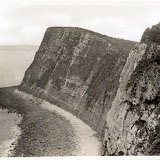
When this photograph was taken of the Devon coast near Clovelly, circa 1930, geologists had a different conception. Shaking off religious notions of everything happening in seven days, they preferred to believe in a process that could take hundreds of thousands of years of gentle erosion. Now we are coming back towards that old idea; that a powerful force could create the landscape overnight, only these days we know it wasn’t God but nature.  


Britain really begins with Stonehenge. We know next to nothing about the people who built it, except they were the first to alter the landscape in any meaningful way and they weren’t Celts and didn’t have druids. Even the name we used to give them, the Windmill Hill culture, is considered imprecise now. Were their ancestors the same people who dug pits to trap mammoths then fell in themselves, giving modern day palaeontologists a lifetime’s work? Or did they sail over from the continent later on little boats built from birch sticks and deer hide?
This postcard was published by the Office of Works, probably in the 1930s, but before 1941. Astonishingly, compared to what we know about Stonehenge now, in the 1930s our understanding of the structure had not progressed much since John Aubrey began investigating the ruins in the 1650s.  Archaeologists went to pains to insist there was no druidic connection although they couldn’t say with surety who did build it. Around the time this postcard came out however, Paul Nash was also taking photographs of Stonehenge. To him, the thick, angular forms were a perfect expression of modernism. Forget Paris; if you wanted to be part of the English avant-garde, Stonehenge was the place to start.


Thanks to the Welsh, the Cornish, the Irish and a handful of feisty Scots, Celtic is still a living language. It is the rootstock of British culture. If the Glastonbury hippy and the Birmingham skinhead could agree one point: without the Celts they would be nothing, or else French. As the survival of the language testifies, the Celts never went away, they became Romans, then Anglo-Saxons, Normans, took one side or the other in the War of the Roses and eventually some voted for the Tories in the last election, some didn’t.
This snapshot was taken under Saint Piran’s Cross in Cornwall, some time in the 1930s. Saint Piran is the patron saint of Cornwall and of tinsmiths. It is an early Celtic cross and before erosion set in it bore intricate carved designs. Fifty years before this photo was taken, Cornish was in danger of vanishing but in the 1890s Henry Jenner published the first modern dictionary and actively promoted the dying culture. By the time this was snapped the language had been revived and was out of danger. It comes from a family album from a holiday on the south coast including several scenes of Tintagel, reputed home of the reputed Arthur. Was the father rediscovering his Cornish heritage? Was he inculcating his daughters with the idea they were English, but Cornish first?


Let’s skip the Romans. They built roads and Hadrian’s Wall but north of that they had little impact. Besides, they wrote everything down so there is little mystery about them. The Anglo Saxons are more intriguing. It used to be believed that they invaded like a pack of soccer hooligans on to a pitch but all sorts of evidence; sites that prove they were buried alongside original inhabitants and indications that the language was willingly absorbed, suggest otherwise. They still look like long-haired smelly brutes from Germany. It is interesting how every BBC documentary about the Anglo-Saxons feels obliged to state from the beginning that the Angles and their enigmatic relatives the Jutes were magnificent artisans and wrote some beautiful poetry. Yes, but if you’ve ever sat in a room with a sculptor or a poet you’ll appreciate they can emit some pretty toxic fumes while blathering on about their place in history. Odour and creativity aren’t even relative.
This cigarette card shows the Weald in about 1920. Amazingly, it didn’t look so different circa 600 AD. But before then it was reckoned to be a dense forest. The Anglo Saxons are either credited or blamed for the clearances. The effect hasn’t been properly measured but there are indications that the flooding and the collapse of settlements around Romney Marsh in the Middle Ages may have had something to do with this early example of ecological overkill. What we got in return however was a part of England that seems, well, so English. Think of a thatched cottage, some black faced sheep and an old gaffer in a tweed coat muttering about the weather and you are probably thinking of the Weald. 


You don’t have to be English to know that in 1066 the Normans invaded. These descendants of Vikings apparently introduced some sophistication to the place – if you prefer ‘re-introduced’ that is fine. Anyway, they spoke French and Latin and knew that if you were going to roast a whole pig on the spit an apple in the mouth improved the flavour. We give them credit for a whole new concept of law, the development of literary culture from the guttural to the written word and the Bayeux Tapestry, which is in France. Wordsworth and other poets found something of the romantic English soul in the ruins of Tintern Abbey, which makes sense in an odd way if you bear in mind this monastery became a ruin after one of those periods that has really defined England for historians; the dissolution of the monasteries and the trashing of the Church’s power base.
This cigarette card is hand-painted, a detail that should not be overlooked. The hand colouring is a little untidy but you can see how the person behind it tried to create some sense of mystery of the place. The light falling on the walls for example suggests the sky was more likely to be an insipid blue than a moody grey.


Actual medieval England was a wonderful place; up to 50 public holidays a year and if you didn’t like your rental arrangement you could head off to the forest to live the life of an outlaw, poaching the local noble’s deer or wild boar when you were hungry and drinking gallons of mead every night. If you could play the lute there was a fair chance said noble’s daughter would call you to her window and suggest running off to France. Not to worry: she spoke the language; she even had a brother over there, who hated his father more than you did.
Leonard Wiseman Horner lived in Hastings and photographed around Sussex in the 1930s. If commercial photography ever had a romantic movement, he belonged to it. The intention wasn’t just to photograph medieval villages and buildings as any good documentary photographer would but to suggest that nothing had changed in 600 years. It was late Pictorialism for the masses and though it appeared to be presenting a response to history that the heritage councils advocated it was undermining it. This was history for people who thought Robin Hood and Errol Flynn were the same person.


There are a lot of myths attached to the Long Walk leading to Windsor Castle, one being that Henry VIII wandered pensively along it while waiting for news of Anne Boleyn’s execution: somewhat unlikely given it was laid out 150 years after her death. Charles II was behind the walk, and given he seems to have spent most of his time wenching in a state of intoxication, the idea of a long avenue for constitutional strolls is both sensible and an extravagance. The real purpose probably was to rival the architectural designs of Louis XIV of France. The two mile long avenue held the splendours of the castle in the traveller’s gaze and inspired the proper dignity.
In 1860 Roger Fenton took the most famous photograph of the Long Walk. He may have directly influenced others to take their photos from the same point of view but there are really few alternatives for the photographer who wants to show the length in all its glory. This miniature snapshot from an unidentified set of views comes from an album full of such photos. It wasn’t uncommon for people to collect wallets of miniature views and put them in albums. It didn't mean they had visited a place but they had visited an idea. In this case, the English landscape was sculptured by men and women of high aesthetics and ideas.


The British Empire was founded on rum, sodomy and the lash. Credit for establishing it belongs to the Tudors but it was the later Georgians who turned it into the buttress of empire.
At first glance this could be a scene many English people would have witnessed in the 18th and 19th centuries, a tall ship taking out the poor against their will out to the colonies but there is more than meets the eye. It is the Herzogin Cecilie, a German windjammer built in 1904. After World War I the ship was part of the reparations Germany paid to France, then it was sold to Finnish shipping magnate Gustaf Erikson. He used it to ship wheat from Australia to Europe because well into the 1930s sail was still cheaper than steam for long voyages. On April 25 1936 the ship struck rocks off the Devon coast and foundered. On January 18 the next year she finally sank. We can see the ship is listing in this snapshot. I think the person who took this photo was thinking of Captain Cook, William Bligh or south coast smugglers.


Before the 1830s the moors had been useful land for grazing, a bit too rugged for crops perhaps but no one ever set foot on them fearful they might get lost if they wandered off the path. Then a generation of writers emerged for whom the best time to visit the moors was in late autumn when the weather was foul and nature, cruel mistress that she was, could signify the torment of unrequited love with a stiff breeze.
Harrogate sits close to the most famous of literary moors, those in Yorkshire where Emily Bronte set Wuthering Heights. Thanks to Ms Bronte the Yorkshire moors cannot be depicted without dark clouds and the ruins of a stone cottage somewhere in the scene. This postcard gives a different impression. Scrubby and unfit for farming some parts might be, but they are not all desolate. And as this scene shows; wander off one path and another will soon appear.


Recall the first image of the sheer cliffs of the Devon coast as stark evidence of how Britain’s geography was born in violence. There is speculation that the same force that shattered the anticline and created the English Channel had the simultaneous effect of pushing parts of the coastline up, hence the cliffs of Dover. A little further around we are at Beachy Head in Eastbourne. The lighthouse was built during the last days of Victoria’s reign and is one of those triumphs of late 19th century engineering. Essentially, it was constructed from the cliffs using cable cars. Presumably the water around the spit of rock it was built on was too small and too rough for the builders to work on it.
Fred Judge pumped out thousands of postcards between the early 1900s and the Second World War. They are often dismissed for lacking originality or anything like an interesting take on their subject although they also attract collectors with a near fanatical passion for them. This is a typical Judge’s postcard and while there is nothing unique about the composition it has an undeniable atmosphere. Photographs don’t have to challenge us to work.  

A BRIEF HISTORY OF BRITAIN

Saturday, 14 April 2012

TORCHES OF FREEDOM

Modern Beauties cigarette cards

“The conscious and intelligent manipulation of the organized habits and opinions of the masses is an important element in democratic society.”
Edward Bernays


In 1917 Sigmund Freud published Introduction to Psychoanalysis and introduced a new word into popular culture. In America his nephew, Edward Bernays had already read some of Freud’s work as well as Gustave le Bon’s 1896 book, The Crowd: A Study of the Popular Mind, and thought there was a use for psychoanalysis beyond the dubious treatment of hysteria. It could also be used to control people’s buying habits and the way they voted. In effect, he argued, the crowd was an organism that could be prodded to move in certain directions and this was actually necessary to prevent the decline into anarchy. Democracy was a meaningless sentiment unless leaders could make the crowd behave according to their will. Before Bernays came along, Hollywood had created one idea of mass desire but no one understood its science.


In 1928 the American Tobacco Company approached Bernays with a problem. Socially it was bad form for women to smoke and that cut out a huge slice of the market for the company. It asked him to find a way to persuade America’s women to take up cigarettes. To do that he turned to one of his uncle’s disciples, Abraham Brill, who outlined a plan to convince women that smoking was a mark of individual identity. In more psychoanalytical terms, a cigarette was a phallic object and if women were directed to think that smoking represented a mastery of the phallus, the ATC stood to make a fortune. Bernays’ first stunt was to have a group of ‘suffragettes’ light up simultaneously during the 1929 Easter Parade, galvanising the reporters and photographers on hand to forget the floats and marching bands and focus on the women and their ‘torches of freedom’. It worked. Within a couple of years women across the US were smoking as a sign of their emancipation. The glaring paradox that they were stating their individuality by engaging in a single act wasn’t lost on Bernays. That was how desire worked. Most of his campaigns worked on the premise that by wanting what everyone else had, a person was declaring their uniqueness.


Bernays also understood how to tap glamour. The notion existed long before he took it on but no one as yet had appreciated how it could be used to control public opinion. In October 1924 President Calvin Coolidge was perceived as dull, humourless and something of a liability with an election just weeks away. Taking on the campaign to restore his image, Bernays invited twenty eight Hollywood stars to a breakfast at the White House. Reports suggest the President moved about the crowd typically unimpressed by the names on the guest list but that was beside the point. He was being photographed shaking hands and talking to people like Al Jolson, the idea being that some of the glamour would rub off. Coolidge won the election though analysts suggest he would have anyway, his Democrat John Davis being regarded as even more dull and conservative.


He had his greatest success selling glamour for the fashion industry in the 1920s, driving a message to America’s women that certain clothes didn’t just make you feel good because of their texture or the way you looked in a mirror. That feeling you got putting on a Cheney Brothers gown came from deep inside. It was your identity showing through. Wear one and you became a more complete woman. The market Bernays pitched to were the middle class women who had surplus income to play with and only needed to be convinced that they needed that new outfit to feel whole. A lot of these women had mothers who had made do with one or two pairs of shoes and wore them till they fell apart. Bernays’ job was to shake them loose of that old notion.


 Modern fashion photography supposedly started with people like Edward Steichen but Bernays’ papers at the Library of Congress show that before the photographers made their mark he was really pushing for outfits to be depicted in a contemporary light, using modern art and design based on work by Georgia O’Keefe and Cezanne to suggest that the very latest in fashion was as necessary as it was sophisticated. The way these outfits looked in photographs was as essential as how they did in real life since it was the photographs women would see first. Technically, he wasn’t directing the photo shoots but he was giving the companies the ideas for how their designs should look.


Though Steichen gets the credit for glamour photography, the photographs here owe more to Bernays than they do him. For one thing, they came from cigarette packets, which Bernays would have approved of, knowing instinctively that the people most likely to collect them were women. Also, they lent smoking that glamour women needed to feel as they lit up. He would have certainly agreed with the idea of using images of Hollywood actresses as marketing tools though he would have pointed out that for a campaign to be effective the women had to inhabit a desirable dream world that was nevertheless, in theory, obtainable. Too sophisticated and removed from reality and the ordinary women who kept consuming in the hope they too would enter this world would soon enough give up and return to simpler values. The secret to convincing the public that buying something would give them entrance to a higher world was to make them believe that whatever it was they bought was all they needed to get there. Notice that the women project a kittenish, girl next door persona. The people involved in the marketing wanted men to think they were available, women to think they were just like them.  


There’s a lot more to be said about Bernays; the grotesque irony for example that his use of his uncle’s ideas would have a marked influence on Goebbels, who used Bernays’ theories in a campaign to whip up hatred against the Viennese Jews, forcing Freud into exile. There was his campaign in the 1950s for the United Fruit Company that was so successful that even the nominally left wing press in the US believed communist rebels were about to take over several Central American countries. There’s his legacy in Hollywood too. The notion that a Hollywood star could campaign on behalf of famine victims in Africa, getting the ear of presidents while being a functionary in a corporation partly responsible for the famine is in its way an ultimate realization of Bernays’ theories on the crowd.

TORCHES OF FREEDOM

Saturday, 3 March 2012

BEAUTIFUL SCOTLAND

15 Senior Service Cigarette Cards 1939


"What enemy would invade Scotland, where there is nothing to be got?"
James Boswell


“Beautiful Scotland” always seemed like an oxymoron. Firstly there was the history, which comes across as a litany of bloody and disastrous defeats. There were the cities, or more accurately their parts, like the Gorbals, which for decades had the reputation as the poorest and the most violent in Europe, and that’s saying something if you’ve seen certain areas in London, Marseilles or Naples. The national cuisine sounded appalling and looked life threatening, and blame the English for spreading propaganda but the people were always portrayed as mean and quick to fight. If you wanted two words to describe Glasgow or Edinburgh then grimy and sinister would do. ‘Highland’ and ‘loch’ on the other hand conjured up a craggy, mist thralled landscape that sounded rather excellent if you were stuck in a damp, smog choked and dreary city. Beautiful Scotland might have existed but you had to get far away from people to find it.


One of the finest panels Hergé ever created is on page 43 of The Black island. Tintin (ridiculous in a kilt and Tam, but then he always liked to go native) is nosing a motorised dinghy between the jagged cliffs of the island while above him looms the ruins of the castle of Craig Dhui. Seabirds wheel about its crumbling turrets. It looks forbidding in broad daylight and it is understandable that the locals on the mainland believe the Black Island is haunted. Hergé hadn’t been to Scotland when he first drew the panel but he didn’t need to. As a boy he had read enough adventure stories to know the atmosphere of the desolate coasts of western Scotland. The Black Island was the first Tintin adventure set in Europe (if you exclude Land of the Soviets, which was always something of a ring-in). Previously the plucky young reporter had travelled to more exotic lands; the Congo, China, South America, Egypt and America, so you have to wonder if when deciding on a European location Hergé settled on the area in that held the most romantic connotations for him. Incidentally, it was first published as a book in France in 1938, the year before Senior Service published these cigarette cards. What Hergé imagined and what the photographers caught weren’t worlds apart.


One of the books Hergé obviously read as a boy was The 39 Steps by John Buchan. The stories follow a similar arc; the hero is falsely accused and on the run from the police also finds himself chased across Scotland by a gang of Eastern Europeans. Buchan published his book in 1915, during the first year of the war against Germany and it has a subtext Hergé may have missed but wouldn’t have found important anyway. The network of spies were plotting an invasion of Britain and for Buchan, thoroughly Scottish and a defender of the Union, the very idea was as plausible as it was terrifying. At threat weren’t so much British values (whatever they were) but his wild lands of heather and moor, the Scotland his characters return to throughout his novels, for release sometimes but also, you get the impression, because they were on a home ground worth fighting for. 


Similar thinking might have been behind the publication of these cigarette cards. Ever since Neville Chamberlain signed the Munich Agreement in September 1938, Britain had been preparing for inevitable war. That same year Senior Service had released the “Our Countryside” series; focusing on the steadily disappearing small villages and rural scenes of England and if neither set of cards was exactly a call to arms they were a reminder that heritage and certain traditions were worth preserving. Once the danger had come from progress, and however you defined that it was mostly a good thing. Now a real enemy was on the horizon and what could happen to the land didn’t bear thinking about.


There’s another possibility that invoked a similar national sense while having nothing to do with imminent threats. The 1930s was the first decade when the car became a part of the average household and most adults drove. In Britain this statistic was celebrated in the Shell guides, pamphlets that listed and gave potted descriptions of the small towns and villages in each county. The series was first edited by the poet John Betjeman and illustrated by some of the nation’s leading artists such as Paul Nash and John Piper. Shell wanted people to get out, drive and buy fuel. The editors and artists wanted them to get out and explore so the benefits of such a project were apparent to everyone involved, even if their motives remained mutually suspicious. In producing its series of rural landscapes Senior Service didn’t have to cash in on the success of the Shell guides to have a similar idea. What the company really wanted was for people to buy cigarettes and if collecting the cards in each packet was one way to encourage them and if a Sunday drive was the fashionable entertainment of the era then inserting miniature photographs of the countryside was an obvious and easy marketing strategy. 


It’s too bad then that Senior Service never saw fit to print the names of the photographers. Small as they are, some of the images are technically exquisite and if they are infused with commercial sentimentality that had been their point in the first place. They were supposed to move people to feel a national pride or a desire to go to these places, not contemplate the nature of photography. Theoretically the company could have commissioned photographers but it would have been cheaper and easier to turn to publishers like Valentine’s, Tuck & Sons, Judge’s or one of dozens of smaller firms that had extensive libraries and could provide exactly the scenes Senior Service required. Business was ruthless, few photographers had any legal power and publishers didn’t like to dispense with money or accreditation if they didn’t have to, so names were left out.


The photographers probably deserve recognition but frankly, identifying them could involve more time than the rewards are worth. One thing you can say is that though professionals may have taken the images here, they also belong to a school of amateur photography that went back to the 1880s and found its most widest exposure in dozens of magazines like Camera and Amateur Photography. These magazines had strict ideas regarding the definition of a good landscape photograph. Beauty was the defining factor and that was dictated by atmosphere and harmony so although the photographs were expected to interpret the landscape the image itself was so emphatic and complete it didn’t itself require interpretation. The magazines and their associated photographic clubs loved sunsets and the hour after a storm had cleared, when the sunlight was still weak and battling with the clouds. Studies like the one below, “On an Ardgour Croft”, were models of fine photography. The draught horses, the two ploughmen and the thatched cottage in the background told the whole story and with the even composition between the three elements it was all up an excellent scene. A lot of these magazines remained heavily influenced by Pictorialism into the 1940s and ‘50s, when smarter competitors were already growing tired of modernist shapes and rhythms. 


Which brings us to the important point. There was a time when this style of photography became dull. It was too neat, obvious and mawkish. Age has improved it, partly because it has become increasingly difficult to find natural landscapes with an expanse unscarred by highways or construction, because we can’t shake the idea that things were much simpler then but also because in a glut of modern practice driven by irony and the worship of banality, our eyes sometimes hurt for the want of something direct and undisguised. They are a reminder that good photography doesn’t have to do much to do its job. The idyllic scenes in some of these images might too nostalgic to be entirely honest but it is only a conceit to think that we could come up with a better truth.

VIEW THE GALLERY HERE
BEAUTIFUL SCOTLAND

Tuesday, 20 July 2010

PUT OUT MORE FLAGS


10 hand painted real photo cigarette cards from Cavenders

“Sing tive, tive, tive, now in full cry,
With yeeble, yabble, gibble, gabble, hey!
The hounds do knock it lustily
With open mouth and lusty cry.”
Anon; C1600: Verse on the back of Cavenders Camera Studies No.4, ‘Unwelcome Followers’.


 It must have made perfect sense at the time; find some 50 photographs of the British countryside, print them 45x70mm, small enough to fit in a cigarette pack but hand paint them too to bring out the vibrant colours of spring, the yellow summer harvest, the reds and browns of autumn and the stark blues and greys of winter. What would that have involved? Dozens, possibly hundreds of workers stippling photographs with fine point paintbrushes. A cursory look at these images indicates the workers’ efforts could be pretty crude but could they be blamed, bent over for hours at a stretch, patiently applying specific colours to tiny areas? Their mistakes did guarantee – and it says something about Cavenders (est. 1775) that the company never promoted this – that each card would be unique. That erratic bleeding of the watercolours couldn’t be replicated.


The hand colouring of these images owed something to Pictorialism, a curious movement that tried to find a compromise between painting and photography. It managed to alienate a lot of photographers and artists while remaining incredibly popular with camera clubs and photographic societies. Probably Pictorialism’s greatest achievement was to divide the photographic community so thoroughly that some people deliberately sought the sharp focus and cold abstraction of modernism. Without Pictorialism to kick against, they might have been content to stick with formal landscapes and portraits. 


These cigarette cards were produced in 1926, when Pictorialism was in its death throes but also at that moment just before natural colour photography became accessible. Autochromes were produced on glass plates and the various other processes, like photochrome, were still too expensive for mass production, at least for something as disposable as a cigarette card. If Cavenders wanted to outdo rivals like Senior Service who had their own series of real photographs, it needed an angle, hence colour. But there was something more going on.


 The company could also lend respectability to the collection by scouring the vast library of British poems dedicated to the countryside. They found Shakespeare, Marlowe, Wordsworth and Keats of course; “How silent comes the water round that bend/Not the minutest whisper does it send.” Maybe not their finest words but then the company wasn’t after quality, just its illusion. The most modern poet included was Rupert Brooke who had been killed in 1915 (probably taken out by a mosquito, not an enemy soldier), though he could hardly be called a modernist unless by accident. 


Post-war Britain was a wreck. High unemployment, thousands had returned from the war too disabled to work, the empire was in decline, manufacturing had shrunk, wages were being forced down and there were the dissenters to worry about; the Irish, women, Bolsheviks, immigrants. 1926 was also the year of the General Strike. A man, the type who smoked Cavenders, had cause to wonder who really won the war. This series can be seen as an attempt by the company to remind its customers that whatever they’d fought for had been worth it. True, there’d never been any real suggestion that the Central Powers would invade Britain but by beating them back the nation had preserved its soul, its hallowed rural traditions, the peace of the English countryside and the centuries of literary heritage. A man could light up, look upon a coloured photograph of sheep grazing outside a thatched cottage, turn to the back, inhale again, read a verse by Thomas Hood and consider that yes, there was something about England guaranteed to bring a lump to the throat.


Saturday, 17 July 2010

COLD COMFORT FARM

10 real photographs from the Senior Service ‘Our Countryside’ series.

Under the ominous bowl of the sky a man was ploughing the sloping field immediately below the farm, where the flints shone bone-sharp and white in the growing light. The ice cascade of the wind leaped over him as he guided the plough over the flinty runnels. Now and again he called roughly to his team: ‘Upidee Travail! Ho, there, Arsenic! Jug-jug!”
Stella Gibbons: Cold Comfort Farm


By the 1920s most British people lived in cities and found some cause to complain about the horridness of their lives. The rich could retreat to the countryside, to a manor house in Sussex or a small castle in the Scottish highlands. The poor had to make do with cigarettes and the miniature photographs that came with each pack. Unwrapping that day’s supply of Senior Service, they might find a timeless scene from the ‘Our Countryside’ series that showed rural England as a world of quiet, dignified labour; a place far removed from the squalor of their actual lives. Some no doubt recalled that their parents had either abandoned or been driven off that same land and moved to the city because it offered more than the miserable drudgery their family had put up with for generations.


During the 1920s nostalgia for rural tradition was becoming a big business in Britain. The working classes who’d moved to the cities had more or less surrendered the countryside to the rich, who could now pick up a decaying mansion at a bargain price and get a charming little village thrown in for free. This was the age of the classic English murder mystery, when a detective, preferably amateur, arrived at a country manor, met a collection of eccentric and debauched suspects with hyphenated names, also some taciturn locals who knew more than they were letting on, and solved a bloodless killing using a logic that was seldom logical. More sophisticated writers like John Buchan regarded the British landscape as the backdrop to an elaborate conspiracy that threatened the very world it was set in. By 1932 Stella Gibbons had grown weary of all this melodramatic nonsense and published Cold Comfort Farm.


One way to show sympathy to the people so mercilessly patronized by her colleagues was to ramp up the attack and make it preposterous, so the Starkadders became a family of physically and emotionally crippled atavistics. They had their own language, which though incomprehensible sounded obscene nevertheless. The women dropped babies at a regular interval without being too sure who the father was or how they even got that way. As for the men, it was horrifying to think they had offspring at all. In the kind of novel Gibbons was mocking it was a duty for the leading character to bring some kind of civilizing influence to the country folk, so Flora Poste introduced birth control, sent one Starkadder off to Hollywood, possibly cured the matriarch of a long standing neurosis and even arranged for the most powerful symbol of the modern age, an aeroplane, to land at the farm. It was funny because it was true; not the part about rural folk being backward, the one about educated city folk regarding their country cousins as a different and vaguely terrifying species.


The 1920s saw another outbreak of that fear Britain suffered from periodically, namely that hallowed traditions were dying. Before long, people worried, there’d be no thatchers, coopers, shepherds or ploughmen left. This was nonsense. Ever since the beginning of the Industrial Revolution 150 years earlier, traditional occupations had been disappearing from the land faster than many animals and the only reason some still survived was that the workers could not afford the new technology. The choices facing the worriers were existential; embrace mass-production and make goods affordable to all or stick to tradition and keep the country backward and poor.


One way around that dilemma was to turn the camera on vanishing Britain. If the old ways were dying, somehow photographs might keep them alive. Senior Service marketed its collection of 48 ‘Our Countryside’ cigarette cards at a time when it was generally acknowledged that Britain had to modernize or die. It was the decade of the General Strike, when production lines were cutting the cost of cars, when America was forging ahead. As with all of its collections of real photograph cigarette cards, the company sought out professional studios like Valentine’s or Frith’s and didn’t credit the photographers. The point was not to think of these images as works of art or as a documentary but as artifacts from a dying world where photography was the fiction that sustained it.


Friday, 14 May 2010

TYPOLOGIES No. 2

National types of beauty


“I love those decadent wenches who do so trouble my dreams”
Rembrandt


In the 1880s Francis Galton was so convinced that measurement could unlock the secrets of science he started collecting data that would establish empirically where in England the most beautiful women came from. Because he believed in the absolute objectivity of science he could not ask assistants to make judgements for him, nor could he ask women to meet at a certain place at a given time so he could take their statistics. Instead he travelled from city to city and when he spied a woman who matched his idea of beauty he’d follow her at a distance, scribbling down information about height, weight, gait and so forth in his notebook. It’s actually not surprising he wasn’t arrested for his behaviour. Men could get away with this sort of thing and had a policeman stopped him and made enquiries he most likely would have been released on the grounds he was just another eccentric savant, and England was full of them.

In the early 1930s publishers of cigarette cards hit upon a scheme that might have intrigued Galton though he wouldn’t have found it at all scientific. They gathered together photographs of actresses and models from around the world into a series called ‘National Types of Beauty’. The idea each nation had its characteristics of beauty would have met with Galton’s approval though the project could hardly be called scientific since it left the final decision to the individual smoker.


Finding examples wasn’t hard; the company approached various studios who were happy to licence out images. Actresses like Anna May Wong from China, Frances Doble from Canada and Greta Nissen from Sweden came to represent those qualities most desirable in a woman from their country, or perhaps they didn’t. Maybe they simply asked for an example without any selection process involved. The primary idea wasn’t to conduct an anthropological survey rather to have a set of photographs that would have the customers coming back for more. Some of the women match stereotypes so the women from the Middle East look mysterious, those from Europe’s hot countries vibrant and so on but some don’t. Miss Eve Gray from Australia with her plaited bun looks more Scandinavian than antipodean. Also, there are no black women. This series is as much about class as beauty so only those women from wealthy, industrialized, ‘sophisticated’ countries stood a chance.

A short description was written on the backs of the cards. This striking example of photographic art gives a vivid impression of the beautiful Norwegian; stately, fair haired, blue eyed and of fair complexion and The distinctive modeling of the face, the black glossy hair and the almond shaped eyes, indicate a type of beauty always associated with the Far East (Japan). This was a time when a man could feel confident in his assessment of foreign women, even if he’d never met one. the Spanish were feisty, the Chinese demure; ‘those Mexican senoritas will as soon as look at a man as cut his throat’.


Depending on your level of sensitivity, the descriptions on the back are either quaint or appalling. In a few, short years racial profiling would stain Europe, not just in Germany but in England, France, Holland and everywhere that fascist groups and sympathizers came together. It was the age when Galton’s theory of eugenics came into force. We’d soon go back to our old ways. 1950s Hollywood was riddled as a poxy sailor with racial stereotyping and in other countries we’d just shift the posts, so a typical Australian beauty now wore an Akubra hat and rode a horse and those eastern European dames still had a hint of cruelty about them but were tragically oppressed by a communist regime.


VIEW THE GALLERY HERE
NATIONAL TYPES OF BEAUTY