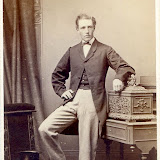
Cartes de visite from gold rush era Melbourne
“A portrait is not made in
the camera but on either side of it.”
Edward
Steichen

Here’s
a coincidence of absolutely no historical importance. In 1835 William Fox
Talbot made his first successful paper negatives, marking for some the birth of
the invention of photography (purists prefer to look back a couple of decades
earlier). The same year but on the other side of the world, John Batman, a
grazier from Sydney via Van Diemen’s Land, had raised interest among investors
for a settlement at Port Philip Bay on Australia’s south coast, making the case
that it was excellent country for sheep. He wasn’t the only one with an eye on
the land. Purists also argue that the real credit for the foundation of the
settlement that became Melbourne should go to John Fawker. All Batman wanted
was enough land and a good port to make a sheep industry viable. Fawker was the
one who imagined a city. Without him Melbourne might have remained a big farm,
called Batville, which is of course an excellent name for a state capital. Not
a lot happened, certainly not much worth photographing, until 1850, when gold
was discovered in the nearby foothills. Within a year the population had
quadrupled, from approximately 10 000 to 50 000 and it kept growing. By 1854
the local newspapers were calling Melbourne the cultural capital of the British
Empire. Quite a few in London were inclined to agree. As a new city fuelled by
new money it sparkled next to London, which was old, polluted and generally
thought to be hopelessly riddled with crime.

Naturally,
the gold rush city needed a few photographic studios. The best known of the
portrait photographers was Perez Batchelder, subject of a post a couple of
years back, but his story is worth recapping. Operating out of San Francisco
during the Californian gold rush, when news of the Victorian gold discoveries
broke he packed up, sold off and boarded a ship. The ‘flying studio’ that
Eadweard Muybridge made famous in the 1860s may have been bought off
Batchelder. Perez’s brothers followed him and Batchelder’s, at 41Collins St,
became what today we’d call a name brand.
One
of the (few) interesting details about the studios in gold rush Melbourne has
to do with the connections that emerge. Actually, this is true of studios
around the world. People start working for one, break away to start their own,
employ someone else, who sets up their business a couple of years later and
before long there is a web of relationships spread across town based on
commercial photography. Originally employed by Batchelder’s as a miniature
painter, John Botterill was one of the driving forces in creating an official
Melbourne arts society. By the late 1850s he had a solid reputation as a
commercial photographer and a society painter. This is a statement that
requires some elucidation. To be a society artist in Melbourne in the gold rush
era meant acknowledging that no matter how many claimed it was the most
exciting place to be right now, the real centres of the art world, London and
Paris, were on the other side of the planet. One heard of new ideas in art
months after Parisians had forgotten them. Cartes de visite from the Botterill
studio are fairly common. Unfortunately, the work he probably wanted to be
remembered for, his landscapes and society portraits, are not. The stamp on the reverse of the first image, from the Batchelder Studio, lists Botterill as one of the proprietors.

Most
Australians have not heard of Charles Nettleton, though they probably know his
portrait of Ned Kelly, taken the day before the outlaw/national hero was
hanged. Nettleton began his photographic career working for Townsend Duryea,
who like Batchelder arrived from America at the height of the rush, realized
what a drag digging for gold was and promptly made his fortune in photography.
Duryea is one of those people whose personal contribution to culture is not as
impressive as the debt a long line of artists owe to him. He could plausibly claim
that one of the leading art schools in the world, the Art Institute of Chicago,
would not exist today had not one of its founders, Henry Spread, had his start in Duryea's Melbourne studio. Nettleton then belongs in a long line of grateful acolytes, but that
is not to belittle him. Unlike Botterill, who it seems had standards when it
came to what he would photograph, Nettleton covered the whole waterfront,
meaning he was often the only photographer available to record important
events, such as the prelude to Kelly’s execution.

Photo-historians
spend their lives chasing down information on obscure commercial photographers,
all the while knowing that what attracted them in the first place wasn’t the
person behind the camera but the people in front of it. This woman is identified on the back of
the carte as “Christina Elizabeth Smith, wife of William Smith and daughter of
J. McPherson”. Searching genealogical records for the surname Smith is too
tedious to bear thinking about, made harder because, during the gold rush,
Melbourne was a city of immigrants. Her family could have arrived from Tasmania,
Scotland, the USA, Canada, South Africa or even India. Suffice to say, a search
for her records requires a professional commitment, but the really interesting
thing about Christina Elizabeth is that she looks so typical. The ringlets in her hair and lace collar tell us at once
she is a woman of the 1860s. We’d know the look at once if the photo had been
taken in Chicago or Edinburgh.

But
there was something special about Melbourne. Up until the 19th
century most cities in the world had long histories; if they possessed
something as dubious as a personality it had been created over centuries. Like
San Francisco, Melbourne’s birth as a city came about through exceptional
events. By 1860s it had the appearance of having arrived fully formed. When
people called it the cultural capital of the Empire, they were also saying it
was more British than any actual British city. That idea persists. People used
to compare Sydney and Melbourne by saying the first was hedonistic and the
second reserved, or prudish (or Victorian). Maybe that had nothing to do with
any supposedly definable character but that it looked like a British city ought
to with a new coat of paint; like London without the mistakes.

Yet
if Melbourne was politically part of the British Empire, culturally it was one
of the new international cities, so full of Irish, Chinese, Russians, French.
Italians, Swedes, Dutch and Americans that it was normal to assume your
neighbour did not speak your language. Just like San Francisco, as soon as
people disembarked from their ship they reinvented themselves and assumed new
names and life histories. These portraits might look like they could have been
taken anywhere, but being Melbourne C1860 we have to assume that nothing is
what it seems.

Anybody searching through boxes and albums of Australian cartes de visite will quickly realize that most of the early one come from Melbourne. It is a sign of the city's prosperity and of its population boom. Reports from Sydney at the time describe how the city suddenly emptied of people. Most of the cartes come from the Batchelder, the Botterill and Nettleton studios. Someone mad enough could attempt to track down all the surviving examples. There are probably tens of thousands out there; enough to give us a comprehensive visual record of the city's population. It sounds like an admirable project and ought to be encouraged.
 |
| SEVEN LITTLE AUSTRALIANS |