And furthermore ...

One Man's Treasure encourages the use of anonymous photographs posted here to illustrate books and album covers.
If an image appeals to you, contact John Toohey at johntoohey@hotmail.com.
Showing posts with label women. Show all posts

Sunday, 19 May 2013

MATERIAL GIRL


 Photographs as material culture
 “Touch has a memory.” 
John Keats


Photographs as material objects, as stuff, where the visual qualities of the image are secondary to the tactile. The idea scarcely exists today but at the turn of last century and the introduction of the postcard all things seemed possible. Around that time the Japanese Novelty Company in Rhode Island applied for a patent for postcards on balsa. The usual cursory search shows the company had bases across the U.S, from Rhode Island to Iowa and Texas, sending teams of salesmen out to lure customers in with cheap amusements, including balsa postcards that people could insert their own photos in. They are rare these days, not because so few were produced but because the wood was fragile. Also, it has to be said, if the card above is any guide, the company wasn’t at the high end of the art market. It probably gave most of its products a year’s life span at best, but that was ok. If it had loyal customers they’d be back for more. A lobster was slang at the time for a shiftless and unreliable type.


We know more about Isaiah Taber, a photographer who began in the era of the daguerreotype, made a name for himself in San Francisco during the gold rush and went on to open studios in London and England. The 1906 earthquake destroyed his studio and much of his work and he died six years later. Today his name means something to photo-historians of the American west but few others, which is too bad because he was not only prolific, he had one of the sharpest minds when it came to business.

There is some confusion about the Taber bas-relief process. It is on record that Isaiah’s brother Freeman applied for the patent for the process but being the photographer, Isaiah took a lot of the images that would be turned into bas-reliefs, inevitably leading some to assume he was involved in coming up with the idea. It isn’t just historians. Advertisements in the Sydney Morning Herald during 1899 credit Isaiah with the process. According to one ad from June 5 that year, “the result has been pronounced by judges and connoisseurs of the art to be the perfection of photography … and it is morally certain that this new style … will win the custom of every person of artistic tastes”. Further on, the suppliers (Eden Photo Studio) threaten legal action against several companies infringing on their copyright. This is a version of the line, ‘beware of imitations’, suggesting theirs was the only company in town capable of producing proper results.


So what was all the fuss about? As the name suggests, bas-reliefs had a tactile, three dimensional quality produced by placing the image over a stamped impression. It is more difficult than it sounds. The image was being stretched over the impression, and as these examples indicate, each portrait had to be embossed individually. It was one more attempt to enhance the already lifelike qualities of photographs. Though actresses and royalty were popular subjects, ultimately the process would quietly disappear. Like the balsa wood postcard it turned out to be a novelty with brief appeal.


The last set of postcards were produced during the dying days of the Art Nouveau movement, when that had ceased to be an exclusive mark of wealth and elegance and filtered down to the hoi polloi. Alongside cheap, mass-produced Charles Rennie MacKintosh look-alike lamps and kitchenware, the middle classes could buy postcards that distinguished them as lovers of beauty without the financial commitment that usually involved.  


The cards were mostly published in Germany and France. Producing them would not have been difficult as appearances might suggest. Once the card stock was selected and cut to size, the design was stamped in and coloured then the portrait cut out and pasted in. The most difficult part would have been the colouring of the embossed surface. 


Though the photographers aren’t identified, the portraits are vaguely familiar. They are of theatre and opera stars and if not from the Reutlinger or Walery studios, from one of their rivals. Ordinarily however studios of their reputation would have put their signatures on the front. That they didn’t suggests that other companies had some arrangement to use them or else, in an age when copyright was still nebulous, simply cut out the parts from photographs that they needed and added them in.


The woman in this card is the same as in the card above, taken at the same photo shoot. This one however was posted in Chile. Presumably the originals were distributed from Paris or Berlin to points around the globe at which point local companies could add whatever details they wanted. Incidentally, the back of this postcard bears a stamp and postmark and a woman’s name (Alicia) but no address for her. Was the image too upfront for the Chilean post office? Or was it customary to have the postcard stamped then placed in an envelope to protect privacy? 


One thing about Art Nouveau that is easy to overlook these days: at the time it was modern – by definition - but it was also essentially nostalgic. Everything about it evoked an earlier age, often as not one lost in the mist of ancient history. Coming of age at the dawn of the automobile, the telephone and powered flight, the art nouveauists had to embrace technology even though it was in conflict with their aesthetic sense of unhurried elegance. The ideal woman wrote long letters, she didn’t sit on the phone, and she preferred the hot air balloon to the aeroplane. A plane after all was good for flying from point A to point B – which at that time wasn’t very far – but a balloon ascended to the heavens. 


If the definition of a photograph is anything that includes one, then that is what these postcards are, but they exist at the fringes, owing more to jewellery, graphic design and even architecture than they do photography. Even if some of these have a sophistication and imagination that makes them almost beautiful, it is more their curiousness that is eye-catching. The idea wasn’t exactly original; Victorian photo-collages used a similar idea of mixing photographs with drawings and some tintypes came in elaborate sleeves that were meant to be part of the whole image, but whoever first came up with this idea didn’t have to see any precedents. The notion of combining portraits of noted Parisian beauties with the iconography of what was still considered beautiful design was as inevitable as it was logical, as was its essential failure.

MATERIAL GIRL

Wednesday, 27 March 2013

THE MYSTERY OF MR FISH


10 portraits by H. P Poisson

“Why are women so much more interesting to men than men are to women?” 
Virginia Woolf


 I feel we have a mystery on our hands. Searching through a stack of some 500 postcards at the Montreal flea market I found 10 portraits by H. P. Poisson of Biddeford, Maine. All are of women in their early twenties, some of the same women and several with the unusual element of a tilted chair. Who was Mr Poisson? And did he specialize in photographing young women to the exclusion of everyone else? Clearly, questions needed answers. 


In case you haven’t discovered this already, if you want to see other examples of an obscure photographer’s work the best place to begin is Ebay. Sure enough, H. P Poisson popped up. There were several of couples and children and a post-mortem and one seller had offered a dozen postcard portraits by Poisson, all similar to these, of young women and some with the tilted chair. Etsy turned up three as well, again young women, though no chairs. The discovery dashed theories he was something more than a regular portrait photographer, but as many detectives have discovered, removing someone from the list of suspects doesn’t make them less intriguing. 


Maybe you had to be there but there was something distinctive about the Poisson postcards that made them stand out from the rest. Searching through the stack, it soon became unnecessary to look for his stamp on the back. Partly it was the distinctive poses and partly because all the women were strikingly beautiful and glamorous but also, among hundreds of other portraits, Poisson’s had a professional quality that set them apart. The women had a presence that a good studio photographer would know how to bring out. Postcard portraits from the 1910s are probably the most ubiquitous encountered in flea markets and junk shops but when you’ve looked at several thousand you realize you have developed an eye for some intangible qualities. Commercial studio portraiture could be as far removed from high art as paint-by-numbers but that didn’t mean people couldn’t be very good at it.    


Obviously, the place to start investigating H. P was Biddeford; too big to be small-town America but not large enough to be a city, a location Disney might have chosen to film Pollyanna in or one Norman Rockwell might have settled on as the ideal site for his saccharine depictions of American life. It was founded early – in 1616, which was before the Mayflower landed. In 1653 the first mill was built and from thereon it became known as a mill town, which is to say there was always work even if there weren’t great boom times. It was close enough to Quebec, only 330 miles from Montreal, that there would be a strong association, not always positive, but by the late 19th century a sizeable percentage of its population of 15 000 were French-Canadian. 


Which brings us back to Mr Fish. Poisson sounds like the surname of a Tintin character but it makes sense when you know it is medieval Norman in origin, from a time when just about everyone in Normandy worked on or around the sea. It seems it was not uncommon in Biddeford in the late 19th century; census records throw up a dozen or so individuals. The best known was Eugene Poisson (1863 – 1908). He moved from Quebec some time around the 1890s and opened the Elite Photographic Studio. We’re still guessing but it would be likely he was a close relative of H. P - his father or even his brother. Of H. P we know little at the moment. According to accessible Biddeford records, a Horace P Poisson was living in nearby York in the 1920s but there is also a Hormidas to deal with. He married Elizabeth Paradis in 1925, which does seem a bit late for our purposes. The studio incidentally was located at 137 Main St. There’s a vegetarian restaurant and a martial arts school there now. One of them occupies the former studio.


All of this is useful; it would be good to know exactly who H. P was and have some firm dates, but short of travelling to Biddeford - which is very proud to be one of the oldest towns in the USA and boasts of its fine archive – we won’t find out in a hurry. In any case, the search for vital statistics can distract us from the real issues. There are more important clues buried in the photos.


Here’s one. Three of the women in these photos are reading a magazine. In this one we can see it the clearest. Studio Light was the Kodak magazine for professionals (Kodakery was for amateurs). Published from C1880 to at least the late 1980s, it offered advice on various technical and business issues and reviews of Kodak products. Even in the 1910s, when it was a little lighter on the technical details, it wasn’t the type of magazine a young lady would flick through unless she cared about the effect of Elon developer on Artura paper. Clearly it was a magazine H. P had lying around. What’s interesting is that only a few years earlier a thick and dusty book would have been the usual prop. Thanks to half-tone and other processes that make reproduction of photos possible in the press, by 1910 the magazine, in particular the women’s magazine, is taking off. Presumably H. P doesn’t have any on hand but to give her a magazine rather than a book is to send out the suggestion she is glamorous, up to date with fashion and relaxes browsing over the latest fashions from Paris. 


Which brings us to this portrait. Note the pattern on her blouse. It is the fleur-de-lys, the symbol of French Quebec. Her blouse is the only hard clue but something about their dress and deportment makes me think all these women are French Canadians. They don’t look American, whatever that means. With much the same obscure sense that it is possible to recognize Poisson’s portraits among a stack of postcards there is a feeling about these women that their identity leans towards Europe rather than America.


Here we may be getting close to understanding the mystery. There were three or four identified photographic studios in Biddeford around 1910. If these women were French-Canadian, it makes sense that they would go to Poisson, particularly if he spoke French and the others didn’t. He could also be promoting himself as having the European touch, which he might have had though if he were genuine about that he’d spend 10 cents on a woman’s magazine instead of putting Studio Light in their hands. Then again, Frenchness might not have so much to do with things. They went to Poisson because he was the best in town. Still stuck in their 19th century ways, the other studios made their subjects look as stiff as desiccated corpses. Only Poisson could breathe life into his portraits. 


All these women look about the same age, somewhere around the lower twenties. Even though back then everyone dressed to the nines for the photographer, their clothes and hairstyles suggest they are not the daughters of mill workers. I feel M. Poisson is trying to tell us something, but he’s holding a bit back at the same time. 

THE MYSTERY OF MR FISH

Saturday, 19 January 2013

BEYOND THE PLEASURE PRINCIPLE

 
Erotic postcards
 “An intellectual is a person who’s found one thing more interesting than sex.”
Aldous Huxley


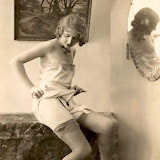
 A scholarly history of the erotic postcard would be an admirable undertaking, particularly as it is full of problems obvious before even beginning. One is that actual facts are rare. People didn’t keep open and detailed records, so the statistical data that would reveal how popular or lucrative the market was doesn’t exist. Another is that most photographers didn’t identify themselves on the cards and the best known studios, Julian Mandel and Yva Richard, didn’t have a look they could call their own. Also, it’s hard to find information that isn’t weighed down with ideological encumbrances. Not being a topic for polite society, it’s no surprise that the greatest amount of information comes from the organizations dedicated to suppressing the trade. The various committees against vice found in America and Europe were good at accounting for the number of magazines and photographs they had destroyed in the last month. A problem is that their definition of pornography was broader than the general population’s, so a lot of images considered filth in their eyes were mild by most other standards. The example above by Reutlinger wouldn’t have survived the flames. When Anthony Comstock’s New York Society for the Suppression of Vice announced it had put 5000 photographs to the torch, how many of those would have met the definition of depraved in most people’s opinion? And let’s not forget, these societies worked on the message that the country was under assault by pornographers dangerously close to corrupting the entire society. When it came to publishing figures, exaggeration was required. They not only had to give the impression that a wave of obscenity was sweeping the country but that despite their best efforts they were in imminent danger of losing the fight. In that situation big numbers would get reactions even if they were completely false. 


A place to start might be to ask who were the photographers behind the trade. The answer appears to be pretty much all of them. Anybody who ran a decent sized studio in a major city regarded the erotic postcard market as a legitimate aspect of their business, well, so far as they were prepared to take it on. There must have been some who considered it a matter of principle not to get involved but generally speaking, whenever the archives are investigated it isn’t long before the erotica comes to light. Some companies, like Reutlinger, made it a stock in trade but it sat alongside their chaste and sentimental line in portraits of children and animals. Basically they responded to customer demand, whatever that meant. The photographer dedicated to manufacturing pornography, inevitably a man of dirty appearance and habits (and frequently a foreigner), was an image concocted by moral guardians. What we know is that some of the most respectable studios in Europe ran a sideline in erotica, and some of those were operated by women.


So what about the women who posed? First hand accounts tend to come from two sources. On the one hand there are the women like Kiki of Montparnasse who not only openly admitted that they posed but knew it added another frisson of scandal to their reputations. A typical story from the age is that the woman arrives in Paris – having been deserted by her lover from the ranks of the minor nobility – and desperate for some money takes on a bit of work that in normal circumstances she thinks is beneath her. Either that or, yes, before she became recognized across Europe as a great dancer she too was forced to do things she is not proud of. It might have sounded like a chapter from a cheap novel but terms of self-promotion it only added to her allure. 


The other side of the coin is the model as innocent victim. Oddly (not really), this one tends to emerge in court trials where the vice committees had a hand in the arrest of the photographer. Apart from protecting society against pornography, one of the self-appointed jobs of the vice committees was to save young women from its clutches. Typically, she had arrived in the city with no money or friends and soon felt the wicked grip of the unscrupulous photographer. Given the attention some of these trials attracted, it served the woman well to also portray herself as victim, especially if family, friends or her official employers were likely to read about it. Sometimes a small detail muddies the story; it emerges that she has form, she assaults the police when they barge in, some point between the original account of the arrest and the trial she undergoes a transformation of character. There are reports of women turning on their so-called saviours, of being taken to a safe location only to escape at the first opportunity. What bothered people then, and still does, is that being an artist’s model might not have been respectable but that didn’t mean women were unwilling.


What about the customers? In his book, Erotic French Postcards, Alexandre Dupony says that a lot of cards were sent by French women to their boyfriends at the front during World War 1. This sounds so typically French; it’s difficult to imagine Australian women doing that, still there’s a hint that Dupony might be trying to let the customer off the hook. It is rare to find these postcards with messages on the back, such as you would therefore expect: “Tu me manque, Pierre”. Not that we can base much of an argument on that but we do know that companies usually advertised their photos for sale in magazines using language that made it obvious what was on offer: ‘artist model photos for sale’, that sort of thing and it was normal, or common, to buy them in sets. That leads us to think the standard customer was a man looking to add to his collection. He was probably married, with children, wore a bowler hat and handlebar moustache and considered himself an aesthete. The really expensive stuff, the limited edition large format photogravures, was beyond the reach of his wallet.


You might wonder why Paris was the centre of the industry. There is plenty of evidence to support the usual arguments that it was a more liberal city than London or New York but there’s a couple of things to consider. Firstly, there’s a point where ‘liberal’ and ‘exploitation’ start to merge. Paris was also famous for its human zoos, where under the guise of education the citizens could go and stare at African villagers who were literally behind cages. And there’s a reason why Nazism and fetishism became entwined. The upper echelon of the party was dominated by men with stunted attitudes to sex; the type who watched porno films but couldn’t look a real woman in the eye. Also, it’s easy to think of the Casino de Paris and the Moulin Rouge and forget that most Parisians didn’t set foot in those places. On Sunday mornings they were more likely to be on their way to Mass than nursing a hangover with some chorine they’d met backstage. What it might be about isn’t Parisian openness so much as strident prudishness in other places. America in the 1920s had prohibition. People could be forgiven for thinking anything went in Paris. 


If you have seen Auguste Belloc’s stereographs from the 1860s you’ll think this one from the 1930s is moderate, even discreet (If you haven’t, go to Courbet’s Origin of the World, painted at the same time. It is tame in comparison.). You will also realize that any talk of historical development in photography of the nude is largely ephemeral; Belloc’s work is as hardcore today as it was then. The notion that the real photo postcards that flourished in France between the 1900s and the 1930s represent some kind of shift in aesthetics is nonsense. The only shift to speak of is commercial, which is a problem if you were writing a serious history because it wouldn’t be long before you found yourself examining technical production, modes of transmission and economic processes, all of which, your viewers would agree, are beside the point. Not that they’d mind if the book was lavishly illustrated.

BEYOND THE PLEASURE PRINCIPLE

Saturday, 21 April 2012

A LA TURCA


Oriental fashions
 “Just as I was about to speak, Atatürk clapped his hands and, as he had orchestrated it, the dancing girls appeared, their multicoloured veils floating suggestively in the coolness of the room. As they danced their slow, sensuous dance, wordlessly Atatürk motioned that I sit on the red velvet and copper-collared cushions next to him. Mesmerized, I complied.”
Zsa Zsa Gabor, One Lifetime Is Not Enough, 1991


When this photo was taken in about 1905, modern A La Turca had been a fashion statement in Paris for just a few years. It didn’t have that much to do with Turkey, or more precisely, if the clothes conjured up images of the Orient they were A La Turca, and the Orient in a lot of peoples’ imagination was anywhere east of Italy. As fashion trends went it was a hard one to kill. Just when it should have faded, something would come along – Mata Hari, a new Rudolph Valentino film, the discovery of Tutankhamen’s tomb and Oriental fever flared up again. Women put on turbans, scarves and long strings of beads and let it be known they were more exotic than their day job suggested they were. Zsa Zsa Gabor wrote two autobiographies, the original, tamer version when her first husband, the Turkish politician Burhan Belge was still alive, and the less discreet account where the quote above was drawn from. Did Ataturk really clap his hands and a troupe of dancing girls appear? It’s possible, although the scene as Ms Gabor tells it reads like she was confusing a memory with a Bob Hope film. 


There’s a common misconception that Ataturk outlawed the headscarf when it was the veil, the niqab, or to be specific, clothing associated with religion that was proscribed. Perhaps he would have liked to get rid of the headscarf but not for any particularly religious reasons, rather because of its associations with peasantry and all that it didn’t represent; education, sophistication, modernity. His vision for the Turkish Republic was that it would be run by self-possessed professionals who could distinguish between science and superstition, but then he hit the nationalist’s dilemma. How far can you go when the elements you want to transform are essential to the culture’s identity? Take the woman above: on the one hand everything she represents is the antithesis of the ideal woman in the new republic, on the other the image she projects is so quintessentially Turkish that to discourage its depiction was to challenge the national character. 


One way around the problem was to think counter-intuitively and instead of suppressing the folklore promote it, being careful to make it obvious that the imagery wasn’t portraits but typologies. No one looking at this photograph would think the woman was an authentic villager; the studio well gave the game away. It belongs to a genre (is that the word?) that began in the 1860s, when European studios producing CDVs found there was extra money to be made out of the local folklore. Some of the very best studios weren’t too proud to play this game, especially when all they needed was a costume and a model and both could be procured cheaply. By the time this photo was taken the idea had pretty much run its course, or more accurately, the traditions had faded from view. Turkey was one of the few countries where most of the population was still rural based and folk traditions survived.


And then there was the new republic’s wealthy, urban and secular elites, which clearly is where this woman came from. There are several possibilities to explain this photo, but whether she dressed for something like a small scale fashion shoot or if the headscarf was part of her daily wear, was she aware that she was drawing on a Western European fashion which originally had found inspiration in Turkey? It’s a great image though irony doesn’t seem the point here. 


But it is here. On the back of this 1930s snapshot is an inscription written in Spanish. “A mia Turca (the mid section is mostly indecipherable) Mil abrazos (a thousand hugs)”. Spanish tourists? Probably. Most of the fun in visiting a foreign country is imagining you have some connection to it, so why not dress as you imagine Turks do, or ought to? 


As discussed in a previous post, in Bulgaria the independence movement was driven by people who wanted to kick free of all Ottoman influences including dress sense. At the turn of the century anything that looked like a celebration of the Ottoman era was a tribute to its worst elements and an image like this was only a reminder of them. A few years on however and folk traditions were considered intrinsic to national identity. Identifying what was indigenous and what was borrowed was a part of the process but after 500 years of occupation there was a lot that no one could be sure of.

A LA TURCA

Saturday, 14 April 2012

TORCHES OF FREEDOM

Modern Beauties cigarette cards

“The conscious and intelligent manipulation of the organized habits and opinions of the masses is an important element in democratic society.”
Edward Bernays


In 1917 Sigmund Freud published Introduction to Psychoanalysis and introduced a new word into popular culture. In America his nephew, Edward Bernays had already read some of Freud’s work as well as Gustave le Bon’s 1896 book, The Crowd: A Study of the Popular Mind, and thought there was a use for psychoanalysis beyond the dubious treatment of hysteria. It could also be used to control people’s buying habits and the way they voted. In effect, he argued, the crowd was an organism that could be prodded to move in certain directions and this was actually necessary to prevent the decline into anarchy. Democracy was a meaningless sentiment unless leaders could make the crowd behave according to their will. Before Bernays came along, Hollywood had created one idea of mass desire but no one understood its science.


In 1928 the American Tobacco Company approached Bernays with a problem. Socially it was bad form for women to smoke and that cut out a huge slice of the market for the company. It asked him to find a way to persuade America’s women to take up cigarettes. To do that he turned to one of his uncle’s disciples, Abraham Brill, who outlined a plan to convince women that smoking was a mark of individual identity. In more psychoanalytical terms, a cigarette was a phallic object and if women were directed to think that smoking represented a mastery of the phallus, the ATC stood to make a fortune. Bernays’ first stunt was to have a group of ‘suffragettes’ light up simultaneously during the 1929 Easter Parade, galvanising the reporters and photographers on hand to forget the floats and marching bands and focus on the women and their ‘torches of freedom’. It worked. Within a couple of years women across the US were smoking as a sign of their emancipation. The glaring paradox that they were stating their individuality by engaging in a single act wasn’t lost on Bernays. That was how desire worked. Most of his campaigns worked on the premise that by wanting what everyone else had, a person was declaring their uniqueness.


Bernays also understood how to tap glamour. The notion existed long before he took it on but no one as yet had appreciated how it could be used to control public opinion. In October 1924 President Calvin Coolidge was perceived as dull, humourless and something of a liability with an election just weeks away. Taking on the campaign to restore his image, Bernays invited twenty eight Hollywood stars to a breakfast at the White House. Reports suggest the President moved about the crowd typically unimpressed by the names on the guest list but that was beside the point. He was being photographed shaking hands and talking to people like Al Jolson, the idea being that some of the glamour would rub off. Coolidge won the election though analysts suggest he would have anyway, his Democrat John Davis being regarded as even more dull and conservative.


He had his greatest success selling glamour for the fashion industry in the 1920s, driving a message to America’s women that certain clothes didn’t just make you feel good because of their texture or the way you looked in a mirror. That feeling you got putting on a Cheney Brothers gown came from deep inside. It was your identity showing through. Wear one and you became a more complete woman. The market Bernays pitched to were the middle class women who had surplus income to play with and only needed to be convinced that they needed that new outfit to feel whole. A lot of these women had mothers who had made do with one or two pairs of shoes and wore them till they fell apart. Bernays’ job was to shake them loose of that old notion.


 Modern fashion photography supposedly started with people like Edward Steichen but Bernays’ papers at the Library of Congress show that before the photographers made their mark he was really pushing for outfits to be depicted in a contemporary light, using modern art and design based on work by Georgia O’Keefe and Cezanne to suggest that the very latest in fashion was as necessary as it was sophisticated. The way these outfits looked in photographs was as essential as how they did in real life since it was the photographs women would see first. Technically, he wasn’t directing the photo shoots but he was giving the companies the ideas for how their designs should look.


Though Steichen gets the credit for glamour photography, the photographs here owe more to Bernays than they do him. For one thing, they came from cigarette packets, which Bernays would have approved of, knowing instinctively that the people most likely to collect them were women. Also, they lent smoking that glamour women needed to feel as they lit up. He would have certainly agreed with the idea of using images of Hollywood actresses as marketing tools though he would have pointed out that for a campaign to be effective the women had to inhabit a desirable dream world that was nevertheless, in theory, obtainable. Too sophisticated and removed from reality and the ordinary women who kept consuming in the hope they too would enter this world would soon enough give up and return to simpler values. The secret to convincing the public that buying something would give them entrance to a higher world was to make them believe that whatever it was they bought was all they needed to get there. Notice that the women project a kittenish, girl next door persona. The people involved in the marketing wanted men to think they were available, women to think they were just like them.  


There’s a lot more to be said about Bernays; the grotesque irony for example that his use of his uncle’s ideas would have a marked influence on Goebbels, who used Bernays’ theories in a campaign to whip up hatred against the Viennese Jews, forcing Freud into exile. There was his campaign in the 1950s for the United Fruit Company that was so successful that even the nominally left wing press in the US believed communist rebels were about to take over several Central American countries. There’s his legacy in Hollywood too. The notion that a Hollywood star could campaign on behalf of famine victims in Africa, getting the ear of presidents while being a functionary in a corporation partly responsible for the famine is in its way an ultimate realization of Bernays’ theories on the crowd.

TORCHES OF FREEDOM

Saturday, 24 March 2012

MIGNON


Images of Mignon in early postcards

“I don't mind what language an opera is sung in so long as it is a language I don't understand.”
Edward Appleton


 Here’s a small mystery. The most popular opera in the early 20th century was about a long suffering wretch who lacked a personality, scarcely had a moment’s happiness in her life and brought much of her misfortune upon herself. Like Carmen, Mignon was a gypsy but where Carmen was unfettered, Mignon was servile, and meek where the former was mean. You could respect Carmen even if you were supposed to think she got everything she deserved. You could also see how she could become a sex symbol, but Mignon, the little dishrag in the corner? Why did she end up the poster girl for bohemian gypsy lifestyles?   


This is the opening to Mignon, a comic opera about thwarted love and mistaken identities: In the courtyard of an inn somewhere in Germany, Lothario, a wandering minstrel, is plucking his harp and singing of the travails in his life while some gypsies dance. Two actors, Filina and Laertes, appear in a castle window and down below a student named Wilhelm Meister turns up. The leader of the gypsies spies Mignon asleep in a cart. He threatens to beat her but Lothario and Wilhelm step in. The grateful Mignon divides a posy of flowers between her saviours. She then tells Wilhelm that she is not a real gypsy. She was kidnapped as a young girl and still has vague memories of her home. You don’t need to be told that once she confesses she was stolen as a child, Mignon will be restored to her family, and that said family own a fabulous castle. Getting to that point however will involve a series of misunderstandings and brilliant coincidences. This is opera, where anything can happen so long as it defies the laws of nature.


 When Ambroise Thomas wrote the opera in the 1860s he expanded on one chapter from Goethe’s Wilhelm Meister's Apprenticeship. In the original, Mignon was the abandoned daughter of a priest and it was only with her untimely death that Wilhelm began to understand the shallowness of his values. As that précis suggests, Mignon’s life was too miserable for a comic opera and Thomas needed an implausible redemption. He turned to a device used in hundreds of folk tales and by Dickens in Oliver Twist and by a remarkable stroke of fortune, Lothario turned out not only to be Mignon’s unwitting father but heir to a throne. At least the cast had something to celebrate with a rousing song at the finale. 


 In the very late 19th century some dancers found it useful to claim an actual gypsy heritage. Not only did it give their performance some authenticity, it conveniently blurred the issue of their origins. People were more willing to believe that Caroline Otero was a gypsy rather than the daughter of farmers, even if they preferred to think of peasants as honest and simple and gypsies as thieving rogues, because it added glamour and gave her credibility. Strange then that in most images Mignon is depicted as ragged, harried and dispirited. Maybe her problem was that she wasn’t the real thing. By admitting early on that she had been kidnapped she gave the story a riddle that needed to be solved but in doing that she extinguished any idea she had that romantic gypsy love of freedom in her veins.


MIGNON

Saturday, 25 February 2012

POSTCARDS FROM THE EDGE II


Six subversive portraits of Turkish women

“A photographic portrait is a picture of someone who knows he’s being photographed, and what he does with this knowledge is as much a part of the photograph as what he’s wearing or how he looks.”
Richard Avedon 


 You’d think that a collection of close to 1000 studio portraits from Turkey in the 1920s and ‘30s would give you some knowledge of the society or at least a clearer idea than most people get but it can also confuse the picture. The six portraits here challenge some essential stereotypes about Turkish women, or they only look like they do. Missing from all of them is some basic information that would provide a context. Are they evidence that the society was rather more complex than we’ve been led to think, or are they the exceptions that prove the rule? These days, everyone agrees that the notion that a photographic portrait imparts a truth beneath its surface is wrong yet we can’t quite shake the idea that it should so therefore it might. We can guess why the woman above posed in a folk costume; it was either for her benefit or the photographer’s, but once the studio props were introduced the image became a fiction. In earlier times photographers like Pascal Sebah would hire models to dress as dervishes or street vendors but we weren’t supposed to know they were only actors. Here the pretence has been dropped but that only makes the intentions more obscure.


We have no idea who this woman is or what she went on to do in her life but in 1923, the year the Turkish republic was founded, universities across the country were made fully co-educational. L’Aigle was a prominent studio in Istanbul at the time and this woman would have been one of the first female graduates. She received her education in an era when, compared to most countries in Western Europe, laws regarding the status of women in Turkey were fundamentally more progressive and enlightened. Not that her degree or the voting powers she was given in 1935 would have necessarily helped. 90 years on and Turkey is ranked one of the worst countries in the world for women’s rights; proof, if you need it, that legislation achieves little without the support of popular will. Still, in one area the country is ahead in Europe. As a percentage - approximately 47% - the number of female academics employed at universities is higher than it is for France, Holland and Italy and only just behind Germany and the UK. So, what did she do with her education; go on to a professional career or end up back at home taking charge of the kids and the domestics?


Looking at film footage shot in Constantinople in the 1910s, it becomes apparent that as crowded as the streets and waterways are, very few women are evident. Research into women in the late Ottoman Empire invariably focuses on Muslims and their cloistered lives, but Christian and Jewish women didn’t have things any better. They also spent most of their lives indoors, dedicated to the home, with no say in civic society and if they did venture outside were expected to cover themselves. There wasn’t that much for a young bride to do, not when she had her new extended family of in-laws on hand to help with the cleaning, cooking and the endless cups of tea. No wonder that so much time was devoted to grooming. A lot has been written about the erotic significance of hair but for whom would a woman lavish so much attention to her tresses if not herself; especially when she was expected to keep it hidden in public? She is clearly not a Muslim but this is also a private portrait. No way would she have gone public with her hair down and her arms exposed. Note the wedding ring on her left middle finger. That appears to be more a Jewish than a Christian tradition although the subject of wedding rings and which finger they should be placed on is one cultural historians can’t seem to agree on.   


The inscription on the back leaves no doubt this photograph was taken in the Ottoman Empire, and the Armenian Sisters of the Immaculate Conception were a prominent Catholic order in Constantinople at the turn of the century, but does that information help? From high art to lowbrow, in Christian art nuns are usually young, beautiful and faintly glamorous but in reality they were expected to be dowdy, almost sexually repellent. It isn’t entirely clear if she is wearing make-up, if so it is very lightly applied but she has devoted a little attention to her eyebrows. She may have been a model for a holy picture, in which case whoever commissioned the portrait ought to have been sued for false advertising.


One statement you can make about Turkish society after you have seen enough images is that the women are much more physical with each other than most Europeans. They wrap their arms around each other and nestle into one another’s breast in ways that would get an implicitly sexual interpretation if they were English or American. It is especially true when they are sisters. That’s merely a cultural difference though it can obviously elevate the intrigue a photo holds. Still, this portrait wouldn’t be so interesting and the connotations not so strong if the woman on the right wasn’t wearing a very manly uniform. In the 1920s Ataturk pushed for women to have the same place in the armed services as men but met resistance from military commanders, who used the international argument; women were too important for the future of children to have a place on the battlefield. Ataturk did manage to have his adopted daughter Sabiha Gokcen entered into the air force where she became the world’s first female fighter pilot, but the most women in general achieved were expanded roles in the military bureaucracy. That sounds like a very logical, sensible and placatory interpretation, but that doesn’t mean it is correct. First impressions don’t always require deeper analysis.


Just to reinforce notions of complexity and equivocality, here she is again, with another friend, and if you wanted to argue that her uniform in the first photo was sufficiently ambiguous to be possibly non military, here there is no doubt. Note that again neither of them wears insignia so they probably have office jobs. There are a few accounts of Turkish and British women taking up arms in the First World War but a common thread is that they arrived at the battlefront as nurses and fought out of necessity. There is also a long tradition of women warriors in Turkish history but they turn to defending the village or the town when the army is absent or in retreat and are not part of the official military. So why should this image be so striking? Possibly because we are so unused to seeing women from that era in military uniform that we assume there is a deeper story attached to it, and then because they are from a society we assume was more conservative than the West’s. Yes, there’s that but more to the point, this is probably not an official portrait. The women went to the studio, chose the backdrop, the setting and the props and then posed, as themselves, self possessed and fully aware of the image’s incongruity. This is a photograph that could only be taken in the midst of revolution, when they both know their traditional roles are being overturned.
VIEW THE GALLERY HERE
POSTCARDS FROM THE EDGE II