And furthermore ...

One Man's Treasure encourages the use of anonymous photographs posted here to illustrate books and album covers.
If an image appeals to you, contact John Toohey at johntoohey@hotmail.com.
Showing posts with label Heritage. Show all posts

Thursday, 31 March 2016

GODS GRAVES AND SCHOLARS

Archaeology and postcards
“The past is still, for us, a place that is not safely settled.”
Michael Ondaatje


 There is now a long, visible and well researched history of the relationship between archaeology and photography. Mostly it is framed by concepts of power, so the first studios in Cairo and Constantinople that sold albums of images of pyramids and temples understood the connection between the places that European societies claimed to have come from and the places they now claimed as their own. The history of Postcards and archaeology follows the same course, with crucial derivations. The most important happened when institutions including state run and private museums took control of the images. All their archaeological postcards are political. The customer who bought a postcard from the Acropolis Museum in Athens and the person who received it were being offered a state sanctioned view of Greece’s long history; not just a statue but a reminder of Western Civilization’s origins, and its debts.

 
Archaeological photographs used to depend on two simple definitions. One was that the object pictured was dug up, or somehow recovered. The other was that it was old, preferably pre-historic, or before the written word. So long as one of these could be applied then the image at hand was archaeological. That has changed. Archaeology today has to be neither dug up nor particularly old. Even the most encompassing definition, that the item in question is tangible doesn’t matter anymore. Some media archaeologists live in a world of pure theory. Contemporary definitions still ride on an old motif however; that image of the archaeologist stumbling across some lost city in the jungle, or wiping the dust from a wall of ancient glyphs, but modern archaeologists have turned out to be a bunch of spoilsports. Not only has Stonehenge nothing to do with druidism, all the evidence unearthed recently suggests it was the winter solstice that drew the crowds. 


Chanctonbury Ring is a famous Iron Age fort in Sussex, hidden behind the copse on the hilltop. There are dozens of hill forts across England, built in the centuries before the Romans arrived, when available technology meant the hill was the easiest position to defend and to seek protection. With this image we see the hill fort’s position within the landscape, from the point of view of either an attacker or someone who would find sanctuary within it. Just how closely it resembles the landscape of the Iron Age is uncertain. There appears to be a large house in the centre just below the ring. Apart from that, the vegetation may be mostly native but we know that one impact of empire on the nation itself was a vast number of introduced plant species. During the late 18th and early 19th century it became fashionable to cultivate a kind of wilderness in Sussex, so areas would be set aside and allowed to grow into what was imagined an ancestral landscape. This would never have been allowed during the Iron Age. One thing we have learned about the Neolithic British is how enthusiastic they were for land clearance.  

 
 In World War 1 Osbert Crawford was attached to a survey corps, reading reconnaissance photographs of the trenches taken from aeroplanes. As an archaeologist in the 1920s he took the same idea, returned to the skies and turned his cameras on to the English landscape. From the air he was able to identify the prehistoric avenue connecting Stonehenge to the Avon River, which apart from everything else, expanded Stonehenge’s place in the landscape. Around the same time, the aerial photographic company, Aerofilms, was established. Aerofilms turned to publishing postcards, with archaeological sites one of the company’s most popular subjects. It isn’t hard to see why. Viewed from the air, the perspective of sites like Maiden Castle was literally transformed. It was more than a matter of reading the shape of the site from a new angle; it was also about reading the site’s context within the landscape. Aerial photography was the most important innovation in archaeology before the advent of LIDAR and its importance was transmitted through postcards.

 
Reading books like Bones by Elaine DeLay, you begin to think there must be no more miserable job on Earth than to be an archaeologist in the Americas. Fights between the traditionalists and revisionists are preliminary bouts compared to what happens once First Nations communities get involved, and it doesn’t require paranoia to detect the hidden hand of government agencies behind some of the biggest disputes. In 1998 the archaeologist Brian Billman said that his research into the Anasazi culture in Mesa Verde indicated an outbreak of cannibalism around the period 1150 to 1250 CE. For decades archaeologists had been seeking answers as to how and why the Anasazi culture collapsed so dramatically during that time. Cannibalism, Billman argued, was a symptom, not a cause, which is usually reckoned to be severe droughts brought on by some localized form of climate change, but it was not news that local indigenous people wanted to hear. A well-worn conflict re-emerged, between archaeologists who believed nothing should be immune to inquiry and First Nations people who responded that aspects of culture were private. Well, those were the basic position, minus the truckload of nuances usually dumped on these situations. For some First Nations people, a postcard view like this is problematic. It brings in tourists and relic hunters when what they would rather have is for history to follow its natural course and these ruins be allowed to slowly return to dust. 


 Call that attitude wilful intransigence if you want, but when you see photos like this, it makes sense. For a long time one of the drawcards to Teotihuacan and other Aztec sites was their association with human sacrifice. The architecture became mere set design. The Aztec Empire existed for a brief time before the Spanish conquest. Before then it was a multi-lingual and fluid confederation of cultures. The first reports of Aztec ceremonies came from the Spanish; to which details were later added by people who may have technically been Aztec but weren’t necessarily loyal to an idea. The spectators seen in the background would have paid to see an ‘authentic traditional Aztec’ performance but since none of the primary sources were trustworthy it was more accurately a recreation of European ideas of what a human sacrifice should look like – think Maureen O’Sullivan tied to a pole while Victor Mature struggles vainly with his captors.  Authenticity is a word archaeologists and historians try to avoid. Inevitably it is used to mean something directly opposite to the dictionary definition. 

 
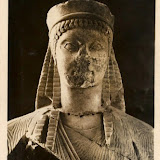
The question of whether archaeology is an art or a science still raises its fuzzy little head though increasingly the revelations provided by technology such as LIDAR push it towards the latter. A good archaeologist need not know much about oxygen isotope analysis but he or she ought to know someone who does. It wasn’t always the case. Before archaeology there were antiquarians and orientalists, who travelled out to sites like Persepolis, sketched the monuments, collected artifacts and proposed theories. Archaeology was an art because it was romantic. With respectability however came responsibility and by the turn of last century very specific skills were required. Being able to read cuneiform was pretty much useless for everything in this world except an excavation at Persepolis and there it was essential. This image you feel tries to evoke that era when travellers might stumble upon some ruined city on the plain then gaze upon its monuments with a philosophical terror.


 A seemingly innocuous image of some ancient foundations but what it presents is a history of archaeology C1860s to 1940s, and then what was to follow. Not all middle eastern archaeology in the 19th century focused on the Bible but so much of it did that it is hard to tell these days whether we are dealing with scholars or fanatics. Take this scrap of wall and the bare framework of a hole. During the 1850s and 60s Orientalists were busy arguing over the site of the hill of Calvary when a number of tombs, including this one were excavated. Suddenly the world had a tomb just below the place then known as Skull Hill, and this according to some was close enough to the biblical account to suffice. There are dozens of very logical reasons why this cannot be the tomb Jesus was placed after being taken down from the cross, but that hasn’t stopped people visiting it as part of their crucifixion tour. Back around the 1940s when this photo was taken the politics surrounding the site were almost non-existent, or at least treated as such. Today while Jews and Muslims fight their battles, lesser known but often violent episodes break out here between Greek, Coptic, Roman, Protestant and other branches of the Christian faith. It no longer matters whether or not this is the actual site. What does is that some people badly feel the need for one. 

   
For a while there, we in the west could look upon archaeology’s tainted past with righteous shame. Museums throughout Europe were full of plunder that rightfully should be returned. The arguments were complex; there’d be no point in having them otherwise. How, for sinister example, could the British Museum and various medical colleges justify all those crates of remains of indigenous people, shipped out from Australia in the 19th century only to be dumped in the cellars and left unopened? Well it couldn’t, and so some were repatriated and everyone put on happy faces. But what about the Elgin Marbles? That was different. Athens was horribly polluted and returning them (right thing, of course) could see these prized sculptures crumble to dust like Dracula in the sunlight, (so wrong thing). The argument changed in 2015, when ISIS took control of Palmyra in Syria and began looting and destroying it. Palmyra represented the very foundations of Western Civilization; from its origins in the Bronze Age to becoming one of the centres of Eastern Greek culture, to one of the great Roman cities and then a major point on the Silk Road. The tragedy of Palmyra’s destruction was partly ameliorated by all that 19th century plunder on our part. Suddenly it looked like foresight that our museums, archaeologists and sundry scholars had been practising all along. Thank God we got all that stuff out in time. The cases for and against repatriation have ceased for the time being, and it is unlikely we will hear them for a long time, at least so far as the Middle East and Africa are concerned. In the meantime, London dealers will continue to keep the market in looted antiquities alive.

GODS GRAVES AND SCHOLARS

Saturday, 17 October 2015

GREETINGS FROM EASTBOURNE


Real photo postcards by George Austin and others
 “I hate to be near the sea, and to hear it raging and roaring like a wild beast in its den. It puts me in mind of the everlasting efforts of the human mind, struggling to be free and ending just where it began.”
William Hazlitt


Eastbourne: a seaside town on the Sussex coast, halfway between Brighton and Hastings, known during the Victorian era for several grand hotels and one notorious murder when a teacher, Thomas Copley, caned his student Reginald Cancellor to death. Today it has an air of shabby gentility about it. The English used to specialize in shabby gentility; the Ealing comedies were essentially about nothing else. That may be a lost art in an age of ostentatious vulgarity but Eastbourne’s waterfront in the summer, with a chill wind blowing off the coast and bringing buckets of rain with it, holds out against the depredations of venality. Those pastel greens, oranges, mauves and pinks splashed across the seafront, the colours of a stick of Brighton rock left in a shop window for a couple of decades, are a reminder that what fades and decays can still have a faint pulse beat.

 
The point of going to Eastbourne has always been to leave, to head inland towards the kind of villages poets and other jolly chaps declared were the soul of England, or to head west and go up to Beachy Head, along what today is called the South Downs Way but back in 1910 was merely the crusty edge of England. The late Victorians and the Edwardians, the people who really developed the seaside town, held many dubious beliefs, particularly about the state of their bodies. One did not walk out to Beachy Head to marvel at the view so much as to improve circulation of the vessels surrounding the liver. This postcard is postmarked September 25 1915 but you can bet it was taken a few years earlier. The publisher was E. A. Schwerdtfiger and it was printed in Berlin. Look closely. The distant figure closest to the cliff edge at the right has one leg and a pair of crutches. 


But we are not in Eastbourne to talk about Germany or missing limbs. Much more interesting is George Edward Austin, photographer from the 1890s to the 1920s, who studio was at 70 Seaside (thanks again to Sussexpostcards.info for the info on Sussex postcards) From the beginning Austin was a portrait photographer. It appears he wasn’t even vaguely interested in the kind of topographical views that people like Fred Judge and Leonard Horner were making a packet out of and never took one. So imagine spending your entire career taking photos of families like this one; a kind of spiritual death you’d think, but born in London’s east end slums in 1864 (Bromley-by-Bow; about the most depressing place for a Londoner to arrive in the world that year) Austin probably didn’t waste much time thinking about spiritual death. And no, we are not in Eastbourne to talk about George Austin’s philosophical opinions but a curious project he undertook and which we can think of as one he made his own.


Beginning sometime between about 1905 and 1910 Austin began turning up to Eastbourne’s hotels to gather the guests and staff out the front and photograph them. According to the inscription in the lower left this was taken on August 4 1913, which the calendar for that year tells us was a bank holiday in England. The women are dressed the same as those in the Beachy Head photo and if they’re not the same individuals they are the same species; people who caught the train down to the seaside on Saturday afternoon and spent the next two days taking constitutionals. On a morning like August 4 1913 George Austin would be rushing between hotels and guest houses before they set out for the cliffs above lighthouse.   


His thinking was infallible. If some photographers were making a living photographing holidaymakers on the promenade during the summer, it made sense to photograph as many people as possible at once, which logically expanded sales from one or two per photo taken to potentially dozens. He didn’t think this up himself. Earlier posts have featured ferries from the same era crowded with passengers who were expected to buy the postcard when the boat docked. Postcards from other photographers taken outside of hotels have also turned up, all of them from seaside resorts and mostly from Sussex and Kent. If the frequency with which his photos turn up in collections, Austin was the most prolific. 


If his motives were entirely to do with economics, look at several of his photographs together and something else comes into play. They become a kind of typology, Eastbourne’s version of the Mass Observation project before its time. Raise a sceptical eyebrow and point out that his images are no different to those taken of school years or sports teams but that misses one important detail. Those are always of the collective as a single unit, hence the team stand together with arms crossed, or the class wear the same uniform. These photos are the opposite; people brought together whose only common bond was that they spent the night under the same roof. They didn’t even have to acknowledge each other in the dining room. That’s why we get a better dynamic: small cells with their own internal dynamics as opposed to the school or the team photo where everyone is the same age and often enough the same gender and who line up to stare dispassionately at the camera. Study one of these hotel photos closely and you discover people who don’t fit in, or someone’s odd gesture. All that aside, they are an object lesson in the ordinariness of life. 


Let’s leave George Austin, but not Eastbourne just yet. One of the odder genres of topographical postcard belongs to scenes of the interiors of convalescent homes, sanatoriums and other institutions for the infirm. Like the photos from outside hotels, these appear to be particular to the south east of England. Here we have one from the Merlynn in Eastbourne. What makes these different is that all other postcards were for tourists but these were for people who having arrived were not always expected to leave. The sitting room became their world. My theory is that they are a direct consequence of two world wars, when hundreds of thousands of former soldiers needed full time care, the south coast with its fresh air was thought to be the best place for them and so a quiet little town by the sea with comfortable armchairs, regularly emptied ashtrays and frequent pots of tea would sound perfect.


GREETINGS FROM EASTBOURNE

Thursday, 11 June 2015

LAND OF THE GIANTS


Postcards of the Redwood Highway
 “The nation behaves well if it treats its natural resources as assets which it must turn over to the next generation increased, and not impaired, in value.” 
Theodore Roosevelt


During the 1920s Ansel Adams photographed the Sierra Nevada and the Californian forests, establishing the image of a world that was sublime and pristine. Adams said wilderness was sacred and some influential people believed him. At the same time Charlie and Leslie Payne were running their postcard company Art Ray out of their van on the Redwood Highway, while Alexander ‘Zan’ Stark travelled the same road as well as others across the mountains ad into Nevada. To them the Redwood Highway was a rather more trashy experience, about as reverential as a plastic Jesus winking on the dashboard. It was a world where once great redwoods and Sequoias were turned into road tunnels, houses and even public toilets. But if honesty has anything to do with reflecting public taste, then Art Ray and Zan were much more honest than Adams. Their image of the highway accorded more closely with the official and the popular image. Between the wars, the more people who visited wilderness the more its status was validated.  The notion that wilderness ought to be protected from people never entered anyone’s head.

 
Today we are driving along the Redwood Highway, in the company of Art Ray, Zan Stark and Frank Patterson. It is the late 1920s (or thereabouts) and the towering trees have inspired two responses among Americans. One is to be overcome with awe at the power and majesty of nature and the other is to calculate how much cash could be made from cutting down a single tree. Some Americans can experience both simultaneously and not be aware of any contradiction, not the least Theodore Roosevelt, who died in 1919, before any of these were taken. Notice how Roosevelt chooses his words in the quote above, advocating neither the protection nor destruction of forests but responsible management; two words America has always struggled with when appearing together. These postcards epitomize the schizophrenic attitude to wilderness that infected the American psyche in the first decades of the last century. The Redwood Highway was a place to worship nature, and it was also a theme park. 

 
During the period when most of these photos were taken, the USA had the best environmental policy in the world. Every other country that had wilderness it wanted preserved adapted the American model. But for something to be the best in the world does not mean it has to be good, merely better than what anywhere else has to offer. The American model, such as it was imposed at Yellowstone, had parcels of wilderness that were not protected from development so much as dependent upon a particular type; tourism. There was nothing inconsistent in having thousands of tourists visiting places like Yellowstone and Yosemite and each individual being asked to imagine they were in some pristine wilderness. Even those two words were dubious. The ecosystems were barely given a moment’s thought: wolves were hunted to extinction in Yellowstone by the mid-1920s and being a national park never gave an area protection from grazing farm animals or logging. As for pristine; it conveniently avoided any idea there had been people living in these areas prior to the arrival of Europeans.

 
The dense fernbrakes are what we expect to find in an ancient forest, but only because we’ve been told to. Most genuinely old growth forests have been subject to thousands of years of human use. Prior to the arrival of the Europeans, the west coast was the most densely inhabited part of North America. We can be sure that fire was used to control the ground cover and promote particular plants. Thick undergrowth like this would have made hunting and movement difficult and when we look at the historical record, it is more common to read descriptions by Europeans remarking on how open the forests are. This photograph shows us what the forest was like after European intervention, when the Native Americans had been forced out of the redwood forests and the undergrowth was allowed to run amok. Our modern idea of wilderness as untouched and untamed is as much propaganda as the idea that First Nations people were passive caretakers who did nothing but watch plants grow.  


The redwoods of the Pacific coast and the Sequoia of the Sierra Nevada are different species of the cypress family. They owe their exceptional height to two factors. One is the competition in a densely populated forest where each tree was involved in a race to the sunlight that over several thousand years became increasingly distant from the rootstock. This can’t explain everything, otherwise all forests would have enormous trees. The second factor is their locations between the broad Pacific and the high Sierras. We don’t consider this part of the world tropical, it’s in the wrong place and it’s too cold, but if we think in terms of humidity, northern California rivals equatorial jungles. For trees to reach 75 metres or 250 feet tall, they don’t need vast amounts of rain but a steady, relentless damp.

 
Theodore Roosevelt was an early supporter of the conservation of the redwood forests and was instrumental in having the Muir Woods protected. The land put aside for the national park belonged to a lesser-known Republican, William Kent. Like Roosevelt, Kent wasn’t at all opposed to a timber industry but he realized that unless some areas were given protection the likely result would be the total destruction of redwood forest. The first steps were taken in 1908 when Roosevelt had the Muir Woods preserved as a national monument.
I have a theory about Roosevelt. Today he is known for three things: his environmental policies, his pre-presidential years as an adventurer, rough rider, cowboy, and for being the last president of the Gilded Age, when the capitalist class showed off its largesse by building public institutions: universities, museums and art galleries and libraries. Think of the latter two reputes and the first takes on a new tone. Here was a man who was passionate about frontiers, the physical ones he could explore on horseback and in canoes,, and the frontiers of knowledge, and by the turn of the century even France and Britain were looking to America to lead the way there. What is it to such a man then when forests are cut down and office towers built in their place? Cut down the wilderness and you remove the frontier, and the world has no need anymore for a man like Roosevelt. His job is done. Preserve wilderness and he can still believe there is a frontier.


Talking about the sacred and the profane; on the back of this postcard stamped 1946, Anita writes that she, Helen and Jack are ‘having a swell time’. At the Cathedral Tree, ‘we sat and listened to the music and it was just like being in church’. Cathedrals are circles of trees that grew up around a dead one and were named cathedrals because the way the light filtered through from the canopy reminded some people of the effect created in great European cathedrals. Anita is telling us however that she, Helen and Jack could sit in the circle and hear piped music, probably one of Bach’s works for organ. These days we say the way to appreciate the wild is to stand still in silence. In the 1940s the idea was to experience comparisons with the great works of man. What nature proposed, we had done better.

 
 The redwoods are among the oldest trees on the planet, with a few getting close to 4000 years old (still falling short of some nearby bristlecone pines by a millennium). We see that this one’s life came to a premature end in 1930. The lumberjacks who set about cutting it down could probably tell how old it was to within a century so when it fell they sliced off a disc and sent it on to whoever was managing the tourist facilities. Dendrochronology is the art of reading tree rings to understand climatic patterns. To people that can read them, tree rings reveal a precise story of shifting weather conditions. Although they cannot tell us who or what was living in the vicinity 500 years ago they can provide an explanation as to why everyone packed up and moved out.  To the rest of us the best that tree rings offer is a timeline that appears astonishing but tells us nothing. Well, we can see here that this tree was already sturdy and mature when William the Conqueror landed at Hastings, which needless to say is nowhere near northern California. And height-wise it was impressive by the time Columbus landed on an island in another ocean. As history lessons go, it’s a bit non sequitur. Still, there’s an irony at work. You want to impress on tourists how old these trees are but the only way you can do that is by cutting them down.


Things could be worse. An ancient tree, just a sapling when the three wise men were on their way to Bethlehem, could end up being turned into what some Americans inanely refer to as ‘comfort stations’. Is this divine retribution, a credit to man’s ingenuity or is it an indignity? Back then the second would have been the answer. Even passionate advocates for wilderness believed that tourism was going to nurture and ultimately protect national parks, so turning dead or dying trees into toilets would have a harmless compromise. It wasn’t until the 1960s, when the damage from 1920s era environmental policies became apparent, that people like Aldo Leopard proposed Washington rethink its environmental strategy while Edward Abbey insisted that everyone from Ansel Adams to Theodore Roosevelt and even the patron saint of the forests, John Muir, had got it wrong. 

 
Well it's been fun. We've witnessed the beauty of nature and the banality of man looking quite comfortable together, seen things that some of our contemporary Americans would rather we hadn't and others that remind us there was a time when the choices facing us were simpler We've saved the best for last. The drive through tree is most iconic image of the Redwood Highway. Even people who can't spell Sequoia know it's the tree you can drive through. During the 1920s and 30s there were several of these trees on the highway. Most, including the Coolidge, have died, which somehow doesn’t sound surprising. At least three are still in operation, and all owned privately so they come with a fee.  Adams photographed plenty of redwoods but it’s doubtful he ever photographed one of these trees – the car, Beaver and Wally Cleaver's faces pressed against the window, would have been anathema to his purist eye – but I can’t help feeling that his view is all the more deceitful for that.  Whether he was suggesting his view was what the Redwood forest looked like now or what it could look like in the future, it was created in the darkroom. He was like a good lawyer in that you had to pay attention to what he was leaving out. Zan Stark and Art Ray weren’t that clever but if you want to know how environmental policy worked in the 1920s and ‘30s, which is the same as wanting to know why some aspects don’t work today, they are the photographers to look at.

LAND OF THE GIANTS

Friday, 4 April 2014

MODERN ARCHITECTURE


Snapshots of modern architecture

“Architecture is the art of how to waste space.”
Philip Johnson


Looking at two books on architecture, I see one locates the beginning of modernism with the Eiffel Tower while the other reminds us that we can’t ask the question without looking back to the Renaissance. Considering that Renaissance architects had classical Rome in mind, and the Romans borrowed from Greece, this sounds like a polite way of telling us the question is irrelevant. However we like beginnings, and some of us need them, so I would put the Palais de la Jetée in Nice near the start. It was opened in 1883, close enough to the 20th century to be modish. Rather than making grand and tiresome claims on behalf of the state, it offered vicarious entertainment. Best of all, it had a brief life. It caught fire three days after it opened, was restored and reopened in 1891 then in World War 2 the German army stripped it for steel. We are becoming conditioned to the idea that grand monuments should never be around for too long, and if they will be, let them be ruins. Just as megalomaniacs build temples to themselves that quickly turn into shopping centres, the modern architect designs buildings expecting them to be torn down or transformed as soon as someone else has another idea. Still, it takes a cold heart not to regret the passing of the Palais de la Jetée. We know that were it around today, American corporations would have plastered their logos across it or some Russian oil baron would have turned it into his exclusive domain. 


The tower once stood in Trafford Park, Manchester. Its correct name is, or was, the Metropolitan Vickers Water Tower. Built in 1902, dismantled in 1940 on account of German bombers, it carried Radio Transmitter 2ZY on its crown and would be the second BBC radio tower in the country. Industry, technology, modern design, Sigmund Freud: it perfectly represents everything the word modernism meant in the first part of last century. The horse adds a post-modern element of contextual opposition. The man is a Turkish tourist; perhaps the photographer was as well. 


Speaking of contextual opposition, a hallmark of modernism was its rejection of neo-classical iconography while embracing its grandeur. Forget Doric columns, porticos and domes, but don’t ignore the monumental scale evoking the expansive breadth of our culture and civilization. When the Grand Masonic Lodge in London called on Henry Ashley and Winton Newman to build a new temple in 1927, they also wanted a memorial to the masons who had died in World War 1. The architects came up with a building now considered one of the outstanding examples of Art Deco design in the world. The columns and the architraves recall neo-classicism but for its time the building was distinctly modern. I have difficulty understanding how far the tentacles of the Masonic conspiracy have reached into our society. Either they are in league with a group of Jewish bankers and pretty much run the world economy, or they are profoundly anti-Semitic. One thing readily identifiable about masons is their architecture. They love the hidden codes found in symmetry and the hints at arcane science and mysticism. Don’t we all.


New Yorkers like to think they own the triumph of modernist architecture, and for once it is hard to be completely unsympathetic towards them. Impressive as it is from the outside, the really exceptional details in the Empire State Building are the plaques in the lobby identifying by name every labourer who worked on it. There is something in that which shows supreme self-confidence; not so much in the idea of the building being the work of a community, but in the attitude that there will one day be taller buildings than this one but they will never surpass the achievement. 


Here we have the Aldred Building in Montreal; completed the same year as the Empire State Building and, clearly, something of a little brother in the looks department. Like the Empire State Building, it stands out on the skyline but the real beauty lies in close-up, the friezes on the exterior and the design work indoors. Let New York have its Empire State Building; every self-respecting city needs an Aldred. Australian cities like Perth used to have quite a few. Now they don’t, they’re about as interesting as the crust on a three day old cup of coffee. 


Speaking of death, which I think we were in passing; architects have designed tombs. There are monuments in Père Lachaise in Paris that are considered the best work of particular architects. Most of these are massive; the size of small mansions, but a few are outstanding for achieving a lot with a minimum of expression. There is a history of modernism in the cemetery, which I am only vaguely familiar with, but as I recall, following World War 1 there was widespread rejection of anything ornate or elaborate in monuments. In some cases, the architects behind the remembrance fields in France consciously rejected typically pseudo-classical designs because these were associated with the state. The people, those who had paid for the state’s errors with their lives, deserved something more dignified. That idea percolated down to civilian monuments in cemeteries. Where once the size and detail in a stone angel said something about the deceased’s wealth or status, now their families were inclined to go for something simple that said a lot more. Note the American flag to the left. I assume this means this is a military memorial. Notice too how you don’t need much at all to give the site proper solemnity.


We are moving towards what is normally classified as late-modernism, but along the way, let’s stop by this charming house by a Canadian lake. Difficult to be absolutely certain here but there is a suspicion this is an example of a phenomenon that took off in post World War 2 North America and spread worldwide faster than any healthy notion should. The concept of pre-fab homes goes back much earlier; there are advertisements for them from the 1849 Californian gold rush, but we associate them with the great suburban land grab of the 1950s. Why think this is a pre-fab? Well, it’s too neat, too small and the asymmetry of the entrance emphasizes the symmetry of the rest. The too small and innocuous verandah above the garage adds to the effect of something built with mass production in mind. The giveaways are the too narrow eaves and the fake shutters. The reasons for investing in a pre-fab are obvious; they were cheap. The desire to design them is harder to understand. One began with a basic premise – two bedrooms, kitchen, bathroom, dining room etc – then worked down from there. It became an exercise in trimming the details so that the homeowner scarcely noticed the difference in space. Designing pre-fab homes was a job for the fundamentally cynical and anti-social.


Here we arrive at something easier to identify. Streamline Moderne was one of those hiccups in taste that did not feel so obnoxious after the first convulsion. One thing to love about it was that it drew its basic influence from ships. The authentic streamline moderne building was supposed to remind observers of ships cutting through the high seas. Really, though a few houses were built in the style, it belonged to just three types of buildings; motels, apartments and factories - perhaps because it was the best design for hiding the drab sordidness of what went on inside.


Here we can see the basic outline of the ship a little better, though this is an example of what we might call streamline moderne light. Real S M would have more features and flaunt its style like a peroxide blonde. Note the broken windows on the first floor, and this apartment was still relatively new when the photo was taken. One measure of how badly Australia’s building heritage has been handled by state governments is that in Perth and Brisbane there would be a fight to preserve this building. That’s sad and embarrassing. This was bought in England. The broken windows have an English look to them, though they tend to turn up more often on housing estates.


I’m not sure if this is south-western U.S desert or Canadian prairie, and I’m cannot say what exactly the building’s purpose is, apart from something industrial or wholesale, but I do know that it belongs out here. Once modernism got over its thing about height and thought about breadth instead, the number of regions it fitted in with suddenly expanded as well.


Interestingly, the cars belong to the era of high S M, as do the portholes over the portico, but the building itself doesn’t really qualify. It’s a motel of some description. My limited experience with American motels accords with what I’ve read in Learning from Las Vegas. All the energy in attracting customers was directed to the street front. Once past the neon you were in a place that could suddenly look old and ordinary.


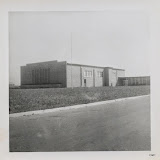
Several of these photos came from the same box in a flea market, and I’m guessing were taken by the same person. Full credit to them for getting the New Topographics look while making it look so patronisingly easy. Here we have a school, presumably in Mexico or south west USA, judging by the sign on the roof. There’s something about the look of this place that encourages truancy. That something is called modern architecture.

MODERN ARCHITECTURE

Friday, 24 January 2014

INVOCATION TO THE EARTH


Fred Judge's Postcards
 “I found the poems in the fields
And only wrote them down” 
John Clare


If you have ever rifled through a box of British topographical postcards, you’ve undoubtedly come across Judges postcards. Depending on your mood, what you were looking for and the price the seller was asking, you either went straight past, thinking they were no different to any of the others, or you stopped and took a second look. Considering that Fred Judge personally took over 9000 photos for his postcards and others in the company later trebled that number, some are going to be ordinary, or even less interesting than that, but others rank among the finest landscape views taken in the early part of last century. This isn’t my opinion: Near the end of his life, Peter Henry Emerson (the photographer of the Norfolk Broads) had a series of medals struck that he then awarded to the photographers he thought had most advanced the cause of art. The only one he gave specifically for landscape photography went to Fred Judge. Searching through editions of old photographic magazine like Photogram of the Year, I came across several mentions of Judge and always in the same context. A group exhibition had been held in London, Liverpool or New York and though the reviewer was mildly impressed with the collection, Judge was always singled out for praise. 


Fred Judge was born in Wakefield, Yorkshire in 1872 and moved to Hastings in 1902 to set up a photographic business with his brother. Initially he was retailing photographic equipment and took landscapes as a sideline but by 1904 he was producing real photo postcards and from then on they became his focus.
There were dozens of companies specializing in real photo topographical scenes in Britain: Valentine’s, Raphael Tuck and Frith and Co are probably the best known. These were large family concerns employing several photographers. Fred Judge, on the other hand, took his own photos, at least in the early years. The page on him at the Sussex postcards site is quite specific. After card number 9347, Oliver Butler shared the photographic work and by number 9847, taken in 1927, Fred Judge remained behind the desk.


He started out in the era when landscape photography was art so long as it was Pictorialist. Soft focus, deep shadows and sepia tones were the first requirements but these only worked if the photographer also regarded the world from an affectedly romantic point of view. England was a land of verdant fields, castles and quaint villages. The Pictorialists weren’t against modernity, in fact quite a few thought they were in the vanguard; it’s just their aesthetic didn’t work for capturing the modern world. Whatever they photographed looked old.


Perversely, that would be one of the secrets to Judge’s success. When he turned his camera to the landscape he could make it look as though nothing had changed for hundreds of years. Even the presence of a car couldn’t detract from that nostalgic feeling. If anything, it probably enhanced it. You could drive out of the city in a brand new Austin and within a few miles be back in the land of the Romantic poets or even Piers Plowman. It was a very literary world and despite what we are told about modernism ramping up time and embracing technology, a lot of people wanted that.


Judge himself was no anachronist. He exhibited regularly in the Royal Photographic Society salons, which might sound like gathering places for old fogeys and they were in so far as the ideas about what constituted a good photograph were narrow and rigid. But the RPS was also at the forefront of technical experimentation. Innovations in film and printing were always encouraged so while aesthetic judgements could be severe, the definition of a photograph was broad.  


In 1915 Judge lodged patents in Britain and the U.S for “a camera for composite heliochromy”, another name for colour photography (GBD191515666 and US1312694A). Rotating discs carrying filters inside the camera would create colour photographs by the subtractive process, which is to say each filter removed colours, allowing only the natural colours through. He was effectively shifting the filtration step in colour printing to the camera. Nothing more has been heard of this camera but on September 21, 1915, The Times reviewed the International Exhibition for the London Salon of Photography, an offshoot of the Brotherhood of the Linked Ring, the temple of Pictorialism in Britain. His colour images were singled out for praise. We’re left to wonder whether he was displaying work taken with his camera or, as others were likely to do, hand coloured bromoil prints.


Speaking of bromoils, he is also credited with inventing the bromoil transfer process. Taking the standard bromoil print a step further, the bromoil transfer process heightened the painterly effect and would become one of the hallmarks of late period Pictorialism. His postcards were usually standard gelatine bromide prints but it is odd, if not unforgiveable, that Judge has been overlooked in most histories of British Pictorialism. The suspicion is that within narrow fields of research he is regarded primarily as a postcard photographer when we should think of him as a Pictorialist who used postcards as a medium.


And while we’re on the topic of people failing to acknowledge Judge, a really useful book about this period is The Camera as Historian by Elizabeth Edwards, who also fails to mention him, but she is concerned with the survey movement. Every weekend hundreds of amateur photographers across Britain set out to photograph villages, buildings and ancient monuments and local councils registered and filed away their efforts. In approach if not ideology, the survey movement was opposed to work like Judge’s. The driving force behind the survey projects, Sir Benjamin Stone, thought not only was Pictorialism a blight photographers needed to avoid, he was against any hint of the picturesque. The problem was, like Judge, the people who spent their weekends photographing Norman churches and village houses were inspired by the picturesque in the first place. That was probably the single most important reason a lot of them had taken up photography. We can see their struggle in some of the photographs reproduced in the book. The fading afternoon light can enhance a scene yet they are being told to avoid that. Even the organizers of the various county committees had to acknowledge that history wasn’t simply an accumulation of facts but involved interpretation. 


What really distinguishes the best Judges postcards is their atmosphere. England appears to have been perpetually bathed in mist, its landscapes viewed through an eternal dusk. There is a gloominess that is neither bleak nor depressing but obviously romantic. Of a type we associate with Victorian Britain. It’s worth remembering that although Judge began his company during the Edwardian era, he came to it a fully formed Victorian. He had been told since childhood that the British Empire was the most powerful the world had known and its reign would probably go on forever, that its backbone was built from superiority in engineering and industry and art was the handmaiden of science. To look upon the landscape wasn’t to see rocks and trees but a culture and its history. That quaint little village in the valley with its thatched roofs and smoking chimneys represented the centuries of triumph and tribulation that had let to this moment where he stood in the mist and pointed his camera.


Take this view of Caedmon’s Cross in Whitby. It speaks of a long history dominated by Christian thought, the cross standing proud before the setting sun. Actually, it was built in 1899, just a few years before Judge took this photo. It was a modern design though the stone came from an ancient Roman quarry and was praised in its time for the way contemporary ideas were reconciled with England’s long history. Judge has captured that concept of the ancient fusing with the modern. The dark tones emphasis the sense that little has changed in Whitby. The photo could have been taken a hundred years earlier.


One of the reasons Pictorialism failed was it had no social content. The people who congratulated themselves on being artists had no way to respond to issues of the day. This is a great image but it is also a failure. From Judge’s series of London night scenes, he titled it (rather than captioned), ““Outcasts” London 1 am”. What are we meant to see? A scene of urban despair, or a street made atmospheric by the evening mist?


Here’s another scene, taken at Wrexham on the Norfolk Broads. For photo-historians the Norfolk Broads mean Peter Henry Emerson, and it takes cold-blooded indifference not to be moved by his work. Judge was a disciple of Emerson: when late period Pictorialists were asked to choose between Emerson and Henry Peach Robinson, you know whose side he was on. This is a ‘nice’ image, very calm, very quiet, but where Emerson understood the quality of stillness, this is static. It might make us want to get in the boat and glide away through the Broads, but it won’t ask us to do anything more. 


Like all prolific postcard photographers, Judge’s works are an inevitable mix of success and failure. It’s a matter of personal taste of course which you prefer. Technically, his church interiors are usually faultless, and photographing them took good equipment but more knowledge and experience in the 1910s. (One reason they were so popular was that most tourists couldn’t take them.) In my mind his best may be his landscapes; scenes where it looks like he stumbled across them and was so taken he had to set up his camera. These can have a sense of stillness he might have wanted in the more Pictorial work but usually missed. Being able to take a good photo in a church doesn’t make you religious, but being able to take a good landscape needs affinity.


The issue to ponder is not why Judge has been neglected or even whether he deserves more recognition. That era between the end of Pictorialism and the birth of modernist photography has been corrupted anyway. It’s astonishing how many New York curators and art historians seem to think Pictorialism began and ended with Alfred Stieglitz, when really, he was late on the scene and a bit slow to leave it. The British on the other hand can come across as faintly embarrassed, wondering why anyone would think boats at sunset made for good photography when there was a class struggle going on. Because Judge turned most of his photos into postcards there are hundreds of thousands of examples of his work floating about. Far from being obscure, as soon as you start looking for him he turns up everywhere.  

VIEW THE GALLERY HERE
INVOCATION TO THE EARTH