And furthermore ...

One Man's Treasure encourages the use of anonymous photographs posted here to illustrate books and album covers.
If an image appeals to you, contact John Toohey at johntoohey@hotmail.com.
Showing posts with label Egypt. Show all posts

Sunday, 29 May 2016

ANCIENT HISTORY


Panoramic postcards of Egypt by Lehnert & Landrock
“Give me my robe, put on my crown; I have immortal longings in me.”
Shakespeare: Antony and Cleopatra


 When Rudolph Lehnert and Ernest Landrock moved their photographic studio from Tunis to Cairo in 1924 they were announcing to anyone listening that Egypt’s capital was also the cultural capital of the Middle East. Not that they decided this: the year before, Howard Carter and his team had broken into Tutankhamen’s tomb and Ancient Egypt had once again become the most exciting idea on the planet. In far off Hastings, builders excavating a basement discovered some odd glyphs in a dingy tunnel and for a moment the theory that ancient Egyptians or Phoenicians had visited the place was kicked around. The place called Ancient Egypt, or at least the idea of it, had seldom been out of fashion’s eye in the last fifty years but now it was back centre stage. There were at least half a dozen other companies in Cairo producing real photo postcards for the European market but Lehnert & Landrock would become the best known.

 
 Lehnert, the photographer, had certainly worked in Egypt before the company opened shop there but once it did, business flourished. We can think of its halcyon years as coming between 1924 and the beginning of the war. Although a great enthusiasm among the British for German product seems unpatriotic, even love of country has its limits. There was a booming international market for shots of L&L’s most renowned genre: nude Bedouin women, and the British were driving demand as much as anyone else. But anyway, we’re not here to talk about that, or even more dubious genres the company marketed but rather the flip side; Egypt as a phenomenon of cultural sophistication.  

 
 From the beginning, postcards were the familiar size by which we know them, approximately 3½ x 6 inches, because they fitted the standard envelopes for informal correspondence. In some countries the laws sounded specific; the post card had to be ‘no more than’ or ‘less than’ or ‘at least’, but this only meant that anything that fitted within the required dimensions was legitimate. Publishers produced midget size and giant size postcards but the most common irregular format was the bookmark size, and though bookmarks of stage stars were popular, landscapes and street views have become the most enduring, especially the bookmark postcards from Cairo that Lehnert and Landrock produced.
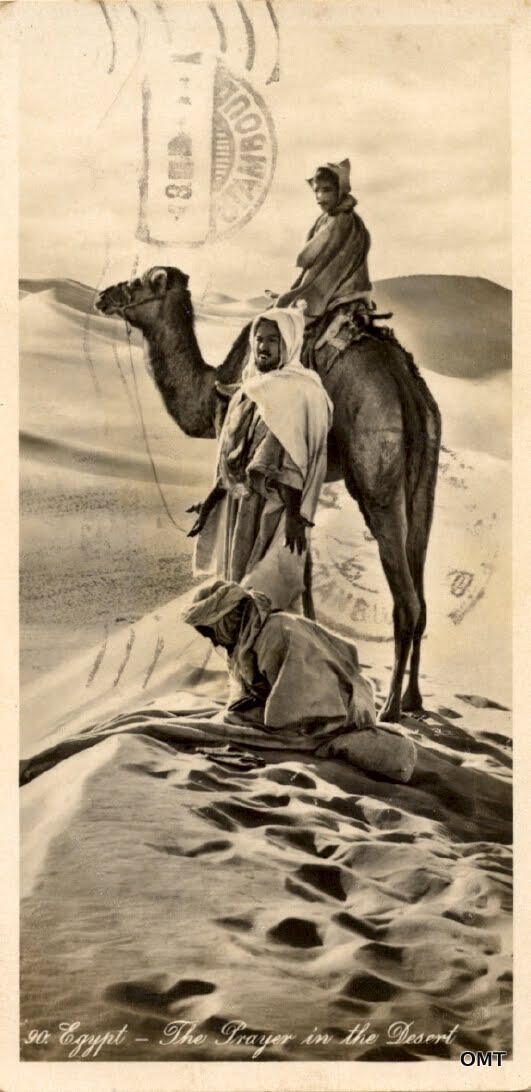
 
 One of the company’s achievements was that it managed to make Egypt look how everyone imagined it to be; a land still touched by its ancient past, with oases of palm trees providing shade from which to contemplate the pyramids, maze-like souks, the stalls piled high with ornate rugs and silverware, and watched over by hawk-eyed Muslims. One hundred years ago, the abiding image of Muslims was of devout, silent and impassive people. Of course, not long before in the Sudan and southern parts of Egypt Muslims were fanatics who needed to be suppressed with violence if necessary, but that was now the past. In popular culture the siege of Khartoum was just another heroic chapter in the history of the British Empire.  

 
 From 1882 until 1922 Egypt was officially a British protectorate (and less officially into the 1950s). This explains why Cairo, a city inhabited by Egyptians since 969 CE would have a ‘native quarter’.  This was both a ghetto and a slum – neither being necessarily the same thing – separate from areas occupied by Europeans, Armenians, Alexandrine Greeks, Jews and Ottoman Turks. Egypt at this time, well, until 1914, was also a khedivate of the Ottoman Empire. The condition for Egyptians was something like being the child of two parents whose contempt for each other was outmatched by that for their offspring. Said children are usually destined for a miserable adulthood.

 
Cleopatra, Khartoum, The Greatest Story Ever Told: in the 1960s Egypt became the canvas for epic visions, though ‘bombastic’ might be a better adjective. There’s a suspicion, and maybe nothing more, that one influence was these panoramic views; well they share the same format and there is something about the panorama, no matter how small, that speaks of the vast – in time as well as space. To create this image the studio simply took a standard format negative and cropped what wasn’t needed. There isn’t the distortion a genuine panoramic camera would produce. Still, removing whatever was extraneous and leaving the palms, the camel, the cart and the porter suggests a scene that could take place anytime in the last 200 years. Interestingly this is titled Kasr el Nil Bridge but it may be the one it replaced in 1931, the Kobri el Gezira. Photos of that one have the palms but they are absent in views of the later bridge. 


 The Orientalist argument says that these views tell us more about the consumers than the place, which should be beyond dispute by now, but what after all do they tell us about Cairo? Where, for one thing, are the crowds? Today the city is so densely packed that a view like this one seems impossible even at unlikely hours. Was it really so magically empty in the 1920s? No. As far back at the 1500s, when Europeans began arguing over the biggest, the richest and the most powerful cities in the world, three were inevitably ignored: Peking, Bombay and Cairo. As engines of civilization they were derided, despite the monumental evidence opposing that, and despite the popularity of Ancient Egypt stemming from the great desire of London, Paris, Rome etc to be seen as the inevitable heir to its culture. So no; this is not the vast, hectic and noisy city tourists encountered but somewhere ancient and austere: the place they came to find.


ANCIENT HISTORY

Thursday, 28 May 2015

TRUTH AND CONSEQUENCES

Discarded sequences
“Murderers will try to recall the sequence of events, they will remember exactly what they did just before and just after. But they can never remember the actual moment of killing. This is why they will always leave a clue.”
Peter Ackroyd


 Sequences of photos snipped from proof sheets, cut out of albums or otherwise cast off, leaving us with what may be mysteries, or not, or clues to a bigger story, or not. Murderers may always leave clues, but so do photographers. The problem is that they seldom tell us what to. Notice how these two images above move from a kind of order to a kind of chaos, suggesting some force outside the photographer’s control is at work.


 All of these were bought Turkey, which explains one or two details in the scenes. Other than for those however, they could have been taken anywhere. This zoo for example doesn’t look Turkish (except for the lion’s tiny cage). Sometimes we are able to read a very apparent narrative in a sequence, as with some below where people are playing for the camera, and then there are others like this one that tell a story like some French film from the mid-sixties; well there might be a plot and it could be logical, but should you care that much?

 
 So, is this five photos or just one? I say it is one because you can not consider any of the portraits here on its own without physically cutting it free from the others. 

 
 This one on the other hand is interesting because all snapshots taken at Giza are interesting, yet I think the middle photo stands up on its own and the two bookending it do not. Remove them and the surviving image is not diminished. 


Here the photos complement each other thanks to the way the child on the right looks at itself on the left. We can see how the photographer would have been pleased with either and printed the proof to compare them. The one on the right wins because of the balance between light and shadow.


Four photos – or do we mean two? – of the same three people. There’s a strong impression here that the three are actors, because they perform so professionally for the camera. The printing isn’t first rate but good enough to see how each frame has its own intriguing details, from the floating hat in one to the expression on the faces of the man and woman in another. 


It’s not rare to read that the source of many snapshots’ enigmatic quality is the absence of a surrounding context, without which we cannot understand the relationship between photographer and subject. Here’s a sequence that is all the more difficult to read because of its surrounding context. We get the three women sitting together, but what of the first photo in the sequence? The radio makes sense, and the book on the left is a medical encyclopaedia, which may help us understand the cut out naked woman on the right, but that is a mere assumption.


Back to a diptych from the same source as the first image, and a reminder of that brief era between the late 1960s and the mid 1970s when the combination of two images on the same panel was considered outré, or at least cool. Robert Frank is the best known exponent and he liked to include a cryptic text on one or both photos. What was good about this style, movement, genre or whatever word fits best, was the way it obliged us to look for and think about the connection. We ended up talking about it, and though the conversations could have been lifted from Annie Hall, their absence is noted these days. In this case we might note how the two women appear in both while the person in the centre is different. During the long and tedious 1990s-2000s the placement of two images together could only mean issues of identity or the self, but in the 1970s the photographer could shrug and say, ‘whatever you see is there’.

TRUTH AND CONSEQUENCES

Thursday, 7 May 2015

THE POSTMAN ALWAYS RINGS TWICE


Postcard views and their written messages
 “I don't film messages. I let the post office take care of those.”
Bernardo Bertolucci


Usually the correspondence on the backs of postcards is perfunctory and not worth a second glance. Someone has arrived somewhere and the weather is fine, or not. (What is this peculiarly English compulsion to start a postcard by describing the weather?) The very public face of the postcard discouraged people from revealing too much and serious correspondence required the traditional sealed letter. Occasionally however a card turns up with a written message that enhances, contradicts or otherwise changes the way we look at the image. This one, to a Mr. T. P. Carson of Polk St in Minneapolis, was posted from Hague, North Dakota on the 14th of July, 1911 and reads:
Dear Brother;
I am sending you just a glimpse of myself, my old man and my buckskin pony. You must excuse me for not writing but I have been so busy. Will write you a long letter soon. Hope you are as well as we both are. Love to you from us both.
Your sis, Mrs J Berg.
We can hear a rural Midwestern accent in her phrasing, and that odd mix of familiarity – ‘Sis’ – and formality - ‘Mrs J Berg – is also found in the image. The photographer was most likely a friend and the Bergs look like they are on their way to church; all dressed up with the wide and empty plains of North Dakota behind them. Image and text tell us a lot about the relentlessly long and dull struggle the prairie farmers endured at the turn of last century.


Around the same time and across the Atlantic an unidentified woman wrote from West Hill House in Hastings to ‘A’. West Hill House is a listed building, which in the 1930s was occupied by the popular author Catherine Cookson. With the resources of the Hastings library at hand it wouldn’t be that hard to track down the author of our card, which reads:
Thanks very much for the P.C of last night it came as a pleasant surprise. I am sorry Eva could not see you last night I have not heard from her so I do not know if she has gone to her new place or not. I had a postcard from Frank (Eva’s brother) this morning he wanted to know if I got home safe last Wednesday night & said he was sorry he did not see me again (Don’t laugh) I am sorry it is ended with your girl through us but still if your not worrying it doesn’t much matter does it I’m afraid there’s not much love lost between you.
The absence of punctuation, the sloppy grammar and the catty tone point to someone in her late teens or early twenties. Note her acknowledgement, even the faint boast, of the part she played in breaking up the relationship between A and his girl. A few years later she could be cast as one of the flippantly cruel young socialites in Evelyn Waugh’s novels. Notice that ‘A’ sends her a P.C but Frank sends her a postcard. I suppose casual abbreviation was one way she distinguished friends from hopeless dolts. Note too the otherwise straight topographical view she has chosen. West Hill House is probably visible in this image, which is why she selected it, but she is unaware that her choice of image reveals how prosaic and suburban her outlook really is. 

 To Germany on September the 13th 1909, where Ella writes to Miss Alice Duvet in Dorchester and in three brief sentences tells us a lot we may one day find useful.
Wouldn’t this stop a clock? In 7 days we start sail for America and if possible will land in 12 days. Most likely it will be 14.
The expression, to have a face that would stop a clock, was current at the time and referred to someone who was particularly ugly. Ella sounds too polite to brand anyone else that bad looking so we can assume she is the woman in the photo. Is that her father with the camera? The person who took this was most likely another family member or a local photographer working the tourist market. The most interesting detail is in regards to the time needed to cross the Atlantic. There’s quite a discrepancy, a whole 48 hours between 12 and 14 days, even for the mechanized and technological 1900s. If a face could stop a clock, heavy fog and storms could halt an ocean liner. 


As previous posts have claimed, Fred Judge was the quintessential British photographer, meaning not just that he photographed the life and the land in detail but it is also hard to imagine him working anywhere else. A couple of sentences in a Hastings newspaper from the 1910s suggest he may have taken a brief trip across the Channel to Calais. That, for Fred, was about as exotic as the world got. The number of the card indicates the photo was taken circa 1910 and the scene is somewhere along the south coast of England, most likely between Brighton and Hastings. So far there is nothing remarkable to say. But read on …
Dear Femihan
I received your letter of April 9th and enclosed a page on May 3rd, yesterday May 27th. I am thrilled by this news! “CHEERS”! But dear, do come quickly, before I go … It will be tragic if you arrived when I’m gone!! … I leave Cairo for Dhour el Choueir, Lebanon; (that’s my address) at the beginning of July. Won’t you be here before? I hope & pray. I rang up the Diara (?) today, your uncle could not give me any news as he knew none! Hoping to see you with all the longing of “long absence” Yours, with love, Leila.   
Leila Mestrick has posted the card from Cairo, Egypt to Femihan, who lives in the Maltepe district of Ankara, Turkey. The punctuation and underlining for emphasis are all Leila’s. But how does a very English postcard get mailed from Cairo? Leila has also dated the card May 28th ’45, which helps explain things: this was during the weeks of progressive surrender by the German forces and Britain would have been in control of Cairo. Leila’s surname is also English, so presumably she married an Englishman. Notice how her English is impeccable though she emphasizes ‘cheers’, a very British idiom, indicating that English is her second language. Femihan speaks it too, demonstrating what we can already read; both women are from educated, prosperous families. Interesting that although we know the photograph was taken on the English coast there isn’t a single detail within it to indicate that. It could have been taken anywhere. Leila’s choice of card was deliberate. She didn’t want one showing a distinctly British scene, of castles or sheep in the fields. Is it too much to see the image of waves crashing on rocks as an allusion to powerful emotions that Femihan would get even if the English hubby didn't? And was there a newsagent in Cairo selling English papers, stationery and postcards or did Leila bring a supply of postcards over from England? Both possibilities tell us something about the British colony in Cairo during the war.

POSTMAN RINGS TWICE

Saturday, 14 January 2012

CURSE OF THE PHAROAHS


Postcards of Egyptian monuments
 
“He died in great agony, raving of mummies, pyramids, serpents, and some fatal curse which had fallen upon him.”
Louisa May Alcott, Lost in a Pyramid (1869)


 Little Women would make Louisa May Alcott famous and relatively wealthy but while she was writing it she needed money so she pumped out some lurid tales including Lost in a Pyramid, which some critics credit as the first story about an Egyptian mummy’s curse reaping what it had sown. By 1922, when Howard Carter discovered Tutankhamen’s tomb the idea was already a boilerplate so when people associated with the discovery started dying off others took it for granted that ancient curses existed. The finger of suspicion regarding Tutankhamen’s curse is often pointed at Arthur Weigall, a respected Egyptologist who was offended that Lord Carnarvon had given the story to the London Times and not to him. Weigall was also a journalist and theatrical set designer so he knew how to spin a convincing story. He didn’t have to try hard. Back in 1909 newspapers around the world had speculated on the strange events around mummy case number 22 542 held at the British Museum. Several people who came into contact with it, whatever that exactly means, suffered horrid fates. It was claimed that a photographer who photographed the casket killed himself after his developed plates revealed the cold, hateful face of an ancient priestess staring back at him.


 Before Edward Said got hold of the word, an orientalist was a scholar interested in ancient Egypt and the Near East. An authentic orientalist was supposed to be fluent in several dead languages and an astute art historian as well, able to date artifacts at a glance and spot anomalies. Despite having one of the most exotic job descriptions on the planet, orientalists spent a lot of time painstakingly deciphering fragments of papyri and if they were good enough to be given charge of an excavation that meant months in the disease ridden desert caught in the negotiations between British and Egyptian authorities. Given a limited season to work, they often had to call a halt to the excavation and wait for some detail to be worked out in London. The images of the orientalists as either toffee-nosed eggheads in linen suits or rugged adventurers in khaki shirts are wildly wrong. Most of them came from the epicentre of the middle class and their interest in the ancient world reflected a quiet alienation from the mainstream. Weigall’s story of Tutankhamen’s curse was scurrilous but he believed that Egypt’s antiquities should remain in the country and fought for that. Carter was also fired from his job as inspector for the Egyptian Antiquities Service when he took sides with the Egyptian guards against foreign visitors. They were also in the habit of upsetting long held biblical doctrines and weren’t to be trusted.


Too little is known about Mohamed Aboudi. He was one of the few Egyptian orientalists working in the 1920s. His guidebooks to the ruins of ancient Egypt carry a scholarly authority, well mapped and frequently advising the visitor to pay attention to small details whose significance could easily be overlooked. A photo online suggests he came from a wealthy family, which is a given since only very wealthy Egyptians could afford interest in ancient history. Also, the British authorities kept Egyptians at a distance in case they got any ideas about national rights.  He was also a photographer and used his images to illustrate his books. It can seem sometimes as though it was impossible to take a bad shot of an ancient monument, or an original one. Lehnert and Landrock produced photos of this statue of Rameses II at Luxor taken from almost the same position as the one above. The emphasis in photographs of ancient monuments was always on size and scale. The figure just behind Rameses is of his most beloved wife, Nefertari. She is probably twice the size of an average person so does it need to be said that Rameses had a high opinion of himself?


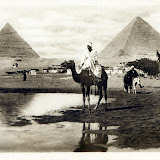
In the 1920s orientalism was still a highly regarded discipline, people were making discoveries that rewrote history, several important languages still required decipherment and governments and educational institutions weren’t yet infected by the doctrine that business was their sole raison d'être. So what did orientalists think of all the European studios setting up business in Cairo and photographing the ‘essence’ of Egypt for customers back home? As long as romantic interest in Egypt was sustained the orientalists kept their prestige, but then they also had to contend with tourists who were often both bored and amazed by how tedious the work of an archaeologist appeared in real life. Lehnert and Landrock never produced an image that wasn’t a cliché. You couldn’t seriously consider them great artists, not against some of the photographers who had already documented Egypt nor against the standards of what was being produced in Europe at the time, but the point of clichés is that they meet assumptions. They depict what people want to believe in. The photo above came from the Scortzis Company, preceding Lehnert and Landrock by a decade though the work of both companies is almost indistinguishable. In the popular imagination, Egypt was a land still dominated by ancient mysteries. A study of a shepherd and his flock resting at an oasis with the pyramids in the background said it all.


Osiris, god of the underworld, was killed by Set, god of the desert and of chaos. Isis gathered all the remnants of her late husband - except his penis, which she threw into the Nile – and assembled Horus, the falcon headed god of the sky. For centuries Horus was the chief deity of southern Upper Egypt and Seth of the northern delta -Lower Egypt, and the two gods engaged in a long metaphysical war. Around 3000 BCE the two states united, which finally brought the gods to the negotiating table. The temple to Horus at Edfu was completed during the reign of Ptolemy XII, making it one of the last great monuments of ancient Egypt. The figure in this photo is usually reckoned to be Ptolemy, It is on the entrance wall to the temple, a building which, in photos at least, could pass for a late 20th century government office block.

EGYPTIAN RUINS

Wednesday, 9 June 2010

ORIENTALISM: RUINS AND ANTIQUITY


Pascal Sebah in Egypt

“The distinction between past, present and the future is only a stubbornly persistent illusion.”
Albert Einstein


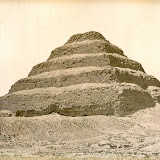
 Pascal Sebah, The Step pyramid, Egypt, 190x250mm, C1860s

Distinguishing the work of Pascal Sebah from his contemporaries, the Abdullah Freres, takes a bit of skill. They were based in Constantinople and worked for the European market so they tended to photograph exactly the same monuments from more or less the same viewpoint. When it came to portraiture they followed European convention, the only difference being that their subjects wore outfits not often seen on the streets of London or Paris. They were the quintessential orientalists but they were not outsiders. Christians raised in Constantinople, they were familiar with the Muslim world, its mores and religious codes. Unlike the Europeans who turned up to open studios, they didn’t have to learn to fit in and knew how to gain access to places off limits to foreigners.


Pascal Sebah, Statue of Ramses 2nd, Egypt 190x250mm, C1860s

Two things mark Pascal Sebah’s work as different from other orientalists. One was that he ranged much further than everyone else, from Constantinople across to Algeria and Morocco. The other was that he appears to have photographed everything he saw. The dogs roaming Constantinople fascinated and offended foreign visitors. Sebah photographed packs of them sprawled on dusty streets. He documented musical instruments and jewelry, people at prayer and nudes reclining on divans, street beggars, middle class merchants and the daughters of nobility. If no other photographer had ever turned up in the Middle East, Sebah’s archive would stand as a sufficiently thorough catalogue.


Pascal Sebah, Ouverture du Pont, Nile, 190x250mm, C1860s

One of the problems with Sebah’s prolificacy is that the idiosyncrasies tend to get obscured by the routine. He understood the two fundamental elements of perspective in 19th century landscape photography; the role of light and shade in the image to create depth and the importance of scale and the great majority of his works conform to the formal aesthetic principles required to meet market expectations. Occasionally he turned to interpretation – there is a famous image of Arabs crossing sand dunes, a camel’s skeleton in the foreground - but mostly he regarded himself as a recorder of fact. Sometimes he turned his attention to details Europeans weren’t interested in. Overwhelmed by spectacle and space, they sought aesthetic beauty in the ruins. The Step Pyramid in his photograph is eroded and crumbling and hardly bears witness to the triumph of Egyptian engineering. Compare it to Legekian’s photograph of the Temple of the Sphinx, which is all symmetry and balance right down to the neatly aligned stonework at the back. Likewise the photograph titled ‘Le Nil (ouverture du pont)’ draws the eye in through the gap to the feluccas on the river but the scene overall is messy and whether intentionally or otherwise he gives a sense of the chaos of activity at the water’s edge. That said, he photographed the pyramid at Cheops, the Sphinx and other famous ruins knowing that so long as he stuck to basic principles he was guaranteed sales. 


 Pascal Sebah, Mosque of Mohamet Ai, Cairo, 190x250mm, C1860s 
It is probably the case that he would have found one European obsession with the ancient east baffling. The idea that there was a continuum of empire that linked the Egyptian to the Greek to the Roman, the Byzantine and up to modern times was a point of rivalry between Britain and France. Napoleon had assumed he was a logical heir, the British weren’t so sure of that. European photographers arrived in Egypt at about the mid-point of the great plundering, when temples were sacked and enormous statues shipped up the Nile and sent to museums. One of the motivations for portraying Ancient Egypt’s splendours in pristine beauty was to imply that these were ours, so to speak. As an Ottoman of Arab background (his parents were Syrian) he may have exploited the theory but he can’t have had much sympathy for it. The Ottomans, colonizers of the very lands Europeans believed held their imperial heritage, were excluded from the equation and regarded as tenants rather than landowners.  


Legekian, Temple of the Sphinx, Egypt, 200x270mm, C1870s

Pascal Sebah died in 1886 and his son Jean took over the business. Though apparently not christened with his father’s first name he was mindful of his reputation so signed his work J Pascal Sebah. In 1888 he formed a partnership with Polycarpe Joaillier and Sebah & Joaillier became the biggest studio in Constantinople. 


J P Sebah, Statues of Ramses, Karnak, Egypt, 200x290, C1880s, 


L Fiorillo, Pompey's Column, Alexandria, C1870s

PASCAL SEBAH AND EGYPT

Wednesday, 2 June 2010

ORIENTALISM: PORTRAITS

19th century portraits from Egypt and North Africa


One curious thing here is the respect, or rather the terror, that everyone displays in the presence of the Franks, as they call Europeans.
Flaubert in a letter to his mother from Alexandria, dated November 17, 1849


When Gustave Flaubert accompanied the photographer Maxime du Camp to Egypt in 1849 he wasn’t yet a famous author but he was a diligent writer. He took notes, kept a diary and sent letters home. Those he sent to his mother described visits to ancient ruins, the heat and encounters with various characters; everything she’d expect to hear from a dutiful son broadening his mind with travel. The letters he sent to his friend Louis Bouilhet had a somewhat different focus:

At Kena I had a beautiful whore who liked me very much and told me in sign language that I had beautiful eyes … and there was another, fat and lubricious, on top of whom I enjoyed myself immensely and who smelled of rancid butter.
(June, 1850)

Flaubert was hardly establishing a tradition – hundreds, perhaps thousands of 19th century travellers had explored Egypt’s ruins and brothels before him – but their descriptions tended to the asinine or only hinted at what they got up to in the evening when they returned from sightseeing. He was one of the earliest writers to depict the somewhat schizophrenic attraction of Egypt. On the one hand it was the land of an ancient civilization still influencing European culture, on the other, cities like Cairo offered all manner of sins and iniquities at bargain prices. The Islamic veil, supposedly intended to protect and distance women, became a symbol to Europeans of exotic, sensual mystery.


For Europeans, access to the world beyond the street was usually difficult to obtain. They were left to wonder what lay behind the walls of the harems, or rather, they left that to their imaginations, were rarely permitted to enter mosques let alone photograph the interior, particularly when people were at prayer, and there are so few accounts of Westerners entering ordinary homes it can be assumed it never happened. It’s not surprising then that so many portraits from the period are of poor tradesmen and workers. These were the people Europeans came into contact with most often and they would have been happy, at least willing, to pose on the offer of a few piastres. What they weren’t to know was that their portraits would appear in expensively produced albums for the European market and they would become representatives from the Arab world. Cairo and the other cities were dusty, squalid places full of beggars and thieves. The dim, narrow streets contained hidden dangers. The intrepid adventurer risked his or her life going there.


It’s worth remembering that people weren’t any kinder towards the denizens of London’s slums. The world Dickens described was every bit as depraved as Cairo and Henry Mayhew’s three volume London Labour and the London Poor catalogued a vast economy of street operators. Mayhew couldn’t illustrate his accounts with photographs but he could use lithographs based on them. The difference was that Dickens and Mayhew were reformers. The photographs here show types whose poverty and physical debilitations were less affecting than their confirmation of everything exotic, sinister and strange about the Middle East.

In 1869, some years after she’d broken up with Flaubert, the writer Louise Colet was in Egypt and went looking for one of the prostitutes he had eulogized. She had a name and a location but wherever she went she met ignorance or indifference. What did she expect? Kucuk Hanim (‘Little Lady’ in Turkish) had probably died abused and neglected years earlier and who was likely to remember her? Only a Frenchman obsessed with his own prowess.


VIEW THE GALLERY HERE
ORIENTALISM PORTRAITS

Tuesday, 9 February 2010

DEATH ON THE NILE


The photographs of Lehnert and Landrock

“If I had been a moderately good otter I suppose I should get back into human shape of some sort; probably something rather primitive – a little brown, unclothed Nubian boy, I should think.”
Saki: Laura


Dixieland bands - white, middle aged men wearing straw boaters and candy striped shirts - are a travesty of jazz. They take all the necessary elements yet somehow leave out the soul. The Lehnert and Landrock Company were the Dixieland artistes of Oriental photography. From 1904 to the 1930s they exploited the image of Egypt, from its antiquity to the eroticism of the veiled Muslim, the sunless medieval jumble of the cities to the simple dignity of the peasant, and made it accessible. Whether we accept their photographs as realistic interpretations or reject them as colonialist stereotypes, we are familiar with their Egypt. We saw it in Raiders of the Lost Ark and just about every other film set in Egypt before World War 2. There are no florid European men in white linen suits and panamas or straitlaced wives of British diplomats loosening their bodices in Lehnert and Landrock photographs, but in a way they are full of them. In a way, when we look at Lehnert and Landrock photographs, we become either of those two types. Much more than the earlier, monumental landscapes of Francis Frith or Maxime du Camp, Lehnert and Landrock’s impressions infused the European imagination for most of the 20th century.


Rudolf Lehnert was the photographer, Ernst Landrock the business manager. They met in Switzerland in 1904 and later that year moved to Tunis to open their first studio. In 1924 they relocated to Cairo, two years after Howard Carter had uncovered Tutankhamen’s tomb in the Valley of the Kings. If Carter’s discovery had no influence on the company’s decision to relocate, the move was fortuitous. Tourists were returning after the hiatus imposed by the war. Popular novelists like Agatha Christie and John Dickson Carr took murder out of the English manor and set it in the desert. Art deco designers rediscovered Egyptian form. Lehnert had a gift for depicting Egypt the way westerners wanted it to be.

Tourists went to Egypt to have their expectations fulfilled. They came to see antiquity and exotic landscapes. No one really went there because the political situation was interesting. In a typical Lehnert view of the pyramids they are placed in the background, often slightly out of focus. The foreground is given to an Arab, his camel and a date palm. This was about a complete picture of Egypt as anyone wanted. To ask for more would have been greedy, to give it would have risked raising questions; ‘what’s that doing there?” “Are there really such things running around Giza?” Naturally, the people in a Lehnert and Landrock photograph are poor but happy, and look remarkably healthy.


Today the image of the veiled woman evokes negative connotations; fundamentalism, oppression, terrorism. In the 1920s it seems a more important question was what lay underneath her garments. Lehnert and Landrock told us. Their nudes remain their most sought after images. The market back in Europe may have been select but from the sheer number of images still circulating it was also insatiable. Of course, the Orient always had that allure; Flaubert’s Egyptian journals from the 1850s amount to a brothel crawl with occasional, obligatory investigations of the ruins, and he was hardly the first to visit with more than history on his mind. Lehnert and Landrock also catered to the pederast market. Androgynous semi-naked boys lounging against doorways were a specialty. The image on view in the gallery, “Good Friends”, is borderline. It could pass as a shot of typical native boys but it could also be an invitation to ageing European males of a particular inclination.


When Edward Said published Orientalism in 1978, he made no mention of Lehnert and Landrock but he gave their nudes an intellectual credibility. Once they had merely been exotic soft porn. Now people could buy them as artifacts of cultural analysis their value shot up. Said might say that has only confirmed his argument that all westerners were imperialists but what was he expecting? Thanks to his book, exhibitions and catalogues of orientalist art (particularly of the academic variety) had a new cachet.     

Lehnert and Landrock published an enormous number of images in several formats, from archival fine art prints to lithographs, photogravures, postcards and miniature snaps. The fine art prints (particularly the nudes) can sell for several thousand dollars. Postcards and snaps can easily be found in European antique stores and junk shops. The images in this post include a heliogravure, medium format prints, postcards and snaps. 


DEATH ON THE NILE