And furthermore ...

One Man's Treasure encourages the use of anonymous photographs posted here to illustrate books and album covers.
If an image appeals to you, contact John Toohey at johntoohey@hotmail.com.
Showing posts with label actors. Show all posts

Friday, 7 August 2015

THE IMPORTANCE OF BEING EARNEST


Real photo postcards from the Edwardian stage
“Romance at short notice was her specialty.” 
Saki; The Open Window


 Real photo postcards of actresses are one of the enduring legacies of the Edwardian era; ‘enduring’ to mean lasting although the general impression from a recent visit to the Spitalfields Market was that interminable would be more apt. Not surprising when you read how many thousands of millions of postcards were published then sent each year of the 1900s and how photos of stage actresses were far and above the most popular category in Britain. But amidst the glut of portraits of women in ubiquitous broad-brimmed, feathery hats and puffy blouses, with their stiff composures and curiously sexless expressions, there are occasional images that catch the eye. Just about every one of Hettie King will do that. She was one of several actresses who made an art of male impersonation. It seems that while transvestitism among the citizenry could always create an absolute scandal in the late Victorian and Edwardian era, gender impersonation in the theatre was a specialized skill and in demand, with none of the connotations of sexual or political transgression apparent today.  Of course, Ms King was a comic actress: she played the man for laughs, and laughs in the Edwardian theatre were often of the double entendre type.


It was already a convention in pantomime that the crotchety widow or the scheming stepmother was played by a man; this was comedy after all. When J. M. Barrie’s play Peter Pan debuted in 1904 it was standard for the lead character to be played by a young actress. The play’s subtitle was the boy who wouldn’t grow up and gender ambiguity was a useful metaphor for somebody trapped in a physical and emotional cocoon. Zena Dare was one of the first actresses to play Peter Pan. Here she is as Napoleon, another comedic role for which the English typically cast women. Well that must have stung Gallic pride, or perhaps not since the Paris music halls had long taken cross-dressing to places the English theatre nervously avoided. 


 Zena Dare is one of those people, like Gabrielle Ray. Lily Elsie and Marie Studholme, who were prolifically photographed for postcards in the 1900s yet whose name barely stirs a hint of recognition today. This is inevitable when we think of the thousands of actresses and advances in technology since the 1900s, yet it might be also reflect a particularly British attitude. Where the French loved scandal and their theatre stars made the most of that, over the Channel the female artistes were presented as having much more sensible private lives. If the reputations of Cléo de Mérode and Caroline Otero live on it is for their behaviour off-stage whereas someone who enjoyed a few years in the West End limelight then married well and retired from the stage to cross breed apples on the Sussex Downs would at best be damned with faint praise by being heralded as a national treasure. 

                       
 Not everyone was so apparently blessed. During the first decade of the last century, Gabrielle Ray was reckoned to be the most photographed woman in the world. Though she was acclaimed as an actress and dancer, a look at her résumé suggests she wasn’t being called to play Lady Macbeth or Juliet or any of the other roles that defined a special talent. It may have been her looks alone that attracted so much attention, in which case her tragedy was as typical as it was awful. Agents, directors, producers – especially fat, white and ugly ones – can love a face without caring what lies behind. Even a casual reading of Ray’s biographical details suggests her alcoholism had something to do with her being marketed for her face not her acting. In 1936 she suffered yet another breakdown and spent the rest of her life – all thirty seven years of it – in psychiatric institutions.
Here’s a good quote from Ray found on the Footlight Notes page. As she makes clear, kissing was fun in 1906, but not as much as tearing about the countryside in a motor car: I have done a lot of motoring, but very little kissing. At the same time, I think it would be a pity to discourage those who like kissing because it seems to please them very much. If I have by accident kissed anyone I have never heard any complaint about my mouths; but there, you see, I put cream on my face when going out in a motor-car, because before I used to do so the wind made my face very dry.”


 We’ll get back to the subjects but we can’t ignore the photographers: William Downey and his son Daniel, Alexander Bassano, the sisters Rita Martin and Lallie Charles (previously discussed HERE) and Francis Foulsham and Arthur Banfield, whose work Cecil Beaton dismissed as “rather quaint in (its) woodenness”. To be fair, that same criticism could have been levelled at most of the photographers, and to be fair again, it wasn’t always their fault. You get the impression with some people that they couldn’t make the intellectual jump between appearing on stage and before a still camera. Maud Jeffries was an international star, pulling in full houses from London to New York to Sydney, especially for the faux biblical epic The Sign of the Cross. You wouldn’t know it from this image. She looks like someone shoved a papier-mâché crucifix in her hands and told her to look fearful of the Lord. This inability to perform for the camera is a common complaint from the period, and comes from photographers, producers and actors. Numerous Edwardian performers will spurn the cinema while others will take it on and fail. The typical explanation is that the actor needs the human presence, the applause and even the heckling, in order to perform. 

 
 Being a photographer to the stars carried responsibilities. The studios above also photographed royalty and anyone else who required an official portrait. What mattered most to their non-theatrical subjects – royals, politicians, etc – was that there be no surprises. Politicians showed gravitas, the prince dignity. They were expected to be a lot more creative with stage performers, which could be hard when the process was a treadmill. Faced with a client list of several dozen performers, each demanding the special touch, even the best photographers could exhaust their repertoire. In the same way, some tricks could startle at first but quickly became clichéd. Phyllis Dare was Zena Dare’s sister. Born in 1890, she began acting when she was nine and by the time she was fifteen was a star in light comedies. When she was seventeen (around the time this photo was taken) she published her autobiography and became one of the first in a long line of juvenile performers to author a necessarily thin and vacuous account of a life so far unlived. The title was From School to Stage, which sounds like it covered everything.

 
 For some of us, the very definition of a perfect Friday afternoon involves sitting down with a pile of century old directories and tracking down long forgotten photographic studios. No matter what joys the exercise holds, there are times when running into brick walls becomes tiring. Who was Kilpatrick? It was usual though not compulsory to attribute the photographer or studio on the postcard but Rotary, which published the card, only licensed the image. There was a studio belonging to a Kilpatrick in Dublin and if Ms Studholme travelled to that city for a performance and the studio paid to photograph her, it could have sold the image on to Rotary. Given that Ms Studholme performed in America and what the English quaintly refer to as ‘the colonies’, the studio could have been anywhere in the English speaking world. Her costume here looks Wagnerian, but operetta rather than opera. 

 
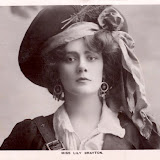
 Here’s another minor mystery. This portrait of Lily Brayton is credited to Johnston and Hoffman, recognized as one of the leading studios at the time – in Calcutta. The National Portrait Gallery in London have 52 portraits by the company in their archives, mostly of theatrical stars. Either we are talking about two companies having the same name or Johnston and Hoffmann opened a branch in London. The latter seems more likely, but if so you’d think that would warrant a mention in the entries found in various encyclopaedias. Once again we have a case of the gender role reversals and while there is a passably interesting history of women dressing as eighteenth century highwaymen, what’s really interesting about this is that we see a really professional use of electric lighting. This was uncommon in the early 1900s. Electric lighting was still too expensive for a lot of studios and even those who could afford it needed to relearn photography to understand how to use it properly. 

 
 Dover Street Studios are another commonly encountered name. Interesting that among a dozen or so sighted, variations on the Gibson girl look are prominent. It looks like the studio had an agenda. The GG’s identifying features were her hairstyle and the long, tight dress or gown, both seen here in Ms Gertie Sinclair. It was actually a North American fashion. The graphic artist who designed the look, Charles Dana Gibson, wanted to capture the essence of the ideal American women, whose very modernness he attributed to a composite of cultural ethnicities and attitudes. I don’t know how successfully the Gibson Girl caught on in Britain.

 
 The cabbage is a nice touch. Here Ms Millar wears the costermonger’s outfit that inspired the original pearly kings and queens, Like Peter Pan, Aladdin was an obviously male figure commonly played by women and the musical, The New Aladdin transplanted the oriental story to London. 

 
 Here’s a well-known study of the Moores, theatrical family of course, of whom Decima and Eva became the best known. As discussed in the post on Rita Martin, the relationship between the theatrical world and the suffragettes was more convoluted than you might think, and thanks in no small part to the suffragettes habit of throwing gas bombs into theatres and ruining performances. The Moores however were firmly behind the movement to give women the vote and were among the founders of the Actresses’ Franchise League, which among other activities produced the plays, How the Vote was Won and Votes for Women. I want to say more but do the research yourself. It’s worth the effort.

 
 And here is Eva Moore with her son in an image that is strange on several levels though in Edwardian England it would have met with widespread approval. These portraits of actresses with their children are more than commonplace. They are a reminder of the sharp distinction between London and Paris, where it was advisable for an actress not to indicate she had a family. They were also a protest against the popular image of the stage as the home of outcasts and other ne’er do wells. How better to show the world that the theatre was not only glamorous but also respectable than by showing actress mums with their kids. Except of course that young Master Moore looks miserable, as you might if Mum had made you put on a clown costume then dragged you before a camera.

 
 There are of course many postcards of male actors and there is a world waiting to be read in the differences between the two, but let’s end with an image of one of the best known female impersonators of the age, Malcolm Scott. Like Hettie King, his choice of role was no indication of his orientation and it seems he lived an otherwise ordinary life with wife and family in the suburbs. What’s to like about this photo of course is its various assumptions. We are told that is Mr Scott but we don’t know for sure. For all we know it could be Hettie King playing Malcolm Scott playing Hettie King; a conundrum we think made perfect sense to the Edwardians. We are lucky that so many of these photographs lie scattered throughout flea markets in abundance. In an age when some people think they can charge small fortunes for snapshots they didn’t take but bought for 25 cents, it’s great to have so many images from the Edwardian theatre, a world that is both familiar and disruptive.


THE IMPORTANCE OF BEING EARNEST

Thursday, 11 December 2014

MY FAIR LADY


Rita Martin; a forgotten photographer
“These pictures are the acme of artificiality and as far removed from nature … as a hat trimmed with artificial summer fruits.”
Cecil Beaton


 All the photographs in this post are of Lily Brayton, the beautiful and celebrated star of Shakespearean drama in the Edwardian era, but she is not the focus. That belongs to Rita Martin, the London portrait photographer who was one of the best known in Britain at the time but is strangely neglected today. It is not unusual to encounter photographers who were household names in their time yet don’t crack a mention in any of the encyclopaedias, but what makes Ms Martin’s case special is that where she does get attention it is for the high standard of her work and her innovative techniques: two qualities you’d think historians would have picked up on.

 
 The facts are these: she was born Margareta Weir Martin in Ireland in 1875 and died in 1958. According to the photoLondon Database her studio was at 74 Baker Street, Marylebone, a mile or so away from the studio of her better-known sister Lallie Charles in Curzon Street, Mayfair. The addresses were in exclusive neighbourhoods. A photo by Lallie Charles in the National Portrait Gallery database shows the two women and their sister Bea in what was probably Lallie’s studio C1899. The furnishings and décor are what we would expect of a high-end studio of the age: a distinct oriental element in the screens, rugs and vases, potted ferns (or are they lilies?) and dark, elaborately tooled tables and chairs. The women have that dreamy gaze we associate with the late-Victorian era; as though life in this room is too achingly elegant to risk leaving it. In 1975 Cecil Beaton co-authored with Gail Buckland a personal history of photography, The Magic Mirror, to which he added an appendix; Commercial Photographers of the Victorian and Edwardian Era. Like the other appendices it accounted for photographers who hadn’t fitted with the general theme of the book. Rita Martin and Lallie Charles were given more attention than anyone else in this section. There’s a sense reading it that Beaton knew Martin - not Charles: she died in 1919 - particularly when he intimates that the sisters fell out. It reads like gossip he received first hand.  

 
 The quote from Beaton at the top however comes from his book British Photographers, part of the Britain in Pictures series published by William Collins during World War II. Each thin volume contained a short essay by a noted authority and thirty or so reproductions of artworks in colour and black and white. The topics ranged from butterflies to canals to a history of fashion: all of them intended to remind people of what was too precious to let fall into the hands of the Germans. Beaton’s contribution included one of his famous scenes of Saint Paul’s Cathedral during the blitz. Given the brief amount of space Beaton was allowed, that he would give more attention to Rita Martin than he would to Lewis Carroll or Roger Fenton may seem surprising, but when you look at his early work especially it is clear that Martin and Charles had defined for him what studio portraiture could achieve. For Beaton, artificiality is a compliment. In The Magic Mirror he says of both sisters that “they transcended the stereotyped (and) showed a tyranny over their subjects, who were willing to do their bidding, for they knew they were being beautified”. Beaton could be describing his own working methods. During the first decade of the twentieth century, photographic postcards of stage actresses were popular around the world. Most studios placed the subject before an elaborate stage backdrop, emphasizing the theatricality above the performer. Rita Martin preferred to place her women in a stark setting that obliged the viewer to consider their stage presence.

 
 Lallie Charles was a photographer of the royal family and made her name more as a society photographer. To understand how she and her sister developed their styles and reputations, we need to consider Alice Hughes, one of the most formidable presences on London’s late-Victorian photographic scene. She would not photograph men. You might think taking this stand at the beginning of the suffragette era would marginalize her, but around the turn of the century her studio was so popular with society women and stage stars that she employed up to sixty assistants; again, none of them men. Lallie Charles was probably one (this is unclear) but the more important point is that Hughes rejected the standard sepia, Pictorialist view for the very expensive, beautifully rendered platinum prints in sharp focus. One of the criticisms of Pictorialism, then and now, was that the photographers frequently confused artistic excellence with vapid sentimentality. A soft focus view of a society lady admiring a tulip might sound like a good idea in theory but the result could make her look as fascinating as a blade of grass in a paddock. Charles and Martin took Hughes’ ideas and when it came to publishing postcards saw the virtue in refining them, reducing background interference, or removing it altogether. Their success however owed as much to their ability to impart or inspire a performance for the camera, something few actors were seriously expected to do.

 
 According to Beaton, Martin had a contract with the theatre manager George Edwardes that gave her exclusive rights to photograph Lily Elsie and other performers once a month. This may not be entirely accurate, or may have only existed for a short time, because other studios photographed Ms Elsie. One was Foulsham and Banfield, whose work Beaton waspishly described as “rather quaint in their woodenness”. The general impression is that all power resided with management. Edwardes could agree to such a contract, as long as Ms Martin kept her fees to a figure he thought was reasonable. More likely, a successful performer like Lily Brayton had enough influence to ask for Rita Martin, and if sales of postcards justified her demands Edwardes would agree. 

 
 Although Ms Martin photographed several leading men of the stage, of the 322 prints held by the National Portrait Gallery, only three are of men alone, though a couple more are of men with their families. The number of prints is enough to be representative and suggests that like Alice Hughes, Ms Martin had principles she couldn’t be persuaded from. The first instinct is to say these were political, but on second thoughts it may have been that she was essentially interested in glamour. That wasn’t a word many male actors would have wanted to be associated with in the 1910s or actually applied to them. It implied an interest in haute couture and other womanly pursuits. When you look through lists of images of male Edwardian actors, they tend to go for either comedy or dashing but respectable, and were typecast as one or the other. Lily Brayton on the other hand could wear costumes from across the centuries and cultures and still transmit an aura of chic allure. For a photographer of the stage, male actors were boring.

 
 According to the NPG website, Lallie Charles photographed some of the suffragettes. Rita Martin photographed Rosamund Massy from the National Women’s Social and Political Union. What does this mean? Were they sympathisers? Were they asked to because they were well-known women photographers? Was it because, like Lily Brayton, the suffragettes were part of the cultural milieu? None of these questions cancels another so the answer may be all three but it’s worth remembering that while London’s theatre world might have been thought progressive, there wasn’t a huge amount of sympathy for the suffragettes. The actress and singer Anna Held complained that they went about slapping men and when they started setting fire to theatres and letting off smoke bombs inside that predictably turned people off them. Rita Martin may have believed that women had the right to vote and agreed to photograph some of the suffragettes but that didn’t mean she was obliged to like any of them.    

 
 Which brings us to the important issue of why she has been forgotten. It isn’t as though her work is hard to find, and she was well enough known in the 1940s for Beaton to assume his readers needed no formal introduction to her. It’s one thing to discover a previously unknown photographer, vis-a-vis Vivian Maier, but when a photographer has a substantial body of work in an archive the neglect is not random. Perhaps, like her sister, she’s seen as too establishment, too Edwardian, and her portraits of theatre stars don’t cast a challenging light on the social history. But the photo-historian’s first job should be to write the history, not re-write it and clearly there are spaces that need filling in. A common myth about early theatre portraits is that they were perfunctory commercial jobs and the genre didn’t take off until a handful of photographers in the 1930s (Beaton in particular) introduced an individual style. If that is the case, these portraits of Lily Brayton reveal a relationship between photographer and subject that was decades ahead of its time.


MY FAIR LADY

Sunday, 27 April 2014

BRIEF LIVES


Portraits of forgotten stars who died young

“One short sleep past, we wake eternally,
And Death shall be no more; Death, thou shalt die.”
John Donne


The history of the silent cinema is littered with young corpses, especially suicides. A very few achieved a kind of immortality through dying: Rudolph Valentino springs immediately to mind, but for most who died young, death brought more than a figurative long silence. They were soon forgotten. It is unfair to expect people born decades after they died to remember who they were, but fame, we are told, is somehow eternal. And we are so often being asked to imagine perpetually sunlit fields where the dead stars wander in a kind of bliss, pausing only to look down upon us indulgently. Among these portraits Pearl White’s is the only name I was familiar with before I bought the photo. Saying that, the image I had of her was of a woman tied to rail tracks as the steam engine bore down, and I cannot remember I saw that in one of her films or got it from Rocky and Bullwinkle. One’s memory doesn’t have gaps so much as rough patches, don’t you find? In any case, Ms White’s story is sad and we should not make light of it. In the early years of silent film she did her own stunts. Having been a bareback rider in the circus she didn’t think much of jumping from heights and rolling out of moving vehicles but she broke bones in the process, with the result that she took to painkillers and alcohol, with the extended result that she died from liver failure aged 49. 


Who today knows anything of Lillian Hall Davis? Not me – at least, not until I found this photo, yet we read that for a time she was one of budding director Alfred Hitchcock’s preferred actresses and starred in his third and fifth films, The Ring and The Farmer’s Wife; films that British cinephiles hold as keys to understanding everything he did that followed.
Some of us can imagine a suicide’s final minutes; the preparation and the execution. What remains utterly mysterious are the days leading up to that; the bleakness, the compact someone makes with themselves. Lillian Hall Davis’s death was particularly horrible. She slashed her wrist and her throat then put her head in a gas oven. Such determination is terrifying.


In the early 1920s Bruno Kastner was a huge star in Germany, with women. Men found it hard to reconcile his attractiveness with his self-evident anti-masculinity. I mean to say; what are the frauleins thinking when a fellow doesn’t have biceps and can’t down three beers without needing a bathroom break? Like Lillian Hall Davis, he was a victim of a sudden shift that saw him regarded as Germany’s most popular cinema hero one year and then a couple later being reduced to selling photo opportunities for a few pfennigs. In Kastner’s case the cause was self-evident. He stuttered, which obviously was an issue when cinema turned to sound, and a source of great humour to the beery chaps when they gathered at the bar after a day blasting at quail with shotguns. One of his last films was Angst, based on a Stefan Zweig novel, and in a scene that could have belonged in the Zweig inspired Grand Budapest Hotel, in 1932 he travelled up to the resort of Bad Kreuznach with its gingerbread houses surrounded by forest, booked into a hotel and hanged himself. 


If you tell Americans that in the early 1920s Gösta Ekman was the biggest star in Swedish cinema, they’ll probably laugh and say, ‘yeah, right. Swedish cinema.” The phrase “1920s Swedish cinema” may not mean much to most Americans but there are some – usually thin, pallid young men with skin conditions – who know that in the 1920s Swedish cinema was everything Hollywood was supposed to be. While Chaplin was pumping out one-reel soufflés, the Swedes were filming two hour long epics. When the Americans imagined the emotion expressed in a starlet’s batting eyelashes said it all, the Swedes were dredging the human soul for every bit of squalor they could find. What would you expect? This was the land of the sunless winter. Henrik Ibsen and Hedda Gabler were neighbours just across the border. Ekman was an artist. He made that clear to the point he was willing to neglect his family for his art. In 1926 he went to Germany to star in one of the expressionist classis, Faust. While working long hours, he started taking cocaine to deal with fatigue. Twelve years later he died of a heart attack after years struggling with chronic addiction. He was 48 years old. Tears of a clown.


In late September of 1912 a funeral procession trundles through the streets of Paris. The coffin is covered in wreaths but it is considered “tenth class”, or ‘very simple’ in Parisian terms. Among the mourners at the head are a Rothschild, a Baron Ceccaldi and several others whose surnames are enough to impress the reporters gathered on the sidewalk. Some of the press have already filed stories expressing outrage that the police would dare question France’s most exemplary citizens on this sombre day. As for the raids on the drug dens; why implicate the nation’s best names when, clearly, her demise was her doing?
Inside the coffin is Pierrete Fleury, 22 year old aspiring dancer who, it is true, wasn’t a household name until today. What went on in her house in Le Vésinet, a wealthy suburb on the outskirts of Paris, has scandalized a city that likes to think it has seen it all. For months a procession of limousines drove out to the house and unloaded their human contents on the steps. Once inside, the sons of France’s finest indulged in behaviour that appalled the staff. Opium, cocaine, sex, more opium, more cocaine, more sex: the place must have resembled a Normandy farmyard at feeding time. Let’s not hold back on Pierrete; she and the other dancers living at the house had instigated this scenario but just a couple of days ago, one of the male staff members alerted that she hadn’t answered the maid’s knocks, took a ladder and climbed up to look in her window. Her cold body lay on the bed, her face wrapped in an ether soaked sheet. Technically it was filed as accidental suicide. As usual, the Government vowed that no one would be spared in its efforts to put an end to these notorious drug dens.


It is tiresome to read yet another claim that the behaviour of Someone Cyrus or Someone Kardashian is liberating for women, especially when it’s a woman writing. Said perp should have to spend a week, at least, walking around with a placard that reads: ‘Culturally speaking, I’m really uneducated’.
Diana Karenne, (born Leucadia Konstanti in Danzig, 1888), was a star of Italian, French and German films in the 1910s and 1920s. Her artistic control extended to directing and producing and she organized her own promotions down to designing the posters. Add to that the detail that she often played a woman with a pragmatic attitude towards her lovers and we have the makings of a feminist icon – except we don’t. Where in all the guff about post-modern feminism are the discussions about women like Karenne and Fern Andra? If the Ms Someones have it so difficult today, what was it like back then, when women couldn’t even vote? Well, there is a situation with Ms Karenne that some posing as feminist intellectuals could have a problem with, but only if they wanted to. In the 1930s, when Germany was the centre of Europe’s film industry, Ms Karenne moved to Berlin and continued her success until she married and moved with her husband to Aachen, where she turned her attention to painting and poetry. In July 1940, she was badly injured in an Allied air raid and died a few weeks later. Aachen is a spit away from the Dutch and Belgian borders. Would things have been different had she been in Holland or Belgium when the bombs hit? Maybe, but the overriding sense is that she has simply been forgotten. Besides which, it is easy to blame the Germans, but we on the winning team still have a problem admitting that our bombs and our actions needlessly killed innocent people.  


On March 3 1908, 34 year old Lily Hanbury gave birth to a stillborn child and two days later she died from complications. These are the empirical facts. The actual facts are that her death was horrific. We have no idea what it is like to first realize the child you are carrying has died and then for you to suffer the physical and emotional consequences, attended to by witless doctors in a grubby London hospital.
Ms Hanbury was born into an acting family. Indeed, those of us who remember Edward Fox shooting watermelons in The Day of the Jackal might also recall his brother James in the fabulously unwatchable Performance and pause to realize there is a direct family connection going back to Ms Hanbury, and beyond.  The point was made at the beginning that people who believe that fame brings immortality are buying an illusion, yet one of the great things about the internet is the way that small groups whose interests are too peripheral to even be considered niche can find support. Maybe the notion that a handful of people can not only perpetuate the memories of Edwardian actresses but provide the rest of us with solid information is something anyone born in the age the internet can’t appreciate. We who are toppling towards our dotage can only express our gratitude, but there is a curious aspect to all of this. Investigating the not so obscure 19th century French photographer Etienne-Jules Marey recently, I was struck by how many websites simply cut and pasted the same (unverified) information. With the great forgottens like Ms Hanbury however we find people who are passionate and want to share their discoveries. They put up photos, old reviews and newspaper articles. In the process they bestow upon her a kind of eternity.

BRIEF LIVES

Friday, 26 July 2013

ICH BIN EIN BERLINER

Weimar photographic studios
 “People of Berlin - people of the world - this is our moment. This is our time.”
Barack Obama, 2008


Between 1924 and 1935 the Ross company (Ross Verlag) published over 40 000 real photo postcards of European, American and especially Weimar German actors. It’s surprising then that few film historians have done work on the company. The most thorough resource can be found on the Ross Cards website, but what’s missing is the commerce. The company was instrumental in promoting cinema stars throughout Europe and promotion wasn’t just about churning out thousands of postcards. It had as much to do with the cultivation of an image and the presentation of a look. It would be good to know how closely Ross worked with the studios in creating the image, who bought the cards and who collected them.
The relationship between Ross Verlag and the film studios isn’t clear. If Heinrich Ross bought a concession from the studios then the use of some of the same images by other German companies such as Photochemie doesn’t make sense. But it doesn’t either that the studios would pay him to publish postcards when they could do that themselves. If it operated according to regular publishing models, which vary between countries, the cards were produced and distributed then percentages were divided up. If that was the case then Ross had a close role in marketing and could presumably reject some images for being outside its interest.


What is also noticeable is that cards usually carried the film studio stamp (UFA, MGM) or the photographer’s but it is unusual to find both. That suggests that Ross Verlag bought images directly from the photographic studios. Most surveys of German photography from the era concentrate on the obvious names, ignoring some studios because it is assumed they were commercial and don’t represent the avant-garde of German modernism. Whether the studio principally worked in portraiture or advertising, familiarity with the new aesthetics was essential. The clients demanded it so every photographer knew the basic principles. What about the customers? How much was Ross working to demand and how much was he creating it?
A recent post was devoted to Alex Binder, the photographer most commonly associated with Ross Verlag but work from studios across Europe was used. The Ross cards website lists over fifty studios from Berlin alone. Assuming that most of the actors who sat for portraits were well known enough to pick the studio, that gives us an idea of how active the business was at the time.
 Below are examples from some of the Berlin studios most likely to be found on Ross cards.  A couple have long been recognized as being at the forefront of German modernism and some have recently become the focus of revived interest. Others remain neglected. 


Becker & Maass

One of the unjustly forgotten studios, it was probably established in the 1870s by Otto Becker with Maass joining as a partner some time in the 1890s. If Becker was still alive when these cards were produced he had been in the business for fifty years. More likely then a family member inherited the business or its success meant that new owners kept the name.
The Becker & Maass name appears on Sterne cards, the precursor to Ross, and early Ross Verlag cards, C1925 but not in the 1930s. It has one of the most distinctive styles. Strongly influenced by the soft focus painterly style of Pictorialism, Becker & Maass avoided the sweet, wholesome look some film studios preferred. Ross cards often hinted at eroticism while very, very rarely being explicit but Becker & Maass suggested something even more troublesome; the independent, self-possessed woman.


Emil Otto Hoppé (1878-1972)

Hoppé was the most famous photographer whose work appeared on Ross cards, as well known in the 1930s as he is today as a leading figure in German modernism. The British also lay claim to him as he lived and worked in London throughout the 1920s and ‘30s but for my money the most interesting book of his work is devoted to his Australian photographs taken in 1930. He travelled across the country, from Tasmania to the Northern Territory and Queensland, the south-west forests to the central desert at a time when these regions were only barely connected to one another. The Australian photographers he met, like Harold Cazneaux, were still excited by ideas that had become outdated a generation earlier. His celebrity portraits however are rarely exceptional. You could argue the difference between this portrait of Lucy Doraine and one Alex Binder might have taken but the distinction is fine. It is clear however that whoever took it was astutely professional.


Angelo Photos

Pál Funk (1894-1974) is better known today in his native Hungary than outside of it though in the 1930s he was recognized as one of the most prominent studio photographers throughout Europe. His connections through work with Hoppé, Leopold Reutlinger and Rudolph Dührkoop and as a cinematographer for Michael Curtiz are impressive as is the list of awards bestowed on him in his later years. These days it is his highly stylized Pictorialist nudes that are most sought after. You can see why in this study of Vilma Banky. Few studio photographers really understood that artificial lighting was meant to evoke rather than expose. Funk did.


 Frieda Riess (1890 - C1955)

It’s surprising how many rediscovered photographers weren’t lost at all. Everything; photographs, documents, biographical information is there, waiting for someone to eventually give it some attention. There has been a revival of interest in Reiss lately, in Germany at least, with a biography and a major exhibition at the Berlinische Galerie. When you consider her sitters included Einstein, Mussolini, Josephine Baker and Jack Dempsey, her social connections extended through Berlin’s art world and she worked as the stills photographer on Fritz Lang’s films, you could wonder why she doesn’t rate a mention in histories of German photography until recently. Part of that was through her design. Around 1930 she married the French ambassador, Pierre de Margiere, and moved to Paris, retreating from photography and Berlin society.  Note the abstract design on the backdrop in this portrait of dancer and actress Grit Hegesa. There are several portraits of dancers Reiss took against such backdrops but it is hard to say whether they were part of a series or if she just liked the effect.


Karl Schenker (C1880-C1952)

Around 1930, Schenker took a series of fashion portraits of store mannequins carefully painted and arranged so that at first glance it is easy to mistake them as real women. Schenker is another who apparently disappeared from view. His work never appears in the surveys of German photography despite adjectives such as ‘famous’ and ‘highly regarded’ occurring before his name. Like a lot of the photographers here, his best known works today are his Pictorialist nudes. Here’s the problem. Having been away from the spotlight for so long, you might think his return would excite more interest: who was this photographer who took these extraordinary nudes? Unfortunately for Schenker the world is awash with Pictorialist nudes and if he was something of a radical experimentalist in 1913 he no longer is. 


Atelier Manassé

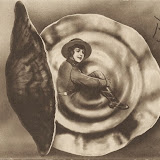
Polish couple Adorján von Wlássics (1893 - 1946) and Olga Spolarics (1896 - 1969) began the Manassé studio in Vienna during the 1920s and relocated to Berlin in the late 1930s. Maybe they tired of Pictorialist nudes early on because although the erotica is their best known work it is highly surreal; women in birdcages, crawling out of snail shells, trapped in bottles, pursued by giant beetles – you get the idea. Monika Faber published a book of the studio’s surrealist images, Divas and lovers: the erotic art of Studio Manassé, in 1998.


Ernst Schneider

If a single magazine represented Weimar Germany it was Berliner Zeitung Illustrirte. Not as experimental with graphics as its later rival AIZ (Arbeiter Illustrierte Zeitung) it was still the place to get your work seen and most photographers here had images appear in it, including Ernst Schneider. In 1908 he published The Human Form and Beauty: templates to study the naked human body, which as the title suggests was erotica wearing the thinnest gauze to disguise itself as art. It came out just after Heinrich Pudor published Nacktkultur in three volumes, which espoused the virtues of nudity, vegetarianism and racial purity. Historians can’t help but make the association between books like Schneider’s and the rise of Nazism. 


Martin Badekow (1896-1983)

These days a vintage print by Badekow will set you back a few hundred dollars but you can still buy a Ross real photo postcard for the price of a bus fare. Overlooked for a long time, his photographs from the Berlin cabarets have become emblematic images of Weimar Germany. Like Funk and Reiss he is frequently referred to in the press of the time as famous or world renowned yet post-war he disappeared from the radar. Today, with the increasing interest in fashion photography, it would be an oversight to leave him out of an exhibition.


Balázs Studio

Nothing can be found about this studio despite its work appearing frequently on Ross cards. Balázs is a common Hungarian surname and Berlin in the 1920s was full of émigrés from central and eastern Europe who had either escaped for political reasons or had moved to where the money and the ideas were. Considering how popular a lot of the actors were when they sat for the studio it must have had a good reputation, in a city full it seems of world class photographers.


WEIMAR PHOTO STUDIOS

Friday, 13 July 2012

STARS III


Some forgotten European actresses from Ross Verlag and others
 “Glamour is what I sell. It’s my stock in trade.”
Marlene Dietrich


 The proliferation of cheap Ross Verlag photos won’t last forever. Soon enough they will rise in value because these things do and even if they will never make you rich, you can pick up an actual Alex Binder or Emil Hoppé photo for next to nothing so you’re doing better than the people prepared to pay thousands for them. The best thing about these photos is that they do their bit to keep alive the names of people who don’t deserve to be forgotten. I hadn’t heard of most of these actresses before I bought the cards but a bit of background research revealed stories sometimes bigger than the films they made. 
Take Marcella Albani, who was a star in early Italian cinema, appearing in some 50 German, French and Czech films before retreating, rather than retiring, from acting to become a producer and novelist. Her last film was Der Kaiser von Kalifornien in 1936. It was a western in so far as it was set in the American west, about Johann Sutter, who discovered gold in California in 1848. Like a lot of films from the early sound era of 1930s it owed a lot to silent cinema, with minimal dialogue and melodramatic facial expressions but the opening scenes when Sutter leaves Switzerland and arrives in America are exceptional examples of early special effects and montage. By the time she died in 1959 aged 60 Albani could reflect on a successful career in several fields yet today it seems her name means nothing except to passionate devotees of silent film.


 In the episode of the 2001 BBC documentary on the human face, Fame and Infamy, we met three men desperate for fame, and Mali Finn, a Hollywood casting agent. In assessing the three actors Finn couldn’t care less about their CVs, making her assessments on such small details as the shape of the nose, the jawline and the distance between the eyes, all from the head shots they'd submitted. If there was a science to her work (she died in 2007) it was phrenology and if the three actors weren’t so self-aggrandizing you could feel pity as their illusions about talent were shattered.
Playing the role of Finn, what could we say about Xenia Desni from this Alex Binder portrait? It goes without saying she is beautiful and glamorous but also she looks more childhood sweetheart than hard hearted vamp. During the 1920s Ukrainian born Desni appeared in a number of films that gave more licence to women than cinema would again for a few decades. Sappho for one, which wasn’t about lesbianism but how a woman (Pola Negri) literally drove weak men insane with her beauty. This portrait is tame compared to some of the others Ross Verlag published of her.


The point here being to cast some light on long forgotten cinema stars it soon becomes obvious that ‘forgotten’ means there isn’t a lot of information about them. A lot of the information on this post comes from another: european film star postcards, a comprehensive site that proudly reminds us “there is more than Hollywood”. Swedish born Mona Mårtenson was a friend and fellow student of Greta Garbo’s and they appeared in several films together including The Saga of Gosta Berling, about a priest falling for a married woman, a motif more popular than shocking in Scandinavian literature. Garbo left Sweden for Hollywood and Mårtenson stayed behind, leading some commentators to suggest she missed a boat. Did that bother her? Her career in Sweden didn’t suffer as she continued acting into the 1940s. In 1949, just before her untimely death, she appeared in Pippi Longstocking, based on the hugely popular Swedish children’s books.  


 Asta Neilsen is not forgotten. To be precise here, if her dozens of films including her version of Hamlet where she played the hapless prince aren’t watched that much anymore, her erotically charged dance lasting all of a minute in the 1910 film Afgrunden has kept her memory alive. What is less remembered are her subsequent careers as a collage artist, art critic and author. When she was 86 she viewed a documentary on her life in pre-production and was so put out she took over the project and made it herself. Two years later she married for the third time (or fifth, but does it matter?). While not a great portrait of Nielsen, this photo does show her at work on one of her collages.


 On October 1 1937 Renate Müller, Germany’s most popular comiedienne, exited a third floor window in a Berlin hospital and was killed. Whether Germans believed it was suicide or murder depended on their politics though it’s telling that immediately the news broke, Goebbels’ ministry of propaganda issued press releases depicting her as a drug addict and mentally unstable sexual misfit. Taught acting by G W Pabst, whose Joyless Street starred Asta Nielsen and Greta Garbo, she had become as popular as Marlene Dietrich in 1920s Berlin. Her refusal to participate in several Nazi propaganda films and her rumoured affair with a Jewish man had her marked by the Gestapo but at the time of her death she had become so fed up with the situation in Germany that she had all but given up acting. Mostly she played in light musicals and comedies though she had the lead role in the original version of Victor and Victoria, playing a singer who helps out a female impersonator in a cabaret and is consequently mistaken for a man. It was the set up for a joke that Billy Wilder would take to Hollywood.


 Ah, Berlin in the 1920s: leather, whips and gender ambiguity. Even if most of the documents show a world of stolid middle-class conservatism, these are the images that stick in our minds and here Eva Speyer plays the archetype, but who was she? The titles of some of her films – Die Morphenstin (Morphine Addict, 1920) Unter der Lanterne (Under the Lantern, 1928) Verirrte Jugend (Misled Youth 1929) lead you to think she specialized in the dark, socially concerned but highly melodramatic film of the New Objectivity movement. Speyer was a common Jewish name and she died in 1932 aged 49. Though it is tempting to draw a conclusion from those two pieces of information we can’t be certain of anything since biographical information is thin on the ground.


 We know something more about the circumstances of Ossi Oswalda’s death in Prague in 1947 where, caught up in shattered post war economy and the Soviet takeover, she was reduced to living on the streets in dire poverty. Just twenty years earlier she had been one of the darlings of Weimar cinema; “Germany’s Mary Pickford”, we are told. Trained as a ballerina, she had been one of Ernst Lubitsch’s favourite actors. At one point she was involved with Crown Prince Wilhelm, who turned out to be something of a political imbecile and the caricatures of the two of them in the press did nothing for her career.


 It may not be fair to call Margarete  Schön forgotten simply because I haven’t heard of her. Of all the actors here she had the longest career, beginning in 1918 and lasting into the mid 50s but it appears that, outside Germany at least, she is best remembered as Kriemhold in Fritz Lang’s 290 minute version of Die Nibelungen. Though her role as the scheming princess made her internationally famous, later she’d be typecast as the perfect, ever faithful and servile wife. Speaking of typecasting, as fashion went, fur lined leather was as German as a pork sausage with sauerkraut and you know at once where Ms Schön comes from.


 Michael Curtiz directed Elvis’s best film, King Creole, and Casablanca, so his work will be remembered for a while but back when he was Mihaly Kertesz his wife, Lucy Doraine, got all the attention. She was born Ilonka Perenyi in Budapest and began appearing in Kertesz’ films soon after World War 1. In Vienna they made Sodom and Gomorrah, a tale of lust, greed and revenge taking place in biblical Syria and contemporary London, that involved sets as elaborate as those Griffith used for Intolerance. Appearing in her husband’s films with film titles like The Scourge of God, Labyrinth of Horror and Good and Evil, in Austria and Germany Ms Doraine had a reputation as one of the most provocative and erotic actresses in Europe. Soon after making Sodom and Gomorrah the two divorced though they moved to Hollywood about the same time, where Kertesz prospered and Doraine went nowhere rapidly.


 Back to Fame and Infamy and the three men anxiously pursuing fame know what they need; a break, and they believe they deserve it. Meanwhile, William Goldman, who has been around the scene a while longer than they have thinks it’s all a matter of luck. “Almost every movie star that we could mention got famous because they had a good part in a hot movie that someone else turned down,” he says. “And that insecurity goes with them forever.” In the late 1920s and early 30s head shots were no big deal. A portrait by Binder or one of the other glamour studios mattered more and if Ross Verlag published it and it became one of their more sought after cards, well, you were in, even if the customers weren’t too sure about your films. But what Goldman said was pertinent. Luck was a bigger player than talent. In the same episode he described how Chaplin came up with his idea for the tramp in a dressing room and was at a loss thereafter to explain why it resonated across the world. But desire has to mean something too, How is it that Thea Steinbrecher has all but vanished so that even information on her birth and death dates is difficult to find? Maybe she quickly tired of the idea of fame and gave it up for more balanced values. As Goldman hinted, fame is a kind of compensation for something more substantial but as elusive.

STARS III