And furthermore ...

One Man's Treasure encourages the use of anonymous photographs posted here to illustrate books and album covers.
If an image appeals to you, contact John Toohey at johntoohey@hotmail.com.
Showing posts with label costume. Show all posts

Thursday, 17 December 2015

A MINOR PLACE

Pages from an American photo album 1916-1920
“If I could do it, I'd do no writing at all here. It would be photographs; the rest would be fragments of cloth, bits of cotton, lumps of earth, records of speech, pieces of wood and iron, phials of odors, plates of food and excrement... a piece of the body torn out by the roots might be more to the point.”
James Agee

An album found in Ottawa, filled with more than sixty photographs taken in New York State and thereabouts between 1916 and 1920. Most of the images have captions and were carefully placed in pages that were then dated. This tells us it was put together some years after the fact. What that fact was becomes one of the album’s essential mysteries.


The photos are of the German community living around Utica in Oneida County C WW1. In the way that Swedish emigrants settled throughout the upper Midwest, Ukrainians the Canadian prairies and Basque sheepherders made Nevada their own, the great arrival of German emigrants that began in the 1850s became established predominantly in mill towns in the north-east. Unlike earlier waves of immigrants (nice phrase that; sort of like David Cameron’s ‘hordes of refugees’ but obviously better dressed), the Germans of the mid-19th century were motivated by economics and were not escaping religious persecution. The Anabaptists – Amish, Mennonite, Hutterite – who had arrived in the seventeenth century were exclusive and kept to themselves but where Germans settled in the 1850s they formed communities where it was common to see a Lutheran and a Catholic church close by each other. Several local histories suggest that back in Bavaria or the Rhineland, Protestants and Catholics kept a deliberate distance from each other but in towns like Utica the Catholic Germans were more likely to hang out with their Lutheran compatriots than their Irish brethren.


Around the same time these photos were taken, over in Hustiford. Wisconsin, German had become established as the majority language, meaning that a generation after their parents arrived the children had no need to learn English. Even non-German residents saw the necessity in learning the German language. The people in these photos are also most likely first generation, defined as being born in the U.S though their parents weren’t. The terms ‘first’ and ‘second’ generation need clarifying since demographers appear to use both interchangeably. Whoever put the album together used English in the captions so considered him or herself a native English speaker but probably spoke German at home.


 They ate and drank German too. Prior to the generation from the 1850s becoming established, beer was not especially popular in the U.S. Within the decade the new arrivals set to put things right. Soon enough Pabst, Coors and Budweiser were unleashed upon the world, leaving non-Americans to shudder at the thought things had somehow improved. That generation of Germans also introduced bacon and ultimately the hot dog, pretty much guaranteeing that America will be bed-ridden by 2100CE and effectively deceased soon after. 

 
A quick skim through the archives doesn’t throw up a Nellie Stiefvater in Utica but a Nellie Wilson born in California on September 17 1877 and dying in May 20 1959, did marry a Julius Stiefvater: all events taking place in the same state. We do find dozens of Stiefvaters in the cemetery records across Oneida County. Like Tremblay in Montreal, it appears that the surname has become so synonymous with place that others from different parts of New York might have assumed at once that a Stietvater came from Utica. 


What about Henry Witte? On draft card Form 886 No.99 we have a Henry Witte, born January 29 1889 and resident at 526 Varick St, Utica. What are the chances this is the same? He fits the bill, but the Henry on the card describes himself as a conscientious objector “opposed to warfare”. This is interesting. Who possessing the merest spark of an IQ isn’t opposed to war? Thousands of Americans tried to declare themselves conscientious objectors in WW1, especially after reading what was going on in France, but there were very few grounds for having the claim accepted without a trial, which was costly, undignified and guaranteed to end in some form of imprisonment. One was if you belonged to a handful of recognized religious groups like the Amish or the Mennonites, and both were originally Germanic. What if the Henry Witte in the public records argued, not unreasonably, that he was opposed to going to war against his ancestral homeland? 


The turnvereins were German community sporting clubs. When they began in Germany during the Napoleonic era they had a marked nationalistic aspect – the idea was to breed a generation of physically healthy German youths who would defend the Fatherland when required (hmm). By the time they were established in the U.S the politics had lost its sting. They were more about getting der jungen from one factory town to play der jungen from another while der mutters und der vaters drank beer, ate sausages and cheered like crazy. 

 
The people in these photos are not just very normal looking; they are very normal looking Americans. The Henry Witte photo is the only one where the war gets a mention. That’s not surprising; it’s only a reminder that photo albums tell the truth but they don’t tell the story.  It must have been hard for a Stiefvater to walk to school in 1916, let alone 1917 when the U.S entered the war.


 But could we be looking for something that isn’t there? There’s that line that sooner or later every historian feels obliged to quote: ‘absence of evidence is not evidence of absence. There are all manner of events and situations we don’t see in these photographs simply because they are not something that would have invited a photograph. That’s the problem with photo albums: they don’t show us the highs and lows so often as the grey spaces in between.


I do not think it is a Model T because if it was it should have grilles on the bonnet. There are several other candidates including the Detroiter, the Scripps-Booth Rocket, the Turnbull Runabout and even the Saxon Roadster, all of which sound like someone’s dream machine, but the more important question is who Wenzel is; apart from being the one with his hands on the steering wheel of course. What’s his relationship with the photographer? Have we met him before? What’s the point of a photo if it offers evidence then fails to explain what it is evidence of? 


 We’re lucky. It’s not that albums like this tell us what we don’t know but what we never thought much about. Prior to discovering this album, what might be called a history of the German Diaspora to the U.S was more accurately described as a statistic, so far as I was concerned anyway, and that’s being generous. It’s history from the side door: we should appreciate that.

VIEW THE GALLERY HERE
A MINOR PLACE

Thursday, 5 February 2015

MEET THE ANCESTORS

Postcards of Edwardians at play
“The English are not happy unless they are miserable.”
George Orwell

 Barely a week goes by without the BBC trotting out some sentimental panegyric to the Edwardian era; documentaries about the grotesque excesses of the royal family or the precarious health and hygiene of the working class, soap operas about life at Carbuncle Manor and dramatisations of classic novels, where actual drama was often in short supply. The crusty old stereotypes are rarely disturbed. Upstairs, there will be one sexually repressed woman and one cad, usually her brother. Downstairs, a scullery maid will have to leave paid employment on account of getting pregnant to person unacknowledged, while a footman regularly spends his half day off getting plastered with one of a dozen girls down in the village. But the most predictable element is that the middle classes will scarcely get a walk on part. Office clerks, schoolteachers, nurses etc aren’t considered to have anything interesting to contribute to our knowledge of that period between the death of Queen Victoria and the First World War. It seems their lives were monotonous but neither sufficiently horrid nor indulgent to hold our attention. Fortunately, we have thousands, possibly even millions of postcards that tell us otherwise. The Kodak was a social machine. Dressing up suddenly became a lot more fun with a camera on hand, but wherever there was a party, an outing or anything more interesting than the day job, the Edwardians were diligent about recording themselves.

 During the 1900s photographic companies and department stores regularly held competitions for amateur photographic postcards. It isn’t unusual to read of organizers overwhelmed by several thousand submissions. Kodak was after sales, the department store wanted customers, and the photographers wanted to see their work on a wall. Call that ‘everyone goes home a winner’: high art was never the point. Cute kittens, flower arrangements and what we think of as human interest were more likely to catch the judges’ eyes. They would have jumped at a scene like this; People sitting outside of a bandstand at a seaside resort: the young, the old and the in-between. Several people dozing, one woman knitting, another reading, a boy looking bored as, like everyone else, he waits for something to happen; it’s a snapshot of English society. The curious thing here is how everybody has turned up to hear the band. It seems that taste in entertainment had little to do with age back then, but maybe the music didn’t matter. Heading off to the bandstand after lunch was one of those things you did as a matter of ritual.


  Every town and village had its amateur dramatic society. In the popular imagination the local ADS was a beehive of eccentrics and misfits, any one of them mad enough to kill, and consequently a staple for writers of stolid whodunits. This was taken by Arthur Burgess of Folkestone. An Arthur Burgess worked as a wood engraver for John Ruskin in Folkestone during the late 1880s and it could be the same, but we are more interested in the result rather than the photographer. It looks like a dramatisation of Kipling’s Kim or another of his stories set in India. At the time this was taken Kipling was probably the best known writer in Britain and adaptations of his stories a natural choice for dramatic societies. The Indian tales were colourful and exotic and he was the unofficial voice of Empire, which in the first decade of last century was widely predicted to go on long into the future. Later scholars would realize Kipling was one of the few who foresaw that cruelty and ignorance would hasten the demise of the British Raj but such nuanced thinking was probably lost on the Folkestone Amateur Dramatic Society when a stirring tale of spies in far off India guaranteed an audience.

  The girls look to be in their final year at a ladies college, with a headmistress very proud of her charges, and her terrier. One of the persistent clichés of contemporary cinema is that during the Edwardian era ladies colleges produced just that; girls whose education was dedicated to French, poetry and the cello and who wandered about the schoolyard in a haze of ethereal loveliness. Crass behaviour of any description never reared its ugly head. Look at the student wearing the kimono in the middle. She has applied tape to her eyes to orientalize them. This was acceptable in an age when the British were told they owned half the world.

Another cliché of the era is that work was all drudgery and employers were nasty and uncompromising. All the evidence describes a much more complex society but social complexity rarely makes for good television, or more likely there aren’t that many in the business with imaginations sophisticated enough to pull it off. We can’t say for certain that either of the two women front and centre are employers, but clearly the female staff in this household were expected to have fun now and then, even if a couple look like they’d rather be scrubbing the floor with caustic. The back of the card has a stamp for Polden and Hogben, 16 Tontine St Folkestone. Research indicates that Polden and Hogben did not call itself a studio but a ‘postcard gallery’, whatever that was.

Let’s leave dressing up and head to transport, and one of the great romances of the age: the love affair between the bicycle and the camera. The development of the safety bicycle occurred as the Kodak was coming on to the market, a coincidence our ancestors were not slow to pick up on. On weekends during the 1910s groups of bicyclists swarmed across the countryside in search of picturesque views to photograph. The ruin of a Norman church outside a small village – snap! A creek slowly meandering through the marshes – snap! The chaps having breakfast before packing up and pedalling off in search of that day’s discovery – snap! To think of amateur photography back then without the bicycle is to think of, well, the cowboy without his horse. You’ll notice that everyone is wearing ties. They really were a different species back then.

What was Edwardian leisure without the charabanc, the most bombastic road vehicle ever built? From the beginning the intention behind the charabanc was recreational. People piled on – there are nineteen on this one, which was not overcrowding – and head off to the seaside or the village inn, not to church. Postcards of people in charabancs are common enough, and all of them tend to suggest a journey undertaken in great disorder. If you wanted a quiet ride admiring the spring flowers you bought a bike. The name Barrington’s indicates this one operated out of Southport Lancashire. Though a seaside town – it has the second longest pier in Britain – apparently one of the big attractions in Southport was the Leeds to Liverpool Canal that passed through Scarisbrick, about five miles distance inland. That was probably where this was taken. Why would the Edwardians be interested in a canal? They were all over the place by then. More likely it was a useful distance from Southport for a day trip. Canals were great because you got to make a lot of noise on the way out to see them and a lot more on the way back when you’d stopped by the local for a couple of hours.

Another fun activity at the seaside was the ferry trip. Along with the concert at the bandstand and the obligatory walk along the promenade, this made for a full day of action. The pier in the background is long enough to also be at Southport though Southend Pier in Essex (one and three quarters of a mile long) would be another candidate. Everyone is looking at the camera. The photographer has it mounted on a tripod and when they return a batch of postcards will be ready to buy for a penny a piece. Ferries always went to a place, not simply out to sea and back, and this one could be going out to the end of the pier. The piers were long because the water was shallow. Still, you read of ferry disasters in the 1910s and dozens drowning, you look at this photo and you can see why. Fortunately the pilot and his young son look like nothing much would bother them. 

  During the first decade of the twentieth long rambles were as popular as cycling. Some rambling clubs could have a hundred members wandering across the countryside on a weekend. In this card, postmarked October 6, 1906 and sent to a Miss K Fernie of Jerusalem Cottage in Falkland, Fifeshire, a J Page identifies the man second from the bottom as her brother, the bottom one a friend she stayed with in Glasgow and the other two “belong to Glasgow”. It is postmarked Menstrie, a village just outside of Stirling. They are out on a walk in the country, and the fact that they are wearing three-piece suits and watch-chains should not persuade us otherwise. It seems a lot of men during that era did everything in a three piece, from ploughing fields to entering accounts in ledgers to wandering along muddy paths and climbing rickety stiles. What makes the image is that none of them are smiling. Fun is always best when taken seriously. Ms Page writes upside down, a common trick to deter postal workers from reading cards. 

Finally, one of those photos where nothing special is happening yet it hints at a lot. The woman in the middle has her coat, scarf, hat and gloves on: she is leaving, not coming, and her long coat was the fashionable wear for driving long distances in the 1900s. The woman at the right, let’s call her Mother, will go back inside once she has said her goodbyes. The woman at the left also has her hat and scarf on, which would suggests she is also leaving except that she is sitting. Before we read too much into that, it’s important to remember the other person in the picture: the photographer. The photograph was taken for his or her benefit, not ours, but knowing who it was could change the whole reading. There’s a difference between a photo taken by someone who is staying and one who is leaving. There are other things to think about. It’s doubtful the two younger women woke up one morning and thought, “Victoria is dead, Edward is King and it is the beginning of a new century”. If anything it was: “I shall turn on the electric light, call Mother on the telephone and drive down to see her in my motor car. Tonight we may go into town and watch a moving picture, and thank God we have a cure for smallpox.” They are well off and the problems that bothered them were largely in the abstract, and in a real way distant: Germany was a danger, anarchists were about in London’s East End and the economy was weak but not crippled, but these were all troubles that a good government could sort out. They have cause to relax, or more accurately, they don’t have cause not to. To be comfortably well off and living in the south of England in the 1910s was sufficient to be convinced you were among the luckiest alive in the world at that time.

MEET THE ANCESTORS

Thursday, 11 December 2014

MY FAIR LADY


Rita Martin; a forgotten photographer
“These pictures are the acme of artificiality and as far removed from nature … as a hat trimmed with artificial summer fruits.”
Cecil Beaton


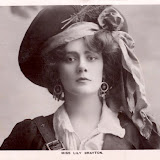
 All the photographs in this post are of Lily Brayton, the beautiful and celebrated star of Shakespearean drama in the Edwardian era, but she is not the focus. That belongs to Rita Martin, the London portrait photographer who was one of the best known in Britain at the time but is strangely neglected today. It is not unusual to encounter photographers who were household names in their time yet don’t crack a mention in any of the encyclopaedias, but what makes Ms Martin’s case special is that where she does get attention it is for the high standard of her work and her innovative techniques: two qualities you’d think historians would have picked up on.

 
 The facts are these: she was born Margareta Weir Martin in Ireland in 1875 and died in 1958. According to the photoLondon Database her studio was at 74 Baker Street, Marylebone, a mile or so away from the studio of her better-known sister Lallie Charles in Curzon Street, Mayfair. The addresses were in exclusive neighbourhoods. A photo by Lallie Charles in the National Portrait Gallery database shows the two women and their sister Bea in what was probably Lallie’s studio C1899. The furnishings and décor are what we would expect of a high-end studio of the age: a distinct oriental element in the screens, rugs and vases, potted ferns (or are they lilies?) and dark, elaborately tooled tables and chairs. The women have that dreamy gaze we associate with the late-Victorian era; as though life in this room is too achingly elegant to risk leaving it. In 1975 Cecil Beaton co-authored with Gail Buckland a personal history of photography, The Magic Mirror, to which he added an appendix; Commercial Photographers of the Victorian and Edwardian Era. Like the other appendices it accounted for photographers who hadn’t fitted with the general theme of the book. Rita Martin and Lallie Charles were given more attention than anyone else in this section. There’s a sense reading it that Beaton knew Martin - not Charles: she died in 1919 - particularly when he intimates that the sisters fell out. It reads like gossip he received first hand.  

 
 The quote from Beaton at the top however comes from his book British Photographers, part of the Britain in Pictures series published by William Collins during World War II. Each thin volume contained a short essay by a noted authority and thirty or so reproductions of artworks in colour and black and white. The topics ranged from butterflies to canals to a history of fashion: all of them intended to remind people of what was too precious to let fall into the hands of the Germans. Beaton’s contribution included one of his famous scenes of Saint Paul’s Cathedral during the blitz. Given the brief amount of space Beaton was allowed, that he would give more attention to Rita Martin than he would to Lewis Carroll or Roger Fenton may seem surprising, but when you look at his early work especially it is clear that Martin and Charles had defined for him what studio portraiture could achieve. For Beaton, artificiality is a compliment. In The Magic Mirror he says of both sisters that “they transcended the stereotyped (and) showed a tyranny over their subjects, who were willing to do their bidding, for they knew they were being beautified”. Beaton could be describing his own working methods. During the first decade of the twentieth century, photographic postcards of stage actresses were popular around the world. Most studios placed the subject before an elaborate stage backdrop, emphasizing the theatricality above the performer. Rita Martin preferred to place her women in a stark setting that obliged the viewer to consider their stage presence.

 
 Lallie Charles was a photographer of the royal family and made her name more as a society photographer. To understand how she and her sister developed their styles and reputations, we need to consider Alice Hughes, one of the most formidable presences on London’s late-Victorian photographic scene. She would not photograph men. You might think taking this stand at the beginning of the suffragette era would marginalize her, but around the turn of the century her studio was so popular with society women and stage stars that she employed up to sixty assistants; again, none of them men. Lallie Charles was probably one (this is unclear) but the more important point is that Hughes rejected the standard sepia, Pictorialist view for the very expensive, beautifully rendered platinum prints in sharp focus. One of the criticisms of Pictorialism, then and now, was that the photographers frequently confused artistic excellence with vapid sentimentality. A soft focus view of a society lady admiring a tulip might sound like a good idea in theory but the result could make her look as fascinating as a blade of grass in a paddock. Charles and Martin took Hughes’ ideas and when it came to publishing postcards saw the virtue in refining them, reducing background interference, or removing it altogether. Their success however owed as much to their ability to impart or inspire a performance for the camera, something few actors were seriously expected to do.

 
 According to Beaton, Martin had a contract with the theatre manager George Edwardes that gave her exclusive rights to photograph Lily Elsie and other performers once a month. This may not be entirely accurate, or may have only existed for a short time, because other studios photographed Ms Elsie. One was Foulsham and Banfield, whose work Beaton waspishly described as “rather quaint in their woodenness”. The general impression is that all power resided with management. Edwardes could agree to such a contract, as long as Ms Martin kept her fees to a figure he thought was reasonable. More likely, a successful performer like Lily Brayton had enough influence to ask for Rita Martin, and if sales of postcards justified her demands Edwardes would agree. 

 
 Although Ms Martin photographed several leading men of the stage, of the 322 prints held by the National Portrait Gallery, only three are of men alone, though a couple more are of men with their families. The number of prints is enough to be representative and suggests that like Alice Hughes, Ms Martin had principles she couldn’t be persuaded from. The first instinct is to say these were political, but on second thoughts it may have been that she was essentially interested in glamour. That wasn’t a word many male actors would have wanted to be associated with in the 1910s or actually applied to them. It implied an interest in haute couture and other womanly pursuits. When you look through lists of images of male Edwardian actors, they tend to go for either comedy or dashing but respectable, and were typecast as one or the other. Lily Brayton on the other hand could wear costumes from across the centuries and cultures and still transmit an aura of chic allure. For a photographer of the stage, male actors were boring.

 
 According to the NPG website, Lallie Charles photographed some of the suffragettes. Rita Martin photographed Rosamund Massy from the National Women’s Social and Political Union. What does this mean? Were they sympathisers? Were they asked to because they were well-known women photographers? Was it because, like Lily Brayton, the suffragettes were part of the cultural milieu? None of these questions cancels another so the answer may be all three but it’s worth remembering that while London’s theatre world might have been thought progressive, there wasn’t a huge amount of sympathy for the suffragettes. The actress and singer Anna Held complained that they went about slapping men and when they started setting fire to theatres and letting off smoke bombs inside that predictably turned people off them. Rita Martin may have believed that women had the right to vote and agreed to photograph some of the suffragettes but that didn’t mean she was obliged to like any of them.    

 
 Which brings us to the important issue of why she has been forgotten. It isn’t as though her work is hard to find, and she was well enough known in the 1940s for Beaton to assume his readers needed no formal introduction to her. It’s one thing to discover a previously unknown photographer, vis-a-vis Vivian Maier, but when a photographer has a substantial body of work in an archive the neglect is not random. Perhaps, like her sister, she’s seen as too establishment, too Edwardian, and her portraits of theatre stars don’t cast a challenging light on the social history. But the photo-historian’s first job should be to write the history, not re-write it and clearly there are spaces that need filling in. A common myth about early theatre portraits is that they were perfunctory commercial jobs and the genre didn’t take off until a handful of photographers in the 1930s (Beaton in particular) introduced an individual style. If that is the case, these portraits of Lily Brayton reveal a relationship between photographer and subject that was decades ahead of its time.


MY FAIR LADY

Tuesday, 21 October 2014

WINGS OF DESIRE


Transgressive images from Weimar cinema
 "I’m sincere in my preference for men’s clothes. I do not wear them to be sensational. I think I am much more alluring in these clothes."
Marlene Dietrich


 Berlin in the Weimar years: a city rampant with leather wrapped, cross-dressing S&M fetishists, or not. Depending on whom you ask (or what you read), that image is either an invention or a conflation. There were bars like the Silhouette, where a customer could take a table and watch a parade of men in make-up and dresses and women in tuxedos, but reliable advice suggests most of the night spots were a lot tamer than that. Apparently we can thank films like The Night Porter and Cabaret for seizing on a rumour and treating it as fact. If the Nazis were perverts by definition, it was assumed that for night time amusements they’d prefer watching a couple of transvestites spanking each other rather than a blonde fraulein singing banal operetta, but when you think it through, the latter is darker, stranger and altogether more disturbing. One of the hallmarks of the Nazi leadership was an abject lack of imagination. These were people who dreamed of a world where everyone shared their passion for kitsch, which meant blonde girls in gingham singing folk songs, not sexual ambiguity. Goodbye to Berlin, Christopher Isherwood’s original book on which Cabaret was based has no scenes set in a cabaret, but can we really blame Michael York and Dirk Bogarde for helping create the enduring image of Berlin C1930? Not entirely. Thanks to the Ross Verlag postcards we have thousands of surviving images that show the photo studios pushed the idea of a city where taboos were broken as a daily habit. Yet, coming from the cinema world, they were images of what the world could be, not what it was. Lya de Putti’s attire may have looked fabulous but it was impractical, and it was easier to imagine a world where women strolled along the Kurfürstendamm in sheer, glistening black rather than live in one where they actually did. After all, for a lot of ordinary citizens struggling with hyperinflation and massive unemployment, to dress like Ms Putti does in this photo was like waving a red flag at a National Socialist rally. The photograph is by M. I. Boris, aka the Bulgarian Boris Majdrakoff, who arrived in New York in the 1920s with a past respectable thriller writers would have dismissed as too unlikely. 

 
 Look at contemporary fashion images of women wearing suits and ties and we are meant to think of them as daring experiments in gender reversal, but so many of the Ross postcards show women wearing men’s clothing, or a close approximation, that we realize they were a trend back in 1920s and ‘30s Berlin. What makes us think they are about playing a game rather than making a statement is that so many of the actresses portrayed did not have reputations for challenging convention. From what we know of Carola Tölle, she played solid roles in films that are largely forgotten because there is no compelling reason to remember them. Her private life can’t be accounted for but it appears scandal free.

 
 Henny Porten’s fame and reputation have endured, for her roles as a gentle or long suffering earth mother type. Comparing the photo of her with that of Ms Tölle, we begin to see a pattern, or rather, a style. Only a decade earlier the notion of a woman wearing a suit and tie would have still caused a stir. In 1919 however, German women won the right to vote.  What had changed had less to do with Weimar Berlin’s free thinking than fashion designers’ understanding of how to accommodate radical into chic. Ms Porten’s sleeveless waistcoat has a decidedly feminine cut. She is not wearing a business suit. In the 1970s Diane Keaton revived the suited look in Annie Hall. If it didn’t make the jump to the pages of Vogue that was because it was too idiosyncratic: it was one thing to look like Diane Keaton, another to look like Annie Hall. And maybe the crusty old editors at the magazines took one glance, recalled their youth in Vienna wearing Papa’s silk ties and thought it had all been done before.

 
 Having never seen Marcella Albani in a film, commenting on her strengths as an actress is pointless, but in every other photograph of her in the collection she is portrayed as the embodiment of graceful elegance; a woman with a preference for haut couture and intelligent conversation. That doesn’t mean she lacked a sense of humour. When she fronted up to the studio on this particular day, she might well have been bored with the idea of yet another soft focus study suggesting she had just emanated from the mists. Perhaps Herr Binder was bored too and together they concocted an image the very opposite of what was expected. She was an actress; it was her job to be out of character. 

 
 Russian born Hella Moja dressed as a baroque era noble (or Mozart) looks to be having the last word on androgyny here, and in a way she is. We know from photographs by Walery and Reutlinger that the Ancien Regime look was popular around the Parisian music halls a generation before Karl Schenker took this portrait. So too were the matador, the Gypsy and even the blacksmith. They were too exaggerated to be subversive, more like fancy dress, and never began with the premise that other women might want to dress that way in the street. Also, it was always more acceptable for women to dress as men than the other way around. How many of the leading male stars were willing to don corsets and bustles?

 
 Sigmund Freud’s nephew Edward Bernays famously turned up in the U.S and turned women on to smoking. He took his lead from home, where the habit was already associated with modern sophistication, added a bit of volume and general crassness and earned the undying gratitude of his employers. A lot of the Ross postcards show women smoking; by the mid 1920s a cigarette in the hand was a sign of elegance, of adulthood, but not necessarily of rebellion. Ms Haake’s forte was light comedies and socially concerned dramas and she’d go on to a long career, appearing in films into the 1980s. If the idea of a woman smoking was as scandalous in Germany as it was in America, she’d be one who’d put hers out before the photographer was ready with the camera.

  Not so Fern Andra, the great, unsung heroine of early cinema. American born but European by preference, she promoted herself as a woman who liked a cigarette and a stiff drink and would be disappointed by any man who did not offer her both. In reality she was an intensely serious worker who understood the dangerous gulf between public image and private life. She paid a price, but not for smoking or dressing in men’s clothing or any of the standard contraventions. As actor, director, producer and even photographer, she controlled her image so closely that when it began to fade no one was on hand to help her revive it.

 
 Which brings us to that most infamous figure of the early screen, the vamp. Her modern history began with the nineteenth century music halls, she came of age with silent film and died with its passing. It was difficult to be a real vamp in the 1930s. The Hays Code in Hollywood was very much opposed to any young woman who thought a man’s marriage was a speed hump not a stop sign. According to the new rules she had to pay for her crimes, which was an obligation no genuine vamp ever considered. The Nazis weren’t keen on her either. For all the bondage and S&M imagery bestowed upon them, publicly their ideal woman was blonde, virtuous and enthusiastic about the outdoor life. She could suffer but never inflict pain herself. The vamp was dark, saturnine and came alive when the sun went down, like Valerie Boothby in this image from Iris cards. Despite her very English name, Ms Boothby was German. Her career was short but included such titles as Girls on the Cross (1929), Adam and Eve (1928) Inherited Passions (1929) and Marriage in Name Only (1930); all which suggest some poor fool learns a lesson about love the hard way. 

  The vamp and the femme fatale were subtly different creatures; though the man who fell victim to either was seldom astute enough to know that. Both depended on exploiting male vulnerabilities but where the first was essentially amoral the second had principles and objectives. Sometimes she was looking for a way out and figured the man would lead her to it, and sometimes she was genuinely in love with him. If the last scene saw the vamp heading down the street with a man in her arm, you knew they were going back to her lair. If it was the femme fatale on the other hand, she may well have been persuaded that the path to true happiness lay in marriage, children and a home in the suburbs. Lissi Arna is one of the many German actresses of the silent screen forgotten now by all but the most devoted fans of the era, yet throughout the 1920s she was one of Weimar cinema’s most popular stars. Her reputation today, such as it is, rests on several films where she played the prostitute (hard hitting exposé) or the seductress (comedy, melodrama) but as it transpires she made more of the routine romances that were the bread and butter of the film business. The Kiesel Studio was located at Kurfürstendamm 11, meaning the address was fashionable but real information beyond that is hard to find. Alongside the celebrity portraits are many more showing children with oversized Easter eggs, or (that other inexplicably popular genre) dressed as their parents. What we see here is one of those minor shifts in the way women were portrayed that don’t raise the number of eyebrows today that they should. There is nothing vulnerable in Ms Arna’s expression. She knows what she wants and how to get it. 

  The secret had less to do with women discovering an independent spirit than technicians realizing the power of lighting. Photographers were learning that a shift in angle to throw a shadow could do more than animate a portrait. It could transform Elizza La Porta, generally sensible star of such morally didactic films as The Right of the Unborn and The Vice of Humanity (abortion and drugs respectively) into a siren of the night. Silent Hollywood gave the vamp fame and notoriety but in Los Angeles she was a European construction. Think of the number of famous Hollywood mantraps from the silent era, how many have ‘European’ names, and what their actual names were: Theda Bara (Theodora Goodman), Dita Naldi (Mary Dooley), Olga Petrova (Muriel Harding). She was by definition exotic because part of the danger of becoming involved with her lay in being unable to penetrate her closed, enigmatic mind. In Germany, America was a strange, distant land (witness the popularity of Karl May’s Native American novels), but so too were places just beyond its borders. The Balkans, home of the vampire, Oriental Turkey and the Arab lands, the Russian steppes; they were all breeding grounds for women who could crush a man’s soul with as much thought and effort as it took to flick a cigarette into the gutter. Romanian born Elizza La Porta may not have played the seductress on screen but she knew how to for the Manasse studio. Operated by Olga Solarics and Adorjan von Wlassics, it specialized in glamour photography and in surreal, modernist erotica. After years of relative neglect, the erotica was rediscovered and in the process became representative of decadent Berlin. The studio was equally adept at portraying actresses as sweet and wholesome as a strudel. But any fool with a camera can do that.

WINGS OF DESIRE

Thursday, 2 October 2014

HORSE AND CARRIAGE

Wedding snapshots
“A man in love is incomplete until he is married. Then he is finished.”
Zsa Zsa Gabor


To be an army officer in Turkey in the 1940s and ‘50s gave a man more status than lawyers or doctors could expect. You might not have made more money but you were a defender of the nation, so when the time came to get married full military dress said more about you than any well-tailored suit could. It might have even been expected, since several of your commanding officers were obligatory guests and according to protocol you were not supposed to appear before them in civilian clothes. Having the groom in his military uniform does tend to add a slightly sinister quality to a wedding photo, but even if he were wearing standard black tie in this scene it would still suggest this wasn’t exactly the happiest day in a young couple’s life. Everyone, including the little boy in the left foreground, seems to regard the camera with suspicion, even hostility. It also looks like they have crammed into an office, or a back room at the registry. 


Ataturk made all Turkish marriages civil rites, meaning that religion was officially removed from the ceremony. The law still stands although people get around it by having two weddings, one official, one not, and so far as a lot of people are concerned it is the second that seals the compact. The first is just a piece of paper. You get an idea why from this scene. A crusty old clerk asks a few questions for formality’s sake before he hands over the documents to be signed. The couple look solemn and attentive, as befits the moment. The two men behind the couple are also looking at the camera with suspicion. The one in the hat bears an uncanny resemblance to an American gangster.


 But before we start thinking that the Turkish marriage is a dry, sombre affair, a farewell rather than a greeting, consider this snapshot. Apart from the fact that, finally, we get a smiling bride, there’s a suggestion the woman with her has donned a turban and applied some blackface. It’s the difference in shade between her face and her arm that make us think so, but could she? Would she? I don’t see why not. Weddings are usually supposed to be fun and it wouldn’t be the last time someone attempted to brighten proceedings with a display of bad taste. At least the bride is laughing. 


 Here we get a scene that suggests some ritual is about to take place. He appears to be a relative rather than the groom and it is possible he has decided to offer some prayers for the couple. Everything about the scene points to hasty improvisation; important details that were overlooked in the hectic rush of the last few days. He had a speech prepared but he left it at home, or thinking how quickly his daughter or his niece has grown up fills him with an existential dread. She wants him to know that everything will be all right, but actually, she’s used to his sudden spells. This is nothing, but she wishes her sister would put the camera down for once. 


 Let’s leave Turkey for a while and head to Canada, to contemplate for a moment how utterly boring it must be being a professional wedding photographer, heading out all day every weekend to take the same photos over and over. Professionals are paid to capture that special day but what they record is a formula. Only family and friends can photograph the day properly. Being the 1950s, this might have been taken at the bride’s home; which is to say her parents’. It’s a moment where past, present and future come together, for this being Canada in the 1950s she will probably have the same wallpaper in her new home, which will be a triumph of domestic taste and design. Mum would have taken the photo; Dad could have but he was in the kitchen knocking back his third bourbon of the morning, on account of nerves. 


 Another Canadian marriage scene; this one taken out in the rural wilds of Ontario. It makes you wonder why people hire professional photographers at all. A professional would have resisted photographing the couple with the farm as a background, preferring a studio setting with a neutral background, but the whole point of wedding photography is to preserve memories of the day. The only memory a commercial photograph would record is that of the experience of being photographed. Here we get an actual incident. The couple are already married and about to drive off for their honeymoon. They don’t look like a couple of farmers, but then women in wedding dresses seldom do. We can speculate on why they are out on the farm but we can’t deny this is a moment that will stay with them. 


 To England, and a photo that looks like someone’s attempt to create the studio look, with the blanket draped over as a backdrop. Everything about the scene is slightly ratty, from the man’s ill-fitting suit to the cheap blanket and the dingy doorway. They probably couldn’t afford a professional photographer, but they didn’t need one. We do hope he’s not a proper Jack the Lad, with a spare bird out in Chelmsford and a couple of geezers on his back for some readies he promised to cough up last week;  that would break her heart.


 Back to Turkey, and a moment that doesn’t look like one the bride would have wanted preserved, but then the other great thing about amateur wedding photographs is the haphazard ways they come together. Not much left to say about this one; it speaks for itself.


Another Turkish snapshot, that also looks like it was taken at the registry office. Notice how the bride and the woman to her right have their eyes shut against the flash. The boy next to the bride has covered his eyes. But then the woman next to him and the one above her have expressions of stark terror. The man just behind the bride has an inane grin. Others are trying to push into the photo or preserve their dignity. The man at the far left looks like he has just realized he left the stove on at home. Think of those millions of photos of everyone standing to attention on the church steps. This one is what a wedding photo should look like. 


 Apart from making marriage a civil ceremony, the Ataturk government tried to outlaw polygamy and arranged and consanguineous marriages, but these were rooted in long traditions and out in the hinterland people stuck to them. This photo was taken in the 1920s, not long after the birth of the Republic and it presents the image of contemporary Turkish society, or what it should have been: an urbane couple without a hint of religious symbolism in sight. The woman’s headdress suggests she is Armenian, so here we encounter one of the conundrums at the heart of Ataturk’s revolution. With outwardly western values, better connections with Europe, a higher level of education and, in urban centres, more prosperity, on the surface the Armenian community embodied the new ideal, but how could that be so much as suggested after 1915? Compare it to the top photo and we see how it is one thing to adopt the manners, quite another to accept the mores.

LOVE AND MARRIAGE