And furthermore ...

One Man's Treasure encourages the use of anonymous photographs posted here to illustrate books and album covers.
If an image appeals to you, contact John Toohey at johntoohey@hotmail.com.
Showing posts with label propaganda. Show all posts

Tuesday, 26 May 2015

HIDDEN PERSUADERS

Canadian advertising photos from the 1950s
 “Advertising is fundamentally persuasion and persuasion happens to be not a science, but an art.”
William Bernbach


A collection of Canadian advertising photographs, of everyday household objects, of stuff. They were taken in the 1950s, something the packaging tells us at once. They tell us things we don’t think we need to know but are the very fine details without which we couldn’t understand the past, such as what products Mr and Mrs Average Canadian bought at the supermarket and what did they keep on the shelf behind the bathroom mirror. This is a world so ordinary it looks alien.

 
 Madmen was set in the same period these photos were taken, when the middle classes became prosperous in a way they hadn’t been able to for a generation, when ad agencies started making serious money, and when advertising became associated with a kind of ruthless creativity. At least that was the way it was in the top end magazines like Esquire and Vogue, who pushed the notion that brands mattered to the modern man and woman, as though they might as well be be naked without Johnny Walker in one hand and Philip Morris in the other. But same time, different world. Down in the real world of mid level incomes and struggling aspirations, advertising was still about product more than image. TV dinners, deodorants and lingerie could be depicted according to the same formulae because there was no need to vary. (Most of these photographs would have ended up in catalogues or newspaper ads.) 

 
 Whatever Madmen might suggest, the accounts that photographers have left us suggest most of them treated advertising as hack work, done only to pay the bills. A handful achieved a glamorous status but most disavowed the very idea. Technically all that was needed to fulfill the Bionet contract was knowledge of the basic rules, mainly what the lighting set-up should be. Madmen is actually about people in our contemporary TV world. Acutely, even cynically aware of how dull and shallow that place is, they are trying to sell the image of glamour, not to us but to themselves. 

 
 A stamp with the name Jack Markow appears on the back of two of these prints. The Markow studio address was at 1827 St Catherine St Montreal. The building still stands, now occupied by an art supply store and a martial arts gym.  Some quick research reveals that Markow was born in Montreal in 1921 and died there in 2001. As with a lot of commercial photographers, his legacy is scattered throughout various archives yet it tells us little about him. A man on hire who prolifically photographed medicinal products, bar mitzvahs, evangelical meetings, Quebec nationalists and new buildings in the CBD will tell us less about himself than someone whose output was narrower and in shorter supply. To understand Markow, we need to find the snaps he took of his family, but maybe they don’t exist. Maybe the busman’s holiday didn’t appeal to him; the mere thought of picking up a camera became physically painful for Jack Markow. Would you be that excited if you had just spent all week photographing diuretics.  

It is just coincidence that so many of the two dozen photographs bought in this collection are of pharmaceutical products, yet it may not be. The 1950s were the beginning of the modern age of the pharmaceutical industry, when there was not only a product for every minor complaint but it had the imprimatur of various government departments. This was a time when the side effects of drugs were often discovered once they had been on the market a few months. Today, conscientious doctors advise us that a little pain is not necessarily a bad thing but in the 1950s discomfort of any intensity was something to be avoided. We can thank the war for that. Firstly it had necessitated a series of pharmaceutical breakthroughs, and also the postwar peace encouraged the avoidance of pain. It was as though the Government was leaning over and asking, in a kindly voice, haven’t you suffered enough?
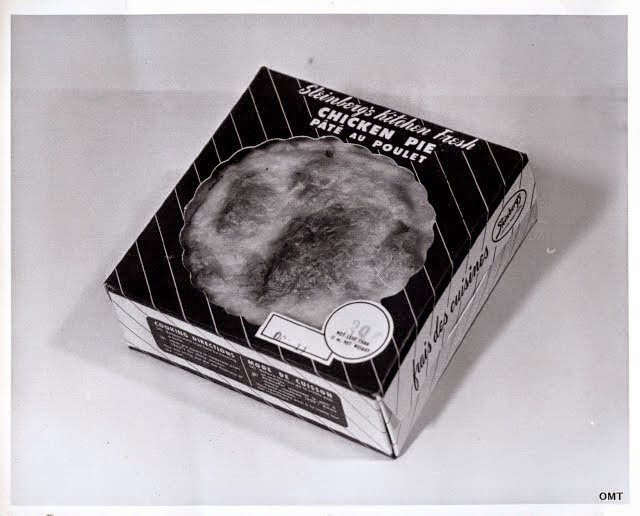
 

But back to the original point, the one about stuff. Those of us born too late to experience the 1950s can be persuaded that things were better back then, and by things we mean stuff, not politics or lifestyles. Well it’s true that in the 1950s cigarettes didn’t give you lung cancer and Coke wasn’t responsible for diabetes, and we’re always being told that a new packaged pie tastes like pies used to, which means like they ought to. When we look at the Steinberg’s ‘kitchen fresh’ (whatever that means) chicken pie, do we not wonder if it would taste more like a chicken pie should to our jaded senses? You can bet it was horrid: a sludgy confection of artificial pastry and gravy surrounding some pink cubes of former chicken, but at a time when the world feels harder, more insecure and less generous place than it was when these photos were taken, nostalgia for a non-existent taste sensation stands in for other illusions as well.


 So, did all the things we see here come about because we wanted them, or was it because advertisers told us that we did? Was BO a problem before deodorants appeared or did it become one only after a solution had been found? In 1957, contemporaneously with these photos, Vance Packard published The Hidden Persuaders, which didn’t just expose some of the tricks advertisers used but argued that the real danger was that political machines were beginning to use them. Half a century of wonder drugs and lotions later, the question is more refined: have we become inoculated?

HIDDEN PERSUADERS

Tuesday, 17 June 2014

THE OTHER SIDE

German propaganda in World War 1 postcards
"...among the calamities of war may be jointly numbered the diminution of the love of truth, by the falsehoods which interest dictates and credulity encourages."
from The Idler magazine, dated November 11, 1758, 160 years before Armistice Day.


On the little chalkboard at the front the message reads, “Kriegsjahr 1914/15”, or “Year of the War” then something indecipherable and what could be Eisenfeld, which would be a small town north of Frankfurt. An expert could interpret the variety of caps and tell us more, but for the time being it looks like a battalion or regiment has been billeted in the town. The sign on the door at the back is for Odam camembert cheese, which obviously makes us think they are outside a store or bar. The middle aged couple at the back could be the owners and the two younger women their daughters or staff. Everything so far has been self explanatory, but what of the mug of beer on the table? Thousands of German postcards just like this one are floating about and the mug of beer is a common element. There’s a simple explanation – someone just ordered a beer, and as the man at the very rear left is also holding a beer that looks straightforward and evident – but simple explanations aren’t always satisfying. Could it have stood in for absent friends? After all, the toast to lost comrades has been common across all armies through the centuries, and though it is somewhat atavistic, the idea of having a glass of beer to stand in for them is not illogical.


The two predominant images of World War 1 are the bodies in the trenches and the fools in charge. As the centenary drew closer there was a spot of revisionism, a few suggestions that as First Lord of the Admiralty during the Gallipoli campaign, Churchill wasn’t quite the disaster he has been made out to be, but even the worst leaders have their ever faithful supporters. Here’s a postcard of Counts Häseler (on the left) and Zeppelin. The caption at the top tells us they are the oldest commanders of the German army. This and several others in the same series were made in 1910, when war was a certainty though no timetable had been drawn up. Neither man had an active role in the war, both being in their 80s, but something about this image says a lot about the state high command. It wasn’t just that so many of the generals were old men who should have been pensioned off, but most of them had come through the various officer corps during an era when class distinctions were so strong they might never exchange words with a single ordinary soldier. It was an era when officers were gentlemen, hoped to engage in at least one legendary cavalry charge and had no clue how to deal with irregular Sudanese, Boer or other upstart militias out in the colonies. Look at these two. What silly hats. What pompous outfits. As for the sabres; what good would they be in the trenches? The photo is by Alfred Kuhlewindt, an official photographer for the German High Command and a man whose job was to make the ridiculous pass for the sublime.


There is a publisher’s stamp on this but no photographer credited. That doesn’t matter. Variations on this image, the young frau wearing the soldier’s cap with a (painted) horse behind her, were among the most popular postcards sent to the soldiers at the front. Thereby hangs a tale, or an idea at least. Wir halten durch! In English: ‘We came by’, or ‘We stopped by’. Who is ‘we’? Well, it is the young women of Germany, but more specifically, the young women who rode horses. In Germany C1914 to 1918, that really meant the young women from good middle to upper middle class families, der junge frauen der mittelschicht (I think): well bred, wholesome, cultured, for whom horse riding was a pleasure, like reading Goethe or going to the museum on Sundays; in other words, the ideal German woman, she whose honour the boys in the trenches are fighting for. Wir halten durch! Why? To offer words of encouragement? To remind young Kurt that trenchfoot, dysentery and good odds of a premature death were but small sacrifices for the greater ideal? There’s a study waiting to be made of this young frau, and her English, French, Belgian, Dutch and Russian equivalents, because they are the same, but different in their subtle ways. You won’t find many images of British lasses with painted horses because horse riding didn’t have the same cultural resonance in England. Ditto the French mademoiselle, who likely as not is holding a flag in one hand, a tray of pastries or a bottle and wine glasses in the other.   


Happy Easter, 1915. It is postmarked April 2nd but even Germans have trouble reading the handwriting, because it is so flowery they can’t tell if they are looking at a t, an f or a j. The message, or what they can work out from it, seems fairly pedestrian. Someone is going to Cologne soon and thinking warmly of the recipient. It is the image that matters in any case, and how strange it is. The egg itself is easy to understand, not so much a symbol of fertility as one of the family. And look at the trench the soldiers are in. It looks more like a culvert, a neat, shallow and well constructed channel. Did the people back home really believe the trenches looked like this? They may have. In early 1917 disillusion with the German army was so strong that several cities were paralysed by riots. It wasn’t just the death toll that made people angry; it was also the discovery that they were being lied to. Their boys weren’t winning magnificent victories, and just like the Allies, they couldn’t retreat if they wanted to, the war being stuck in the trenches. Despite all the evidence in the form of the war wounded wandering the streets it took two years for that message to affect enough people that civil unrest became possible. The day this postcard was mailed off, a German cavalry unit was badly beaten in Poland by a Russian force but the chances were slim the author of the postcard knew that. Only the Russian news services would have published that information, and as every German knew, they weren’t to be trusted. In 1915 Easter fell on Sunday April 4. This postcard was mailed on Good Friday.


While we are on the topic of truth being ignored, misconstrued or overlooked, here’s one the Allies may have conveniently forgotten. On the back the message reads, in German, “Three Tonkinese soldiers captured 5. 6. .18.” It also says where, though that isn’t clear. ‘Tonkinese’ was the common term for people from North Vietnam, but often enough anyone from what was then French Indochina, which included Cambodia. Consider the background. The palms suggest an exotic, tropical location. Brief research (Wikipedia) has uncovered the detail that some 92 000 Vietnamese soldiers served in the French army on the Western Front. That’s an awful lot of people to leave out of the standard histories, especially when you remember that approximately 103 000 New Zealanders served. The French could argue that, coming from the Colonies, they were part of France anyway, but perhaps France has always been troubled by the Indochinese contribution. The history of the Indochinese wars that began in 1946 and ended with America’s defeat in 1975, properly begins in the First World War when the initial anti-colonial uprisings took place. Vietnam wasn’t just sending soldiers but being taxed to support the French effort, and when you study the expressions on these men’s faces you get an inkling of why the King of Vietnam, Duy Tân, would leave his palace to join the protestors in the streets in 1916. Ho Chi Minh later claimed his political ideologies first formed during the war.

THE OTHER SIDE

Saturday, 20 July 2013

FANCY DRESS

Images of fancy dress

“If you asked me now who I am, the only answer I could give with any certainty would be my name. For the rest: my loves, my hates, down even to my deepest desires, I can no longer say whether these emotions are my own, or stolen from those I once so desperately wished to be.” 
Evelyn Waugh: Brideshead Revisited


At a recent conference in Nottingham Verity Wilson from Oxford gave an engaging presentation on fancy dress in photography. A historian of fashion and textiles rather than photography, she admitted the topic was broader than she had first anticipated. Well, yes. Once anyone started talking about fancy dress in photography they would quickly have to set out parameters and enforce definitions before they were swamped. Here are just a few of the types, genres if you like, of photographs where people not only dressed up for the camera but assumed roles for it: theatrical, tableaux de vivant, family snapshots, glamour, fashion, folk costumes for the tourist market, tourists in folk costumes, fancy dress balls and costume parties, national identity, the erasure of identity and with all that we haven’t left the 19th century yet. Someone asked how we could tell the difference between a fancy dress photo and one of an acting troupe. Often we can’t though the distinction matters. We think actors in costume are less interesting than ordinary citizens in fancy dress because they are only doing their job. The photo above was taken in Winnipeg, C1910. I think it is a group of actors because most of them look like actors but I say that not knowing what exactly an actor looks like. And if it is a group of actors, does it matter if they are amateur rather than professional? Fancy dress in photographs is a form of amateur theatre.


For the purposes of the presentation Ms Wilson excluded actors. She was more interested in that basic desire we have to slip into another character and how the camera was the perfect machine to help us achieve that. It gives us a record that verifies the memory but more than that, from the very beginning there was the idea that the camera was a truth machine and the photograph a fact, so what better use was to be made of it than to manufacture evidence? You could assume any identity you wanted; the camera would vouch for it. 


From the Edwardian era into the 1920s, costume parties were incredibly popular at Oxbridge colleges, particularly among the arts students. A whole mythology has been built around the parties Stephen Tennant and his circle of bright young things threw and cameras were essential. The various images we have of their parties don’t suggest the behaviour was particularly wild but then, people tended to stop what they were doing as soon as the camera came out and hold that pose (Cecil Beaton was often the photographer). Evelyn Waugh’s descriptions of them usually amount to scenes of giggling groups in retarded adolescence recklessly driving around dressed as playing cards, or something to that effect. Fancy dress was part of being liberated. Some social historians relate it to the passing of the Victorian era, others to the end of the First World War, though both seem to be missing something. Just as important was a conscious effort among younger generations to engage in adult games like masked balls that had once been reserved for the very wealthy. The people in this photograph look too rough around the edges part of the Bright Young Thing set; notice how the two men are wearing carpets for togas. 


Tableaux vivant were also a popular Victorian then Edwardian pastime, but unlike costume parties the photograph was the whole point. A scene like this could take hours to put together, given that first it had to be imagined, people had to dress for it and then it had to be arranged. I can’t explain the thinking behind this though it may have had its origins in some fairly trashy artwork. It is possible the children were in a school play but we know Charles Dodgson took a lot of these staged scenes with children and there’s no reason to think he wasn’t following a fashion. During the era when tableaux vivant were popular, people didn’t shy from the morbid or grotesque. For a series of tableaux vivant look at Luminous Lint here.   


This image appears to combine elements of the costume party and the tableau vivant. If it is a costume party I doubt it was very decadent since there appear to be young children in this scene – and no sign of alcohol. They are dressed as Japanese. No idea why they are all pretending to be asleep unless the photographer wanted the impression this was a dream. Despite the costumes, something about this photo tells you immediately it was taken in England.


When it came to fancy dress, other cultures were high on the list, and the more exotic the better. The gut reaction to call it colonialist, or worse, needs to be tempered with the huge number of images we have of Chinese dressing as westerners, Turks as Arabs, Arabs as Chinese and so on. If the motive for dressing as another culture is a joke in bad taste it is also universal. This was obvuiously taken in a photo studio. Was dressing up as Arabs one of the services the studio offered? It isn’t so strange when you think how popular studio cowboys were (see here) or even sitting in a papier maché boat. It is possible too that they are soldiers on the North African front in the Second World War. When he was in Constantinople after the Crimean War, Roger Fenton wanted to photograph some of the locals in their native dress but was too shy to ask. When he returned to England he got his friends to dress up instead.


This is by Theodore Servanis, a Greek photographer working in Constantinople from the 1900s to the 1920s, and it is obviously from a school play. If the play is a French classic by Moliére, Hugo or one of their cohorts, the school was most likely Armenian as French was often the language of instruction and these were the schools that taught European classics. French wasn’t just the language of commerce; it distinguished high from low culture. If the intention was to present the façade of sophistication you could argue that was another form of fancy dress. The wristwatch the girl on the far right wears is a nice touch.


Compare the Servanis photo to this one. The man’s costume indicates he is Meskhetian Turkish, from Georgia, which when this was taken was part of the USSR. Technically this is traditional rather than fancy dress but he wouldn’t have worn this costume in his daily life. The date this was taken is important. In 1944 Stalin began a purge of Georgia and the Meskhetians who weren’t killed fled to the Black Sea region of Turkey, Trabzon in particular. If this was taken at that time he is probably a refugee making an obvious political point.


Speaking of national identity, this woman was photographed at an Elizabethan fair in England on July 30, 1924. Some quick research suggests that the Elizabethan theme was popular for fetes and fairs at the time; several examples of advertisements pop up on the internet. Historians who like symmetry might find it revealing that at one end we have the beginning of the British Empire, at the other its end, but it isn’t really clear that in 1924 most English people accepted the Empire was over. More likely; Elizabethan suggested not only elaborate costumes but also Merrie England, that hard to locate halcyon era that apparently existed sometime after the Black Death and before industrialization. These days we associate Elizabethan with ruthless machinations at the court, religious persecution and the prelude to revolution. History can take the fun out of the past.


What is it with the Far East? As often as not, fancy dress has meant the Orient, for women especially. Around 1880 Japanese style started to become fashionable. One reason was that the country had only recently opened its ports to the West and designers discovered the concept of style with minimum appearance. Teapots, bureaus and vases turned Japanese and kimonos and bamboo umbrellas became fashion items. Ancient Egypt had been popular at the same time but interest waned until Tutankhamen’s tomb was discovered in the 1920s. Japan however never went away. If its allure remained mysterious it might be because the country was never colonized by Europeans. Its stuff never belonged to the West so it never lost its glamour. And if you think about it, there are a lot of things we Europeans can’t do these days; it is crude to wear black face or dress as Native Americans, Arabs, Sikhs, Turks, Zulu or Inuit but even now, when a group get together for fancy dress you can be guaranteed that at least one male will be a cowboy, one female will come Japanese.


Anyone who collects vernacular photographs will have a sizeable proportion devoted to fancy dress, whether they set out with that in mind or not. Some collectors specialize in it. As subjects go these photos are hard to pass over. They are about people having fun for the camera and more than one scholar has pointed out that’s what we think the Kodak was invented for. But there is more, because if all vernacular photos are inherently mysterious, fancy dress adds another layer to the riddle. Philosophically speaking, it is about identity, the construction of truth and reality and so on, with the implicit understanding we are not going to get a single categorical answer. It’s that paradox that the more a photo tells us the less interesting it becomes.

FANCY DRESS

Sunday, 23 June 2013

WONDERFUL WORLD


Keystone stereographs and God.
“Many people have never stopped to wonder why they have two eyes.”
Albert E, Osborne; The Stereograph and the Stereoscope, 1909


The story of the Keystone View Company really begins with early rivals Underwood & Underwood. Two brothers in Ottawa, Kansas, Elmer and Ben Underwood, were only 20 and 18 at the time they set up that company in 1882 but their business plan had foresight. Firstly they would not only produce stereographs but act as agents for smaller American companies in the region. Within a few years U&U would be the leading provider of stereographs on the eastern side of the country.  Rather than sell the cards in the usual way, in small sets of ten or a dozen, they packaged them in boxes of 100 along with the stereoscope. They understood that customers were willing to pay more for a set of 100 than wait for the series to be released in small doses. They also used a modern sales technique we normally associate with bibles and encyclopaedias, door to door, and for that they needed a small army of travelling salesmen. The brothers were devout Christians and hired their crew on the understanding they dressed well, did not smoke or drink and attended church every Sunday. For the Underwoods, stereographs were not just pretty pictures in 3D; they were morally improving. Show people scenes of Yosemite Park or New York’s architecture and they would be moved by the works of God and man. One category the company specialized in was biblical lands. Using its stereographs, Sunday school and other teachers could educate children about the Bible. With a scene of a side street in old Jerusalem the students could see where and how Jesus lived.


Underwood & Underwood was successful but they entered the scene as the stereograph began to decline in popularity. The reasons for this probably have more to do with people tiring of the novelty rather than any threat from alternative technology. The company’s sales techniques and their religious fervour re-energized the market and they were smart enough to buy up the stock of companies that were folding. Still, by the turn of the century the brothers had diversified and were becoming less interested in stereographs.


Enter former U&U travelling salesman B. L Singley. He had started a small and undistinguished company called Keystone View that struggled along until the Spanish American War, when President McKinley encouraged companies to go south and send back propaganda. By the first decade of the 20th century Keystone was strong enough to challenge U&U’s dominance and in 1912 it bought the U&U archive, which was itself a collection of other archives. Though there were a few companies still producing stereographs. Singley had a virtual monopoly in the U.S.


A good account of the business of stereographs is found in Anthony W. Lee’s A Shoemaker’s Story (2008). Ostensibly about the interaction between Quebecois and Chinese and workers’ resistance in a Massachusetts town in the 1870s, it takes a diversion into the story of the Kilburn brothers, then significant publishers of stereographs. Though Benjamin Kilburn was a photographer the company began buying images from studios or sourced them from collections and built up a library of American images. He takes the credit for the idea of buying images then selling stereographs in boxed sets through door to door salesmen. Lee is good as describing how the Kilburns’ nard-nosed attitude to business and sharp sense of what the customers needed, rather than just wanted, set a template for others.


Although U&U frequently credited the photographer this was unusual. Most companies including Keystone rarely bothered. We know this photograph was taken by Wisconsin photographer H. H Bennett in 1886, not because Keystone tells us but because Bennett was significant enough to have his work held in Wisconsin archives and it can be traced. Other times the only way to know the photographer’s name is if their image appeared in an earlier series by U&U or another company and had been recorded. Even that can be uncertain. Some scenes had a natural vantage point for the camera so on the same day two photographers could take near identical shots. Likewise copyright dates refer to publishing, not necessarily when the photograph was taken. This is particularly relevant to Keystone because by the 1920s, when it was effectively the only company in America publishing stereographs, it used stock negatives that could have been taken in the 1860s. 


A case in point is this and the other image from Russia. On the back of both are references to the Communist revolution (it was rare for Keystone to make explicit political comments though it would always make an exception for the Soviets). Both look decidedly 19th century and could well have been taken pre-revolution. Following the revolution, Russia wasn’t exactly cut off but travel was difficult and in some parts still dangerous, so if the company wanted Russian scenes it was likely to look through its stock rather than send someone out or try and buy some from Russian agencies.


Singley may not have shared the Underwood brothers religious zeal but along with the negatives Keystone inherited the U&U philosophy that stereographs were best thought of as didactic tools. On the back of the cards was a short essay giving a brief history and geography of the place and an introduction to the culture. In a lot of ways the company’s approach mirrored that of National Geographic, which had begun publication in 1888. Both considered their photographs objective studies, anthropology for the masses, and who could fault an organization that only wanted to educate people? The problem was that to express that idea they paradoxically had to make foreign lands look as exotic as possible. Take this scene from Hungary: the shepherd’s life however was “characteristic of the Tartar nomads who were (his) ancestors … They have no dwellings.” in the 1920s, when it was published, Budapest was a centre of contemporary European intellectual culture. The shepherd may not have cared much about modern art but not only did he have a house he could well have driven out to his flock in a car. 


Or take this scene of a Czechoslovakian village. Clearly the scene was carefully arranged by the photographer, down to getting the boy on the left to look towards something off camera. We can’t be too sure how the original photo came about; Keystone could have bought rights to an existing image or sent someone out to find a scene. Whatever happened, it was taken without awareness of the text that would accompany it. “Almost entirely an agricultural people, the Slovakians are an untrained, uneducated nation who chose illiteracy in preference to Hungarian education”. Forget Slovakian Ján Bahýľ, who built the first motor driven helicopter, wireless inventor Jozef Murgaš or some 300 years of classical composers’ those kind of details might have obliged Keystone to explain to its viewers that they were actually looking at the effects of economic deprivation.


In 1909 Underwood & Underwood commissioned Albert E. Osborne to write The Stereograph and the Stereoscope. Like any book with the subtitle, What they mean for individual development. What they promise for the spread of civilization, it has dated, but it casts light on the thinking of U&U and Keystone. The central argument is that in itself the act of looking at beauty is moral improvement. To make his point Osborne had to define his terms; beauty, image and reality, which he did in a very early 19th century way, but his grounds became shakier when he tried to persuade us that the stereograph was even better than the real thing. “The farther an object is away from us the more air we have to look through in seeing it”. Most decent scientists would say that it is light not atmosphere that disturbs vision - unless you are in a fog – but that would have spoiled Osborne’s real argument. Because the stereograph rendered the world more accurately in images than any other process it was the best means for viewing the world and all its wonders. Because it removed the flaws of natural vision, ultimately it drew us closer to God.  

 VIEW THE GALLERY HERE
WONDERFUL WORLD

Thursday, 25 April 2013

THE WAR TO END ALL WARS


Some portraits from World War 1, most with a sense of tragic irony
“One day the great European War will come out of some damned foolish thing in the Balkans.”
Otto von Bismarck (1888).


There’s a painting by John Singer Sargent at the National Gallery in London called General Officers of the Great War. Twenty two of the British and Allied commanders are standing together; William Birdwood, Douglas Haig, Edmund Allenby, George Milne and so on, and unless you still get teary at the idea of the British Empire, you have to ask; did any of them feel just a twinge of shame at being asked to pose? Too bad Winston Churchill wasn’t asked to join in. Then Sargent could have titled his painting 23 men whose ignorance and incompetence led to the unnecessary deaths of hundreds of thousands, but that’s perhaps a bit unwieldy. 


Here’s one of the French culprits; well he looks like he had a walk-on part in Kubrick’s Paths of Glory, which was incidentally based on a novel, itself drawn from actual events when four soldiers were executed for mutiny. For the record, Australia was the only country in the First World War that did not have an official policy of executing deserters or soldiers accused of cowardice. The British executed 306 soldiers, including 25 Canadians, 22 Irish and 5 from New Zealand. The Americans executed very few (so too the Germans) but US High Command wasn’t averse to punishments of public humiliation, including sentencing deserters to wear placards. The French outdid everyone. Over 600 soldiers were shot. Worse, there was a policy of decimation in place, which meant that when a unit rebelled and refused to follow a reckless order, one of every ten men could be shot as punishment for all. The most infamous case was on December 15, 1914 in Flanders when several French-African soldiers were executed. To make things even worse, in the French and American armies the soldiers called on to carry out executions were most likely to come from the soldier’s own regiment. They were his brothers in arms.


The mythology that England, France, Germany, Turkey and Australia have developed around the First World War reduces the enemy to simple terms. If you were Australian he spoke German or Turkish. The fact he may have been Bulgarian gets lost in the lack of detail. Bulgaria’s part in the war has been discussed in earlier posts but it is worth reiterating. After all, in the First Balkan War of 1912 Bulgaria was allied to Serbia and Greece against the Ottomans, went into the second Balkan War against its earlier allies and by 1915 had joined the First World War on the side of the Ottomans. There’s a tendency to describe Balkan politics as complex, as though too much thought went into them, but there’s another possibility; they were as thoughtless as they were self-serving, visceral and absolutely lacking in foresight. These men, photographed in 1916, are cannon fodder.


The Americans came in late, or as they would put it, to clean up the mess. They weren’t there at Gallipoli, Ypres or the Somme, which explains why there is no great American novel about the war. This may not be a bad thing. There’s been a proliferation from Britain in recent years and the plots quite frankly have become predictable: Irish boy goes off to fight for England and returns to the troubles at home - The Soldier's Song, A Long Long Way – episodic narrative of young soldier’s road to awakening and disillusion – Birdsong, Regeneration, etc. Worse, they appear to have identical covers of soldiers silhouetted on a ridge. Nothing so odd as this photo then. Not that there was anything at all strange about a soldier having his portrait taken before he shipped out, but it is somewhat to pose in front of a painted backdrop of a military barracks, and he has the expression of the rabbit in the headlights.


Something similar is going on in this portrait of a nurse. Was she put in front of the backdrop of the military tents because it needed to be reinforced that she was going off to the front? For a long time, at least up to the mid-1980s, the idea that nurses also served in battle wasn’t taken too seriously, as though having to tend to soldiers who’d been shot, gassed, had bits blown off or were suffering shell-shock was all in a day’s work. Read some of the nurse’s accounts from Gallipoli: working for days without rest while a stream of the wounded poured in and knowing there wasn’t much they could do for a lot of them. All that while an officer was screaming that they weren’t doing a good job. Something like 400 American nurses died at the front, though only very few from weaponry. Disease killed most of them. 


Fraulein Feldweber: Miss Sergeant. She’s not one of course. She represents the cause the Germans were fighting for, or so they were told. There are a few postcards floating around with this same portrait although the backgrounds are different. She was probably one of the faces of the home front, mailed out to the troops to remind them what they stood to lose if the enemy succeeded in its aims.


On the back of this postcard the author has written: “A ma chere Marraine Alda Drouin Souvenir de guerre de votre petit ami Belge”, which translates as “To my dear godmother Alda Drouin, a souvenir of the war from your little Belgian friend.” Presumably it was taken in Belgium but the soldier, whose signature in indecipherable, is Canadian. The card is undated but join the dots between Canada, Belgium and World War 1 and the conclusion is almost certainly Ypres. In the first battle between October 19 and November 22 1914, over 170 000 were killed on both sides. During the second battle, April 22 to May 25 1915 the Canadians took the brunt of the first poison gas used in war. It was a Canadian, John McCrea, who wrote In Flanders Field, probably the most famous poem to have been written in World War 1. He wrote it for a friend who was killed at Ypres but in that perverse way things work it was used in Britain to recruit soldiers. 


“Men, I am not ordering you to fight, I am ordering you to die.” This was Mustafa Kemal’s command to his soldiers on the morning of April 25 1915, and that is pretty much what his soldiers did. Turkish casualties were higher during the Gallipoli campaign than the Allied losses (approximately 250 000 opposed to 208 000), but who was counting? Victory or defeat has never depended on the body count. There’s something in this photo that tells you what was at stake for the Ottoman Empire - dignity if nothing else. Of the options open to the Ottomans at the start of the war, neutrality or alliance with either the Allies or the Central Powers, it chose what now looks like the worst but in the end the other two would have only changed the timing of its inevitable collapse. When this photo was taken these two must have known the writing was on the wall for empire. Would that have influenced their willingness to die for it? 


This snapshot was taken at Camp Cody, Deming, New Mexico in 1918, then the training headquarters for the 34th Division. The Division arrived in Europe in October 1918 and wasn’t involved in fighting. That would have to wait until the Second World War when its soldiers made up the bulk of William Darby’s Rangers. Was this boy, clearly enjoying his role as camp mascot, among them? He looks to be about seven or eight and that would put him in the age bracket. 

VIEW THE GALLERY HERE
THE WAR TO END ALL WARS

Saturday, 27 February 2010

ALL QUIET ON THE WESTERN FRONT


Hapsburg propaganda postcards from World War One


Or you'll be dozing safe in your dug-out -
A great roar - the trench shakes and falls about
You're struggling, gasping, struggling, then ... hullo!
Elsie comes tripping gaily down the trench,
Hanky to nose - that lyddite makes a stench -
Getting her pinafore all over grime.
Funny! because she died ten years ago!
It's a queer time.
Robert Graves; “It’s a Queer Time”


Erich Maria Remarque’s All Quiet on the Western Front opens with one soldier coveting another’s flying boots. It sets up a basic image that will run through the novel; the German soldiers - they are about 19 years old - imagine the smallest comfort would make a huge difference. Battle is only one of their tribulations. Boredom, hunger and the pointlessness of the war wear them down just as much. A few chapters later the soldier does inherit the boots, when their owner, Kemmerich, is wounded and has a leg amputated.


This post’s gallery contains thirteen Austro-Hungarian propaganda postcards from the First World War. Every country involved in the war produced postcards extolling the virtuous efforts on their own side and the moral turpitude of the enemy. These particular images use a montage of photography, painting and text to depict the glory of serving your country. Technically they weren’t difficult to produce and could be churned out by the thousands. Even today they are relatively cheap to buy, but their price and availability isn’t what makes them interesting, although perverse may be the more accurate term.


Religion is a common motif in these photographs. A soldier shares bread with two children, guardian angels hover over soldiers, a nun stops to talk to two patients, the nurses wear crosses and crucifixes. But religion wasn’t a cause in the war. Even at Gallipoli the notion that Christians were fighting Muslims didn’t get traction. It’s not surprising though; propagandists always make a connection between dying for your country and dying for God. Religiosity however is not the most macabre element in these photographs.


That dubious honour belongs to their bloodless sentimentality. These soldiers aren’t really wounded. Their bandages and sheets are as pristine as the girls tending them. Perhaps the men in these scenes were genuine soldiers but if so, they were photographed before they’d seen battle. This is war as imagined by little boys, except that the people responsible for these images are adults, who must have had some idea what was unfolding on the front lines. By late 1917 citizens in Berlin were rioting against the war. On the other hand, around the same time, Baumer, the narrator in AQOTWF returns to his hometown and meets a local bore who still regards the conflict as a game of strategy. He at least would have seen no irony in these postcards.


The battles of the Somme, Gallipoli and Passchendaele created a whole new iconography of war. The death’s head and the rotting corpse chased the angels away from the trenches and it was easy to subvert the militaristic aesthetic of sharp diagonals and vibrant colour into morbid satire. By 1916 a Hapsburg soldier seeing a postcard of a soldier and nurse must have been baffled by its simple message. That year George Grosz and Tristan Tzara were using the same collage techniques as in these postcards to produce scabrous indictments. Instead of young, mooning conscripts their central figures were fat industrialists, cripples and dehumanized automatons. Could postcards like these have been an influence on Dada? The media with its raucous and saccharine nationalism was a part of the war machine, and it was a much more accessible target than the generals and factory owners. Whether or not these postcards directly influenced Dada, they were emblematic of the attitudes it damned.


In the late 1920s John Heartfield (born Helmut Herzfelde) began producing anti-fascist posters also using photomontage. In November 1932 he produced one of two skeletons lying in a pit. All that remain of their uniforms are their boots, still in excellent condition. The caption reads, “And again?”


ALL QUIET ON THE WESTERN FRONT