And furthermore ...

One Man's Treasure encourages the use of anonymous photographs posted here to illustrate books and album covers.
If an image appeals to you, contact John Toohey at johntoohey@hotmail.com.

Thursday, 18 October 2012

WAY OUT WEST

A myth that took some dying


“Get off your horse and drink your milk.”
John Wayne


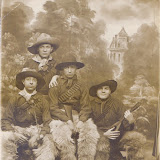
 The six photos here have all got to do with the American West and attempts to keep the legend alive, so let’s start in London, at the Fancy Dress Studio at 37 Oxford St, sometime between 1910 and 1920. One can forgive the English for getting a few details wrong; they weren’t there after all, and no real cowboy ever posed with a gothic manor in the background, but the woollen chaps? Somehow around the turn of the century the idea got about and then became fixated that woollen chaps were a standard part of the cowboy’s outfit. As we have come to understand things, chaps were worn by Native Americans and then by Mexicans as a way to protect the legs when riding through thick scrub. Wool, you’d think, would only attract thorns and burrs and make things worse. Another point you can forgive the English for because it was Americans who spread the idea, was that cowboys were bred musical. By the time this photo was taken you couldn’t dress as a cowboy without strapping on a gun and holding a ukulele. You get the impression real riders of the purple sage did nothing else except sit in the saddle and yodel at the cows. No wonder they complained theirs was a lonely life.


This image has it all, the cattle scattered across the wide open plain, the solitary cowpokes, the mesas in the distance. Welcome to Wyoming, battleground of the Johnson County War and close to the Hole in the Wall, legendary hideout of Butch Cassidy and the Sundance Kid’s Wild Bunch gang. We’re in the heart of the Old West, a time and a place that has passed, though you wouldn’t know it from the photo. Maybe you have to live in a certain part of the US, map-wise on the left side of Nebraska and Kansas, to believe that America was born in the west, but you’d have a lot of arguments on your side. From the moment its death was announced people have kept the Old West alive, a cottage industry of small town photographers as much as anyone. This scene probably wasn’t staged but it’s a fair bet the photographer knew that on a certain day the ranch hands would be moving a small herd of cattle a short distance, maybe to an auction, and drove out, knowing exactly what image he or she wanted and was guaranteed to get.


There are ghost towns all over the world but they have a special association with the American West, especially with gold and silver mines and dozens still litter the lower edges of the Sierra Nevada where the 1849 gold rush took place. The wind moans through the broken shutters, the tumbleweed bounces erratically through the dust. In the 1930s Buena Park berry farmer Walter Knott thought a way to expand business at the roadside stand where his wife Cordelia sold her fried chicken dinners and raspberry pies was to keep the customers hanging about, so he built a few attractions including a twelve foot high volcano and a mine shaft where diners could pretend to pan for gold. In 1940 he began buying up buildings and salvaging furniture, wagon wheels and implements from actual ghost towns around California and Arizona and trucking them in. Knott took pride in his research, making sure that every feature of his ghost town came from the period and it took two decades to complete. In the meantime it was a serious rival for Disneyland, just down the road.


 More singing cowboys … Out west, the early pioneers were told, was the land of opportunity, meaning that if you had an idea, the nerve to risk it and a little luck you could go far. In 1931 pharmacist Ted Hustead bought a small drugstore in Wall, population about 200 and just outside of South Dakota’s Badlands. The one thing the town had going for it was Mount Rushmore, 100 kms away and pulling in the tourists while it was still under construction. Hustead had a similar idea to Knott but on a grander scale, figuring that a department store was just what the middle of nowhere needed and a few life size models of dinosaurs would help draw the customers. He was right. Today the Wall Drug Store has an estimated turnover of $10 million a year. The animatronic cowboy orchestra was one of Hustead’s early strokes of genius and today it has a revered place behind glass.


 In 1937 Edward Weston came across a man’s corpse out in the Colorado Desert in southern California and photographed it. We’re not really sure what happened after that, whether Weston set off immediately to tell the police or if he wanted to whether he’d even know how to find it again. Such is life and if you believe the stories the deserts of the southwest were littered with the desiccated, vulture picked bodies of men who’d gone out to find something and only got lost. The grizzled old prospector wandering through the desert with only his mules for company is one of the classic images of the Southwest, so much that if you actually encountered one on the trail you’d know pretty much exactly where you were.


As the word suggests, rodeo was a Mexican invention and it didn’t become emblematic of the Old West until that was gone to dust. In the late 19th century rodeos were found all over the US but cities like Chicago and New York began to doubt their relevancy and soon they were mostly found in places where the myth of the cowboy needed to be kept alive, like Pendleton in Oregon, home to the Roundup established in 1910. At that time Walter Bowman ran one of the town’s photo studios and was little known outside its perimeters but in the early days of the Roundup he made his name with action shots like this, taken in 1912, at a time other photographers were struggling to photograph a Model T on the move. Talking of speed, Bowman was the first person in Pendleton to own a car and was once arrested for speeding at 12 mph down the main street. He was killed in a car accident in 1938.

WAY OUT WEST

Friday, 5 October 2012

BIGGER THAN TEXAS


 Exaggeration postcards by William 'Dad' Martin
 “Toto, I've a feeling we're not in Kansas any more.”
L. Frank Baum, The Wizard of Oz


 There’s a photo of William ‘Dad’ Martin floating around the Internet. He is wearing a battered Civil War style forage cap and is cross-eyed. In other words he looks like the village idiot. But he can’t have been that silly. Within a year of hitting on the idea of constructing his first photographs featuring giant rabbits, corn and other agricultural products, each real photo postcard he produced was selling in the tens of thousands. At a time when most studios in New York were just getting by and serious art photographers couldn’t think of their work in terms of sales because they were so meagre, he was the most successful photographer in the US, and he was working out of Ottawa, Kansas, a town that wasn’t much more than a main street. Maybe that’s what the boggle eyes and the dopey expression are all about. Maybe they are pointed at those people up north – meaning New York and Chicago – who thought Kansas was inhabited by inbreds and other simpletons. Martin may just be saying, ‘everything you believe about us folks out here is true. Just ask my accountant’.


Even though he is usually described as being a photographer before he began creating his postcards, there doesn’t seem to be much or any of Martin’s earlier work around. Like a lot of small town photographers he could have left off identifying stamps, or more likely the popularity of his exaggeration postcards led him to neglect the standard studio work and the old negatives were sold off, destroyed or left to rot in a shed somewhere. He must have been a photographer in his early years. While imagining the scenes in his postcards was easy enough, creating them took skill only someone with considerable darkroom experience could have pulled off.


 It wasn’t just his darkroom skill you have to admire. His attention to detail was scrupulous. In this image the ribbons on the girl’s bonnet as she squats on the running board are stretched out and her father is hunched forward as though the car is travelling at high speed. The top speed in the best cars at that time was about 40 mph, which may have been fast enough to flutter her ribbons, especially if the car was pointed into a breeze. Still, if it were really travelling that fast the spokes on the tyre would be a blur. The point is, when Martin set up the scene he understood that what made the image really funny wasn’t just the giant eggs and the potato on the back; it was the idea that the family would drive helter-skelter into town to sell their produce, the daughter hanging bravely off the car as it churned through a puddle. That puddle, obviously added on afterwards, is one of the few examples where Martin couldn’t get things precise. 


The humour in the detail comes through in this one too, where the watermelon has fallen off the wagon and split. Lesser operators, and in the years following his success there’d be a few, rarely thought the scene through that carefully. How Martin achieved it was fairly straightforward. He took a photograph of the farmer on the road with his broken wagon and one of the melons and spliced them together. Even so, examine his postcards under a magnifying glass and only a few show the seams so to speak. 


Another reason why he was the most superior of the exaggeration postcard creators in rural America was the sense of movement he brought to each scene. Here’s one by the Rotograph Co that is excellent in the care with which it has been made yet static compared to Martin’s scenes. In the one below, the hunter at the front slouches as though carrying a heavy load, (which he obviously wasn’t when the photo was taken) adding to the credibility of the scene. This one (of the giant ear of corn) is copyrighted 1907, at least a year before Martin started producing his cards. So he wasn’t the inventor as is often claimed but then he didn’t have to be. Comparing his to this, it’s clear he brought an energy and sophistication that hadn’t existed before.


Sophistication sounds like an odd word to use for Martin since the humour isn’t exactly subtle or restrained but it is carefully orchestrated and he knew all the jokes about rural Midwesterners, milking them for everybody else’s benefit while turning them on their head. Eight years earlier L Frank Baum had written The Wizard of Oz, a huge success critically and publically. To transport Dorothy to the fantastic world of Oz he needed a starting point and so he chose a place he had visited for only one day - two at most - yet appeared to be the dullest place on earth; “the dry, grey place you call Kansas”, as the scarecrow describes it to Dorothy. That seems to have been the general opinion of the state; flat and dull and running on a clock several hours slower than civilization desired. Martin understood that. Most of his farming folk don’t seem too bothered by time but if you were growing the world’s biggest cabbages would you need to be? So was Martin responding directly to Baum? There’s no proof though he is clearly taking aim at the attitude towards Kansas that Baum typified.


Interesting … When you read a lot in a hurry you tend to take things for granted, like the idea that Martin basically took two photographs and combined them. But look at this photo of the wagon loaded with giant cabbages and the one at the very top with the giant mules. Notice something similar? Look at the man leaning against the mules (or horses) in this photo and the man standing at the front of the wagon in the top photo. He’s one and the same. It seems Martin didn’t use just two photos as several commentaries suggest but several to make his images. In that sense he was a direct descendant of Oscar Rejlander, whose best known example of combination printing is The Two Ways of Life from 1857, involving 32 montages photographs. The difference is that Rejlander could have taken just the one photograph but artistic sensibilities of the age compelled him to make his job difficult. To make his vision of rural America work Martin had to go to just as complicated lengths. Another one of these people who didn’t invent anything yet was an original.

VIEW THE GALLERY HERE
BIGGER THAN TEXAS

Saturday, 29 September 2012

BLACK MISCHIEF


Stereographs from the 1931 Colonial Exposition in Paris.

"Colonization is legitimate. It is beneficial. These are the truths that are inscribed on the walls of the pavilions at the Bois de Vincennes."
Marcel Olivier, Delegate general to the 1931 Colonial Exposition


It was the last, and if size means anything the greatest colonial exposition, and it was in Paris in 1931, which was fitting because the French had really invented the idea of the world fair devoted to colonial power and all that entailed; civilization, power, human zoos. Spread across the 1000 hectares of the Bois de Vincennes, Parisians called it Lyauteyville after Marshall Hubert Lyautey, who ran the whole show and knew a bit about colonialism having served in Algeria and Indochina, led the 1902 invasion of Madagascar and been Governor of Morocco for some thirteen years. The nickname is revealing. Outside of the military Lyautey was considered as something between an imperialist throwback and a megalomaniac. He never hid his political belief; he would die in three years but not before boasting he was on the verge of overthrowing the socialist government with his cadre of young fascists. You could say he was the perfect man for the job of running the exposition.


The key to success for any world’s fair lay in its architecture. It was the expression of everything the event stood for. Pushed for time and money, the directors of the 1893 Columbian Exposition in Chicago made the sudden decision to render all the buildings white. Knowing nothing of their motives, visitors were astonished at how modern and visionary everything looked. Each expo had to have its centrepiece, the Crystal Palace in London in 1851, the Eiffel Tower at Paris in 1889 and the Colonial Exposition would have its own, a seventeen metre high cascading fountain built of steel that was soon labelled ‘le cactus’.  That single nod to the 20th century aside, Paris’s leading architectural firms were called on to built faithful copies, of grand monuments such as Angkor Wat but mostly more traditional structures such as a Buddhist temple, a mosque or a street in Tunisia. You can come up with a few reasons why that was but you can’t discount lack of imagination. The effect wasn’t that different from the claims made for early stereographs; you didn’t have to go to Senegal or Laos to experience it. Of course you couldn’t smell Senegal or feel the tropical heat of Laos but you weren’t going to catch blackwater fever either.


By 1931 colonialism was a disreputable word across Europe. You could thank King Leopold of Belgium for that; no other single person did so much to stain the concept, but World War 1 had also made a lot of people aware of how rotten the heart of the aristocracy was, and now the international economy had collapsed it didn’t take complicated arithmetic to work out that the loudest supporters of empire were also responsible for the mess the continent was in. The French Communist Party reasoned it could respond to the Expo with its own it called La Verité sur les Colonies. It turned out to be only a little more popular with the general public that it was with the authorities. That may have been because instead of fake Asian temples, exotic dancers, food stalls and bars it would run a series of panels and lectures dedicated to racism, slavery and other forms of exploitation. What humour the left had was provided by L’Humanité, the only Parisian newspaper consistently critical of the expo. It published heavy handed cartoons showing Lyautey on display in a cage and a circus woman standing over the expo entrance, a guillotine. The African and Asian students liked the idea of an alternative expo but the government jailed most of their leaders until the real one was over. Another problem was that La Verité sur les Colonies was getting a lot of its funding from the Soviets so it was inclined praise the workers’ paradise while ignoring reports of Siberian labour camps. All up it was dismissed as a failure, except by a group of African and Vietnamese students who came away convinced that the future for their countries lay in Marxist theory.


Meanwhile back in the real world, or what passed for that in the Bois de Vincennes, the architects had discovered that it wasn’t so easy to build faithful replicas. Size was an issue; some great monuments – Angkor Wat was one – would have swallowed up most of the park grounds while others couldn’t be accurately reproduced without resorting to construction methods that were either lost to time or required such attention to detail that the buildings wouldn’t be finished until long after the expo had also faded from living memory. In the end it would become a compromise; sun baked mud replaced with quick drying plaster and intricate sculpturing with readymade moulds. It wasn’t a complete disaster. The Tunisian village was given a careful patina of decayed and crumbling brickwork and if the Parisians let themselves they could just about imagine they were in North Africa; just about because as every architect knows a city is made of people and the Tunisians in this village were for display purposes only.


One of the visitors during the opening weeks was the Belgian cartoonist Georges Remi, there with his parents and his girlfriend who constantly moped because he was more interested in sketching than paying attention to her. As Hergé, Remi was barely known outside of Belgium but his second Tintin adventure, Tintin au Congo, was just weeks away from publication in Le Petit Vingtième. It was too late then for any claims the expo had any influence on Tintin au Congo but it would have its effect for years afterwards. The sketches weren’t a waste of time. As Tintin flew around Asia, the Middle East and Africa they would provide the basis for street scenes and buildings, Hergé instinctively knowing we’re inclined to recognize something authentic in the fake while the real often disappoints.
In the 1970s Hergé would confess his depictions of Africans were naïve (not in time to stop the book being banned in British libraries) but after June 1931 any French or Belgian boy visiting the expo had his impressions of Africa from Tintin au Congo confirmed.


For Lyautey and his committee the expo was intended to be proof that colonialism was a mutually beneficial transaction. We took the minerals and the agricultural products but we gave back education and modernization. That was an argument the communists could have shot down without trying, but they wouldn’t necessarily win public sympathy. Colonialism might have brought to mind images of slavery but empire was a word that could still get people standing to attention with their hands over their hearts. You can see all of that in the cyanotype stereographs taken of the expo at night. They transform ancient ruins into 20th century monuments; Had Angkor Wat ever looked this spectacular? For sure, nobody who actually lived there ever saw it lit up against a backdrop of searchlights.


One another thing about these photos: according to reports the expo was pulling in crowds of 60 000 a day. So where are all the people?

1931 Colonial Exposition, Paris