And furthermore ...

One Man's Treasure encourages the use of anonymous photographs posted here to illustrate books and album covers.
If an image appeals to you, contact John Toohey at johntoohey@hotmail.com.

Saturday, 25 September 2010

ORIENTALISM REDUX

Turkish Orientalist Images


“It is part of morality not to be at home in one's home.”
Edward Said


His central thesis of Orientalism being that the Orient - specifically the Islamic Middle East - was a European invention; Edward Said had no shortage of evidence to make his point. Descriptions of Constantinople by 18th and 19th century quickly become tiresome in their use of every cliché available. It was dirty of course, sinister, bustling, primitive and so on, and its allures belonged to the senses. One smelt, one heard, one saw, inhaled, drank in and so forth, etcetera. Describing a wizened Jewish book dealer in the bazaar or a fat, lugubrious merchant was enough to convince readers the author had actually been in his presence and probably smoked opium in a dingy bordello. 


Said was most interested in literature and didn’t consider photography, which was a small oversight because European photographers generally sought to confirm all the stories were true. The beggars were grotesque, the streets dangerous mazes, the women sultry and mysterious. It was all grist for the mill and no one was about to deny the proof that photographs laid before their eyes. Orientalism was the first book to give intellectuals the base to really shift defence into an attack. These days, ‘orientalist’ is a slur with a different resonance in Istanbul than it has in Western Europe.


But there’s a problem. If the Orient was really a creation motivated by European hegemony, where do the photographs employing Orientalist imagery that Turks took fit in? Are they evidence that people were so subjected to Western ideas they could only imagine their culture according to European rules, or was Said’s theory blindsided by its own vehemence? Could self-deprecating humour have nothing to do with what others thought but be a part of how people regarded themselves? Could it also be a form of resistance?


If the image of Turks as lazy, dishonest, saturnine and slippery didn’t originate with the people themselves, like a lot of cultures they have always been their own harshest critics. That said, the arsenal Turks draw on to make fun of themselves is the same that Said railed against; Western stereotypes. The arrival on stage or screen of an obese slob with a flourishing moustache is always the signal for the laughs to begin. The appearance of his girlfriend, sultry and conniving in her belly dancing costume, makes the performance a real riot. It’s dumbass humour for sure but the point is, if what people were laughing at was, as Said would apparently suggest, two European stereotypes entrenched with racist attitudes, then logically Turks are incapable of discerning when they are being mocked. If instead they subverted that image then what they are laughing at is something of their own creation. Edward Said was noted for several things but not his sense of humour.


All the photographs in this post show Turkish people making fun of the Orientalist idea. In one small way or all of them challenge Said’s thesis.


ORIENTALISM 2

Thursday, 16 September 2010

MYSTERY TRAIN


Trains in photographs

Winding up the valley to the watershed,
Thro' the heather and the weather and the dawn overhead.
Past cotton-grass and moorland boulder
Shovelling white steam over her shoulder,
Snorting noisily as she passes
Silent miles of wind-bent grasses.
W H Auden; Night Mail


As plot devices go, the train remains foolproof. Put a group of characters in an enclosed space, but one they can move through, between carriages and compartments, and have that enclosed space itself travel through landscapes and across borders. Best of all the train represents a journey; between departure and arrival a story unfolds, some mystery is solved and a dramatic encounter reconciled. The English loved the Orient Express; Agatha Christie, Graham Greene and Ian Fleming put their characters on it, the Americans preferred shorter journeys but both recognized the importance of the dining car. This was the place where secrets were revealed, over a bottle of fine wine and an excellent steak. Film makers also loved the image of the train at the station, belching steam as its mechanical parts grinded and screamed. It was a pawing bull, a beast of incredible force. So far as metaphors go, one of the best was delivered by Gabriel Garcia Marquez In 100 Years of Solitude when he described the arrival of the first train at the village as ‘a kitchen dragging a village behind it’. 


In the real world trains are more functional. One settles in a seat and rarely leaves it, the food in the dining car can be as bad as it is expensive and toilets are too often the stuff of nightmares. Still, the train evokes the idea of the journey much more poignantly than the bus or the aeroplane. It offers a possibility that something might happen on board, that we will arrive at the other end changed in a way. Even the act of saying farewell at a train station has a certain melancholic romance to it. Perhaps because the farewell can be prolonged, we can see one another till the end and we know that when the train pulls away one will walk down the platform alone, the other will settle into the compartment and what; open a book or newspaper or stare out at the industrial wasteland that always seems to cocoon train stations?


The births of the locomotive and the camera were close enough for us to consider them contemporaries. In aesthetic if not actual appearance they have always mirrored one another, from the massive, clunky machines of the mid 19th century to the beautiful, streamlined creations of the 1930s and 40s. There was a sense that both represented the spirit of their times. When the Transcontinental Railroad was built to join Omaha and San Francisco in the 1860s teams of photographers were sent out to document its progress. They didn’t set out to tell the story of its construction, rather its scale; a massive venture involving thousands of workers, millions of dollars and various other record breaking statistics that pen and ink could never do justice to.


For all that, photographers have mythologized the road trip but the chronicling of train journeys has largely been the province of writers and filmmakers. Despite some brilliant cinematography in documentaries like the GPO Film Unit’s Night Mail and Jean Mitry’s Pacific 321, it’s hard to think of a single extended photo essay set on a train where travelling is the point (Paul Fusco’s Funeral Train was concerned with the journey of Robert Kennedy’s coffin and the mourners lining the track). That seems remiss. Cars do have the advantage that they can be stopped when the photographer wants to spend time capturing a scene but the train has been every bit a part of our cultural experience as the car.


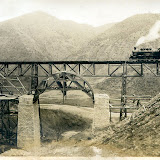
With the exception of the first photograph, one from a series of images documentation the construction of a Turkish railway, the photographs in this gallery were taken by amateurs.

VIEW THE GALLERY HERE
MYSTERY TRAIN

Thursday, 9 September 2010

CIRCUS WORLD

19th century cartes de visite of circus performers


“Most people go through life dreading they'll have a traumatic experience. Freaks were born with their trauma. They've already passed their test in life. They're aristocrats.”
Diane Arbus

Rosalia Griffray, circus fat lady, J Plessix, Lisbon, C1860s


The marriage of General Tom Thumb and Lavinia Warren in February 1863 was good for Mathew Brady. The photographer sold some 25 000 cartes de visite of one image alone, not to mention the dozens of others he’d taken of the two dwarves and could reprint. It was also good for less scrupulous studio operators who bought the carte, re-photographed it and sold it on for much less. The wedding was one of the biggest social events of the year and though we can proffer explanations for that – America was in the second year of the Civil War, people needed levity – one seems so obvious that all others can be passed off as asides. Circus freaks fascinated people. Customers paid good money to stare at a giant, a fat lady or Siamese twins. Just why is a question with so many possible answers, most of which we already know, that to pursue it is pointless. Suffice to say; in the 1860s the circus freak was a commodity with its own extended market. Photographers were just one section that stood to make money from the exhibition.

Commodore Nutt and Minnie Warren, probably copy of E Anthony original, C1860s


As commodities went, the carte de visite of the circus exhibit was reliable, the evidence for that being the number still circulating today. Mostly they followed exactly the same format as for actors. The performer wore a costume and fronted the camera to leave no doubt who or what they were. A midget or dwarf, ideally dressed in some form of livery, might stand next to a table or chair just to give a sense of proportion. That was an important detail. Such staging reinforced the idea the circus exhibit was a performer first, an outcast after that. 

Circus performers, Bradley & Rulofson, San Fransisco, C1870s


Whether there were people who actively built up collections of circus freaks and what kind of people they were are probably the two most interesting questions. Were they like collectors of Civil War photos today who measure the value in their collection by its scope and detail, or were they more like collectors of erotica who lust (yes) after the single image and often make no distinction between art and pornography? Possibly, but they could also be more like modern day collectors of 19th century ethnographic images who can see the colonial racism built into the image, reject the principle behind it yet acknowledge that’s a point that makes the photograph so compelling. There are records from the mid 19th century of people collecting medical photos, which tended to emphasize the most grotesque examples of a disease’s manifestations; vaguely aware that what they were doing crossed the boundaries of good taste. There were also popular sub-genres, CDVs of executed criminals for example, which were openly displayed in shop windows. The evidence indicates that in the mid 19th century people were generally inured to the macabre in photography. The circus freak was a curiosity and a moderate one at that.

Circus midget, De la Chaproniere, Calais, C1870s


In August 1883 the New York Times reported that circus exhibits in the US were attempting to form a trade union. The Freaks Protective Union demanded a fixed pay rate and hours (some were being exhibited for 16 hours a day, seven days a week), in other words, much what every union was demanding for its members. The author couldn’t resist an attempt at humour, noting that the only people not asking for three meals a day were the living skeletons and wondering what a protest march through the streets would look like. The most interesting detail in the article was that certain exhibits were being denied membership. Circassian ladies, tattooed people, anyone who could manufacture their image would not be admitted. Even a small and hermetic fragment of society had its hierarchies. It also indicates a certain defensive insolence on the part of circus exhibits who were there because of some genetic malfunction. Theirs was in the end an exclusive club. Those body artists who attempted to get in by applying ink to their skin or frizzing their hair were mere pretenders. They were like the nouveau riche attempting to hobnob with the aristocracy. 

One legged castanet player, T A Naumann, Liepzig, C1860s


Whatever progress the union made, it appears to have lost the interest of newspapers and the public soon after.  Photographs of circus performers never did. By the late 1960s, early 1970s, when the idea of exhibiting circus freaks became socially unacceptable, the curiosity value in old photographs started to kick in. People discovered that scattered among the portraits of middle class Europeans in their top hats and hoop skirts lay other images that cut away the idea of a staid and prim society. Today the carte de visite of the circus midget or the fat lady in every bit as desirable as it was when it was taken.

Siamese twins, T A Beach, Ohio, C1870s