And furthermore ...

One Man's Treasure encourages the use of anonymous photographs posted here to illustrate books and album covers.
If an image appeals to you, contact John Toohey at johntoohey@hotmail.com.

Sunday, 31 January 2010

ON THE BEACH


Beach Snapshots, 1910 – 1950s

The sea rises, the light fails, lovers cling to each other, and children cling to us. The moment we cease to hold each other, the moment we break faith with one another, the sea engulfs us and the light goes out.
James Baldwin

Switzerland doesn’t have a beach. Neither do the Czech Republic, Hungary, Turkmenistan, Chechnya, Laos, Chad, Zimbabwe and Botswana, for starters. The people from those lands never know what it means to gaze out across an empty sea and contemplate its space, which is the same as meditating on life’s alternatives. More, or worse, than that, they never feel the erotic charge of the beach. It’s not something to be discovered on a rare trip to the seaside. It has to be deep in the psyche and so intrinsic as to be taken for granted. People who grow up with the beach head off each summer to be semi naked with thousands of others, drop their pretence at being adults and return to that primeval state where they splash and scream like little children. The next day they knot their ties, polish their shoes and go to work where they assume a mask of mature, responsible dedication. It’s not wildly different from the medieval carnivals where, for a few days each year, the citizens went into a carnal frenzy before the church bell tolled the return to normalcy.


Some time ago, a film maker discovered that one way to let the audience know the actor was in a profoundly melancholic mood was to have him or her walk alone up a deserted beach. Even the Czechs and Laotians who had never seen the seaside understood what was going on. Today in Turkey, the land of the hyperglycaemic video clip, it’s like Mum’s recipe for baklava; no need to change what’s always worked so well. Thing is; most of us beach dwellers have at some time found ourselves on an empty stretch of coast, pondering life’s sharp turns. It draws us, especially when the circumstances demand a particular, self-absorbed sentimentality. It’s no good, for example, if a real tragedy has occurred. That requires serious grieving, ideally in a small, enclosed space like a bedroom. The beach is the place to go when that brief relationship we both knew was flawed has come to an end. The questions we ask are rhetorical because we know the answers very well. Answers aren’t the point anyway; it’s the emotion. In other words, we may be feeling down and philosophical but we’re still enjoying ourselves, enormously.  


Technically, the beach is the worst place to take a camera. Sand scratches the lens, salt air is corrosive and seawater can rust a camera in a matter of hours. Still, we must bring it along. The beach is one of our ritual zones, a place we can behave in ways we can’t anywhere else and if we don’t have the camera to record the moment it could be lost forever. These photographs come from Turkey, Australia, Britain, the USA and a Melanesian island and were taken between 1910 and the 1950s. They prove that no matter where we come from, when we get to the beach we behave the same ways, and the only thing that has changed in the last 100 years is the swimsuit.
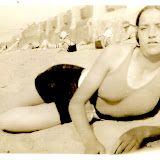

ON THE BEACH

Thursday, 28 January 2010

THE OWL AND THE PUSSYCAT

Studio Boats

The owl and the pussycat went to sea
In a beautiful pea green boat
They took some honey, and plenty of money
Wrapped up in a five pound note

Edward Lear, 1871


The beautiful pea green boat the owl and the pussycat set out in came from a photographer’s studio. The boat Edward Lear drew for the 1871 edition of Nonsense Songs and Stories has a high curved bow and stern and barely enough room for two small animals and a pot of honey. But what other vessel would a bird and a cat use? Lear’s poem has a dream’s logic and clarity. One could say the same about photographs of people in studio boats. At first glance they are ridiculous yet the very best of them have a poetic sensibility. In A. Caccia’s image, the girl wears a soporific expression as though midway through her sleep the boat has glided to the still water’s bank. It’s a verse from a poem, if not by Lear then Lewis Carroll.


The concept of using a boat as a studio prop is so idiosyncratic that one person must have come up with it but while their name is lost, the idea spread so quickly that examples from the 19th century can be found across the world. From small town America to Cairo, Egypt, in Sydney, Tokyo, Norway and New Zealand, people stood or sat behind a painted effigy and held an oar out while the photographer fussed under the black cloth. The idea most probably originated in a seaside resort like Blackpool or Nice in the 1860s, about the same time studios were learning the tricks of montage and double exposure so that they could photograph the subject, retreat to the darkroom and emerge with a print of him or her standing somewhere else in the world.


Studio boats were cheap and easy to construct. An actual boat could be used but a stage set worked just as well and if the studio’s finances were stretched, hay or wool could pass for water. The backdrop only had to suggest clouds or a distant shore. Around resorts it helped to give a sense of location, a local feature or the shoreline for example. Ironically, the actual scene was often just outside the front door.


Clearly, customers agreed with photographers that studio boats were a great gimmick, which brings us to one of the great mysteries in these images. Why do so few people appear to be enjoying themselves? Usually they look a little bored but sometimes they are quite disturbed, as though afraid the little boat is about to capsize. Was a session at the photographer’s really fun, or was it one of those obligations one had to endure on holiday, like watching bad comedians at the music hall?


Studio boat portraits occupy their own, neglected place in the history of photography. They are too popular to be art but they employ the same contrivances and though they are portraiture the sitters are highly fictionalized. They subvert the idea that a photograph is a record of truth but they don’t quite represent ideas. They are kitsch, but sooner or later everything popular gets that label.

View the Gallery Here
THE OWL AND THE PUSSYCAT

Monday, 25 January 2010

THE EYE OF THE BEHOLDER


The Snapshot Aesthetic


 When OMT first picked up a camera with serious intent, back in the very late 1970s, he quickly discovered the work of Lee Friedlander, Diane Arbus and Gary Winogrand. It was a revelation. Good photography had nothing to do with the textbooks. It wasn’t bound by strict rules of composition and a great image could be domestic and banal. Even better, he didn’t have to learn tedious lighting and darkroom techniques. The important thing was to respond to a scene, preferably with irony or aloofness. The end result for our budding snapper was about two years worth of utterly boring photographs and a lesson learned too slowly. The apparently casual regard for rules of composition by photographers in the 1960s belied a deliberate, studied approach. As so many gunslingers discovered too late, shooting from the hip takes practice and Friedlander’s haphazard compositions were never as accidental as they first appeared. To be artless is easy but to appear that way takes effort.


Whether they wanted to be or not, Friedlander, Arbus and Winogrand were associated with the last formally declared art movement of straight photography. Given several names, the most resilient is the ‘snapshot aesthetic’. It followed certain, traditional laws of art movements in that it returned to old values while subverting them, in this case, amateur snapshots. That at least was the thinking behind the ‘New Documents’ show at the MOMA in 1967. None of the photographers exhibited seems to have disputed the association with snapshots though they would have insisted that their work was more considered. It had a point.

The snapshot aesthetic occupied a non-state. Emotions were at best enigmatic, the subjects ideally caught, to quote Lou Reed, between thought and expression. Their actions were unresolved and they looked out of place in their environment. The viewer meanwhile was not always certain of where to look. Roland Barthes’ punctum wasn’t always evident, or if it was it was the wrong detail. 


The photos in this week’s gallery anticipated the snapshot aesthetic. They were, with one exception, taken in Turkey, during the 1940s and 50s but they share some of the uncertainty and misplaced tension in Friedlander and Arbus’ photographs. The similarity is usually coincidental though in a few it appears the photographer attempted something and fell short, accidentally leaving us a glimpse of the future. Such serendipity reinforces one of the fundamental elements of photography. It isn’t that anyone can take a good photograph (true enough) but we can all take photographs that suddenly reveal mysterious symmetries and hidden contexts. We can’t all be artists but we can be poets.

View the gallery here
SNAPSHOT AESTHETIC