And furthermore ...

One Man's Treasure encourages the use of anonymous photographs posted here to illustrate books and album covers.
If an image appeals to you, contact John Toohey at johntoohey@hotmail.com.

Saturday, 9 July 2011

FUZZY LOGIC


 Why do we hate Pictorialism?


"I don’t know anything about art, but for some reason or other I have never wanted to photograph the way you paint.”
Alfred Stieglitz


 “Pictorialism,” the narrator of the BBC’s 2007 series, The Genius of Photography declared, “was photography at its most po-faced.” Well, yes, but so what? Artists frequently take themselves too seriously and become the butt of jokes. The Pictorialists were a sombre bunch. They also believed they were at the vanguard of modern art when what they produced often looks to us like cheap copies of the worst that came out of the academic painting salons. Still, dismissing them as dull and humourless is unfair; a little like saying that Dostoevsky would have been a great writer if he had cracked a few more jokes. He didn’t so regretting their absence is beside the point.


One problem with Pictorialism is that it very quickly became associated with a handful of categories, landscapes and nudes especially, as though art was still about natural beauty at a moment when genuinely progressive artists were thinking about machines and technology as the defining characteristics of the future. Another is that it outlived its welcome by much too long. Into the 1940s and ‘50s some photographic magazines still judged the artistic qualities of photographs on their Pictorialist elements. It’s hard to look at some of that work now without wondering if there was a deliberately perverse decision to stay behind the times. A third problem is that it was never about revealing some essential truth in the subject. That idea is perfectly acceptable now but during the Pictorialist era the entire point of photography was it revelatory power. Even the rawest Kodak amateur in the 1890s seemed to be saying more about the real world than the most seasoned Pictorialists.  


The really great thing about Pictorialism is that 20th century modernist photography couldn’t have existed without it. Most of the Americans who became associated with Modernism; Alfred Stieglitz, Paul Strand, Alvin Langdon Coburn, Gertrude Käsebier etc, began as Pictorialists and the shift wasn’t that profound or disruptive. A more obscure photographer to look up is Marjorie Content, whose work from the 1920s comes from the moment one movement was evolving into the other. It’s as though a fog is lifting and the world is gradually coming into focus.


There are some classic examples but no great Pictorialist works in this gallery. Not surprising really; although quite a few historians dismiss Pictorialism as conservative, authoritarian and vapid, they’ve obviously had little influence on the art market. The 2006 sale of Edward Steichen’s The Pond – Moonlight for nearly 3 million US broke records and inevitably dragged up the value of his contemporaries. No one really believes the upper echelons of the art market are inhabited by people of good judgement and taste but they do have power and they have decided that Pictorialism really matters after all.
PICTORIALISM

Saturday, 2 July 2011

THE SWIMSUIT EDITION

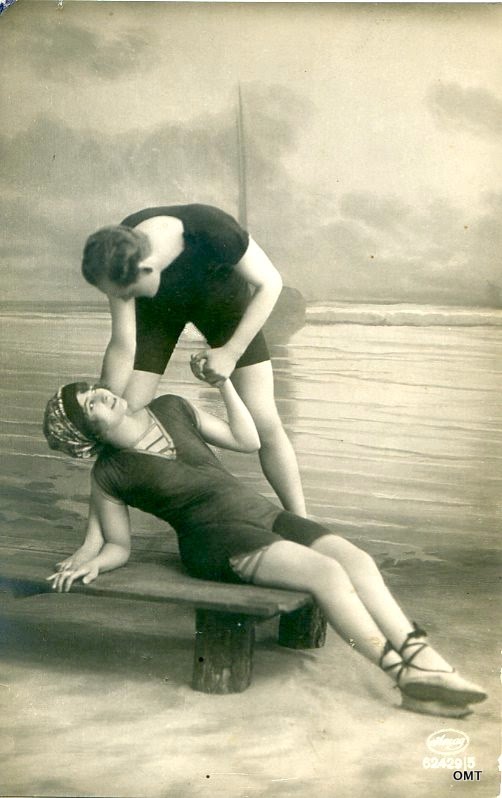
Edwardian photo postcards of women in bathing costumes


“There are two kinds of bathing suits, those that are adapted for use in the water, and those that are unfit for use except on dry land. If you are going to swim, wear a water bathing suit. But if you are merely going to play on the beach and pose for your camera friends, you may safely wear the dry land variety.”
How to Swim, Annette Kellerman, 1918


In the summer of 1898 Paul Martin was wandering along the crowded Yarmouth beachfront with what looked like a box wrapped in brown paper. Every so often he’d stop, idle about then continue on, barely noticed by anyone. The box was actually a camera and he was after candid shots of the holidaymakers. What he caught on film should put to rest any notions the late Victorians were a prudish bunch. He caught dozens of couples groping in the sands, inevitably still wearing their suits and skirts but unabashed in their pursuit of flesh. The British seaside was a place where social mores were suspended. People could be themselves or, if this was what they really wanted, someone else; Still a timid bank clerk or a straitlaced domestic perhaps but let off the leash. No one cared, or if they did not too many were listening to their objections.


Go forward a few years. Victoria is dead, Edward is King and bank holidays at resorts like Brighton and Blackpool have become part of Britain’s cultural identity. In France people head to the Mediterranean. The beachfronts already have somewhat salacious reputations and many of them have partitioned areas where ladies and gentlemen may stroll without needing to encounter more unruly citizens. The postcard has taken off and some of the most popular are comic pictures of fat men and women at the seaside mouthing bald double entendres. Certain resorts like Brighton are notorious as places to conduct affairs and private detectives can make some easy money tracking errant husbands or wives. The seaside is one place where a woman may appear showing her bare upper arms or her legs below the knees. Heady stuff and no wonder there is a market for real photo postcards of young ladies in swimming costumes.


Sharp-eyed observers will note none of the women here are actually at the beach. The term ‘fashion photography’ didn’t exist in 1910 although fashion photography itself did, albeit with picture editors still using photographs as the basis for pen and ink sketches. Fashion as it was understood belonged to the privileged. Only the well off could afford the dresses and accoutrements that people like Leopold Reutlinger photographed. The rest had to do make do with cheap copies but they could probably afford a swimsuit. During the Edwardian era it was woolen, loose and covered the upper arms and just above the knees. Since women weren’t expected to swim but sit in a wooden bathing machine that washed seawater over them, you could say it was adequate. Although segregation of swimming areas had ended a few years earlier and the bathing machine was being phased out, for some men these postcards were the closest they’d get to seeing a woman in a swimsuit. Photographers were cluing on to a principle of fashion photography. The market wasn’t gender orientated. Put a young lady in a swimsuit, the women would admire the costume, the men her body and everyone could appreciate the photographer’s good work.


In particular ways these postcards already resemble the fashion photography of the 1940s and ‘50s much more than they do the era that immediately followed them. During the 1920s and ‘30s the ideal model was a creature of high and unreachable elegance, enhanced by dramatic lighting that cast parts of her face or figure in shadow and usually provided the background too. Postwar she descended earthwards, a little, and might be photographed at a suburban cocktail party, playing tennis or at an actual beach. The lighting was flatter and the settings more adventurous. You can’t trace a direct line between these postcards and the work of photographers like Richard Avedon but you could say they share elements that had been neglected in the interim. There is so much in these images that became integral to fashion photography they would have to be included in any authoritative history of the genre, which, when you think about it, is strange. Somewhere in the dim and foggy place where fashion photography was born there is a link to the shameless behaviour of the unsophisticated at the British seaside.

VIEW THE GALLERY HERE
THE SWIMSUIT EDITION

Saturday, 25 June 2011

BOYS WILL BE BOYS

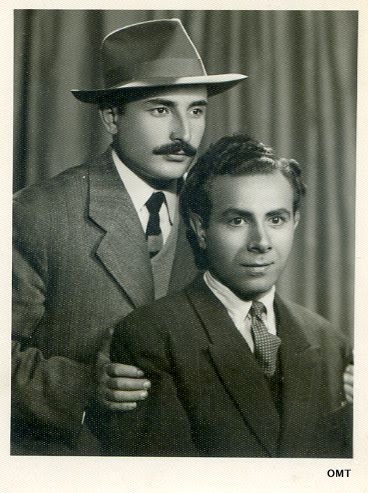
Some wallet sized studio portraits of men 
”Men are all alike – except the one you’ve met who’s different.”
Mae West


What if back in the mid-1970s a Turkish record producer came up with a concept that would take disco out of the clubs and on to the top 40, a boy band for people who’d lost their innocence a while back? The five men fronting the group would be professional performers, not specifically singers, dancers or actors but a bit of all three. Forget art, this would be theatre. The performers would dress as Turkish stereotypes and everyone would get the irony immediately. Even old conservatives fundamentally opposed to the notion of gay men dressing up as Turkish stereotypes wouldn’t be able to stop themselves humming the tunes and practising the steps in front of the mirror. One of the performers, probably the front man, would be an Ottoman gazi or pasha (though a tea seller would suffice). Wearing a fez and a ridiculous moustache, he’d punch the air and twirl about as he led the anthemic chants for the other four. He might be centre stage but he wouldn’t necessarily be the star. The genius of the concept was that the audience always had their personal favourites.


Among the other four one had to be an army officer. Impeccably dressed down to his Sam Browne belt and jackboots, he’d represent that schizophrenic relationship Turks had with their army; part selfless defender of the borders, part instrument of dictatorship. When it came to minorities the producer needed to tread carefully. Some people had no sense of humour and might respond with bombs. Having someone dress up as an Arab could work. It acknowledged the imperialist past and think of him not as an Arab but as Peter O’Toole in Lawrence of Arabia and even the Arabs would laugh along.


Who was left? A policeman? There was already the army officer and the uniforms not to mention the political implications were already too close. A construction worker? No one would get that. How about a gangster of some description? By the mid-70s a fair number of real life gangsters were convinced they were living the dream, part Michael Corleone, part Little Caesar and besides, at that time people the world over believed gangsters were swarthy Mediterranean types. The last member of the group required some deliberation. How about an athlete? In the mid-70s Turkey didn’t have an international reputation for excellence in many areas but it had produced a succession of wrestlers and weightlifters who were more agile and could lift a lot more than anyone else around. Let the Americans triumph at short course running events, how many of them could raise twice their weight above their heads and hold it there? Put one of the performers in a wresting costume and it was like putting a beret and a handlebar moustache on someone and calling him French.


In the middle of the last century especially it was common for people to go to a studio to have their portrait taken, get a dozen or so prints that they could put in their wallet and distribute to whomever they thought required them. The idea was to get an image that distinguished the sitter’s individuality, or in other words their better side. What we end up with however are images that correspond to stereotypes. Maybe Jack Nicholson was right, there really are only twelve types of men on the planet, or possibly people in these photos look like stereotypes because that is the easiest reference point we have for them. One of the men in the gallery looks like a cross between a young Phil Silvers and an insurance salesman from Midwest America (hat, glasses, pin on lapel). There might not be a place for him onstage with the group but he’d make an excellent PR agent.  It’s one of the strange things about these portraits; we always feel like we already know the person.

VIEW THE GALLERY HERE
BOYS WILL BE BOYS