And furthermore ...

One Man's Treasure encourages the use of anonymous photographs posted here to illustrate books and album covers.
If an image appeals to you, contact John Toohey at johntoohey@hotmail.com.

Tuesday, 23 March 2010

GREAT EXPECTATIONS


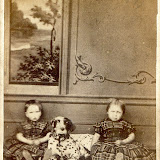
Photographs of children from the Victorian age

“He walks shockingly and is dreadfully awkward, holds himself as badly as ever and his manners are despairing, as well as his speech, which is quite dreadful. It is so provoking as he learns so well and reads quite fluently; but his French is more like Chinese than anything else; poor child, he is really very unfortunate."
Queen Victoria describing her son, Leopold, in 1859

I had a kind of Dickensian childhood.
Shaun Cassidy


Pity Lewis Carroll. It is his tragedy that no one can discuss him without raising the spectre of paedophilia. A tragedy because the evidence is unresolved so it continues to haunt his reputation; tragic too because people are inclined to read a sinister eroticism into some of his portraits merely because the subject is a young girl. And it gets worse. What is often deemed dangerous, at least unsettling, in Carroll’s portraits could be nothing more harmless than girls playing dress-ups. Meanwhile some of his contemporaries, Oscar Rejlander for one, have escaped scrutiny for works of much more deliberate salacity. 


Alice is the most well adjusted child in Victorian literature, encountering the various characters she meets in Wonderland with unruffled maturity and commonsense. Then again she hasn’t suffered the litany of horrors usually dumped on her contemporaries, Pip in Great Expectations, Tom the chimney-sweep in The Water Babies and all those other children adrift in the world without parents, raised in the workhouse or cut down by disease. For a lot of us, our first impressions of the Victorian era were formed when some well meaning relative gave us a copy of A Christmas Carol or Oliver Twist and plunged us into a world of unrelieved miseries. Even now, with a few years of accumulated knowledge behind us, it’s hard to imagine London in the 1860s washed in sunlight and alive with the sounds of chuckling infants. It was grim, the air was filthy and children battled through unloved and abused. No wonder they seldom smiled for the camera.  


Newspapers provide convincing evidence that life was actually as bad as that. In 1862 a Dr Greenhow discovered that three quarters of children born to Nottingham factory workers died in infancy, that at a time when one in four children in England died in their first year. Overlooking the frequent reports of murders and neglect that happen as much today, we have the stories of child labourers. A story from the New York Times in November 1875 describes a group of spectators so disgusted by the treatment handed out to one of ‘Count Leo’s’ circus acrobats they had him arrested. Subsequently it was found that all his child workers were severely malnourished. In an orphanage in Buffalo misbehaving children must place their hands under a window sash. It is brought down hard upon their fingers, somehow guaranteeing they won’t play up again.

It’s not all horrid. Just as Dickens’ child heroes find some kind of redemption, there are stories of sharp-eyed adults rescuing children from the brink and of politicians and newspapermen roused to action by their own compassion. Carroll regarded his own childhood as idyllic. Still, the idea remains that the Victorian childhood was a nasty place to be. Our great, great grandparents wander through contemporary films and novels hollow eyed and pale, resigned to a premature death or a life of unrelenting, thankless toil. 


The children in this gallery come from England, Europe, the US and Australia. They are aged between four and about fourteen. They play, they work, look miserable, bored, sulk and smile. One thing that unites them is that they all appear strangely adult in their deportment, as though whatever their background they had to grow up faster back then. The images are cabinet cards and CDVs from the 1860s to the 1890s.

GREAT EXPECTATIONS

Wednesday, 17 March 2010

GOODBYE TO BERLIN


Photographs by a Turkish Student in Berlin, 1929 - 1930


“I am a camera with its shutter open, quite passive, recording, not thinking …”
Christopher Isherwood. Goodbye to Berlin


Driven to be a writer, in the late 1920s Christopher Isherwood believed he had two options. One was to remove himself to a farmhouse and work in solitude. The other was to stand at the centre of the world from where he could study the chaos of its detritus furiously spinning around. That meant moving to Berlin, the city any intelligent observer at the time realized was where Europe’s fate was about to be determined.


Whether or not he was a capable analyst, Isherwood had one quality that would give his observations a vividness lacking among seasoned professionals. Throughout the two books that came from his stay, Goodbye to Berlin and Mr Norris Changes Trains, he comes across as a fish out of water, bemused and somewhat naïve. From this position, he learns things in Berlin others take for granted. Neither book explains what is unfolding as the Weimar Republic collapses but, in line with his famous quote about being a camera, he presents a series of tacit images. Isherwood began writing his ideas down in 1930. By the time the six pieces that make up Goodbye to Berlin were assembled into one, nine years later, war was just a breath away and the book had taken on a sibylline quality.

At exactly the same time as Isherwood was blithely moving between apartments and collecting his thoughts, a student from Turkey arrived in the city. He had a real camera, a Kodak or a Voigtlander with a folding bellows and a little ground glass window which allowed him to hold the instrument at waist height to compose his shots. If he was a good student, he understood he was there to observe.


The Turkish Republic was just seven years old and in the middle of its own cultural revolution. Ataturk was tearing down the remnants of the Ottoman Empire and assembling a modern, secular state. It’s quite likely the student was sent abroad with the idea that what he learned in Europe he would bring back to the new republic, that he was expected to be in the vanguard of modernism.


Whatever knowledge he brought back about law or science or the arts, his photographs, the only tangible remains of his experience, correspond with some of Isherwood’s sentiments. Isherwood, for example, never mentions modernist art, but it is clear from the way he structured his writing that he was aware he could say things in new ways. Whether or not student was aware of the Bauhaus before he arrived in Berlin, his photographs of the tower and the harbour and window scenes are not coincidences. He is playing with contemporary ideas.

The most apparent comparisons however are in their portraits. Isherwood ranged across a wide spectrum, from the inhabitants of cheap boarding houses to millionaires who never quite explained the source of their wealth, from the gay milieu to upright Jewish department store owners, with the developing theme that their ideas and lifestyles will damn them. A similar sense of doom infects the photographs. Maybe it’s because there is a whole set of images and everybody is expressively affectionate and happy but there is a poignancy to these photos that has everything to do with time and place. Beneath the smiles these people may have a sense of unease but we know for sure what will occur in a few years. 


Up to a point, that is. We actually don’t know anything about these people, whether they graduated and served as officers in the SS, were sent to concentration camps or watched the war and wrung their hands from the sidelines. Then again, that’s the whole point about anonymous photographs; wondering rather than having answers. Presumably the student returned to Turkey. After he died, somebody must have glanced at the photos and thrown them into a discard pile from where they were passed about until ending up in a suitcase outside a particularly grimy second hand store in Istanbul. Luckily for us, no one ever bothered looking too closely at them.

VIEW THE GALLERY HERE
GOODBYE TO BERLIN

Friday, 12 March 2010

THE FLOATING LIBRARY

Photographs of people reading


“I have always imagined that Paradise will be a kind of library.”
Jorge Luis Borges


Reading is usually a solitary, self-absorbed activity so photographs of people reading represent an intrusion. Alternatively, a photograph of someone reading is a photograph of someone only pretending to read. The photographer is a spy or an accomplice, both soiled occupations and each is instrumental to photography.


Reading was one of the earliest themes in photography. People sat for their portraits at a table with a book. Sometimes it was open and they leaned forward to read. The book was a prop to add interest to the scene with the advantage that having the subject study the open page kept them still for the long exposures. The presence of a book could signify knowledge, education and class but it could also have been the nearest object at hand for the photographer to use.

By the mid 1880s amateurs were buying miniature cameras that fitted into their stovepipe hats or cravats and some models that actually looked like books. The era of the amateur spy was a godsend to fear-mongers. Newspapers from the period carried wise warnings to young women to be aware that however harmless their activities outdoors, snappers were always lurking in the bushes. On August 20, 1884 the New York Times suggested no one was safe from camera lunatics. Almost exactly one year later, on August 18, an amateur interviewed proudly boasted that ‘while there is honor amongst thieves, there is none amongst photographers’. (That was after he woke up a group of sleeping drunks just so he could get a look of surprise on their faces.)


If spying on readers is the more recent phenomenon it’s a lot more interesting as well. People absorbed in reading have all manner of curious gestures. They screw up their faces, laugh to themselves, mouth words, pick their noses and suddenly look up and stare into space, lost in thought. Of all the activities usually done with the clothes on, reading is the most removed from the outer world. People can read on busy streets or in crowded terminals, in noisy cafes or rattling trains oblivious to everything happening around them. The photographer is invading a personal space the subject isn’t even aware of having created.

Andre Kertész occasionally photographed people reading and collected his examples in a book published in 1971 and called On Reading. For a man who spent a long time wandering the streets of various countries, readers were a natural subject. They remained still long enough for him to structure the composition and most of them weren’t conscious they were being photographed. Beginning in 1936, for five years Walker Evans rode the New York subway with a camera strapped under his jacket. Some of his unwitting subjects were also reading. Kertész and Evans were using a similar approach, the difference being that Evans needed to get closer so had to hide the camera, and both wanted the same result. Evans wanted to photograph people when ‘the guard is down and the mask is off”, which was what Kertész was also after.

VIEW THE GALLERY HERE
READING