And furthermore ...

One Man's Treasure encourages the use of anonymous photographs posted here to illustrate books and album covers.
If an image appeals to you, contact John Toohey at johntoohey@hotmail.com.
Showing posts with label snaphots. Show all posts

Saturday, 19 March 2016

BAD LAND


Snapshots from the Canadian Prairies
In the winter time when we can't farm
Me and Junny-Mae sit arm in arm
By a big ole fire and honeymoon
A little bit south of Saskatoon
Sonny James; “A Little bit South of Saskatoon”


’Horse Power’, Tendall’s Ranch, S. Sask.
Milestone, Saskatchewan, a town of twenty two streets just north of the Montana border; maybe not the centre of the prairies but when the world is this flat and featureless there is no centre. Looking down on Milestone with Google Maps we see a small triangle on Highway 39, surrounded by a chequerboard of precisely measured out squares of wheat fields, so exact in their dimensions to be heartbreaking. Is there anywhere more desolate to live on this planet than Saskatchewan’s prairies? There are towns in Australia more geographically isolated but the terrain is not so relentlessly unchanging, and they don’t have the long winters that used to drive people indoors for months at a time.


Tendall Ranch, Saskatchewan
These photos come from a single, loose collection, centred around the Tendall family ranch at Milestone but some also taken in Ontario and Quebec. They can be broken onto three, with the earliest, including the first three, taken in Milestone around 1915, two more from Ontario in the 1920s and the rest back at the Tendall ranch in the 1930s. The photographer wasn’t a Tendall. Local records show a Tindall family around Milestone but information on the family is somewhat sparse. There are no Tendalls or Tindalls in the Milestone Cemetery although there are several Tindalls buried in Weyburn, a town further down Highway 39. More about the family later.


Somewhere in S. Saskatchewan. A young friend of Roy Carson Circa 1915 (Fishing trip – see poles on car).
By 1915 it may have been historically too late to be considered a pioneer on the prairies but whatever comforts technology had brought were at best meagre. The Model T wasn’t so much a car yet as an idea of what one could be after basic problems were figured out. People old enough to have travelled in stagecoaches didn’t see a great deal of improvement so far as comfort was concerned. In 1908 the Provincial government established the Department of Telephones with the intention of connecting all the towns on the prairies. The telephone would have alleviated isolation, especially in the winter.


Eva Carson at Rockliffe, Ont.
In January and February the temperature on the prairies can hit -40 and stay there for weeks on end – or as someone put it recently; from November to May. In Canada it isn’t the temperature but the wind chill to watch out for. Winds blowing down from the Arctic have nothing but some low hills and a few trees in their way. The cold that defines the prairies more than the flatness does. A couple of years ago one news service cheerfully reported that it was colder on the prairies than it was on Mars. Rockville, on Lake Manitou in Ontario was tropical in comparison. 


Eva Carson
And here is Eva in the summer, possibly still at Rockville although there are a few small lakes in the vicinity of Milestone.  


Old Carson homestead. Roy Carson’s horses, C1921.
Whoever took this photo didn’t spend much time around horses. In his or her eye a foal was a cute baby animal, not an economic asset. Strange that we have sheep and cattle farmers but we say ‘horse breeders’ not horse farmers. Maybe it’s because that sounds like we are rearing them for knackery yards and glue pots when we like to think we have more noble plans for them.


Mortimer’s car, taken at Masson, Que, just opposite Cumberland, Ont. (Mortimer Cummings, oldest brother of Alberta).   
The Ottawa River marks a border between Quebec and Ontario. Today Masson is part of Gatineau, a quick skip over the bridge from Ottawa. A hasty bit of research indicates an Alberta Cummings born in Ontario 1879, marrying a Thomas Pollock in 1899, and a Mortimer Cummings marrying Victoria Byham in 1896, though with the paywall in the way we can’t say they were related. There is always a small mystery as to who these captions are written for: the person putting the album together or others intending to look at it. 


Fred Tendall at Milestone, Sask. Roy Carson worked for him circa 1915.
Back to Milestone, and to Fred Tendall. Roy Carson (obviously related to Eva) may be one of the people in the third photograph above. This photo was taken approximately twenty years later. Sometimes a journey returning to another’s past is a kind of pilgrimage of honour, and sometimes it’s because the person whose past it is recommends stopping by the old homestead. Despite what Hollywood wanted us to believe, no rancher dressed like this for work, unless the business ran a dude ranch on the side. Those curiosities of excess urbanisation had their heyday in the 1930s, when this photo was taken and when city folk would pay good money to get back to nature – or the closest thing to it. 


Mr and Mrs Tendall, Milestone Sask – Roy Carson worked for these people sometime between 13-1918.
 Interesting the way Roy Carson is always referred to by his full name, suggesting the photographer does not know him (though Eva Carson is a friend). In A History of the Marshall and Related Families, written by Wallace Marshall in 1922, we read That William Tindall, was a Nebraska farmer who had eight children, including Fred, who married Lilliam Brumsay and moved to Milestone. The thing in the bottom right is a dog.


Milestone Sask
It was odd to discover there are art historians and heritage researchers devoting their lives to the study of grain elevators. What could be more emblematic of the dullness that reputedly marks Canadian culture?  Head out to the flatlands, witness the proliferation of silos and you realize these are really what windmills are to the Dutch or what the gas station is to an Arizonan; the defining architecture. There is something else. We have this response wired in to our consciousnesses so that when we see a big structure built by other humans we instinctively gravitate towards it.   


Milestone Sask.
The setting of these photos reminds me of Jonathan Raban’s travelogue and historical investigation Bad Land; an American Romance. Set on the North Dakota and Montana prairies south of the border, the trigger for Raban’s inquiry are old photographs of homesteaders. The story they lead into (but don’t reveal) is an upturning of one of the great American myths.


Milestone Sask.
That myth is that European man sets out to tame the land and does so, fearlessly and with determination. In Raban’s account things are a little less obvious. It isn’t the land but economics that defeat many of the farmers. A sodbuster can break the soil and plant a seed but there’s not much he can do when decisions made in Washingtoncauses the grain market to collapse. 


Fred Tendall, friend of Roy Carson; the best cowpuncher in the west.
Like all good photo collections, these photos don’t tell a story so much as nod to one hidden in the empty spaces between images. In this case it is one that stretches over three decades and a thousand miles but centres, unwittingly perhaps, on Fred Tindall, rancher in one of the most quietly inhospitable places on earth.

VIEW THE GALLERY HERE
BAD LAND

Friday, 6 November 2015

WINDY

Snapshots of Chicago in the 1940s and 1950s
 I have struck a city - a real city - and they call it Chicago... I urgently desire never to see it again. It is inhabited by savages.”
Rudyard Kipling


People will tell you New York used to be the world’s biggest city, the richest or most beautiful, but also the most violent and depraved. It was the cultural capital of the world or its actual beating heart, and so on. One or two of these may have come close to the truth at some point. Chicago never attracted that level of hyperbole but what we were told about it made it more glamorous, in a tough, seedy way: the meatpacking district, the black sox scandal, Al Capone and the outfit, Memphis Minnie and Muddy Waters. If New York was an overdressed hooker preening under Neon lights, Chicago was the snivelling little pimp standing back in the shadows.

  Not that you’ll see that in this collection, centred essentially on this and the next two, being snapshots taken by the same person in 1943. This one in particular is rather special in that we get two military men framing a view down the sidewalk on Michigan Ave, the Stars and Stripes above them creating a triangle while on the right we get a line of Cadillacs under the Pabst beer sign. Pabst is horrid: you wouldn’t feed it to a dog, but the company did build one of the few advertisements deserving praise as an architectural icon. Note the time on the sign: it looks like 7 to 12.

  Which is about two and a half hours before this photo was taken. It’s a shame there aren’t more by this photographer of Chicago in the collection. He or she had an eye for the panoramic view. Consider the way your eye moves from the pole in the foreground to the one at the middle space, and then to the Pabst sign sitting between them in the distant background. Your eye is led in towards the sign; a trick that professionals don’t always understand.

 
 Okay it might be a fluke except that we see it again; less successfully if you want to argue that, but enough to demonstrate our photographer understands the interior design of a photograph. Janet Malcolm in her famous essay on vernacular photography, “Diana and Nikon”, struggled with the problem that an ordinary snapshot could be visually richer than work by professionals; the problem being that she wondered how to judge it without the standard parameters in place. And now the Pabst clock says it is 5:30.

 
 Chicago 1954: Syphilis took care of Al Capone some years back but the Outfit is alive and kicking. Whether Memphis Minnie knows it or not, her career is riding a steep slope downhill, but in a couple of years Muddy Waters and Howling Wolf will shake up England with the blues, and on June 19 the city, being several hundred miles from the coast, is struck by a tidal wave that kills eight people. Is our photographer here aware of any of that? Seems not.

 
 But he/she has time to visit the Chicago Zoo in 1954, and who wouldn’t? Opened twenty(ish) years earlier, it was revolutionary in the way it removed the bars between spectator and animal. All that separated some vicious, slow-witted carnivores from the furrier mammals was a moat and a low fence. We could wonder who benefited most from this – human or animal – and here we see two polar bears sans anything like a protecting fence or safe distance. In other words, we (the people) got to imagine animals as though there was nothing between us and them. What did the polar bears think of this? Who has the foggiest to be honest, but the stretch of lawn is a nice touch. Bet they never saw that on the ice floe back home.

 
 From the zoo to the aquarium, to the Shedd Aquarium to give it its proper monicker, despite ‘Shedd’ obviously being a thoughtless name for the world’s biggest aquarium and an institution that will boast of its size from the moment it was founded in 1930. Shedd was one of those figures common to America C1890-1920 who made a lot of money in ways only vaguely understood by the rest of us but poured a lot of it into public institutions like the eponymous aquarium, libraries and museums. One thinks of such entrepreneurs as being either great men or lesser men that have something guilt-like to deal with, but likable nevertheless for what they bequeathed. It’s possible the photographer wanted an exposure that filled the hall with light while showing the sea creatures floating about in detail but that could never be. What we get instead is something much better – a kind of modernist laboratory. What lies behind the glass in this scene? Something more mysterious than wrasse and perch. 


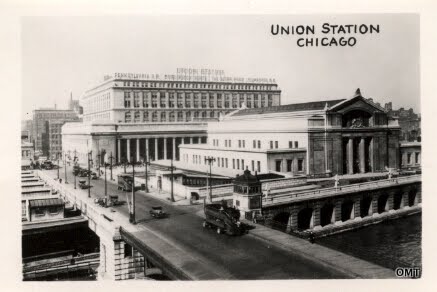
The visit to Chicago has been too short and too shallow. We barely get a sense of the second city. Back in the day, if we were to leave town, presumably because our luck had run out or because the local law enforcement officers encouraged us to, Union Station would be the place to head to. It was the kid of place that required a proper entrance, in a dark suit, grey rabbit fur homburg and a kipper tie. This view vanished years ago. That neo-classical thing in the foreground was replaced by an office tower seven times as high, four times as wide and twenty three times less interesting. This should come as no surprise. Like so many cities busily erasing their past, it is stuck back there and can never be genuinely contemporary.


WINDY

Thursday, 5 February 2015

MEET THE ANCESTORS

Postcards of Edwardians at play
“The English are not happy unless they are miserable.”
George Orwell

 Barely a week goes by without the BBC trotting out some sentimental panegyric to the Edwardian era; documentaries about the grotesque excesses of the royal family or the precarious health and hygiene of the working class, soap operas about life at Carbuncle Manor and dramatisations of classic novels, where actual drama was often in short supply. The crusty old stereotypes are rarely disturbed. Upstairs, there will be one sexually repressed woman and one cad, usually her brother. Downstairs, a scullery maid will have to leave paid employment on account of getting pregnant to person unacknowledged, while a footman regularly spends his half day off getting plastered with one of a dozen girls down in the village. But the most predictable element is that the middle classes will scarcely get a walk on part. Office clerks, schoolteachers, nurses etc aren’t considered to have anything interesting to contribute to our knowledge of that period between the death of Queen Victoria and the First World War. It seems their lives were monotonous but neither sufficiently horrid nor indulgent to hold our attention. Fortunately, we have thousands, possibly even millions of postcards that tell us otherwise. The Kodak was a social machine. Dressing up suddenly became a lot more fun with a camera on hand, but wherever there was a party, an outing or anything more interesting than the day job, the Edwardians were diligent about recording themselves.

 During the 1900s photographic companies and department stores regularly held competitions for amateur photographic postcards. It isn’t unusual to read of organizers overwhelmed by several thousand submissions. Kodak was after sales, the department store wanted customers, and the photographers wanted to see their work on a wall. Call that ‘everyone goes home a winner’: high art was never the point. Cute kittens, flower arrangements and what we think of as human interest were more likely to catch the judges’ eyes. They would have jumped at a scene like this; People sitting outside of a bandstand at a seaside resort: the young, the old and the in-between. Several people dozing, one woman knitting, another reading, a boy looking bored as, like everyone else, he waits for something to happen; it’s a snapshot of English society. The curious thing here is how everybody has turned up to hear the band. It seems that taste in entertainment had little to do with age back then, but maybe the music didn’t matter. Heading off to the bandstand after lunch was one of those things you did as a matter of ritual.


  Every town and village had its amateur dramatic society. In the popular imagination the local ADS was a beehive of eccentrics and misfits, any one of them mad enough to kill, and consequently a staple for writers of stolid whodunits. This was taken by Arthur Burgess of Folkestone. An Arthur Burgess worked as a wood engraver for John Ruskin in Folkestone during the late 1880s and it could be the same, but we are more interested in the result rather than the photographer. It looks like a dramatisation of Kipling’s Kim or another of his stories set in India. At the time this was taken Kipling was probably the best known writer in Britain and adaptations of his stories a natural choice for dramatic societies. The Indian tales were colourful and exotic and he was the unofficial voice of Empire, which in the first decade of last century was widely predicted to go on long into the future. Later scholars would realize Kipling was one of the few who foresaw that cruelty and ignorance would hasten the demise of the British Raj but such nuanced thinking was probably lost on the Folkestone Amateur Dramatic Society when a stirring tale of spies in far off India guaranteed an audience.

  The girls look to be in their final year at a ladies college, with a headmistress very proud of her charges, and her terrier. One of the persistent clichés of contemporary cinema is that during the Edwardian era ladies colleges produced just that; girls whose education was dedicated to French, poetry and the cello and who wandered about the schoolyard in a haze of ethereal loveliness. Crass behaviour of any description never reared its ugly head. Look at the student wearing the kimono in the middle. She has applied tape to her eyes to orientalize them. This was acceptable in an age when the British were told they owned half the world.

Another cliché of the era is that work was all drudgery and employers were nasty and uncompromising. All the evidence describes a much more complex society but social complexity rarely makes for good television, or more likely there aren’t that many in the business with imaginations sophisticated enough to pull it off. We can’t say for certain that either of the two women front and centre are employers, but clearly the female staff in this household were expected to have fun now and then, even if a couple look like they’d rather be scrubbing the floor with caustic. The back of the card has a stamp for Polden and Hogben, 16 Tontine St Folkestone. Research indicates that Polden and Hogben did not call itself a studio but a ‘postcard gallery’, whatever that was.

Let’s leave dressing up and head to transport, and one of the great romances of the age: the love affair between the bicycle and the camera. The development of the safety bicycle occurred as the Kodak was coming on to the market, a coincidence our ancestors were not slow to pick up on. On weekends during the 1910s groups of bicyclists swarmed across the countryside in search of picturesque views to photograph. The ruin of a Norman church outside a small village – snap! A creek slowly meandering through the marshes – snap! The chaps having breakfast before packing up and pedalling off in search of that day’s discovery – snap! To think of amateur photography back then without the bicycle is to think of, well, the cowboy without his horse. You’ll notice that everyone is wearing ties. They really were a different species back then.

What was Edwardian leisure without the charabanc, the most bombastic road vehicle ever built? From the beginning the intention behind the charabanc was recreational. People piled on – there are nineteen on this one, which was not overcrowding – and head off to the seaside or the village inn, not to church. Postcards of people in charabancs are common enough, and all of them tend to suggest a journey undertaken in great disorder. If you wanted a quiet ride admiring the spring flowers you bought a bike. The name Barrington’s indicates this one operated out of Southport Lancashire. Though a seaside town – it has the second longest pier in Britain – apparently one of the big attractions in Southport was the Leeds to Liverpool Canal that passed through Scarisbrick, about five miles distance inland. That was probably where this was taken. Why would the Edwardians be interested in a canal? They were all over the place by then. More likely it was a useful distance from Southport for a day trip. Canals were great because you got to make a lot of noise on the way out to see them and a lot more on the way back when you’d stopped by the local for a couple of hours.

Another fun activity at the seaside was the ferry trip. Along with the concert at the bandstand and the obligatory walk along the promenade, this made for a full day of action. The pier in the background is long enough to also be at Southport though Southend Pier in Essex (one and three quarters of a mile long) would be another candidate. Everyone is looking at the camera. The photographer has it mounted on a tripod and when they return a batch of postcards will be ready to buy for a penny a piece. Ferries always went to a place, not simply out to sea and back, and this one could be going out to the end of the pier. The piers were long because the water was shallow. Still, you read of ferry disasters in the 1910s and dozens drowning, you look at this photo and you can see why. Fortunately the pilot and his young son look like nothing much would bother them. 

  During the first decade of the twentieth long rambles were as popular as cycling. Some rambling clubs could have a hundred members wandering across the countryside on a weekend. In this card, postmarked October 6, 1906 and sent to a Miss K Fernie of Jerusalem Cottage in Falkland, Fifeshire, a J Page identifies the man second from the bottom as her brother, the bottom one a friend she stayed with in Glasgow and the other two “belong to Glasgow”. It is postmarked Menstrie, a village just outside of Stirling. They are out on a walk in the country, and the fact that they are wearing three-piece suits and watch-chains should not persuade us otherwise. It seems a lot of men during that era did everything in a three piece, from ploughing fields to entering accounts in ledgers to wandering along muddy paths and climbing rickety stiles. What makes the image is that none of them are smiling. Fun is always best when taken seriously. Ms Page writes upside down, a common trick to deter postal workers from reading cards. 

Finally, one of those photos where nothing special is happening yet it hints at a lot. The woman in the middle has her coat, scarf, hat and gloves on: she is leaving, not coming, and her long coat was the fashionable wear for driving long distances in the 1900s. The woman at the right, let’s call her Mother, will go back inside once she has said her goodbyes. The woman at the left also has her hat and scarf on, which would suggests she is also leaving except that she is sitting. Before we read too much into that, it’s important to remember the other person in the picture: the photographer. The photograph was taken for his or her benefit, not ours, but knowing who it was could change the whole reading. There’s a difference between a photo taken by someone who is staying and one who is leaving. There are other things to think about. It’s doubtful the two younger women woke up one morning and thought, “Victoria is dead, Edward is King and it is the beginning of a new century”. If anything it was: “I shall turn on the electric light, call Mother on the telephone and drive down to see her in my motor car. Tonight we may go into town and watch a moving picture, and thank God we have a cure for smallpox.” They are well off and the problems that bothered them were largely in the abstract, and in a real way distant: Germany was a danger, anarchists were about in London’s East End and the economy was weak but not crippled, but these were all troubles that a good government could sort out. They have cause to relax, or more accurately, they don’t have cause not to. To be comfortably well off and living in the south of England in the 1910s was sufficient to be convinced you were among the luckiest alive in the world at that time.

MEET THE ANCESTORS

Thursday, 2 October 2014

HORSE AND CARRIAGE

Wedding snapshots
“A man in love is incomplete until he is married. Then he is finished.”
Zsa Zsa Gabor


To be an army officer in Turkey in the 1940s and ‘50s gave a man more status than lawyers or doctors could expect. You might not have made more money but you were a defender of the nation, so when the time came to get married full military dress said more about you than any well-tailored suit could. It might have even been expected, since several of your commanding officers were obligatory guests and according to protocol you were not supposed to appear before them in civilian clothes. Having the groom in his military uniform does tend to add a slightly sinister quality to a wedding photo, but even if he were wearing standard black tie in this scene it would still suggest this wasn’t exactly the happiest day in a young couple’s life. Everyone, including the little boy in the left foreground, seems to regard the camera with suspicion, even hostility. It also looks like they have crammed into an office, or a back room at the registry. 


Ataturk made all Turkish marriages civil rites, meaning that religion was officially removed from the ceremony. The law still stands although people get around it by having two weddings, one official, one not, and so far as a lot of people are concerned it is the second that seals the compact. The first is just a piece of paper. You get an idea why from this scene. A crusty old clerk asks a few questions for formality’s sake before he hands over the documents to be signed. The couple look solemn and attentive, as befits the moment. The two men behind the couple are also looking at the camera with suspicion. The one in the hat bears an uncanny resemblance to an American gangster.


 But before we start thinking that the Turkish marriage is a dry, sombre affair, a farewell rather than a greeting, consider this snapshot. Apart from the fact that, finally, we get a smiling bride, there’s a suggestion the woman with her has donned a turban and applied some blackface. It’s the difference in shade between her face and her arm that make us think so, but could she? Would she? I don’t see why not. Weddings are usually supposed to be fun and it wouldn’t be the last time someone attempted to brighten proceedings with a display of bad taste. At least the bride is laughing. 


 Here we get a scene that suggests some ritual is about to take place. He appears to be a relative rather than the groom and it is possible he has decided to offer some prayers for the couple. Everything about the scene points to hasty improvisation; important details that were overlooked in the hectic rush of the last few days. He had a speech prepared but he left it at home, or thinking how quickly his daughter or his niece has grown up fills him with an existential dread. She wants him to know that everything will be all right, but actually, she’s used to his sudden spells. This is nothing, but she wishes her sister would put the camera down for once. 


 Let’s leave Turkey for a while and head to Canada, to contemplate for a moment how utterly boring it must be being a professional wedding photographer, heading out all day every weekend to take the same photos over and over. Professionals are paid to capture that special day but what they record is a formula. Only family and friends can photograph the day properly. Being the 1950s, this might have been taken at the bride’s home; which is to say her parents’. It’s a moment where past, present and future come together, for this being Canada in the 1950s she will probably have the same wallpaper in her new home, which will be a triumph of domestic taste and design. Mum would have taken the photo; Dad could have but he was in the kitchen knocking back his third bourbon of the morning, on account of nerves. 


 Another Canadian marriage scene; this one taken out in the rural wilds of Ontario. It makes you wonder why people hire professional photographers at all. A professional would have resisted photographing the couple with the farm as a background, preferring a studio setting with a neutral background, but the whole point of wedding photography is to preserve memories of the day. The only memory a commercial photograph would record is that of the experience of being photographed. Here we get an actual incident. The couple are already married and about to drive off for their honeymoon. They don’t look like a couple of farmers, but then women in wedding dresses seldom do. We can speculate on why they are out on the farm but we can’t deny this is a moment that will stay with them. 


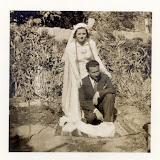
 To England, and a photo that looks like someone’s attempt to create the studio look, with the blanket draped over as a backdrop. Everything about the scene is slightly ratty, from the man’s ill-fitting suit to the cheap blanket and the dingy doorway. They probably couldn’t afford a professional photographer, but they didn’t need one. We do hope he’s not a proper Jack the Lad, with a spare bird out in Chelmsford and a couple of geezers on his back for some readies he promised to cough up last week;  that would break her heart.


 Back to Turkey, and a moment that doesn’t look like one the bride would have wanted preserved, but then the other great thing about amateur wedding photographs is the haphazard ways they come together. Not much left to say about this one; it speaks for itself.


Another Turkish snapshot, that also looks like it was taken at the registry office. Notice how the bride and the woman to her right have their eyes shut against the flash. The boy next to the bride has covered his eyes. But then the woman next to him and the one above her have expressions of stark terror. The man just behind the bride has an inane grin. Others are trying to push into the photo or preserve their dignity. The man at the far left looks like he has just realized he left the stove on at home. Think of those millions of photos of everyone standing to attention on the church steps. This one is what a wedding photo should look like. 


 Apart from making marriage a civil ceremony, the Ataturk government tried to outlaw polygamy and arranged and consanguineous marriages, but these were rooted in long traditions and out in the hinterland people stuck to them. This photo was taken in the 1920s, not long after the birth of the Republic and it presents the image of contemporary Turkish society, or what it should have been: an urbane couple without a hint of religious symbolism in sight. The woman’s headdress suggests she is Armenian, so here we encounter one of the conundrums at the heart of Ataturk’s revolution. With outwardly western values, better connections with Europe, a higher level of education and, in urban centres, more prosperity, on the surface the Armenian community embodied the new ideal, but how could that be so much as suggested after 1915? Compare it to the top photo and we see how it is one thing to adopt the manners, quite another to accept the mores.

LOVE AND MARRIAGE

Friday, 5 September 2014

NOTHING TO IT


Minimalist snapshots of the landscape
 “Landscape photography is the supreme test of the photographer - and often the supreme disappointment. ” 
Ansel Adams


One of the several annoying things reading Ansel Adams is that he basically thinks there is only one way to take a photograph. If you don’t have a certain lens, with a particular filter attached, and you are not shooting on 4x5 sheet film or larger, forget it. Your picture might be pretty, but that’s all. It’s a bit like sitting at the lights in your Fiat Bambino when a guy in a Bentley pulls up alongside, winds down the window and tells you your car is crap because it doesn’t have multi point fuel injection. As the lights change and he roars off, you’re left wondering how it is some people know so much and get so little.
 Scattered throughout the collection are snapshots of the landscape with a particular quality that Adams would have dismissed without a second glance. It isn’t that they are pretty pictures; some of them are that but what makes them work may not be what the photographer was hoping for. In their minimalist aesthetic they are all about space and light, the two qualities Adams believed were sacred to landscape photography, and the most elusive. 


 One of the general assumptions about landscape photography is that everything in a professional’s image is there by intention, while in an amateur’s it only may be. Professionals don’t make happy accidents. Here’s a snapshot taken in Canada, which has more than 31 000 lakes, so forget about exactly where. We can see why the photographer might have taken this; the scene has a still, quiet atmosphere, but we cannot be absolutely sure that he or she met the intentions. On the one hand it is a non-image; it looks like a random shot. On the other, the placement of the figures, especially to the left, is almost perfect. The image has harmony and balance. 


 Another from the school of less is more. Without the car the photo would be boring. If the car had been framed properly, it would be too perfect. In the middle foreground, and too small to be seen without zooming in, is another car crossing the open ground. Just above the main car, also only obvious by zooming in, is a barn or stable. A fence runs alongside the trees at the right foreground and some indeterminate object is emerging from them. How much of this the photographer was conscious of doesn’t matter. An apparently empty scene reveals a wealth of detail. 


 If you asked Ansel Adams what he thought of this photo, he may just deign to give an answer but it would be rude. If you asked Robert Adams, he might pause and contemplate what would have transpired had the photographer used a decent camera. Being a photographer who likes symmetry and the absence of it, he might approve of the way the three important elements, the power pole and the two kiosks, are framed, barely nudging the bottom of the image. The photo was taken at Port Noarlunga, a resort on the outskirts of Adelaide (Australia, if you need to know). At the time holiday towns like Noarlunga amounted to a scattering of fibro and asbestos shacks, a shop that sold fishing equipment and a milk bar. Not much else was needed. The kiosk on the left advertises Alaska and the one on the right Amscol, the two big rivals for South Australia’s ice cream market in the 1940s, 50s and 60s. More poignant to anyone old enough to remember is the sign for pies, pasties and cool drinks on the side of the Amscol kiosk. Some people lived through the summer on nothing else. 


 Big oil. Robert Adams almost certainly would approve of the ethereal, discarnate appearance of the rigs; Ansel Adams might too. There is nothing accidental here. The photographer was struck by the number of oil wells receding to the distance and that the only way to distinguish the water from the sky is the thin ribbon of land at the left. This was taken in North America in the 1950s or 60s, when oil was cheap, everyone was told it would be around for years and concerns about pollution were only mentioned in passing. To the photographer, this scene was not only visually beautiful, it represented American power. Today, a photographer like Richard Misrach would look at the scene from a similar vantage point but emphasize the sickly yellow taint of the water or the gathering rust on the rigs.


This photograph comes from the same set of Mississippi landscapes posted a few months earlier.  I said then that the photographer had the eye. This photo confirms that. The composition can’t be improved on. The barrier and the ground in front occupy precisely the space they ought to. The atmosphere with the heavy clouds moving in from the sea speaks of an uncomfortable but not oppressive humidity. Like some of the other photos here, ultimately what makes it work is its sense of quiet solitude. There could be a tiki bar full of raucous Americans in Hawaiian shirts and a car park lined with Cadillacs and Thunderbirds just behind the photographer, but you would never know it.

 Alaska in the summer is said to be wretched; stifling heat, and swarms of mosquitoes and black fly bring no relief from the long winters. What it does have going for it, apparently, is spectacular light. Filtered through the polar atmosphere, it possesses qualities found nowhere else. This actually befuddled early photographers. They wanted to record the brilliant sunrises and sunsets and all they got was a disreputable mess of blurred outlines and muddy tones. We can say our photographer understood how they felt. Technically, this is a failure, but so what? If our parameters for success include the rendering of the landscape into abstract patterns of tones, this qualifies. 

 
 Funny how some critics have to defend accusations that Hiroshi Sugimoto’s seascapes are boring by admitting first off that they are, only to contradict themselves and insist that they are not. By any intelligent person’s judgement the works are boring or they are not. Vacillating is a sure sign said critic is in the wrong job. This writer has seen a few in real life and thought they were mostly beautiful, but there are many beautiful photos out there. He prefers this photo to any of them. The problem with the Sugimoto seascapes is that they are contrived to the degree you sense he looks out upon the sea and feels, well, nothing much, beyond a calculated understanding of how to render the scene in ways that appear delicate and fragile. With this photo on the other hand, we have the feeling our photographer was genuinely moved. In the process he or she took a photograph that is banal yet visually compelling.

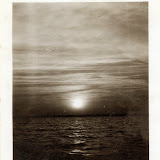
  How many of us have stood at the sea’s edge at sunset and wished for a camera? There are approximately 7 billion people on the planet. If we say (a random guess) that a quarter live by the coast, that roughly a tenth of them have access to a camera or some kind of recording device, then we are still talking millions. Somebody with more time on their hands could work out a more precise figure, but we get the picture, right? This snapshot was taken in Turkey in 1933. Historically, Alfred Stieglitz took the last of his cloud studies known as the Equivalents series just two years earlier. What would he have thought of this one; that he had wished he had taken it himself? It is old and a bit knocked about but the clouds have a muscular power.

 
 Another Turkish snapshot, and one that reconciles everything this post has been about. It was taken from a moving vehicle, (car, bus or train) and again it is a technical failure, again it transmits something that may have fallen short of the photographer’s intention yet holds our eye. I am reminded in a way of the vast abstract paintings that hang in commercial offices. The streak off light at the left (it could be the galvanized tin roof of a building) is not meant to be there, but only a painter with an eye on the market would think of putting it there. At first glance we see shapes, at second they begin to form into vaguely recognizable objects. Like all the photographs here, what’s interesting about it lies in that space between what the photographer saw and what he or she wanted to say.


NOTHING TO IT